Does Sauna Burn Fat? The 400-Calorie Claim Came From a Wristwatch

Maybe. And that is the honest answer, not a dodge — because the evidence here is one small trial and a number that came off a wristwatch.
Start with what is definitely true: you weigh less when you get out.
A pound and a half, and the researchers told you what it was
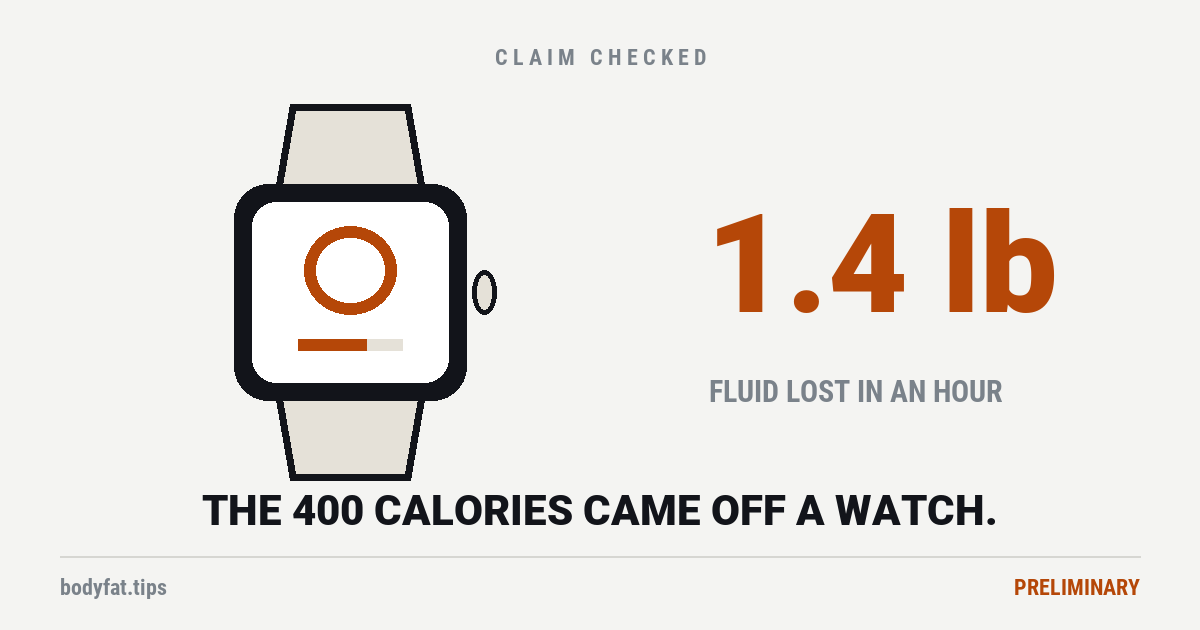
Forty-five sedentary, overweight young men did four ten-minute sessions at 90–91°C with five-minute breaks — an hour in total. Average body mass loss: 1.4 lb (0.65 kg) [2].
Now read the authors’ own concluding sentence, which is the part that never travels: those men “lose around 0.65 kg of bodily fluids.”
Fluids. They said it in the conclusion. You drink a couple of glasses of water and it comes back, because it was never anything else. We went through the same arithmetic on why the first week of low-carb looks so dramatic — a scale that moves because you are drier is not a scale reporting fat.
The 400 calories came off a watch
Here is where the popular claim comes from, and it is worth following carefully.
The same study reports energy expenditure rising across the four sessions: 73, 94, 115 and 131 kcal, which people add up to roughly 413 for the hour [2]. That is the number on the sauna retailer and wellness pages we checked.
It was measured with a Suunto Ambit3 sports watch reading a chest-strap heart-rate sensor [2].
That matters more than it sounds. Heart-rate calorie algorithms are built on exercise, where your pulse climbs because muscles are demanding oxygen. In a sauna your pulse climbs for a different reason entirely — blood is being pushed to the skin to dump heat. Same reading on the wrist, no muscular work underneath it. The device is being asked a question it was not calibrated for.
The paper also does not state whether those figures are total expenditure or only the amount above what you would have burned sitting still. Sitting still for an hour is not free either, and nobody subtracts it.
We are not saying the number is wrong. We are saying it is an estimate from a consumer sports watch, reported in an uncontrolled study of 45 men with no comparison group, and it is being sold to you as a measured fat loss.
The one trial that actually randomised people
Forty-seven sedentary adults with cardiovascular risk factors, eight weeks, three arms: exercise plus a 15-minute sauna afterwards, exercise alone, or neither [1].
Fat mass. Exercise alone: −2.9 lb (1.3 kg), significant against the control group (p = 0.0125). Control: no change. Exercise plus sauna: −4.2 lb (1.9 kg).
And the comparison that answers the question — sauna-plus-exercise against exercise alone — came out at p = 0.339 [1]. Not significant. The exercise did the work; adding heat to it produced no detectable extra fat loss.
Why this is Preliminary and not Unsupported
We could have called this one no and moved on. Here is why we didn’t.
That trial had fifteen or sixteen people per arm. At that size it could not have detected a modest real effect even if one existed — and the sauna group did lose numerically more, 4.2 lb against 2.9 lb. A non-significant result in a small trial means we could not tell, not there is nothing there. Those get conflated constantly and we are not going to add to it.
Two other randomised trials exist, and we should say so. Both tested sauna on its own, not sauna added to exercise, in young men at 100°C. In one, 23 physically active university students were randomised to twelve sessions over four weeks or to no sauna, and DXA scans — the X-ray method that separates fat from bone and muscle — found fat mass unchanged: the sauna group went from 21.2 to 21.6 lb (9.6 to 9.8 kg) and the control group from 22.9 to 25.8 lb (10.4 to 11.7 kg), neither shift significant [3]. In the other, 36 semi-professional footballers were randomised to nine sessions over three weeks or to a control group, and the abstract reports body fat and fat percentage falling within the sauna group (p < 0.05) with no change in the controls [4]. We have read only that abstract — the full text sits behind a publisher bot-check we could not get past — so we cannot tell you whether the sauna group’s fall beat the control group’s, which is the comparison that counts. One trial says nothing moved. One says something did, in lean athletes who are not the people buying a sauna membership to lose weight. That is not a replication of the trial above; it is two more small trials pointing in different directions.
So: one underpowered trial pointing gently the right way, two smaller sauna-only trials that disagree with each other, and a calorie figure resting on a sports watch. That is genuinely unresolved, and unresolved is what Preliminary means here.
If a properly powered trial runs and finds nothing, this becomes Unsupported and we will say so on this page.
What we couldn’t stand behind
Retailers cite a randomised trial of 112 overweight adults finding no advantage for infrared sauna. That finding would support our verdict, and we are still leaving it out: we could not locate the paper. The trail leads to sauna sellers and a product-listing page, and a PubMed search for infrared sauna returned no weight-loss trial in overweight adults on the results we saw.
It may well exist and we may simply have missed it. But we do not repeat numbers we have not read, including the convenient ones. That rule is worth more than any single argument it costs us.
One more thing this page does not cover: sauna suits. The address of this page mentions them, and the garment — a sweat suit worn during exercise to hold heat in — is a different question from sitting in a hot room. Neither study here tested one, we have not read that literature, and so this page rates sauna bathing and nothing else.
What sauna does do
Worth saying clearly, because “it doesn’t burn fat” gets heard as “it’s useless.”
In that same trial, adding sauna to exercise produced a supplementary effect on cardiorespiratory fitness, systolic blood pressure and total cholesterol [1]. The authors’ conclusion is about cardiovascular function, not body fat. That is a real result and it is the one the researchers actually led with.
So one small trial suggests sauna may help the heart when it is added to exercise. Pooled with 19 other randomised trials of regular heat, though, the heart markers mostly did not move, and the small dip in cholesterol leaned on this one trial; our sauna benefits verdict has the details. It is being sold on your waistline, which is the one thing the trial could not show.
The bottom line
Sit in a sauna because it feels good, because it may do something useful for your blood pressure, or because you like it. Those are sufficient reasons and two of them have a randomised trial behind them.
Do not weigh yourself afterwards and call it progress. That is a pound and a half of water and the researchers who measured it said so in their own conclusion. And the four hundred calories on the sauna company’s website came from a wristwatch worn by a sedentary twenty-year-old in an uncontrolled study, which is not nothing — but it is not a measurement of fat either.
Three parts of this page’s apparatus were corrected on 15 September 2026 after an independent editorial review. The search snippet promised a finding about sauna suits and core temperature that the page never made and that its sources, which test sauna rooms, cannot support; it now describes what the page shows, and a paragraph says plainly that sauna suits are outside this page’s evidence. The evidence panel said no second randomised fat-mass trial had been found; two small randomised trials of sauna alone in young men were published in 2021, one finding DXA fat mass unchanged (n = 23) and one reporting, in its abstract, body fat lower within the sauna group (n = 36). Both are now sources [3] and [4], described in the text, and the panel says what they found and in whom.
Also changed: the 2019 study of 45 men was labelled observational; it exposed every participant to the same hour of sauna with no control group, and the panel and the text now call it what it is, an uncontrolled study. Its heart-rate readings came from a chest-strap sensor feeding a Suunto sports watch, not from a wrist sensor, and the sentence now says so; the calorie-algorithm point is unchanged. And “every sauna retailer’s page” has become the pages we checked. The rating is unchanged: Preliminary.
Corrected on 18 September 2026. This page said sauna “appears to be good for your heart”, on the strength of one eight-week trial of 47 people in which sauna was added to exercise. Our sauna benefits verdict, corrected today after an independent editorial review, reports a 2025 meta-analysis that pooled that trial with 19 other randomised trials of regular heat: most heart markers did not move, and the small dip in cholesterol leaned on this trial. The sentence now says what the one trial suggests and what the pooled trials found. The rating is unchanged.
- Grounding Sheets: Engineers Measured the Current. It Was Nanoamperes, and It Only Tracked You Moving.
unsupported - Massage for Sore Muscles: It Beat Every Other Recovery Method. It Still Will Not Make You Stronger Tomorrow.
supported - Compression Boots: 319 People in the Whole Literature, and the Effect Is “Trivial to Small”. Massage Won.
preliminary