Cortisol Face and Cortisol Belly: Borrowed From a Disease That Affects 3 in a Million.

Somewhere in the last two years, two new conditions appeared: cortisol face and cortisol belly. Puffiness you can allegedly diagnose in the bathroom mirror, and a specific kind of stomach that stress supposedly builds.
The facial one is borrowed. Moon face is a real clinical sign — of a disease that affects between 1.8 and 3.2 people per million per year. [2] The belly one rests on a real association that 146 cohorts measured at about one percent of the story. [1]
Forty-four thousand people a month search for these. The videos explaining how to fix yours very often have a supplement underneath them — frequently the creator’s own brand, sometimes with a discount code.
Moon face is real. It belongs to a disease.
The puffy, rounded facial appearance being described is a genuine clinical sign. Doctors call it moon face, and it is associated with Cushing’s syndrome — a condition where the body is exposed to far too much cortisol, usually because of a small tumour on a gland. [2]
It is a real illness. It raises the risk of dying, mostly from heart disease, and survival stays affected even after apparently successful treatment. [2] It is genuinely serious.
It is also this rare: the annual incidence is between 1.8 and 3.2 cases per million people. [2]
Per million. Per year. In a city of a million people, somewhere between two and three of them will develop it in the course of a year.
So “cortisol face” takes a sign of a rare disease, detaches it from the disease, and offers it back to everybody as something ordinary stress has done to them. The face in the mirror is puffy because you slept badly, or ate salt, or are thirty-eight. Not because your cortisol has staged a coup.
Now the belly, where there is actually something
Here we have to be fair, because there is real evidence and we are not going to pretend otherwise.
Cortisol genuinely is associated with fat around the middle. And the evidence base is enormous: a meta-analysis pooling 146 cohorts and 34,342 people, measuring cortisol in hair — which captures months of exposure rather than one anxious morning. [1]
The association was consistently positive across BMI, waist circumference and waist-to-hip ratio. Consistently. Across 146 separate groups of people.
Then you look at how big it is.
Consistent is not the same as large
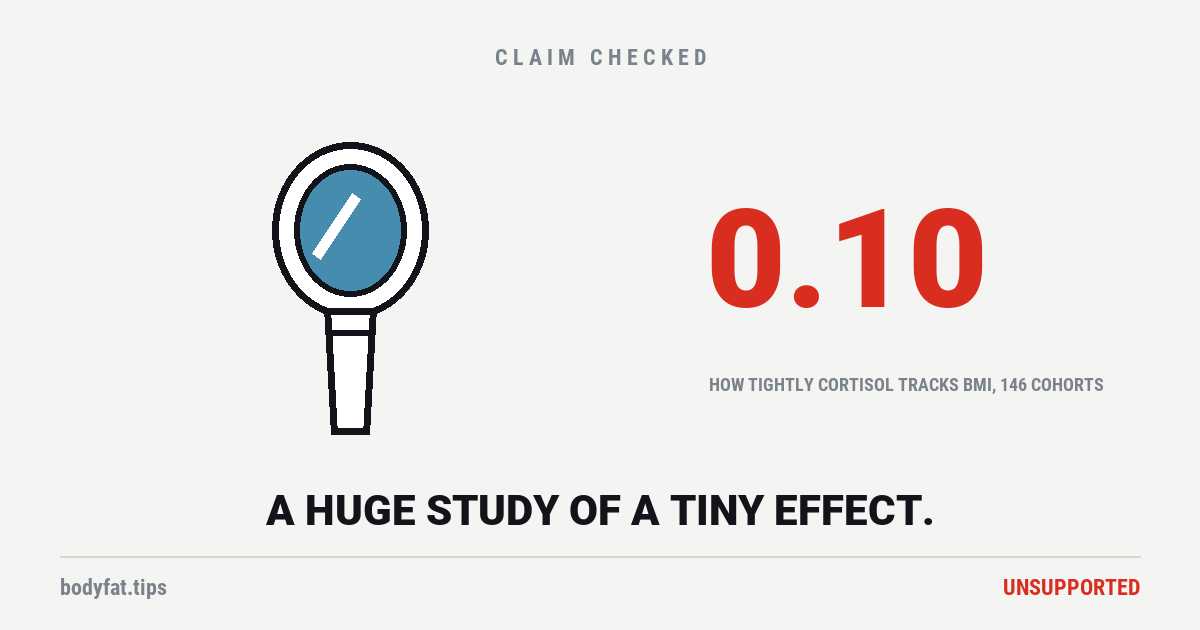
A correlation of 0.10 is what they found between hair cortisol and BMI, pooled across 122 cohorts and 26,527 people. [1] The strongest relationship in the whole analysis — a different cortisol breakdown product against waist size — reached 0.18. [1]
Square a correlation and you get the share of the variation it accounts for. At 0.10, that is about one percent. Ninety-nine percent of why one person’s waist differs from another’s is something else entirely.
This is the distinction the whole page turns on, and it is worth carrying away for other topics too: 146 cohorts can prove an effect is real and simultaneously prove it is tiny. A huge study does not make a small number big. It just makes you confident the small number is correct.
And the arrow may point the other way
One more detail, from the researchers’ own conclusion, that changes the entire sales pitch.
They write that their findings “suggest an altered setpoint of the hypothalamic-pituitary-adrenal axis with increasing central adiposity”. [1] Read that direction carefully: they are proposing that carrying more fat around the middle shifts the cortisol system — not that cortisol built the belly.
Their data cannot settle it either way. Every study in the pool was cross-sectional, meaning everything was measured at one moment, so nothing in it can tell you which came first. [1] But when the people who did the work lean one way, and the supplement videos lean the opposite way, that is worth knowing.
What is actually being sold
We searched the most-viewed videos on fixing cortisol belly. The explicitly cortisol-titled ones carry more than six million views between them; the wider result set runs past fourteen million. Several descriptions link to a cortisol supplement sold by the person in the video. At least one carries a discount code. One was published a month ago.
We are not naming anybody, because the individuals are not the point and this site does not do that. The point is the shape: a real but one-percent association, plus a real but one-in-a-million disease, combined into a condition you can be sold a cure for.
That measurement tells you how far the claim travels and what it sells. It tells you nothing about whether cortisol is doing anything to your face, and we are not using it that way.
The part we want you to actually take seriously
Cushing’s syndrome is rare, but it is not imaginary, and people who have it benefit enormously from being diagnosed early. [2]
So this page is not telling you that facial puffiness never matters. If something about your face, your weight or your energy has genuinely changed and you cannot explain it — go and be looked at by a doctor, who can order a test that settles it in a way a mirror and a video never will.
What we are telling you is that the answer to that question is not a supplement, and the place to ask it is not a comments section.
The verdict
“Cortisol face” and “cortisol belly” as conditions you can spot in the mirror and reverse: Unsupported. The facial version borrows a clinical sign from a disease affecting about three people in a million. The belly version rests on a real association that 146 cohorts have measured at roughly one percent of the story — and whose direction the researchers themselves suspect runs backwards from the pitch.
Stress is worth taking seriously. Just not as a diagnosis you give yourself, and not as a reason to buy anything.
Related: ashwagandha benefits · can exercise target belly fat · sleep hygiene · box breathing · all the habits we have checked