How Much Water a Day? A 1945 Recommendation Lost Its Last Sentence.

In 2002 a physiologist called Heinz Valtin went looking for the study behind “drink eight glasses of water a day”.
He searched the electronic databases. He went through older literature that the databases do not cover. He consulted specialists in thirst and drinking. Then he wrote the sentence up front:
“No scientific studies were found in support of 8 × 8.” [1]
What he found instead is a better story than the absence.
The sentence that got dropped
Valtin reports a suggested origin — and we are going to be careful with the hedging here, because he was. His own section heading is “Possible origin of 8 × 8”, and the lead reached him second-hand: according to one correspondent, another had suggested it. [1]
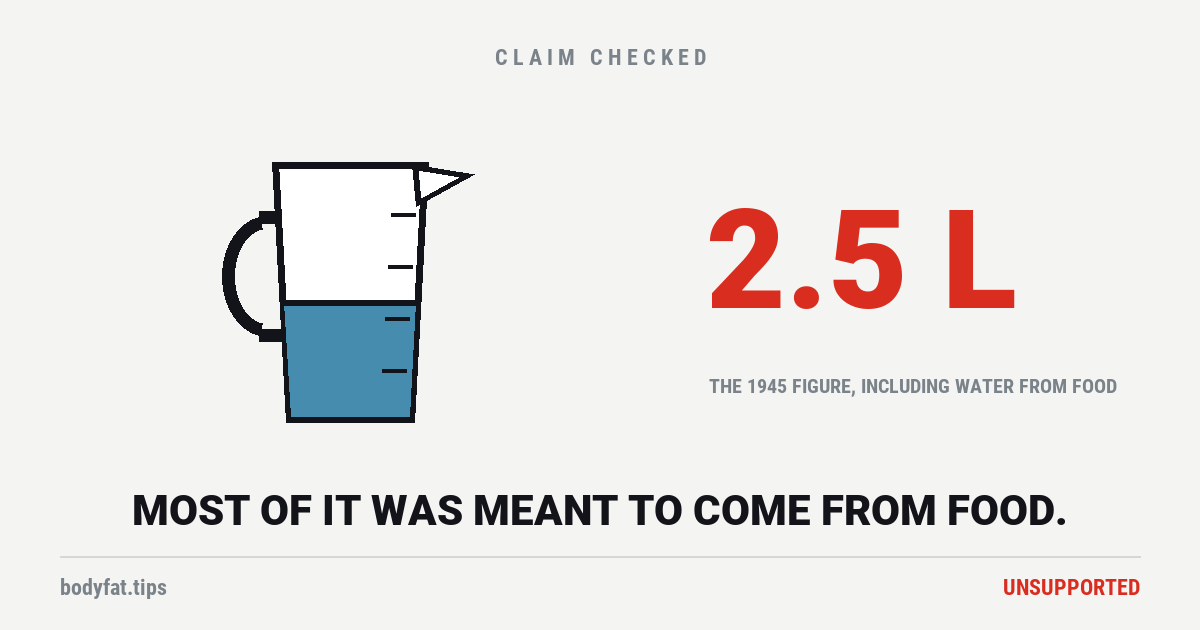
The suggestion is that it traces to this, from 1945:
Read the last line again.
Two and a half litres a day — most of it already in your food. The recommendation was for total water from all sources, of which the part you actually drink is a fraction.
The suggestion is that the final sentence stopped being repeated, and a figure for total water became a target for drinking. [1] Nobody has proved that is how it happened, and we are not going to tell you they have. But the 1945 text says what it says, and it does not say “drink”.
The closest thing to a source is an obituary
This is our favourite detail in the paper, and it is not in most write-ups.
After the comprehensive search, the nearest thing Valtin could find to an original recommendation was an obituary of a nutritionist, which described him as “an early champion of drinking at least six glasses of water a day.” [1]
Six. In an obituary. That is the documentary bedrock under the most repeated health instruction in the English language.
And to be clear, since the man is dead and did nothing wrong: he is reported to have said six. The number that went around the world was not his.
Coffee counts
The rule usually arrives with a rider — that tea, coffee and anything caffeinated do not count, and may even work against you.
Valtin found the published evidence does not support that either. Caffeinated drinks may be counted toward the daily total, and the list of things that count is long: “tap water and bottled water, coffee, tea, soft drinks, milk, juices, and possibly even beer in moderation.” [1]
Which makes the daily total a much easier target than it sounds, because you have been hitting most of it without counting.
Please do not take the wrong message from this
Valtin put this in his own paper twice, and we are putting it here in bold, because it is the part that gets lost when this research becomes a headline.
His conclusion applies to healthy adults, in a temperate climate, who are largely sedentary. [1] In the same breath he writes that intakes equal to or greater than eight glasses are advisable for treating or preventing certain diseases, and are “certainly called for” during vigorous work or exercise, especially in hot climates. [1]
So: the specific number has nothing behind it. Drinking water does. Those are not the same statement, and anyone finishing this page thinking they should drink less has read it wrong.
What actually determines how much you need
In 2022, researchers measured it properly. They tracked water through the bodies of 5,604 people, from eight days old to 96, across 23 countries, using isotope methods rather than asking people what they drank. [2]
What predicted how much water a body used? Age. Body size. Body composition. Physical activity. Whether you are an athlete. Whether you are pregnant. And your environment — latitude, altitude, air temperature, humidity. Even national income level showed up. [2]
Faced with that, the researchers did not publish a number. They published equations. [2] Because there is no single answer to give — the honest output of measuring 5,604 people is a formula with your circumstances as inputs.
One precision note, since it matters: what they measured was water turnover, the total moving through you each day. That includes water from food and water made by your own metabolism. It is not a drinking target either.
A note on how the paper ends
Valtin finished by pointing out that you cannot prove a negative — he could not prove no supporting study exists anywhere — and so he invited readers who knew of one to write in. [1]
That is a correction policy, published inside the paper, in 2002. We extend the same offer on everything here.
The verdict
“Eight glasses of water a day” is Unsupported. The most thorough search anybody has published found no study behind it, the likeliest origin is a total-water figure that was meant to include your food, and the closest thing to a founding document is an obituary that says six.
What replaces it is not another number. It is the fact that your requirement moves with your size, your activity, the weather and whether you are pregnant — and that a healthy adult with a working sense of thirst and a normal diet is already most of the way there.
If you are ill, pregnant, working hard or somewhere hot, that is a conversation with a clinician, not a rule of thumb. We read the research; we are not your doctor.
Related: does drinking water help you lose weight · lemon water · all the habits we have checked · how many steps a day · sauna benefits