Cod Liver Oil Benefits: It Helped End Rickets. In a Winter Trial of 34,601 Adults, It Did Not Reduce Colds or Covid.

“Fish oil cod liver oil benefits” and the phrasings grouped with it, “benefits of fish liver oil” among them, are searched about 14,800 times a month in the United States, the database’s figure for the past year; in each month from May to September 2026 it read 12,100 (from a paid keyword database, pulled 23 October 2026) [1]. The answers people find are generous. Cod liver oil is sold for the joints, the heart, the immune system and colds, the skin, hair, brain and eyes, and as a step up from ordinary fish oil because it brings vitamins A and D along with its omega-3 fats [1]. Many people met it first as a spoonful in childhood.
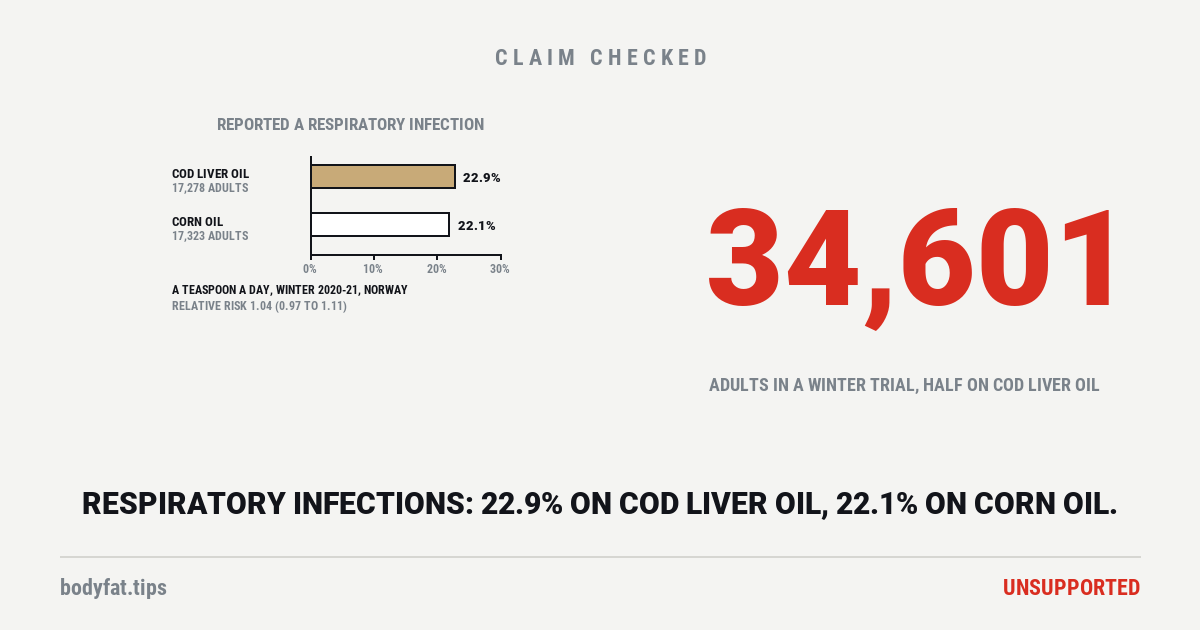
The short answer: cod liver oil earned its reputation against deficiency, and its vitamin D helped end rickets. As a supplement for well-fed adults, the biggest trial of it we found, 34,601 Norwegians over a winter, half of them on cod liver oil and half on corn oil, found it did not reduce colds, other respiratory infections or Covid. The joint trials are small and split. The one cod liver oil trial we found that counted heart attacks found no significant difference. And no trial we found compared it with ordinary fish oil on any health outcome. What it reliably delivers is vitamin A, in amounts that vary from bottle to bottle by a factor of a hundred.
This is journalism, not medical advice, and one part of it is a caution. Cod liver oil carries its vitamin A as retinol, the form that can harm a developing baby. The NHS says not to take cod liver oil, or supplements containing vitamin A, when you are pregnant [2]. US experts advise women who are or might be pregnant not to take more than 3,000 micrograms (10,000 IU) of vitamin A a day from supplements [3]. So if you are pregnant, the UK advice is not to take it at all, and if you could become pregnant, ask a clinician first. If you already take a multivitamin, vitamin A, vitamin D or another fish liver oil, add up your total from the labels before taking cod liver oil daily, and ask a clinician or pharmacist. If you take a blood thinner such as warfarin, ask before you start: fish oil might lengthen clotting times with warfarin, a US government fact sheet says, though most research at 3 to 6 grams a day found no significant effect [4], and a drug-information sheet lists warfarin among cod liver oil’s interactions [5].
What happens if I take cod liver oil every day?
Start with what goes in. A teaspoon of cod liver oil, as the US Department of Agriculture’s food tables list it, carries 1,350 micrograms of vitamin A, all of it retinol, 450 IU (11.25 micrograms) of vitamin D, and about 0.8 grams of EPA and DHA, the two omega-3 fats fish oil is sold for [6]. A tablespoon carries three times as much: 4,080 micrograms of vitamin A, more than the US upper limit for adults of 3,000 [6] [3]. An upper limit is the most a day judged unlikely to cause harm. It is a ceiling, not a target.
Bottles are not the food table. Many makers now take much of the vitamin A out. The oil in the Norwegian trial below carried 250 micrograms per teaspoon (5 mL) [7]. In the NIH’s database of supplement labels, we tallied liquid cod liver oils entered since 2020 that give their vitamin A for one teaspoon: 16 brands, from 40 micrograms a teaspoon to 4,000 [8]. The top of that range is a label entered in September 2025 that states 4 milligrams a teaspoon, 444% of the daily value [8]. So the honest answer to “how much vitamin A is in cod liver oil” is: read your label, because the next bottle on the shelf may hold a hundred times more, or less.
What happens when people take it every day? The best record is that Norwegian trial: 34,601 adults took a daily teaspoon of cod liver oil or of corn oil, flavoured to taste the same, for a median of 164 days through the winter of 2020–21 [7]. Side effects were mild and slightly less common on the cod liver oil: 10.1% reported at least one, against 11.3% on the corn oil, mostly nausea, burping and stomach upset [7]. In 342 participants who sent in blood spots, vitamin D ended up about 6 ng/mL (15.0 nmol/L) higher on cod liver oil than on the dummy oil, because it stopped the winter fall the corn-oil group had [7]. That much a daily teaspoon measurably does.
Over years, the vitamin A is the part that builds up. The body stores it in the liver, and regular high intakes can cause dry skin, painful muscles and joints, fatigue and abnormal liver tests [3]. How much counts as high is where the regulators come in, further down.
Does cod liver oil help your immune system? The biggest trial
This is the test that matters most, because immunity and colds sit at the centre of how cod liver oil is sold, and because it was done properly. In November 2020, researchers at Oslo University Hospital began enrolling Norwegian adults aged 18 to 75 who were not taking vitamin D supplements on five or more days a week, and assigned them at random to a daily teaspoon of lemon-flavoured cod liver oil or of lemon-flavoured corn oil [7]. Neither the participants nor the researchers knew who had which. Each teaspoon of the cod liver oil carried 400 IU (10 micrograms) of vitamin D, 1.2 grams of omega-3 fats and 250 micrograms of vitamin A [7].
The results, 17,278 people on cod liver oil against 17,323 on corn oil [7]: a positive Covid test, 227 people (1.31%) against 228 (1.32%); serious Covid, 121 (0.70%) against 101 (0.58%); at least one respiratory infection reported, 3,964 (22.94%) against 3,834 (22.13%); at least one negative Covid test, the trial’s marker for other respiratory infections, 49.46% against 49.44%. For the infections people reported, the relative risk, the risk on cod liver oil divided by the risk on the dummy oil, was 1.04, with a range of 0.97 to 1.11 [7]. That range is a confidence interval, the range the true answer probably sits in; this one was set extra wide because the trial tested four outcomes at once. It includes 1.00, which would mean exactly the same risk, and its most favourable end is a 3% lower risk. The authors’ conclusion: cod liver oil in winter did not reduce Covid, serious Covid or other acute respiratory infections compared with placebo [7].
Two things to know about it. Most of the volunteers were not short of vitamin D: in the blood-spot sample, 86% started at or above 20 ng/mL (50 nmol/L), a level the authors note has been suggested as adequate, and they write that a benefit in people starting lower cannot be excluded [7]. Their own check found no sign of it: splitting the results by things that go with vitamin D levels, such as summer sun, occasional vitamin D supplements and fatty fish, they found no difference [7]. And it was paid for by the company that makes the cod liver oil it tested, which supplied both oils and had the right to comment on the manuscript, though not, the paper says, any role in running or analysing the trial [7]. A maker paid for the biggest test of its own product, and the result went against the product. That deserves saying as plainly as the result.
It is not the first time the idea was tested. In the 1920s vitamin A was promoted as an “anti-infective” vitamin, and a history of the period counts at least 30 trials of it, usually given as cod liver oil, against respiratory disease, measles and other infections, up to 1940 [9] [10]. In a factory in the American Midwest, a trial of daily cod liver oil in more than 300 workers reported absence from work for respiratory illness cut by 40%, and the same group’s later trials, in 1,800 and then more than 3,000 workers, by up to two-thirds; a measles trial in 600 London children reported deaths halved, and a later one saw no fall in deaths [10]. Most of those trials lacked randomisation or a placebo, the results were mixed, and the industry advertised the positive ones, much of it to young mothers [10]. Where children really are short of vitamin A, the deficiency makes measles and diarrhoeal infections more severe and more deadly; in the United States, deficiency is rare [3].
In well-fed children, the trials we found are small. A 2004 trial took two paediatric offices in Manhattan, about a mile apart, assigned one at random to give its children a daily teaspoon of lemon-flavoured cod liver oil and half a multivitamin tablet, and used the other office’s records for comparison: 94 children aged 6 months to 5 years, 47 at each [11]. Visits for upper respiratory illness fell over the season at the supplement office and stayed flat at the other [11]. With one office per group, a multivitamin in the mix and no placebo, it cannot separate the oil from everything else that differed between two practices. A cod liver oil maker donated the supplements [11].
The vitamin D in cod liver oil has its own large literature on infections. The newest pooling we read, published in 2025, gathered 46 trials and 64,086 people; in the 40 trials that compared vitamin D with a placebo, 61,589 people, it found an odds ratio, a comparison of the odds of an infection where 1.00 means no difference, of 0.94, with a range of 0.88 to 1.00 [12]. Its rules admitted trials of vitamin D alone, and the cod liver oil trial is not in its table [12]. For children it found more. In the 16 trials with children aged 1 to 15, 11,944 children in all, those given vitamin D had fewer respiratory infections, an odds ratio of 0.74 with a range of 0.60 to 0.92 [12]. Two things temper that. Three in four of those children were in one trial, of 8,819 schoolchildren in Mongolia given vitamin D once a week, which on its own found no reduction, an odds ratio of 1.01 with a range of 0.89 to 1.14; the pooling’s method, which gives smaller trials more say when results vary, gave it about a quarter of the weight [12]. And when the authors tested whether age changed vitamin D’s effect, they found no statistically significant sign that it did [12]. These were trials of vitamin D on its own, at a range of doses and schedules, not of cod liver oil, which brings vitamin A and omega-3 fats with it. Our page on how much vitamin D to take covers that evidence, and zinc for colds has a page of its own.
Does cod liver oil help joint pain and arthritis?
Joints are the oldest claim on this page. In 1782 a Manchester physician reported that the town’s infirmary got through nearly a hogshead of cod liver oil a year, giving it for “obstinate chronic rheumatisms”, sciatica and stiff joints, and that in his comparisons with a rival remedy, gum guaiacum, the oil “almost always” came out ahead [13]. The modern trials are fewer and less sure of themselves.
| Trial | Who, what, how long | What happened |
|---|---|---|
| Osteoarthritis, 1992 [14] | 86 patients aged 49 to 87, still in pain on anti-inflammatory painkillers; 10 mL a day of cod liver oil (44) or olive oil (42); 24 weeks | No significant difference in pain or disability; 22 dropped out |
| Rheumatoid arthritis, 2008 [15] | 97 patients; ten 1-gram capsules a day of a cod liver oil and fish oil blend (49) or empty, air-filled capsules (48); 9 months | 19 of 49 against 5 of 48 cut their painkiller dose by more than 30%; pain a little lower on the oil, a difference the authors report as significant; disease activity not significantly different |
| Hip or knee osteoarthritis, 2009 [16] [17] | 177 patients; glucosamine with a cod liver and fish oil mix, or glucosamine with a mix of other oils; 26 weeks | At least 20% less pain: 92.2% against 94.3%, no significant difference. A stricter measure, counted in patients who kept to the protocol: 44% against 32% |
| Joint pain with bowel disease, 2008 [18] | 38 patients; 10 mL of seal oil (18) or cod liver oil (20) three times a day; 14 days | No significant difference between the two oils; no group without either |
| Children with inflammatory arthritis, 2017 [19] | 88 children aged 5 to 16; usual treatment, with or without cod liver oil capsules; 3 months; the summary does not say the groups were assigned at random | Larger falls in morning stiffness and in joint counts with the capsules |
The rheumatoid arthritis trial is the strongest result in favour, and it is worth reading closely [15]. The capsules held a blend of cod liver oil and fish oil; ten a day carried 2.2 grams of omega-3 fats and 800 micrograms of vitamin A [15]. Its main measure was whether patients could cut their NSAIDs, anti-inflammatory painkillers such as diclofenac and naproxen, by more than 30% without their arthritis getting worse: 19 of 49 on the oil managed it, against 5 of 48 on placebo [15]. Disease activity, morning stiffness, grip strength and C-reactive protein, a blood marker of inflammation, did not differ significantly between the groups. Pain scores fell 6.7 points on a 100-point scale on the oil and rose 1.9 on placebo, a small difference the authors report as statistically significant [15].
Two catches. The placebo capsules were empty, filled with air; the authors write that some patients discovered this and others noticed the missing fishy taste, so the blinding may have been compromised [15]. And the trial was funded by a cod liver oil maker, which supplied the capsules and paid the open-access fee [15]. The same maker supported the 1992 osteoarthritis trial, and the EU’s register of clinical trials names it as sponsor of the 2009 glucosamine trial; neither found a significant benefit on its main measure [14] [16].
The wider evidence on fish oils for arthritis points the same modest way. A 2017 review of 42 trials of marine oils pooled the 30 that reported pain fully and found a small reduction, an effect size of 0.24 (0.2 is what researchers call small, 0.8 large), with a significant effect in rheumatoid arthritis and none it could separate from chance in osteoarthritis; in its comparison of oil types, cod liver oil sat in a mixed group of five trials whose effect was not significant on its own [17]. A 2024 review of 23 placebo-controlled trials in rheumatoid arthritis found small effects whose ranges crossed no difference, rated the certainty mostly very low or low, and wrote that earlier findings of reduced painkiller use “may have been biased” by inadequate blinding [23]. We read that review as its summary only. A 2025 review of 41 trials of omega-3 for chronic pain of all kinds, searched to February 2025, found a moderate reduction overall, an effect size of 0.55, though the trials’ results varied far more than chance would produce; in rheumatoid arthritis the reduction was an effect size of 0.42 across 16 trials, a significant one; in osteoarthritis the average was larger, 0.77 across 5 trials, but its range ran from a large reduction to zero, so the authors report no significant pain relief [24]. We read it in full. Two newer poolings of krill oil, a different omega-3 oil, in knee osteoarthritis found more on one measure: one, of 5 trials, found less pain on a standard osteoarthritis questionnaire, an effect size of 0.60, though not on a simple pain scale, and the other, of 6 trials, reported less pain on that questionnaire after four weeks [25] [26]. We read both as their summaries only.
One joint study made headlines and, as far as our searches reach, never reached a journal. On 12 February 2004 a Welsh university announced “human proof” that cod liver oil slows osteoarthritis: 31 patients waiting for knee replacements took cod liver oil capsules or a placebo for 10 to 12 weeks, and cartilage removed at surgery showed reduced levels of cartilage-destroying enzymes in 86% of the oil group against 26% of the placebo group [27]. The release said the findings would be published in a medical journal later that year [27]. We could not find them published [28]. Two years earlier the same group’s laboratory work, on cartilage exposed to omega-3 fats in a dish, had been reported as new evidence “confirming the long-held belief” that cod liver oil is good for the joints [29]. Both of the group’s 2002 journal papers on that laboratory work were retracted in 2006: one in a notice signed by its senior author, which we have read only as its index record, so we give no reason for that one [30]; the other at the request of all its authors, in a notice saying that further work had found “several examples of misrepresentation of scientific data” in the paper [31]. Enzyme levels in tissue removed at surgery are not joint pain, and 31 patients are not proof.
Cod liver oil and the heart: cholesterol, triglycerides and heart attacks
The heart claim rests on the omega-3 fats, and omega-3 fats lower triglycerides, a type of fat in the blood, at high enough doses. Our page on fish oil benefits covers the big picture: at about 4 grams a day of EPA and DHA, prescription omega-3 lowers triglycerides substantially, while ordinary fish oil capsules, at the doses people usually take, have not protected hearts in large trials of the general population. The largest, of 25,871 US men aged 50 and over and women aged 55 and over, gave a one-gram capsule a day carrying 840 mg of EPA and DHA, about what a teaspoon of cod liver oil carries, or a placebo, for a median of 5.3 years: major heart events, 386 against 419, a difference within what chance could produce; heart attacks alone, one of its secondary measures, were significantly fewer on the fish oil, a result our fish oil page reads with caution [32]. At higher doses the picture is mixed, and our fish oil page sets out the two large trials of 4-gram prescription omega-3 drugs, one of which cut heart events and one of which did not. Another large trial, of a higher dose than a teaspoon’s, was published online in November 2025, in the journal’s January 2026 issue. In 1,228 adults on kidney dialysis in Canada and Australia, people for whom heart and blood-vessel disease is the leading cause of death, a daily fish oil described as 4 grams of omega-3 fats, among them 1.6 grams of EPA and 0.8 grams of DHA, was tested against a corn-oil placebo; over 3.5 years, serious heart and blood-vessel events came at 0.31 per 1,000 patient-days on the fish oil against 0.61, a significant difference [33]. A patient-day is one person followed for one day. That is a high dose in very sick people, not a spoonful in a healthy adult. Three teaspoons of the food-table cod liver oil carry about the same 2.4 grams of EPA and DHA, but with more of it as DHA: about 0.9 grams of EPA and 1.5 grams of DHA, by our arithmetic [6]. Cod liver oil’s own trials are small, and they track the dose.
| Trial | Who, what, how long | What happened |
|---|---|---|
| Heart attacks, 2021 [34] | 806 at-risk patients analysed (870 enrolled), Pakistan; a 415 mg cod liver oil capsule a day (400) or nothing added (406), so everyone knew their group; 12 months | Heart attacks 29 (7.2%) against 42 (10.3%): relative risk 0.70, range 0.44 to 1.10, not significant |
| Cholesterol on a statin, 2021 [35] | 550 patients analysed (600 enrolled), approved by the same university’s ethics board; rosuvastatin with a 415 mg cod liver oil capsule (274) or a dummy capsule (276); 30 days | Total cholesterol 152 against 172 mg/dL at day 30; triglycerides 121 against 123 mg/dL, not significantly different |
| Raised cholesterol, 2001 [36] | 120 adults with cholesterol of 270 to 366 mg/dL (7.0 to 9.5 mmol/L); 15 mL a day of seal oil or cod liver oil, beside a group given nothing; 14 months | Platelets less sticky; total and HDL cholesterol and triglycerides after a meal did not change on either oil, the summary reports |
| Healthy volunteers, 1998 [37] | 266 people; 15 mL a day of cod liver oil, whale oil, or cod liver oil mixed with seal or olive oil; 12 weeks; no group without a marine oil | Triglycerides fell on cod liver oil, but the differences in triglycerides and cholesterol were not significant |
| Healthy men, 1981 [38] | 12 men; 20 mL a day; 6 weeks; no comparison group | Triglycerides fell and HDL, the “good” cholesterol, rose; bleeding time lengthened, then recovered after stopping |
| Healthy volunteers, 1993 [39] | 34 people; 25 mL a day; 8 weeks; a controlled crossover study | In men, triglycerides fell about 19 mg/dL (0.21 mmol/L) and LDL, the “bad” cholesterol, rose about 11 mg/dL (0.28 mmol/L) |
| Type 1 diabetes with kidney damage, 1989 [40] | 18 patients; cod liver oil and olive oil, 8 weeks each, in turn | On cod liver oil, triglycerides fell, HDL rose and blood pressure went from 146/90 to 139/85 |
| Heart rhythm after a heart attack, 1989 [41] | 18 men; 20 mL a day for 6 weeks, early or late in recovery | Extra heartbeats on 48-hour monitors: no significant change |
The two 2021 trials need a caution beyond their size. Both used 415 mg of cod liver oil a day, under a tenth of a teaspoon, which at the composition in the US food tables carries about 0.07 grams of EPA and DHA, by our arithmetic [34] [35] [6]. The cholesterol trial reported total cholesterol 19 mg/dL lower after 30 days, while triglycerides, the fat omega-3 is known to lower, did not differ significantly [35]. The heart-attack trial gave the comparison group nothing at all, so everyone knew which group they were in [34]. Both declare no competing interests, and we found no funding statement in either [34] [35].
Where the heart signal looks bigger, it comes from watching people rather than assigning them. In a Norfolk cohort of 22,035 adults followed for a median of 19 years, people taking omega-3 supplements, mainly cod liver oil, were less likely to die of coronary heart disease when their use was updated over time, a hazard ratio of 0.74 (0.66 to 0.84), though use at the start of the study was not linked to it; the authors say leftover confounding cannot be excluded [42]. A hazard ratio compares how often something happens over time, where 1.00 means no difference. The same team had found that cod liver oil users in that cohort differed from non-users when they joined it: cod liver oil use went with not smoking, more exercise and better eating habits, and men who had already had a heart attack had 42% lower odds of taking it [43]. That is why the trials matter more than the cohorts here.
Cod liver oil and rickets: what its vitamin D did, and what it means today
Here cod liver oil has a real record. It was a remedy for rickets, the soft, bowed bones of children short of vitamin D, before anyone knew what vitamin D was, and once the vitamin was discovered and the oil’s action on rickets worked out, by the 1930s, it became possible to treat and then eradicate rickets in the United States [44]. Our page on how much vitamin D to take tells the story of the 1917 trial. In Sweden, infants were given vitamins A and D as cod liver oil from 1932, and rickets became rare [45]; in the United States, fortified milk and cod liver oil together made it rare, a US government fact sheet says [46].
What that establishes today is narrower than it sounds. The active ingredient against rickets was the vitamin D, and a teaspoon of cod liver oil carries roughly 400 to 450 IU of it [6] [7]. In 1999, Swedish paediatric and food authorities concluded there was no reason to keep giving infants the vitamin A, and kept recommending vitamin D at the same 400 IU a day [45]. So cod liver oil prevents rickets because vitamin D does, and a vitamin D supplement does the same without the vitamin A. What else vitamin D does is a separate question: our vitamin D page rates the claim that it helps people who are short of it, and explains why the big trials mostly tested people who had enough.
How much vitamin A is in cod liver oil, and how much is too much?
| Source | Vitamin A per teaspoon (5 mL) | Against the limits |
|---|---|---|
| Cod liver oil in the US food tables [6] | 1,350 micrograms, all retinol | 45% of the US adult upper limit; 90% of the UK’s daily cap for older adults |
| Norway’s standard formula before 1999 [47] | 1,000 micrograms | Cut by 75%, a Norwegian cohort paper reports [48] |
| The oil in the 2022 Norwegian trial [7] | 250 micrograms | 8% of the US adult upper limit |
| Labels of 16 brands of liquid cod liver oil in the NIH database, entered since 2020 [8] | 40 to 4,000 micrograms | 3 brands at 1,500 or more; 1 above 3,000 |
Pregnancy is where the regulators speak most plainly. The NHS says not to take cod liver oil, or supplements containing vitamin A (sometimes called retinol), when pregnant, because too much vitamin A can harm a baby’s development [2]. US experts advise women who are or might be pregnant, and those who are breastfeeding, not to take more than 3,000 micrograms (10,000 IU) a day of vitamin A supplements; total intakes above the upper limit can cause birth defects of the eye, skull, lungs and heart [3]. The European Food Safety Authority kept its 3,000 microgram limit in 2024, basing it on birth defects, and kept its advice that women planning a pregnancy, or pregnant, should not eat liver or liver products [49].
On bones the regulators disagree, and the disagreement is worth knowing. The UK health department advises women past the menopause and older men, who are more at risk of osteoporosis, to keep vitamin A from food and supplements to 1.5 mg (1,500 micrograms) a day or less, naming fish liver oil, because some research suggests more than that over many years makes fractures likelier [50]. The European Food Safety Authority’s 2024 review of the same question concluded that a causal link between intakes of 1,000 to 3,000 micrograms a day and fractures cannot be established [49]. Studies of cod liver oil itself are observational and split: in a Norwegian cohort of 3,052 women aged 50 to 70, those who took cod liver oil all year round in childhood had 2.3 times the odds of low forearm bone density, with a range of 1.4 to 3.9 [48]; in an Icelandic cohort of 4,798 adults aged 66 to 96, cod liver oil earlier in life was not significantly linked to hip bone density [51].
One more practical point. A hospital drug sheet on cod liver oil warns that household spoons are not accurate and asks for a marked measuring spoon [5], and Google’s AI answer gives a typical adult dose as one to two teaspoons a day [1]. Two teaspoons of the oil in the US food tables carry 2,700 micrograms of vitamin A: 90% of the US adult upper limit and 1.8 times the UK cap for older adults, by our arithmetic [6].
Cod liver oil vs fish oil: which is better for inflammation?
In the bottle, the difference is real. Cod liver oil supplements provide vitamins A and D as well as omega-3 fats; a typical fish oil capsule is 1,000 mg of oil carrying 180 mg of EPA and 120 mg of DHA [4]. By weight, that is about 30% EPA and DHA, against about 18% in the cod liver oil of the US food tables, by our arithmetic [6].
In outcomes, no trial we found gave people cod liver oil and an ordinary fish oil and compared what happened to their joints, hearts or infections [28]. What has been compared is absorption, markers of inflammation and, once, oxidation: a 2010 study gave 72 volunteers several omega-3 preparations, a cod liver oil and a fish body oil among them, for two weeks and measured blood levels; we read its summary only, and it does not report those two against each other [52]. A 1988 study measured a breakdown product of oxidised fat in the urine of adults taking either a pharmaceutical-grade cod liver oil with no antioxidant added or an omega-3 concentrate with antioxidants added: it rose at once on the cod liver oil, from the breakdown product already in the oil, and did not rise on the concentrate over 50 days; we read its summary only [53]. On inflammation itself, the rheumatoid arthritis trial’s blend did not significantly change C-reactive protein against placebo [15], and the 2022 trial’s outcomes were infections, not markers of inflammation [7]. A 2026 trial did compare markers of inflammation, and it was paid for in full by the company that makes the salmon oil it tested, where three of its four authors worked or consulted. It assigned 96 healthy adults at random to two capsules a day of that whole salmon oil or one capsule a day of a cod liver oil sold as an omega-3 supplement, each at its label dose, for 14 weeks; 84 finished. The cod liver oil capsule carried 250 mg of EPA and DHA, about a third of what a teaspoon of the food-table oil carries, by our arithmetic, and the salmon oil 100 mg. The omega-3 index, the share of EPA and DHA among the fats in red blood cell membranes, rose more on the salmon oil; C-reactive protein and another marker of inflammation, TNF-alpha, fell more on it, differences the authors report as statistically significant [54]. It measured blood markers and sleep, not joints, hearts or infections.
So which is better? For inflammation, neither has a trial showing it beats the other. If the goal is vitamin D, cod liver oil brings some, and so does a vitamin D pill, without the vitamin A. If the goal is omega-3 at the doses that lower triglycerides, the arithmetic is awkward for cod liver oil: four to five teaspoons a day would bring about 3.2 to 4 grams of EPA and DHA and, at the US food-table composition, 5,400 to 6,750 micrograms of vitamin A [6]. Cod liver oil vs fish oil vs krill oil is the comparison many shoppers make; krill oil against fish oil has its own page.
Cod liver oil benefits for women, pregnancy and the brain
For women, the trial evidence is mostly about pregnancy, and it is mixed. In a Norwegian trial, 341 women took 10 mL of cod liver oil or corn oil a day from mid-pregnancy until three months after birth; both oils carried the same vitamins A and D, so the test was of the omega-3 fats [55] [56]. Pregnancy length and birth weight did not differ [55]. At age 4, the 84 children tested scored higher on an intelligence battery if their mothers had taken cod liver oil, 106.4 against 102.3 [56]; at age 7, among 143 children, the difference was not significant [57]. The trial was financed by grants from a Norwegian company’s cod liver oil division, which supplied both oils, and from two funds, one of them a chocolate company’s medical fund; the lead author’s listed affiliation included that division, and a co-author worked there [55] [56] [57]. None of it is a reason to take cod liver oil in pregnancy: the UK’s health service advises against it, as the caution at the top of this page says [2].
A Chinese trial gave 550 women with diabetes of pregnancy a 500 mg cod liver oil capsule or a placebo; on its main measures of blood sugar and insulin resistance it found no significant difference, though it reported lower values on secondary measures and fewer complications [58]. On mood, a Norwegian survey of 21,835 middle-aged and older adults found daily users less likely to report high levels of depressive symptoms, 2.5% against 3.8%; that is a snapshot of who takes it, not a test of what it does [59]. For bones, see the regulators above.
Some of what is sold to women goes further. The 4,000-microgram label in the NIH database lists “Balancing female hormones” and “Cataract Prevention” among what the oil is “best known for” [8]; we found no trial of cod liver oil for either [28].
Cod liver oil benefits for men, skin, hair, the eyes and the liver
For men we found no trial of cod liver oil on testosterone, fertility or anything else specific to men [28]. For skin and hair, the cod liver oil literature we found is mostly about putting it on the skin: reports from the 1940s to the 1960s of the oil, or ointments made with it, applied to wounds, burns and eczema; we found no randomised trial of cod liver oil taken by mouth for skin, hair or nails [28].
For the eyes, vitamin A does matter: night blindness is the first sign of deficiency [3]. In people who are not deficient, we found no trial of cod liver oil for eyesight or eye disease [28]. And for “cod liver oil benefits for the liver”, the human evidence points the other way: the US upper limits for vitamin A were set partly because too much harms the liver [3]; the liver-protection studies we found were in rats [28].
Should I take cod liver oil in the morning or at night?
The trials on this page did not compare times of day; the largest simply asked people to take it at the same time each day [7]. The habit of taking it first thing has a traceable source, though. In 1959 a Massachusetts clinic reported a regimen for arthritis in which cod liver oil, shaken with orange juice or milk, was taken on an empty stomach, last thing at night or an hour before breakfast, alongside rules on when to drink water; 92 of the 98 patients who finished it showed “major clinical improvement”, with each patient serving as their own comparison and 42 of the 140 who started dropping out [20]. A hospital drug sheet says it can be taken with or without food [5].
What are the side effects of cod liver oil?
In the 2022 trial, about one person in ten on either oil reported a side effect, mostly mild stomach trouble [7]. The risks that matter are the ones above: vitamin A building up over time, and birth defects in pregnancy [3]; and doubling up on vitamins A and D from other supplements, which the drug sheet lists among cod liver oil’s interactions [5]. At high doses the omega-3 fats affect clotting: in the 1981 study, 20 mL a day for six weeks lengthened bleeding time, which returned to normal five weeks after stopping [38]. And one association is worth knowing about the old high-vitamin-A oil: in a Norwegian cohort of 17,528 adults followed for 11 years, daily users were more likely to develop asthma, an odds ratio of 1.62 (1.32 to 1.98); that is a pattern in observational data, not a trial [47].
Who these studies were done on
The infection trial: Norwegian adults aged 18 to 75, about two-thirds women, mostly not short of vitamin D, not pregnant [7]. The joint trials: British adults with osteoarthritis aged 49 to 87 and with rheumatoid arthritis aged 37 to 78 [14] [15], and adults with hip or knee osteoarthritis in a 2009 trial run in Germany [16]. The heart and cholesterol trials of 2021: patients at risk of heart disease in Pakistan [34] [35]. The children’s trial: pre-school children in Manhattan [11]. The pregnancy trials: Norwegian and Chinese women [55] [58]. If you are an older adult who is short of vitamin D, or pregnant, or a child, the evidence about you is thinner than the 34,601 suggests.
If cod liver oil helped end rickets, why did it not cut colds in a trial of 34,601 adults?
This section is the desk’s own reasoning, and it is labelled as such. The history and the modern trial seem to contradict each other: a remedy that changed children’s health for a generation, and a well-run trial in which it did not reduce the thing it is most often sold for. Here are three answers, with what supports each.
Answer one: it was a cure for deficiency, and the volunteers were not deficient. Rickets is a disease of too little vitamin D [46]; the deadly infections of vitamin A deficiency happen where children are short of it, and in the United States that is rare [3]. In the trial, 86% of the blood-spot sample started at or above 20 ng/mL (50 nmol/L) [7]. The deficiency diseases are measured. That they explain why the trial found no benefit is our inference, and the trial’s own authors raise the same possibility [7]. Against it: in the 2025 pooling, people who started lowest, below 10 ng/mL (25 nmol/L), showed no significant benefit from vitamin D, an odds ratio of 0.98 with a range of 0.80 to 1.20, in 3,806 people from 22 trials, and the pooling found no sign that starting level changed the effect [12]; the Norwegian trial’s own split by things that go with vitamin D levels found no difference either [7]. So this answer is a possibility the evidence has not borne out, not a finding.
Answer two: the people who take it are different. In the Norfolk cohort, cod liver oil users smoked less, exercised more and ate better, and men who had had a heart attack had lower odds of taking it [43]; the same cohort later linked supplement use to fewer heart deaths [42]. The differences are measured. That they explain the gap between watching people and assigning them to take it is a surmise.
Answer three: the dose that moves blood fats is a dose the vitamin A rules out. Triglycerides fell at 20 to 25 mL a day [38] [39] and did not differ significantly at 15 mL [37] [36]. Four to five teaspoons of oil with the vitamin A in the US food tables would carry 5,400 to 6,750 micrograms, about twice the adult upper limit [6] [3]. That is arithmetic, not a measurement. A low-vitamin-A cod liver oil escapes it, and at that dose it is, as far as the trials can tell, a fish oil by another name; that last part is a surmise.
Put the three together and here is what we think is true, stated plainly so you can disagree with it: cod liver oil was a vitamin pill before there were vitamin pills, and for a well-fed adult it still mostly is one: some vitamin D, a dose of vitamin A that varies a hundredfold between bottles, and too little omega-3 in a teaspoon to do what fish oil does at four grams.
What we could not find, and would like to: a trial in adults who start short of vitamin D, comparing cod liver oil with a fish oil of the same omega-3 dose and a vitamin D pill of the same vitamin D dose, and counting infections and joint pain. That design would show which part, if any, does the work. If you know of one, the corrections line on this site is open.
Where “immune, heart and joints” came from
Each part of the claim has its own origin. The joints come first: the 1782 Manchester report [13]. The immune system came with the vitamins: in 1928 a paper in the British Medical Journal was titled “Vitamin A as an anti-infective agent”, and in the years to 1940 cod liver oil was trialled, and advertised, against infection [9] [10]. The heart came with the omega-3 fats, measured in small trials of cod liver oil on blood fats and platelets from the early 1980s [38]. The joint claim got a modern boost in 2002 and 2004, from the laboratory work and press release above [29] [27].
Today all three arrive together. For “cod liver oil benefits”, the top ordinary result on Google on 23 October 2026, below its AI answer, was a US hospital system’s blog post, dated 1 April 2025, listing “Supports heart health”, “Reduces pain and inflammation” and “Supports immune health” [1]. Google’s AI answer, which cites it among eight pages from seven sites, told readers cod liver oil “Boosts Immune Function”, “Relieves Joint Pain” and “Supports Heart Health” [1]. A health publisher’s list of nine benefits, updated nine days earlier, describes the rheumatoid arthritis trial as a study in 58 people in which 39% cut their medication; 58 was the number who finished, of 97 who started, and the 39% was 19 of the 49 who started on the oil [1] [15].
And on the shelf: a Norwegian cod liver oil label entered in the NIH database in June 2022 says it “Promotes healthy brain, heart, joints, vision & immunity”, at 1,500 micrograms of vitamin A a teaspoon, the UK’s whole-day cap for older adults in a single spoon [8] [50].
None of this is aimed at anyone who takes cod liver oil, or who was given it as a child. It did real good against real deficiency, and in the 2022 trial a daily teaspoon of a low-vitamin-A oil caused only mild side effects, no more often than corn oil [7]. The problem is a sales line that took a cure for deficiency and turned it into a tonic for everyone, without much attention to the dose of the vitamin that has a ceiling.
What this is rated, and what the rating covers
For adults: Unsupported, of the tested kind — for the claim that cod liver oil supports your immune system and keeps colds and other infections away.
It was tested, and it did not hold up. The biggest trial we found, 34,601 adults over a winter, 17,278 of them on cod liver oil and 17,323 on corn oil, found no reduction in colds, other respiratory infections or Covid [7]. For children, the cod liver oil trials we found are small and cannot settle it [11]. The 2025 vitamin D pooling found fewer infections in children aged 1 to 15, but on vitamin D alone; its largest children’s trial found no reduction, and the authors found no statistically significant sign that age changed the effect [12]. Rated for children alone, the claim would be Preliminary: small for cod liver oil itself, and indirect and mixed for vitamin D. The claim as it is sold also names the heart and the joints. This rating sits beside the part a large trial tested; the other parts are rated below, one by one, and the joints rate higher.
Each part, rated alone, in words. That cod liver oil prevents rickets: Established, because its vitamin D does [46] [45]; a vitamin D supplement does the same without the vitamin A.
That it eases joint pain: Preliminary. One trial in rheumatoid arthritis, paid for by a maker and with a placebo some patients could tell was empty, found less painkiller use and slightly lower pain [15]. Two osteoarthritis trials, backed by the same maker, found no significant benefit on their main measures [14] [16]. Reviews of omega-3 oils point to a small effect on pain in rheumatoid arthritis, though the 2024 review’s range included no difference. In osteoarthritis the 2017 review found none it could separate from chance, the 2025 review a larger average whose range reached no difference, and two poolings of krill oil less pain on one questionnaire [17] [23] [24] [25] [26]. One trial with a leaky placebo is not enough to rate it higher.
That it protects the heart: Unsupported, of the tested kind — tested mostly through fish oil, which carries the same omega-3 fats. At about the dose in a teaspoon of cod liver oil, the largest fish oil trial found no significant reduction in major heart events [32], and the review on our fish oil page found little or no difference. Cod liver oil’s own heart-attack trial cannot settle it either way: it gave under a tenth of a teaspoon a day, everyone knew their group, and its fewer heart attacks on the oil were within what chance could produce [34]. In its blood-fat trials, triglycerides fell at 20 to 25 mL a day and did not differ significantly at 15 mL or in capsules [38] [37] [35]. The 2026 dialysis trial found fewer heart events on about three teaspoons’ worth of EPA and DHA, in people at very high risk [33], and it is not a test of a spoonful in a healthy adult; three teaspoons of a food-table cod liver oil would carry 4,050 micrograms of vitamin A, more than the adult upper limit, by our arithmetic [6] [3].
That it is better than fish oil: Unsupported, of the untested kind — no trial we found compared the two on joints, hearts or infections, and nothing tested is in its favour [28]: in a 2026 trial paid for by the maker of a whole salmon oil, blood omega-3 rose more, and two markers of inflammation fell more, on its salmon oil than on a cod liver oil capsule [54]. What differs is in the bottle, and the extra vitamin A is the part the regulators warn about [2] [49].
What is not rated here: what vitamin D does beyond rickets (our vitamin D page rates what it does for people who are short of it), omega-3 in pregnancy, the observational findings on mood, bones and asthma, and the frame in the section above, which is this desk’s reasoning from the evidence rather than a result the evidence delivered. It is marked as ours so that you can weigh it as ours. How we read a study, and what each tier means, is set out here.
This is journalism, not medical advice. If you are pregnant, the UK advice is not to take cod liver oil at all [2]. If you could become pregnant, take other supplements that contain vitamin A or D, or take a blood thinner, the decision about cod liver oil belongs with a clinician or pharmacist who can add up your total.