Does Zinc Help With Colds? Maybe 2 Days Shorter. Likely More Side Effects.

Cochrane’s reviewers found 34 randomised trials, in 8,526 people, that tested whether zinc does anything for a cold. [1]
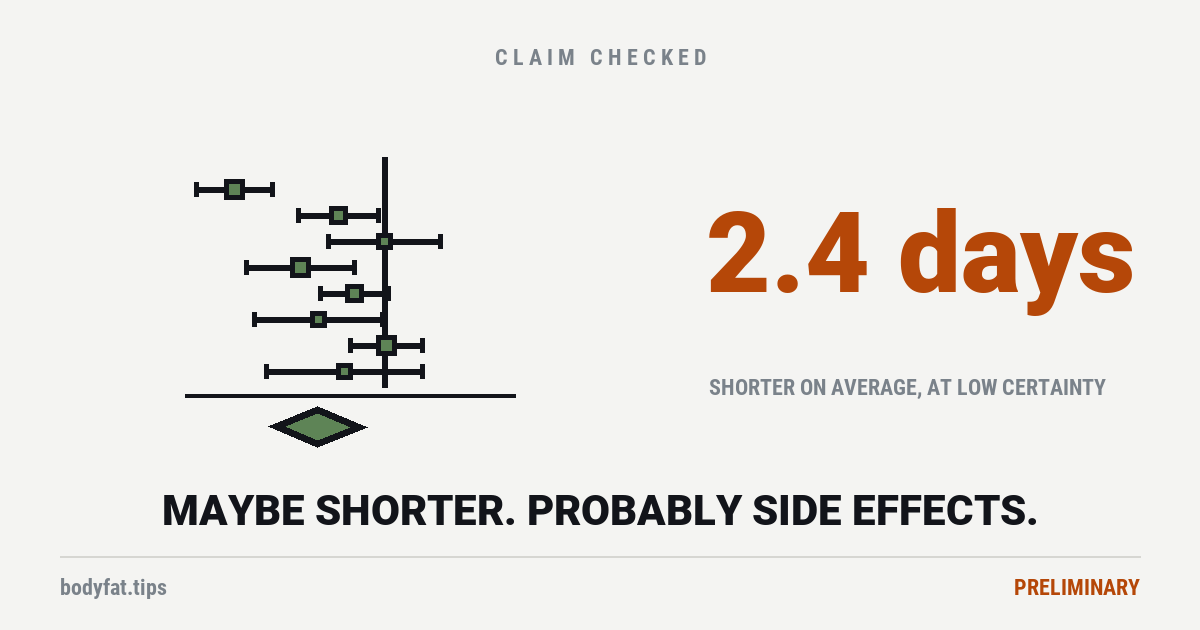
On preventing one: little or no effect, at low certainty. On making symptoms milder: the trials can’t tell. On shortening a cold you already have: maybe 2.37 days — at low certainty.
In Cochrane’s summary table for treatment, the only row graded moderate, one step above low, is the one for side effects: zinc probably gives you more of them. [1]
| Question | Answer | Certainty |
| Stops you catching one | little or none | low |
| Taken daily, shortens the colds children still catch | little or none | moderate |
| Shortens one you have | −2.37 days | low |
| Makes symptoms milder | can’t tell | very low |
| Clears a blocked nose sooner | −1.41 days | moderate* |
| Causes side effects | yes, 34% more | moderate |
Certainty is the column nobody reads
Every result above carries a grade for how much confidence the evidence itself has earned — separate from what the result says. It is the difference between “this is the answer” and “this is our current best guess and here is how shaky it is”.
The 2.37-day figure is graded low. One reason is its heterogeneity, a measure of how far apart the trials’ results sit, which came in at 97%. [1] That number is the share of the spread between the trials that is more than chance would produce. Zero would mean they differed no more than luck allows. Ninety-seven per cent means nearly all of the gap between them is real. And the gap is wide: by the trials’ own abstracts, two of the eight found no difference at all (a dilute zinc nasal spray in adults, and lozenges in schoolchildren) and the other six found colds between about one and nearly seven days shorter. An average of results that far apart describes none of them well.
Meanwhile the side-effect finding — 34% more non-serious adverse events, across 16 trials and 2,084 people — is graded moderate. [1] So the side effects are graded one step higher than the benefit on the box.
They are not the only thing graded moderate, though. Cochrane’s summary tables carry a second moderate rating, from the prevention trials: children given zinc every day who still caught a cold were ill for about as long as children given a placebo (3 trials, 740 children). And in the body of the review “moderate” is printed beside four pooled treatment results that the summary leaves out: a blocked nose cleared about 1.4 days sooner, and sneezing, muscle aches and headache each cleared less than a day sooner. [1] The review’s own methods say only the main outcomes were graded, so we cannot tell you how much weight its authors meant those four to carry. We report them because they are there.
So what are the side effects?
Mostly your mouth and your stomach. A bad or altered taste and stomach upset were the most reported, then a dry or sore mouth and, with the nasal products, a sore nose. [1] In round numbers, 36 in every 100 people on placebo reported a side effect of some kind, against about 48 in every 100 on zinc (the plausible range for that average is 41 to 56). [1] The gap was wider with lozenges than with nasal products, wider at higher doses, and clearer in adults than in children. [1] None of the review’s 19 treatment trials assessed or reported a serious side effect, so on rare, serious harm the review has nothing to say either way. [1]
Zinc in the nose is a different matter, and it is the one harm a regulator has acted on. On 16 June 2009 the US Food and Drug Administration told consumers to stop using three zinc nasal products (Zicam Cold Remedy Nasal Gel, Zicam Cold Remedy Nasal Swabs and Zicam Cold Remedy Swabs, Kids Size) and throw them away, after more than 130 reports of people losing their sense of smell, in some cases for a long time or for good. [5] What that does and does not settle: these were reports sent to the agency, not a trial, so they tell you how many people complained and not how many users were harmed. The warning named three products of one brand. And it said in terms that it “does not concern oral zinc tablets and lozenges taken by mouth”. [5]
Now put that beside the 2.37 days. Three of the eight trials behind that figure tested zinc in the nose, and one of them was a trial of that brand’s gel. It reported the largest effect in the whole pool: colds lasting 2.3 days on the gel against 9.0 days on placebo. [1][16] The FDA’s 2009 advisory says those products “have not been shown to be effective”. [5] Cochrane’s review says its nasal trials reported no cases of lost smell, and that “information about specific side effects is uncertain”. [1] The brand’s nasal spray and swabs are sold today as “zinc-free” (its maker’s site, read 30 September 2026).
One more fact about the trials that the packaging leaves out. The adult lozenge trials gave roughly 80 to 190 mg of zinc a day, for a week or two. [1][2] The long-term upper limit for a healthy adult is 40 mg a day in the US and 25 mg in the EU. [6][7] Those limits are set for intake day after day, not for a week with a cold, and they are built on what zinc does to the body’s copper: the NIH’s fact sheet says 50 mg or more taken for weeks can block copper absorption. [6] So the trials tested between two and nearly eight times the long-term ceiling, for a short time. That is a description of the trials, not a dose to copy. The US limits expressly do not cover zinc taken under a doctor’s care, and whether any of this suits you is a question for one. [6]
And which zinc was tested? Every trial in the 2.37-day figure used a lozenge dissolved in the mouth, or a spray or gel in the nose. None of the review’s 19 treatment trials tested a tablet or capsule that is swallowed. The only swallowed zinc it tested as a treatment was a syrup and a powder, both in young children: the syrup trial found colds no shorter, though symptoms were milder, and the powder trial found no difference in how many children improved. The one lozenge trial in children, in 249 school students, found no difference either. [1]
Then two researchers said the key analysis was built wrong
This is where it gets genuinely interesting, because the dispute is happening in print.
In October 2024 Harri Hemilä and Elizabeth Chalker published a critique of the review, and in 2025 a letter repeating it, written in answer to a summary of the review by one of its authors. [2][3] Their charges against that 2.37-day analysis are specific rather than vague, and two of them are easy to check.
First, the scale. Measuring the effect in days, they argue, treats every cold as if it were the same length. As they put it, “1-day colds cannot be shortened by 2.37 days”. [2] A percentage, they say, fits the data better.
Second, and harder to wave away: what went into the pool. The analysis combined five trials of zinc lozenges with three trials of zinc sprayed or squirted up the nose, and 451 of its 972 people were in the nasal trials. [1] One lozenge trial gave about 190 mg of zinc a day. One nasal-gel trial gave 2.1 mg. [1] Lozenges and nasal zinc, the critics write, “are not similar treatments”. [2]
Cochrane’s own stated method is to pool “only where meaningful, that is, if the treatments, participants, and the underlying clinical question(s) were similar enough for pooling to make sense”. [2] The critics are holding the review to its own sentence.
The review does show its working, which this page failed to say the first time. Lozenges alone: colds 1.96 days shorter (5 trials, 521 people; the plausible range for that average runs from 0.77 to 3.14 days). Nasal products alone: 3.15 days shorter on paper, with a range running from 7.36 days shorter to 1.05 days longer, which means those three trials cannot tell (451 people). [1]
Their reanalysis, and who they are
Hemilä and Chalker redid it — lozenges only, adults only, one left-out trial added back, percentages instead of days — and got zinc lozenges shortening colds in adults by 37% (95% confidence interval 27–46%). [2] That is an average over five trials and 371 adults, and the interval is the range the true average probably sits in, not a forecast for any one cold. In those trials colds lasted about seven days on placebo, so 37% works out at roughly two and a half days (our arithmetic, from the placebo groups in the critics’ own chart). [2]
Which brings us to something this page did not tell you the first time: on size, the two sides nearly agree. Cochrane’s own subgroup of the four higher-dose lozenge trials, all of them in adults, comes out at 2.36 days shorter (272 people; range 1.22 to 3.51). [1] Four of the critics’ five trials are those same four. [1][2] What the two sides disagree about is how far to trust the number, and whether nasal products and a children’s trial belong in the headline.
There are also reasons for doubt that neither headline carries. Keep only the three trials whose way of assigning people to zinc or placebo Cochrane judged sound, and the effect shrinks to about half a day, with a range that includes no effect at all (0.57 days; 482 people). [1] Those three are a mixed bag, though: the dilute nasal spray, the children’s trial and one adult lozenge trial. The one trial the review rates low-risk on every count is a 2020 Finnish trial of a pharmacy zinc lozenge in 87 adults with colds. Colds lasted a median of seven days on zinc and five on placebo, a difference that could be chance, and its authors suspected the lozenge dissolved too fast and five days of it was too short. [1][4] One of the two critics led that trial. Their re-pooling does not include it, and their paper does not mention it. [2]
Now the part you need in order to weigh that. They are not neutral. They have their own published meta-analyses finding zinc lozenges work — 33% shortening in one, a tripled recovery rate in another — and they cite them in the critique. [2] Those are not three separate bodies of evidence: the five trials behind the 37% are among the seven behind the 33%, and the three behind the tripled recovery rate are in both. [17][18] The two declare no funding and no commercial ties. [2]
That is not a scandal. The people who notice a method problem in a field are usually the people who have spent years in it. But they arrived with a position, and you should know that before you decide who convinced you.
Has Cochrane answered? Not in so many words, but the review has changed. On 21 May 2026 it was amended. Its authors updated the section listing where they departed from their protocol, “to reflect correction to Methods section regarding primary analysis by administration route”. That section now says the protocol planned to analyse oral and nasal zinc separately, and that the authors instead pooled everything and looked at route as a subgroup. [1] The note recording the change names no critic and mentions nothing about the scale, the left-out trial or the children’s trial, and the review’s status line reads “no change to conclusions”. [1] We found no reply from the review’s authors in a journal, and we could not open the comments section of the review’s own page in the Cochrane Library, which is where one could sit. So: amended on the pooling point, conclusions unchanged, and no public answer on the rest that we could find.
The last Cochrane review of zinc was withdrawn
There was a Cochrane review of zinc for colds in 2011, updated in June 2013. Errors were pointed out in the first, the critics say, and the update “contained essentially the same errors”. [2]
Cochrane’s own notice tells the next part. The 2013 update was withdrawn in April 2015, after comments sent in that February by the researcher who is first author of the 2024 critique, reporting errors and alleging that text and data had been copied from that researcher’s own 2011 review of zinc lozenges. Cochrane’s editor in chief found the copied text “limited to copying of short phrases”, acknowledged by the authors, and “minor”. On the data, the editor found the authors’ explanation of some similarities “not conclusive”, and the review stayed withdrawn. [8] The summary of it that JAMA had published in 2014 was retracted in December 2016, at its own authors’ request, because the review it summarised had been withdrawn. [9]
Which is worth sitting with, given that zinc is, in the 2024 review’s words, “a popular supplement”, and Cochrane is the organisation people point to when they want an answer without a commercial stake in it. [1] It also cuts both ways. The researcher whose comments led to the withdrawal has been publishing criticisms of Cochrane’s zinc reviews since 2011. And the last time, Cochrane’s own editor kept the review withdrawn. [2][8]
Where the whole idea came from
One last thing, because it is the most human fact in this entire file.
Zinc lozenges exist because of a three-year-old girl being treated for leukaemia. She would not swallow a zinc tablet, so she let it dissolve in her mouth — and her cold symptoms disappeared within a few hours. [2][10]
Her father thought that was worth testing, and ran the first randomised trial of zinc lozenges himself. It recruited volunteers in the fall of 1981 and was published in Antimicrobial Agents and Chemotherapy in 1984. [2][10]
It is also where the money starts. He had first applied for a US patent on the method in July 1981, before that trial recruited, and a patent was granted in 1985. In a 2010 paper he declared having profited from patent royalties and lozenge sales. [11] A foundation funded from those patent earnings part-paid for two of the eight trials behind Cochrane’s 2.37 days, and he supplied the lozenges for both. Five of the other six name a company as funder or supplier, and for the sixth, the trial of the branded nasal gel, Cochrane found no funding statement. [1] Four of the five trials behind the critics’ 37% are among the seven with a funder or supplier of that kind. [1][2] Across all 34 trials, Cochrane counts 17 as funded by an organisation with industry ties or as not saying who paid. [1] The review itself was funded by the US National Institutes of Health. [1]
Four decades, thirty-four trials, one withdrawn review and a retracted JAMA summary later, we are still arguing about what he found.
Does it stop you catching one?
Cochrane’s answer is little or no effect, at low certainty. In its nine trials about 59 in every 100 people on zinc caught a cold, against about 64 in every 100 on placebo, a gap small enough to be chance (a risk ratio of 0.93, where the plausible range runs from 15% fewer colds to 1% more; 1,449 people). [1]
Now look at who those 1,449 people were. By the review’s own table, about three-quarters were children between about two and twelve in Indonesia, Turkey and Thailand, given zinc every day for two to seven months. Most of the adults were volunteers who had a cold virus put into their noses in a laboratory. That leaves 108 adults catching colds the ordinary way: 59 soldiers in Iran given zinc for three weeks, and 49 older Americans given it for a year (our count, from the review’s table). [1] So this is mostly an answer about children, and about laboratory colds.
Pooled analyses of adults alone disagree with each other, and the split follows what they count. One from 2021 pooled three laboratory experiments with two ordinary trials and found no effect (554 adults). [15] Another from the same year kept the two kinds apart: no protection after deliberate infection, but about five fewer infections for every 100 people taking zinc for a month in everyday life, which its authors graded moderate. That result rests on four trials, and most of the people in them were in two Chinese trials of a zinc nasal spray, not a pill. [12] A 2025 analysis of swallowed zinc only found about a third fewer colds, on three small trials (145 adults by our count from its supplement, 108 of them the same soldiers and older Americans), graded low by its own authors and no longer clear once the weakest trials were set aside. [13] In children, a 2026 analysis of seven trials and 5,761 children found no clear difference in respiratory infections of any kind. [14]
So if you are an adult wondering whether a daily zinc pill keeps colds away, the honest answer is that it has barely been tested in people like you. “Zinc does not prevent colds” says more than the trials do. So does “zinc prevents colds”.
The verdict
Preliminary. Not because the evidence is thin — 34 randomised trials is not thin — but because the one result that matters to a person with a cold is graded low by the reviewers who produced it, seven of the eight trials behind it name a company or a patent-funded foundation as funder or supplier, and the one trial rated low-risk throughout found no benefit.
On catching one: little or no effect in Cochrane’s pool, at low certainty, and that pool is mostly children and laboratory colds. For adults in ordinary life the question is nearer open than closed.
On shortening one: for adults using zinc lozenges, Cochrane’s own subgroup and its critics land close together, at around two and a half days off a cold that would otherwise last about a week. Cochrane calls its evidence low-certainty; the critics call theirs “very strong evidence”. [1][2] The better-randomised trials, and the one trial rated low-risk throughout, show less or nothing. For children, the one lozenge trial found no difference. And none of the review’s 19 treatment trials tested a tablet or capsule you swallow. [1]
On side effects: probably more of them, about 48 people in 100 against 36 in 100 on placebo, mostly a bad taste and an upset stomach. That is graded moderate, one step above the benefit, and it is one of two results Cochrane’s summary tables grade that high. It is disputed as well: the critics argue that a risk ratio is the wrong yardstick for mild effects and that lozenge recipes differ. [1][2] Zinc in the nose is a separate question, with a federal warning attached. [5]
None of this is advice. The trials used doses well above the long-term upper limits, for a week or two, and whether zinc is sensible with your health and your medicines is a question for a clinician.
Related: ashwagandha benefits · magnesium benefits · colostrum benefits · beetroot juice benefits · every claim we’ve checked
This page was corrected on 30 September 2026 after an independent editorial review. Its headline claim was wrong. We said the side effects were Cochrane’s most certain finding and the only thing its review graded moderate. We had read the review’s abstract and not its full text, which has been free to read since May 2025. The abstract itself grades two results moderate, and the full text prints moderate beside several more, a blocked nose cleared about 1.4 days sooner among them. The side effects are graded one step above the two-day result; they are not the most certain thing in the review, and the critics dispute them too. We also said both sides agree zinc does not prevent colds: the critics’ paper never discusses prevention, Cochrane’s own words are “little or no” effect at low certainty, and about three-quarters of the people in that analysis were children. We said we had found no Cochrane reply: the review had been amended on 21 May 2026, twelve weeks before this page was published, on the point about pooling nasal and oral zinc, and its full text reports the two separately. We said funding was not stated: seven of the eight trials behind the 2.37 days name a company or a patent-funded foundation as funder or supplier. And we described the 97% heterogeneity figure as trials finding “almost entirely different things”, when it is the share of the spread between trials that is more than chance.
Added: what the side effects are and how common; the FDA’s 2009 warning about three zinc nasal products and loss of smell, and the fact that a trial of that brand’s nasal gel sits inside Cochrane’s 2.37-day average; the doses the trials used beside the long-term upper limits; who the critics’ 37% rests on (five trials, 371 adults) and the 2020 trial it leaves out; other pooled analyses of prevention; and Cochrane’s own account of why its previous zinc review was withdrawn, in place of the critics’ account. Removed: “in the 1980s” (neither the 1984 paper nor the critics’ gives a year for the observation), “one of the most-taken supplements on earth” (we had nothing to back it), and the critics’ “4,300-fold” dose comparison, which depends on a dose for one nasal-spray trial that we could not check in the trial’s own report and that does not match the spray Cochrane’s table describes. The third source, which we had cited unread, has now been read. The title changed with the finding. The rating is unchanged: Preliminary.