Fish Oil vs Krill Oil: 64 Trials Found No Difference. The Absorption Study Has 12 People.

Sixty-four randomised trials have compared krill oil and fish oil. On triglycerides, LDL, HDL and total cholesterol, the difference between them is nothing. [1]
Not “small”. Every one of those four comparisons produced a range of plausible answers that sits on top of zero.
The reviewers’ own summary: “The lipid-modifying effects of krill oil and fish oil do not differ. The reduction in triglycerides depends on the dose of n-3 fatty acids consumed.” [1] Triglycerides being a fat that circulates in your blood, and the one omega-3 moves most reliably.
It is not the krill. It is not the fish. It is how many grams of omega-3 you actually swallowed.
| Measure | Krill vs fish oil |
| Triglycerides | no difference |
| LDL cholesterol | no difference |
| HDL cholesterol | no difference |
| Total cholesterol | no difference |
The absorption study everyone cites has twelve people in it
Krill oil costs more because of one idea: its omega-3 comes wrapped in phospholipids rather than triglycerides, and phospholipids absorb better. There is a specific study behind that. It is worth meeting.
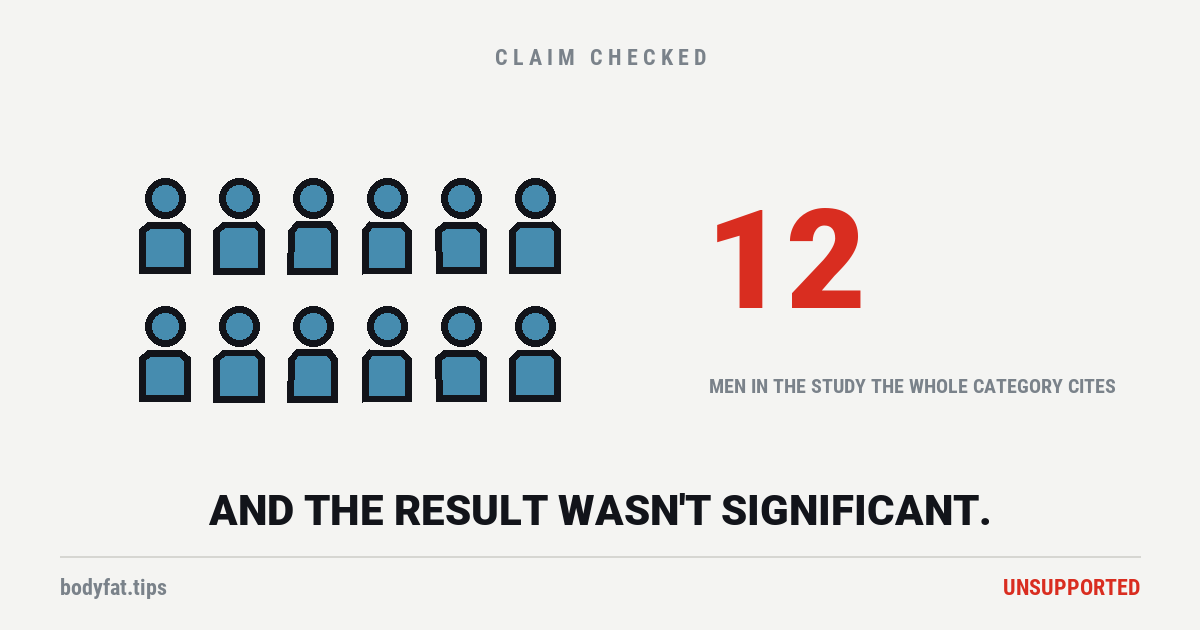
Twelve healthy men. One dose. Three capsules compared head to head, dose-matched at 1,680 mg. [2]
Krill did come out on top for total absorption over 72 hours. And then the paper says this: “However, due to high standard deviation values, the observed differences were not significant.” [2]
Twelve people, and the headline result did not clear the bar.
Its one significant win was against the cheapest kind of fish oil
One measurement in that study did reach significance — peak blood concentration. But when the authors compared the three arms against each other individually, only one pairing came out significant: krill oil versus fish oil in the ethyl ester form. [2]
The study used two kinds of fish oil. Ethyl ester is the cheaper, more processed one, and it finished last of the three arms. Re-esterified triglyceride is the costlier one — and krill did not significantly beat it on any measure. [2]
So the claim that survives the study is narrower than the claim on the bottle: krill oil beat the budget version of its competitor, once, on one measure, in twelve men.
And the mechanism might not be the one being sold
Here is the detail in that paper that almost nobody quotes, and it is in the authors’ own conclusion.
When they analysed the actual oils, the krill oil turned out to contain a large amount of free fatty acids — omega-3 not bound into anything at all. 22% of its EPA and 21% of its DHA. The two fish oils contained none. [2]
Free fatty acids are easy to absorb. So if krill oil went into the blood faster, the phospholipid story may not be why. The authors say so themselves: the free fatty acid content “might have a significant influence on the bioavailability” and “should be investigated in more depth”. [2]
A premium is being charged for a mechanism the source study flagged as possibly not the mechanism.
There is also less omega-3 in there
A second head-to-head, ten women, weighed what they were actually giving people. Five grams of oil either way. The krill oil carried 907 mg of long-chain omega-3. The fish oil carried 1,441 mg. [3]
That is two specific products, not a law of nature, and we are not going to pretend it settles the category. But it points at the arithmetic worth doing on whatever is in front of you: not the price of the bottle, but the price per gram of omega-3 inside it. That number is on the label, and it is the only number the 64 trials say matters.
Interestingly, EPA in the blood rose about the same from both, despite krill delivering 31% less of it — which is a genuine point in krill’s favour on efficiency. DHA and DPA showed no difference between any of the groups. [3] Ten women, five hours, one dose.
One more thing, from the paper’s own small print
The competing-interests statement on the twelve-man absorption study: one author “founded Omegametrix, a company offering fatty acid analyses”, and two others “worked as consultants for companies which also produce and merchandise fatty acid supplements.” [2]
They disclosed it, in the paper, where it belongs. That is the system working. It is simply information you should have when a supplement category cites one study at you for fifteen years.
The verdict
Unsupported, for the claim that krill oil is better.
Be precise about what that does and doesn’t mean. Krill oil works: against a control, it lowered triglycerides significantly. [1] And the narrow absorption claim has a real if wobbly signal behind it — two single-dose studies, twenty-two people between them, DHA unmoved.
What is unsupported is the part you are paying for: that any of this produces a better result. Sixty-four trials looked and found no difference on a single lipid measured.
Which leaves the more awkward question hanging over both bottles. We already checked whether fish oil capsules do much of anything, across 86 trials and 162,796 people, and the answer was not the one the shelf implies. Choosing the premium version of that is a decision about which capsule, when the prior question was whether.
Related: fish oil benefits · magnesium benefits · collagen benefits · how much protein to build muscle · every claim we’ve checked