Urolithin A Benefits: Both Ageing-Muscle Trials Missed Their Main Goal

“Urolithin A benefits” is searched about 3,600 times a month in the United States, the database’s figure for the past year, and 4,400 to 6,600 a month from July to September 2026; plain “urolithin A” at 33,100, the same kind of yearly figure, and 49,500 in each of those three months (from a paid keyword database, pulled 23 October 2026) [1]. It is a fair thing to look up. The supplement is sold to keep your muscles and your mitochondria, the parts of each cell that turn food into usable energy, working as you get older.
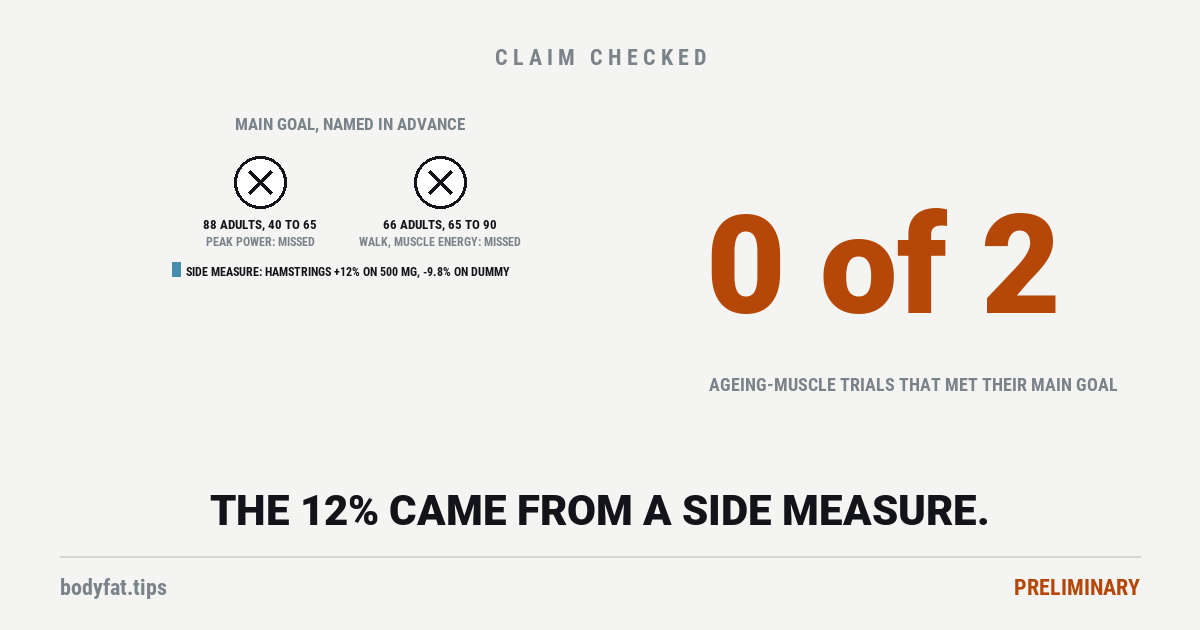
Possibly, but it has not been shown. Both muscle trials in middle-aged and older adults missed the result they named in advance as their test. The figures people quote, like a 12% rise in leg strength, come from other measures in those same trials, and the company that sells the best-known supplement paid for both. That is why this page rates the claim Preliminary: a real signal in small, short trials, not yet repeated and not yet independent [2] [3].
This is journalism, not medical advice. The trials enrolled mostly healthy adults for four weeks to four months, so they say little about anyone on prescribed medicines, pregnant or breastfeeding, or managing a chronic illness: if that is you, ask a clinician or pharmacist before starting it [2] [3] [4]. None of these trials tested it as a treatment for diabetes or for diagnosed muscle loss, and the one small trial in heart failure found no significant improvement in the heart [5]. It is not a stand-in for treating any of them.
What is urolithin A, and how does it work in the body?
Urolithin A is made by gut bacteria. Pomegranates, walnuts and some berries contain ellagitannins, plant compounds of which the body absorbs only a little [6]; in some people, microbes in the large intestine break them down into urolithin A, which is absorbed [7]. The supplement skips the bacteria. The powder in it is made in a factory by chemical synthesis, as the maker’s own safety notice to the US Food and Drug Administration describes [8].
The selling point is a process called mitophagy: the cell’s way of breaking down worn-out mitochondria and recycling them. The idea comes from a 2016 study by a Swiss university lab working with the company: urolithin A switched on mitophagy, made worms live longer, and let old mice and young rats run further [9]. Worms and mice are where the story is strongest.
In people, the trials have measured the shadow of that process more than the process. Four weeks of 500 or 1,000 mg shifted blood levels of acylcarnitines, fat fragments that pile up when mitochondria burn fat less completely, and switched on muscle genes tied to mitochondria [10]. But when a trial in older adults measured how fast a muscle could actually make energy, using a scanner, the urolithin A group did not improve significantly more than the group on a dummy pill [3], and in trained runners the muscle’s mitochondrial output was not significantly altered by either treatment [11].
Urolithin A and muscle: what the trials in people found
We found thirteen published randomised trials of urolithin A taken by mouth, which means people were assigned to it or to a comparison by chance [12]. Two of them, both from Japan, are in Japanese journals and do not come up in a search of PubMed [12]. Here they are, with the one result each trial named in advance as its test. Researchers call that the primary outcome: deciding it before the data come in is what stops a study from picking its best number afterwards.
| Trial | Who, what dose, how long | Main outcome, named in advance | What it found |
|---|---|---|---|
| First safety trial, 2019 [10] | 60 inactive adults aged 61 to 85; single doses, or 250, 500 or 1,000 mg a day for 28 days | Safety | Judged safe; blood fat fragments and muscle genes tied to mitochondria shifted at 500 and 1,000 mg |
| Older adults, 2022 [3] | 66 aged 65 to 90 (33 and 33), 76% women; 1,000 mg a day; 4 months | Six-minute walk distance, and energy production in a hand muscle | Neither significantly better than the dummy pill. Hand and leg endurance better at 2 months, not significantly at 4 |
| Middle-aged adults, 2022 [2] | 88 aged 40 to 65, overweight and inactive: 29 on a dummy pill, 29 on 500 mg, 30 on 1,000 mg; 4 months | Peak power on an exercise bike | Not significantly better. Hamstring strength up 12% (500 mg) and 9.8% (1,000 mg), against 9.8% down on the dummy pill |
| Blood levels, 2022 [7] | 100 adults aged 20 to 80; one 500 mg dose against one glass of pomegranate juice | How much reached the blood over a day | More than six times as much from the supplement |
| Blood vessels, Japan, 2023 [13] | 36 adults aged 40 to 65 who make little or none of it; 10 or 50 mg of urolithin A a day; 12 weeks | Artery widening in the arm | No significant improvement in vessel function or blood pressure |
| Capillaries, Japan, 2023 [14] | 32 healthy adults aged 40 to 65; 10 mg of urolithin A a day, in a fermented pomegranate product, or a dummy pill; 12 weeks | Tiny blood vessels at a fingertip, seen through a microscope (registered after the trial ended) | Capillaries longer than on the dummy pill, and weight down against it; read as its summary only |
| Heart failure, 2024 [5] | 10 patients, each taking both in turn; 1,000 mg a day; 4 weeks each | Heart measures on ultrasound | No significant effect on any; HDL cholesterol rose |
| Weightlifters, 2024 [15] | 20 trained men, average age 24 (10 and 10); 1 g a day; 8 weeks | None named | Bench and squat maxes not significantly different from the dummy pill; leg strength pushing against something that does not move, and bench reps to failure, rose |
| Skin and hair, Japan, 2024 [16] | 59 healthy women (29 and 30) on 10 or 20 mg of urolithin A a day, as one or two capsules of the Japanese company’s fermented pomegranate product; 12 weeks; no dummy pill, and everyone knew what they took | Skin, wrinkles and hair | Some skin and hair measures better than at the start; the two doses not significantly different on skin, hair or body fat |
| Runners, 2025 [11] | 42 trained male runners (22 and 20) at an altitude camp; 1,000 mg a day; 4 weeks | A muscle-damage marker, then 3,000 m race time | Marker lower after the race (22 runners), not after weekly downhill runs (all 42); race time not significantly faster |
| Soccer academy, 2025 [17] | 20 players, average age 17.5 (10 and 10); 1,000 mg a day; 6 weeks; only the players were blinded | A shuttle-run endurance test | About 784 ft (239 m) further than the dummy group; the groups started unevenly on it |
| Immune cells, 2025 [18] | 50 healthy adults aged 45 to 70 (25 and 25); 1,000 mg a day; 4 weeks | Types of T cell, and how they burn fuel | Met: more “naive” killer T cells, which burned more fat for fuel |
| Adults with obesity, 2026 [4] | 50 aged 40 to 64 with a BMI of 30 or more (25 and 25), 74% women; 1,000 mg a day; 4 weeks | Artery widening in the arm | Not significantly better; the brain’s blood-flow response to a memory task was larger |
The muscle claim rests on the two rows in bold. The bigger of the two is also the biggest published trial of a health measure we found [12]: 88 overweight, inactive adults aged 40 to 65 at one site in Canada, given a dummy pill (29), 500 mg (29) or 1,000 mg (30) a day for four months [2]. Its primary outcome, the peak power people could produce on an exercise bike, was not significantly different from the dummy pill group’s [2].
Its headline came from a different test. Hamstring strength, measured on a machine, rose 12% on 500 mg and 9.8% on 1,000 mg, both significant against the dummy pill [2]. Read the other column too: in the dummy-pill group hamstring strength fell 9.8% over the same four months [2]. So about half of the gap that made the result significant is the comparison group getting weaker, by our arithmetic. Thigh-muscle strength on the front of the leg and grip strength were not significantly different [2]. Aerobic fitness on 1,000 mg rose 10.2%, against a 1.1% fall on the dummy pill, which missed significance, with a P value of 0.058 — just the wrong side of the line researchers use for “probably not chance” [2]. Lean muscle measured by scan did not differ significantly between the groups [2].
The second is 66 adults aged 65 to 90 in Seattle, three in four of them women, on 1,000 mg or a dummy pill for four months [3]. Its primary outcomes were how far people could walk in six minutes and how fast a hand muscle could make energy, measured with a scanner. Neither was significantly better on urolithin A: the urolithin A group walked about 200 ft (60.8 m) further than at the start, the dummy-pill group about 139 ft (42.5 m) further [3].
What the trial did find was endurance: how many times a hand muscle and a shin muscle could contract before tiring. At two months the urolithin A group was significantly ahead. At four months, the end of the trial, the paper says the dummy-pill group had improved in parallel and the difference was no longer significant [3]. The paper also reports that its original primary outcomes, hand-muscle energy and hand-muscle endurance, were replaced after the study began with the walk and hand-muscle energy, because the walk was judged “more functionally important” [3]. We report that as the paper states it.
Does pooling them help? A 2026 systematic review, which gathers every trial that meets fixed rules and judges them together, found five trials and 236 people [19]. The only result it could pool was the six-minute walk, from the two trials above: 56 ft (17.03 m) further on urolithin A on average, with a confidence interval, the range the true average probably sits in, from 17 ft shorter to 129 ft longer (−5.33 to 39.40 m) [19]. That range includes no difference at all, and the reviewers rated their certainty low [19]. The biggest study inside it is the 88-person trial [19] [2]. The review calls the strength and endurance findings “exploratory signals rather than reproducible effects” [19].
One correction to that review, because a summary is only as good as its rows. Its table lists the older adults’ endurance gains under a four-month time point [19]. The trial’s own paper gives those figures at two months, and says the four-month difference was not significant [3]. An earlier 2024 review of five studies put it more plainly in its summary: urolithin A “increased muscle strength and endurance, however, had no effect on anthropometrics, cardiovascular outcomes, and physical function” [20]. That is the review’s wording, quoted, and its “no effect” means the trials found no significant difference.
Urolithin A for men: the sports trials
Three small trials gave it to young, fit men [15] [11] [17]. Twenty weightlifters took 1 g a day for eight weeks: their bench-press and squat maxes were not significantly different from the dummy group’s, while leg strength pushing against something that does not move, and bench-press reps to failure, rose significantly [15]. That trial named no primary outcome, used the leading brand’s urolithin A and was paid for by a provincial education plan, with no company money declared [15].
Forty-two trained runners took 1,000 mg or a dummy pill for four weeks at an altitude camp [11]. Its first test was a blood marker of muscle damage, creatine kinase, which leaks out of strained muscle: after the weekly downhill runs, in all 42, there was no significant difference between the groups; after a 3,000 m race, in the 22 who ran it, the urolithin A group’s levels were lower, from a starting point that was higher [11]. Race times were not significantly faster [11]. The maker funded it, three of its staff were authors, and a fourth author had worked for a food company that had partnered with the maker [11].
Twenty academy soccer players, average age 17.5, took 1,000 mg or a dummy powder in a post-training drink for six weeks, and ran about 784 ft (239 m) further on a shuttle-run test than the dummy group [17]. The range for that difference runs from 66 to 1,490 ft (20 to 454 m), only the players were blinded, and the authors note the two groups started unevenly on that very test [17]. It is the one trial in the table whose primary physical outcome came out in urolithin A’s favour in full, and it is a pilot of 20 young players, most of them teenagers.
Does urolithin A have any effect on blood pressure?
Not in the trials that looked. The one trial we found that named blood pressure among its outcomes, in Japan, found no significant improvement [13], and the two muscle trials, which checked it with the other vital signs for safety, found no significant changes between the groups [2] [3]. A second Japanese trial checked blood pressure every four weeks; its published summary gives no blood-pressure result, and its full text is sold, so we read only the summary [14].
The closest test of the blood vessels themselves is the newest, published in October 2026, paid for by the American Heart Association and a private foundation; its authors report no conflicts, and its protocol says the capsules were the maker’s own, bought commercially [4]. It gave 50 adults aged 40 to 64 with obesity 1,000 mg or a dummy pill for four weeks and measured flow-mediated dilation, how much the main artery in the arm widens after a cuff is released, a standard test of blood-vessel health. Change was 1.3% on urolithin A and 0.3% on the dummy pill, not significantly different, and the other vessel tests were not significantly different either [4].
It did find something: when people did a memory task, the blood-flow response in the front of the brain was larger after urolithin A than after the dummy pill, while their scores on the task were not significantly different [4]. The authors call that worth further study; it was one of their secondary measures [4].
A Japanese trial gave 36 people who make little urolithin A of their own 10 or 50 mg of it a day for 12 weeks, and found no significant improvement in vessel function, its primary outcome, or in systolic or diastolic blood pressure [13]. A Japanese chemical company’s healthcare division paid for it, two of its staff were authors, and the capsules were the company’s own fermented pomegranate product [13] [21]. And ten people with heart failure, taking it and a dummy pill in turn for four weeks each, showed no significant change in heart measures on ultrasound; their HDL cholesterol rose [5]. Pomegranate itself, as fruit or juice, has its own small, mixed blood-pressure evidence, rated Preliminary in our verdict on lowering blood pressure naturally.
The same company paid for a second trial in Japan, and it is the one vessel trial in the table whose main outcome came out in the product’s favour [14]. Thirty-two healthy adults aged 40 to 65 took one supplement a day of the company’s fermented pomegranate product, holding 10 mg of urolithin A, or a dummy pill, for 12 weeks. The tiny blood vessels at a fingertip, photographed through a microscope made by a company that the first author gives as an affiliation and that the second author heads as its representative director, grew significantly longer on the product than on the dummy pill, and a second reading from the same images, of the fluid around the capillaries, rose more than on the dummy pill; the Japanese company’s 2023 review marks both as significant [14] [21]. Its title promises an evaluation of endothelial function, how well the lining of the vessels works, but its summary calls what it measured the capillaries’ “morphology”, their shape, and reports no test of how arteries or capillaries work and no blood-pressure result; the authors write that the change “is expected to be associated with improvements in the capillary functions” [14]. The trial was registered seven months after its last participant’s final visit, though its record gives a protocol date before the trial began, and we read it only as its published summary [14]. That summary describes the company’s earlier trial as having “increased the flow–mediated dilation”. The earlier trial’s own paper reports no significant improvement in it, and the company’s 2023 review gives the result as a trend at eight weeks on 10 mg, with a P value of 0.078, short of the line [13] [21].
Urolithin A weight loss: where it comes from
From mice. A 2020 study found urolithin A kept mice on a high-fat diet from gaining weight, by making their fat tissue burn more energy, and it still sits in Google’s results for this question [22]. In people, no completed trial we found made weight loss its main question [12]. Some trials measured body fat or weight along the way. In the 88-person trial, fat measured by scan did not differ significantly between the groups, and in the 2026 trial in adults with obesity weight held steady on average across the trial [2] [4]. In the Japanese skin trial, which listed body fat among its secondary measures, the two doses did not differ significantly, and there was no dummy pill to compare against [16]. One small trial points the other way: in the Japanese capillary trial, its summary says weight in the product group “significantly decreased compared to the placebo group”, in 32 people over 12 weeks, without giving a figure. Weight is not among the outcomes in its registry record, the same company paid for it, and we read only the summary [14]. A 24-week trial in 100 adults with obesity on a restricted diet is under way; its registry summary says it will test whether urolithin A helps them lose weight while keeping muscle, and its main outcome is muscle [23].
Urolithin A, inflammation, immune cells and skin
C-reactive protein, or CRP, is a blood marker that rises with inflammation. It was lower on 1,000 mg than on the dummy pill in the 88-person trial [2]. In the weightlifters the paper reports it significantly lower against the dummy pill, though within the urolithin A group itself it rose significantly over the eight weeks [15]. In the older adults it held at about 2.1 mg/L on urolithin A while it rose from 2.17 to 2.65 mg/L on the dummy pill [3]. In the runners there was no significant change in either group [11], in the adults with obesity the blood markers were not significantly different [4], and in the ten people with heart failure CRP was not significantly different either [5]. Mixed, in other words.
Of the maker’s trials of a health measure, the immune trial is the one that met its primary outcomes in full. Fifty healthy adults aged 45 to 70 took 1,000 mg or a dummy pill for four weeks, and there were more “naive” killer T cells, the kind not yet used against an infection, up 0.50 percentage points (range 0.16 to 0.83), and those cells burning more fat for fuel [18]. Of the blood signals of inflammation it measured, only one, interleukin-2, was significantly lower [18]. The authors say themselves that whether any of this means fewer infections or better vaccine responses is still to be tested [18].
A wellness doctor’s article that Google’s AI answer cites says that this same trial found “significantly lower levels of C-reactive protein (CRP)” [24]. We read the trial’s full paper: CRP does not appear anywhere in its text or figure legends [18]. The article’s author discloses that the maker sponsors the author’s podcast and newsletters [24].
Skin is mostly a cream story. In the maker’s split-face trial, 48 women with an average age of 59 were split between a 1% and a 0.5% urolithin A cream, and each woman put the urolithin A cream on one side of the face and a dummy cream on the other for eight weeks. With the 1% cream, in the 22 women analysed, wrinkle depth fell 3.4% on the treated side and rose 4.0% on the other, a significant difference; the 0.5% cream did not significantly differ from the dummy [25]. The same paper reports a second trial, of sunburn: in 21 adults whose skin was given a mild burn with ultraviolet B light on small patches, the patches under the 1% cream were 13% less red a day later than untreated skin, at the stronger of the two doses of light, while the paper’s chart marks no significant difference between the 1% cream and the plain cream [25]. The maker and a cosmetics group ran both [25]. For skin from a capsule we found one published trial, from Japan, and it had no dummy pill [12] [16]. Fifty-nine healthy women took 10 or 20 mg of urolithin A a day for 12 weeks, as one or two capsules each holding 100 mg of the Japanese company’s fermented pomegranate product, knowing what they took; skin elasticity, spots, redness and wrinkle grade, and how visible the hairline was, came out significantly better than at the start in the paper’s comparisons within its groups, and the two doses did not differ significantly from each other on any skin or hair measure [16]. The paper also says it made no allowance for running many tests at once, which raises the odds that some measure comes out significant by chance [16]. A change from the start with no comparison group cannot separate the pill from the season, from expectation or from being measured a second time. The company paid for the trial and supplied the capsules, and two of the four authors are its staff [16]. The Swiss maker’s own trial of an oral supplement, which its registry record does not name, given with a cream against dummies, finished in July 2025 with no results posted, and a second, of an unnamed oral skin supplement, began recruiting in August 2026 [23].
Does pomegranate juice increase urolithin A?
Yes, if your gut bacteria can make it, and most people’s can make some. In 2006, 18 volunteers drank 6 fl oz (180 mL) of pomegranate juice concentrate, and urolithin A turned up in the urine of 11 on the same day and 16 the day after [6]. That study was supported by a trust of a juice company’s owners, which also supplied the juice [6]. Across the trials that defined the three types of “producer”, the share who made no urolithins at all from pomegranates, walnuts or berries ran from 5 to 25% [26].
The figure in Google’s AI answer is smaller: “only about 30% to 40% of people” can make it [1]. The wellness doctor’s article gives the same range and cites for it the maker’s own study of 100 adults [24], which counted as “high” producers the 40% whose blood level passed 100 ng/mL in the 24 hours after one 8 fl oz (240 mL) glass of juice; 27% made a little and 33% none in that window, and 12% had any in their blood beforehand [7]. How many people “make it” depends on how long you wait and where you draw the line.
The same study found that one 500 mg dose put more than six times as much urolithin A into the blood over a day as the glass of juice did, and its authors estimate it would take about six glasses, about 51 fl oz (1.5 L), to match [7]. That is a real difference in dose. It is not evidence that the dose does anything for your muscles. For urolithin A foods, the list is short: pomegranates, walnuts and berries, and what you get depends on your bacteria. Pomegranate’s other gut story, about the microbe Akkermansia, is in our Akkermansia verdict.
Is urolithin A the same as CoQ10?
No. Coenzyme Q10 is a substance already present in the human body, at its highest levels in the heart, liver, kidneys and pancreas, and sold as a supplement [27]. Urolithin A is made by some people’s gut bacteria from plant foods, or bought as a factory-made powder [7] [8]. They are different molecules sold on a similar idea, mitochondria. So is NAD+, and our NAD+ supplement verdict found the blood level moves and little else does.
Urolithin A side effects and safety
In the trials that counted them, side effects were about as common on urolithin A as on the dummy pill. In the 88-person trial, 17 people on the dummy pill reported 42 adverse events, against 13 people with 24 events on 500 mg and 15 people with 36 events on 1,000 mg [2]. In the older adults there were no serious adverse events [3]. In the 2026 trial, headache was the most common complaint: six people on the dummy pill, three on urolithin A [4].
The limits are length and who took part. None of the published trials we found ran longer than four months [12]. In the United States, the FDA wrote in 2018 that it had “no questions at this time” about the maker’s conclusion that synthetic urolithin A is safe as a food ingredient at up to 500 or 1,000 mg a serving [8]. That letter answers the company’s own safety case; in its own words it is “not an affirmation” that the ingredient is safe, and it says the agency did not evaluate any labeling claims [8]. Google’s AI answer turns it into “FDA Generally Recognized as Safe [GRAS] status” [1]. We found no opinion on urolithin A from the European Food Safety Authority [12]. The maker applied to the European Union for approval of synthetic urolithin A as a novel food on 31 August 2018; in the United Kingdom its application is listed as in progress, at risk assessment; and in July 2025 Switzerland’s food safety office classed urolithin A as a novel food that needs authorisation [28]. Those are filings and a classification, not findings on safety or benefit.
Who these trials were done on
Mostly healthy volunteers, and never for long. The muscle trials enrolled overweight, inactive adults aged 40 to 65, about two-thirds of them women [2], and adults aged 65 to 90 in Seattle, three in four women and all of them White, who could already walk a fair distance [3]. The sports trials were all male, and one was mostly teenagers [15] [11] [17]. The only trial in patients was ten people with heart failure [5]. The 2026 vessel trial’s 50 adults with obesity were not all in good health either: half had high blood pressure and a fifth type 2 diabetes [4]. The Japanese capillary and skin trials enrolled healthy adults, the skin trial only women [14] [16].
So read yourself against them. If you are frail, already losing muscle, or over 90, these trials were not built around people like you: the older adults’ trial took healthy volunteers who walked unaided and managed daily life without help [3], and a registered trial in frail older adults finished in April 2025 with no results posted [23]. If your goal is strength as you age, the evidence for lifting is far stronger: resistance training in older adults is rated Established on this site, and creatine taken with training is one of two supplements that beat training alone in a screen of 250. For pills sold on a general promise of health, our multivitamin verdict is the long version of how that tends to go.
If the main results keep missing, why does every summary sound so sure?
This section is the desk’s own reasoning, and it is labelled as such. The trials’ primary outcomes mostly missed. The pages that come up when you search sound confident. Here are three ways those fit together, each rated.
Answer one: the wins are on the side measures, and the side measures get quoted. Of the seven trials in the table that named a primary outcome for muscle, fitness or blood vessels, four missed it [2] [3] [4] [13], one met half of it [11] and two met it: the 20-player pilot [17] and the Japanese capillary trial, whose main outcome was the capillaries’ shape and which was registered only after it had finished [14]. The numbers people repeat, the 12% hamstring gain and the endurance gain, are secondary results [2] [3]. The count is from the papers; that this explains the confident summaries is our inference.
Answer two: the dummy-pill groups moved. In the older adults, the dummy-pill group walked about 139 ft (42.5 m) further after four months, which the authors put down to a “higher-than-anticipated placebo effect” [3]. In the middle-aged trial, the dummy-pill group lost 9.8% of its hamstring strength [2]. A trial result is the difference between two groups, so a comparison group that drifts up can hide an effect and one that drifts down can make one. Both drifts are measured; which way the truth lies is not something two trials can settle.
Answer three: something small and real is happening in the blood. Blood levels of the acylcarnitine fat fragments fell in three of the maker’s trials, in one of them only on the lower dose [10] [3] [2], and the immune trial met its primary outcomes [18]. It may be that urolithin A does change mitochondria a little, too little to show up in a walking test within four months. That is a surmise, and the maker is testing it: a six-month trial of 120 middle-aged adults with leg strength as its primary outcome is recruiting now [23].
Put the three together and here is what we think is true, stated plainly so you can disagree with it: urolithin A reliably changes what a blood sample can show, and whether it changes what your legs can do is the question its own maker’s next trial is built to answer.
What we could not find, and would like to: a trial of urolithin A in older adults, run and paid for by no one who sells it, lasting six months or more, with walking or strength named in advance as the primary outcome, and with its primary result reported first [12]. Of the trials in the table whose papers declare no company money, the weightlifters’ trial named no primary outcome [15] and the October 2026 vessel trial missed its own [4]; neither tested older adults’ muscles. If you know of the trial we describe, the corrections line on this site is open.
Where “urolithin A for healthy ageing” came from
The research is the 2016 worm-and-rodent paper from a Swiss university lab and the company it worked with, which reported longer-lived worms and fitter rodents [9]. The framing came three years later. The company’s press release on its first human trial, a four-week study of blood and gene markers in 60 older adults whose primary outcome was safety, was headlined “First Human Clinical Trial Results on the Anti-Aging Compound, Urolithin A” and called the dose “effective in improving mitochondrial health” [29] [10]. A food company that had partnered with the maker published it on its own newsroom [29].
It spread through wellness media. For “urolithin A benefits”, Google’s AI answer leads with a 2021 review written by the maker’s staff and an adviser, then a gut-testing company, a wellness doctor, a website about NAD+, PubMed Central’s copy of the middle-aged trial, a body-scan company, a social-media video and a longevity clinic [1]. The doctor’s article says the 1,000 mg group “increased their aerobic fitness by 10 percent” [24]; the trial found that rise was not significant against the dummy pill [2]. Not every page oversells: the longevity clinic’s guide says plainly that “Primary endpoints have not consistently reached significance” [1].
And it sells as capsules and powders at 500 to 1,000 mg a day, the doses in the maker’s trials, from a Swiss longevity company that also paid for six of the thirteen trials in the table and sells skin creams with the same ingredient [2] [25]. A Japanese chemical company, which paid for the three Japanese trials, has sold a fermented pomegranate ingredient containing 10% urolithin A since May 2021 [16].
None of this is aimed at anyone who has bought it or wondered about it. Wanting to keep your strength as you age is the right goal, and asking whether a pill helps is the right question. It is the distance between a side measure in a company trial and a headline about ageing that the evidence does not yet cover.
What this is rated, and what the rating covers
Preliminary — for the claim that urolithin A improves muscle and mitochondrial health as you age.
The evidence in its favour is early and small. Two muscle trials in middle-aged and older adults, 88 and 66 people, both paid for by the maker, missed their primary outcomes and found gains on side measures that have not yet been repeated [2] [3]. The one pooled result includes no difference [19]. Blood markers linked to mitochondria moved in several trials [10] [3] [2]. That is a signal, not a finding.
Each part, rated alone, in words. That it improves muscle strength or endurance in middle-aged and older adults: Preliminary, on secondary results in two maker-funded trials: strength rose in the trial of adults aged 40 to 65, and endurance in the trial of adults aged 65 to 90 was ahead at two months and not significantly at four [2] [3]. The older adults’ trial lists hand-grip strength, leg strength and a standard test of physical performance among its secondary outcomes in its registry record; its paper does not report them, and the registry shows no results [3] [23]. That it improves mitochondrial health: Preliminary; blood and gene markers shift, while the direct measures of a muscle’s energy output did not change significantly [10] [3] [11].
That it improves blood-vessel function or blood pressure: Unsupported, of the tested kind. Three small trials that measured artery function, blood pressure or the heart found no significant improvement [4] [13] [5]. A fourth, paid for by the company that makes its product and registered after it ended, reports longer capillaries at a fingertip, a change in their shape that its authors expect, without reporting a test of it, to go with better capillary function; we read only its summary [14]. We keep the rating at Unsupported, not Preliminary, because a capillary’s shape is not a test of how vessels work, and every trial on this page that reported such a test, or blood pressure, found no significant improvement; that is our judgement, and a reader who counts the capillaries would call the evidence conflicting, which on our scale is Preliminary. The brain blood-flow signal in the 2026 trial is a single secondary result [4]. That it helps you lose weight: Preliminary. No completed trial we found made weight loss its main question [12]; one small company-paid trial reports weight down against a dummy pill as a side measure, read as its summary [14], while the 88-person trial found no significant difference in body fat [2] and the idea began in mice [22]. That is early, small and conflicting evidence. That the capsule improves skin: Unsupported, of the untested kind. No published trial we found has compared urolithin A by mouth with a dummy pill for skin [12]. The one trial that gave it for skin, paid for by the Japanese company, found skin measures better than at the start, which cannot show that the capsule did it, and its only comparison between groups, twice the dose against the single dose, found no significant difference on any skin or hair measure [16]. A change within one group is not a comparison, so we do not count it as evidence in favour, and the Swiss maker’s registered trials of an unnamed oral skin supplement against dummies have posted no results [23]. An untested claim is not a disproven one. That a urolithin A cream improves skin: Preliminary, on two small trials run by the maker and reported in one paper: in the split-face trial the 1% cream reduced wrinkle depth, a secondary outcome in its registry record, against the dummy side, and the 0.5% cream did not differ significantly; in the sunburn trial the 1% cream left less redness than untreated skin, with no significant difference marked against the plain cream [25].
What is not rated here: cancer, where two trials in people with cancer are only now recruiting [23]; the immune trial’s cell changes, which are one trial’s result [18]; and the frame in the section above, which is this desk’s reasoning from the evidence rather than a result the evidence delivered. It is marked as ours so that you can weigh it as ours.
This is journalism, not medical advice. Whether to take a supplement alongside medicines you are prescribed is a question for your clinician or pharmacist. How we read a study, and what each tier means, is set out here.
- Cod Liver Oil Benefits: It Helped End Rickets. In a Winter Trial of 34,601 Adults, It Did Not Reduce Colds or Covid.
unsupported - B12 Shot Benefits: Real for Deficiency. Energy: Dummy Shots Kept Up. Weight: No Published Trial
unsupported - Do Probiotics Cause Diarrhea? In Trials, About as Often as a Dummy Capsule
unsupported