When to Take Creatine: Before or After Training, Six Trials Found No Significant Difference in Muscle or Strength

Before or after? It is the first thing people ask once they have bought the tub. “When to take creatine” is searched about 40,500 times a month in the United States (from a paid keyword database, pulled 20 October 2026) [1]. Ask Google and its AI answer opens by saying the single most important factor is “daily consistency rather than the exact time of day”, then tells you, on workout days, to “Take creatine close to your exercise session—either shortly before or right after” [1]. So which is it: the clock, or the habit?
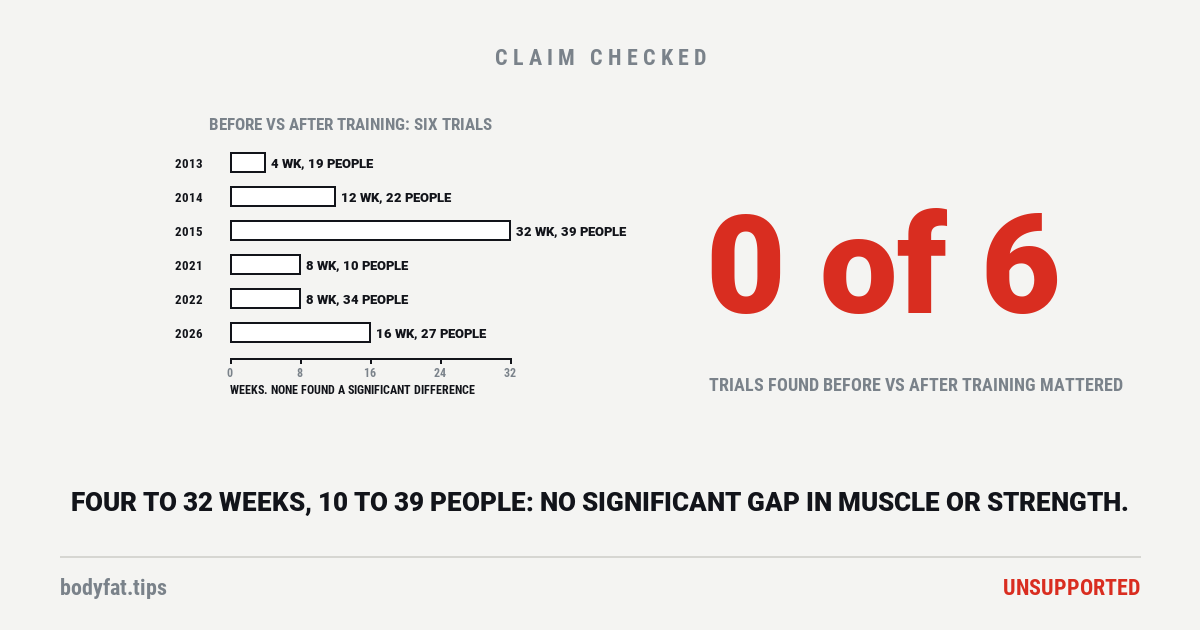
As far as the trials can tell, not the clock. In six randomised trials, where chance decides who gets which version, creatine taken just before training was set against creatine taken just after, for four to 32 weeks, and none found a statistically significant difference in muscle or strength, meaning none found a gap bigger than chance alone could easily produce [2] [3] [4] [5] [6] [7]. Morning against evening was tested once that we found, in 14 women, with the same result [8]. Creatine with sugar has been set against creatine alone in six trials we found that measured performance or muscle: the four that tested one against the other found no significant difference, and two did not report that test in what we could read, one of them the longest, which leans toward the sugar [9] [10] [11] [12] [13] [14] [15]. The place the schedule may matter is rest days, and there the evidence is mostly indirect and points both ways: a European food-safety panel found strength gains in trials that gave creatine daily, and not in the four that gave it only on training days [16], while other trials of training-day creatine split [17] [18] [7]. The one trial we found that set the two schedules against each other has so far reported six people [19].
This is journalism, not medical advice. If you have kidney disease, take advice from a clinician before you take creatine at any time of day; the same goes if you are pregnant or take regular medication. Why creatine can move a kidney blood test is on our creatine safety page.
| Trial | Who finished, and for how long | What it found |
|---|---|---|
| 2013 [2] | 19 men who lift (9 before, 10 after); 4 weeks; no placebo | Fat-free mass up 2.0 lb (0.9 kg) before and 4.4 lb (2.0 kg) after; the difference was not statistically significant |
| 2014 [3] | 22 adults over 50 (11 and 11); 12 weeks; no placebo | Lean tissue, muscle thickness and strength rose in both groups; not significantly different |
| 2015 [4] | 39 adults aged 50 to 71 (15 before, 12 after, 12 placebo); 32 weeks | Both creatine groups gained more strength than placebo; after gained more lean tissue than placebo; before and after not significantly different |
| 2021 [5] | 10 young adults, one side of the body trained each way; 8 weeks | Muscle thickness and strength rose on both sides; not significantly different |
| 2022 [6] | 34 college athletes, 18 men and 16 women (12 before, 11 after, 11 placebo); 8 weeks | No group gained significantly more fat-free mass or strength than another, placebo included |
| 2026 [7] | 27 trained young adults, 12 men and 15 women (10 before, 9 after, 8 placebo); creatine on training days only; 16 weeks | Strength rose in all groups; neither creatine group gained significantly more muscle or strength than placebo; before and after not significantly different |
Is it better to take creatine before or after a workout?
The usual answer, after, traces back to one small trial. In 2013, 19 recreational bodybuilders, all men, took 5 g of creatine either straight before or straight after their workouts for four weeks, 9 before and 10 after, and whenever suited them on rest days [2]. Fat-free mass, everything in the body that is not fat, rose by 2.0 lb (0.9 kg) in the before group and 4.4 lb (2.0 kg) in the after group; the bench press rose by 14.6 and 16.8 lb (6.6 and 7.6 kg) [2]. There was no placebo group, and the paper describes no blinding [2].
Those look like a win for after. By the usual test they were not: “While there were trends, no significant interactions were found”, the authors wrote, which means the gap between the groups was within what chance could produce [2]. The verdict for after came from a second method, magnitude-based inference, which grades how likely a difference is to be worth having; it rated after “possibly” better for fat-free mass [2]. Five years later a statistician tested that method with its own proponents’ simulation code and found that, at the small-to-moderate sample sizes its creators’ calculators recommend, it raises the rate of false positives, findings of an effect that is not there, to two to six times that of the standard test; the paper’s conclusion was that it “should not be used” [20]. The 2013 authors themselves wrote that the difference could have been “the result of a small sample size” [2]. The lead author had been a consultant to the supplement company that provided the creatine [2].
Five more trials ran the same comparison. In 22 adults aged 50 to 64, creatine immediately before or immediately after three sessions a week for 12 weeks produced gains in lean tissue, muscle thickness and strength that were not significantly different [3] [21]. In 10 young adults, 7 men and 3 women, each person trained one side of the body with creatine just before and the other side with creatine just after, on alternate days, for eight weeks; muscle thickness and strength rose on both sides, not significantly differently [5].
The longest ran 32 weeks and added what the 2013 trial lacked, a group that took no creatine. Sixty-four adults aged 50 or over started; 39 finished, aged 50 to 71: 15 taking creatine just before each session, 12 just after and 12 a dummy powder, a placebo [4]. Both creatine groups gained more strength than the placebo group: on the leg press, about 81 lb (36.6 kg) before and about 90 lb (40.8 kg) after, against about 12 lb (5.6 kg) [4]. On muscle the picture split. The after group gained 6.6 lb (3.0 kg) of lean tissue, the scan’s measure of everything that is not fat or bone, significantly more than the placebo group’s 1.1 lb (0.5 kg); the before group’s gain, 4.0 lb (1.8 kg) by a later pooling’s chart, sat between them and was not significantly different from either [4] [17]. In the paper’s own words: “There were no differences between pre- and post-exercise creatine supplementation” [4].
Two details matter for reading that split. The groups were not alike: the after group was 7 men and 5 women, the placebo group 3 men and 9 women, and the after group started with more lean tissue, 102.7 lb (46.6 kg) against 91.9 lb (41.7 kg) [4]. The authors report that the changes were similar in men and women [4]. And 25 of the 64 who started dropped out, citing lack of time [4].
The 2022 trial had a placebo group too: 34 college athletes, 18 men and 16 women, finished eight weeks, 12 taking 5 g of creatine within an hour before training, 11 within an hour after and 11 a placebo [6]. Every dose came with 25 g of whey protein and 25 g of maltodextrin, a starch-based carbohydrate [6]. No group gained significantly more fat-free mass or strength than another, the placebo group included [6]. The authors suggest that the protein and carbohydrate everyone received, and the lack of a loading week, may have made creatine’s own effect harder to see [6].
The newest, published in June 2026, is the trial a Canadian university registered in 2024, and it tested trained young adults against a placebo. Twenty-seven finished, 12 men and 15 women aged 18 to 39: 10 taking 5 g of creatine just before each session, 9 just after and 8 a placebo, on training days only, for 16 weeks [7]. Strength rose in all three groups; neither creatine group gained significantly more muscle or strength than the placebo group, and before and after were not significantly different from each other [7]. The authors say the result should be read with caution: 37 people were randomised where their own calculation called for 17 a group, and they suggest that trained people may need creatine every day, or a loading week, to see a benefit [7]. The creatine was donated by a company that makes it; one author sits on that company’s scientific advisory board and on two other creatine makers’ [7].
Put the first three together and you get the strongest case for after. In 2018 two of the researchers behind the 2014 and 2015 trials pooled those trials with the 2013 one, 68 people taking creatine by our count, and found more lean tissue after training than before [21]. The size of that edge was a standardised mean difference of 0.52, a way of putting results measured in different ways onto one scale, on which 0.2 is small, 0.5 moderate and 0.8 large by the usual rule of thumb [21]. Its confidence interval, the range the true average probably sits in, ran from 0.03 to 1.00, almost touching zero, the point at which there would be no edge [21]. Strength was not significantly different [21]. No single trial made up most of the pooling: the largest share, the 2015 trial’s two creatine groups, was 27 of the 68 people, about 40% by our arithmetic [21].
Then the next three trials found no significant difference in either direction [5] [6] [7]. By 2022 the same two researchers, writing with seven colleagues, concluded that creatine before or after training appears to produce “similar muscle benefits in young and older adults”, and that the research “does not support timed creatine supplementation prescription” [22]. A 2025 review whose authors include the lead author of the 2013 trial called consistent intake “likely the most important variable” [23]. Several of these reviewers sit on creatine makers’ advisory boards or have received creatine for their studies, as their papers declare [22] [23].
Does taking creatine close to your workout matter?
Close to training against far from it is a different question from before against after, and the trial most often quoted for it did not test creatine alone. In 2006, 17 men who lift took a drink of whey protein, glucose and creatine either just before and just after training or in the morning and late evening, for 10 weeks; the close-to-training group gained more lean mass, more strength in two of three lifts, and more creatine in the muscle [24] [22]. Every 100 g of the drink held 40 g of whey, 43 g of glucose and 7 g of creatine [22]. Protein timed around training could explain the result as easily as creatine; there was no group without creatine; and the trial was single-blind rather than double-blind, in which neither the people taking a drink nor the people measuring them know who had which [24] [22].
One small trial asked the question inside each person’s body. In 2004, 11 adults on creatine trained one side of the body on some days and the other side on others, taking creatine after one side’s sessions and a placebo after the other’s, for six weeks; the elbow flexors on the side trained on creatine days thickened more, while the paper reports that all its other measures changed to a similar extent on both sides [25].
And one 2026 pilot tested a single dose on a single day. Eleven men lifted under five conditions a week apart: creatine before, during or after the session, a placebo, or nothing [26]. Creatine before beat the placebo and the no-supplement session on the bench press and the squat, and beat creatine taken during the session on the squat [26]. The title says creatine before enhances strength “More than Ingestion During or After Training”; among the paper’s own comparisons, before against after is not one of the significant differences, on either lift [26]. The no-supplement session also beat the placebo session, which, in our reading, shows how noisy a single day’s lifting is. The authors call their findings “exploratory” and say they should not be applied to everyday supplement use [26].
Should I take creatine before bed or in the morning?
We found one trial that compared morning with evening. Fourteen elite women handball players, seven in each group, took creatine straight after their strength sessions for 12 weeks, one group training in the morning and the other in the evening [8]. Squat strength, jump height and throwing distance improved in both, and the comparison between the groups found no significant difference on any measure studied [8]. There was no placebo group, and because each group took its creatine straight after its own training, the trial cannot separate the time of the creatine from the time of the training [8].
Bedtime against another time of day we could not find tested on muscle at all [9]. The nearest is the 2006 drink study, in which the far-from-training group took its second serving before sleep, with protein and glucose in it [22]. A Turkish university registered a trial in 2025 of 5 g of creatine 30 minutes before sleep, but against a placebo rather than against another time, and it lists no results [9]. So for muscle, we found no comparison of a bedtime dose with any other time, and nothing showing it works better or worse. Whether creatine affects sleep is a separate question, not rated here.
Do you need to take creatine on rest days?
This is the timing question with the most behind it, and the one head-to-head trial we found has so far reported six people [19]. In 2016 the European Food Safety Authority’s nutrition panel assessed whether creatine taken with weight training improves strength in people over 55, on an application from a creatine manufacturer [16]. Of the trials it could draw conclusions from, six gave creatine every day: three showed an effect on strength, two on some measures but not others, and one did not [16]. Four gave creatine only on training days, three times a week, and none of those four showed an effect on strength [16]. The wording the panel put forward begins “daily creatine consumption” [16].
That is a comparison between trials, not within one, and the two sets differ in more than the schedule. All four training-day trials were in men aged 48 to 77 [16]. And by the group sizes and ages the panel lists, two of the four appear to report the same 42 men, which would make them three groups of people rather than four; that reading is ours [16].
A 2021 pooling by researchers who study creatine timing came at it from the other side. In three trials of older adults that gave creatine only on training days, the creatine groups gained 3.8 lb (1.73 kg) more lean tissue than the placebo groups, with a confidence interval of 1.9 to 5.7 lb (0.87 to 2.59 kg), and more strength [17]. About 60% of the weight in that lean-tissue result came from one trial, the 32-week before-and-after trial above, whose placebo group was counted twice, once against each creatine group [17]. The pooling included a trial the European panel did not have, and the panel included two that the pooling did not [16] [17]. Neither held a trial that set training days only against every day, and both looked only at older adults.
Three other trials were in younger people. In 2011, 38 university students, 21 men and 17 women, trained two or three days a week for six weeks, taking creatine only on training days, part of each dose just before and part just after each session, or a placebo; the two creatine groups took the same weekly amount, spread over two or three training days, and spreading it over three days rather than two did not change the result [18]. Both creatine groups’ elbow flexors, the muscles at the front of the upper arm, thickened more than the placebo groups’; strength and muscle thickness rose in every group, and the abstract, the part we read, reports a creatine advantage only for the elbow flexors, one of the four muscle groups measured [18].
The trial the Canadian university registered in 2024 is the 2026 trial above: creatine just before or just after training, on training days only, did not do significantly better than a placebo over 16 weeks in trained young adults [7]. Its registry record lists a fourth group, creatine on non-training days only, which would have put rest days to the test; the paper reports three groups and does not mention the fourth [7] [9].
And one trial has set the two schedules against each other. Researchers in Chile, two of the 2026 trial’s authors among them, randomly assigned trained young adults to 5 g of creatine every day or 5 g on training days only, with 12 weeks of supervised training three times a week [19]. A 2025 conference abstract reports its first six people, three women and three men: the two schedules produced “similar responses”, and the authors warn that the sample is small [19]. Recruitment was still under way; we found no full report and no registry entry for it [9].
So on rest days the evidence points both ways. Training-day creatine did not show a strength gain in the panel’s four trials and did not beat the placebo in the 2026 trial; it beat placebo on lean tissue and strength in the pooling and on one muscle in the 2011 trial; and the only head-to-head comparison we found is six people [16] [7] [17] [18] [19]. The schedule the sports-nutrition position stand describes is a small dose every day [27]. How much, and how slowly the store drains if you stop, is on our dosing page.
What should you take creatine with?
The carbohydrate advice has a real result behind it. In 1996 a lab in Nottingham gave 24 men 5 g of creatine four times a day for five days, half of them followed each time by 93 g of simple sugar; the creatine stored in their muscle rose 60% more in the sugar group, and insulin, the hormone that helps muscle take up sugar and, these studies suggest, creatine, rose sharply [28]. That was 372 g of sugar a day, about 1,490 calories of it, by our arithmetic. Four of the paper’s five authors were the named inventors on a patent for creatine taken with a larger amount of carbohydrate, first filed in Britain in December 1994 and granted in the United States in 1999 [29]. Later work on how much creatine the body keeps with carbohydrate and protein is on our dosing page.
Storing more creatine is not the same as gaining more muscle, and the second is what you are after. We found six trials that set creatine with carbohydrate against creatine alone and measured performance or muscle [9]. The longest, in 1999, gave 24 college football players a carbohydrate placebo, creatine with 1 g of carbohydrate, or creatine with 33 g, four times a day for five days and twice a day after that, through eight weeks of lifting and speed drills [10]. Only the group taking creatine with the larger amount of carbohydrate improved significantly more than the placebo group, on the bench press, the vertical jump, a 100-yard dash and fat-free weight; the creatine-alone group’s changes were not significantly different from the placebo group’s [10]. That pattern leans toward carbohydrate. It is two comparisons with a placebo, though, not a test of one creatine group against the other, and the abstract, the only part we could read, reports no such test [10]. In 10 international-level swimmers loading creatine for four days, with or without about 100 g of sugar after each of five daily doses, both groups swam faster, and by the authors’ analysis the size of the improvement did not differ between them [11]. In a Korean study, 10 elite college rowers each rowed about 1.2 miles (2,000 m) on a rowing machine four times: with nothing, after three days of a carbohydrate supplement, after five days of creatine, and after both; the times were not significantly different [12]. In 25 young men over three weeks, creatine with 70 g of carbohydrate, creatine with a cinnamon extract and creatine alone all improved sprint power and strength, with no significant difference between the groups afterwards; measured within each group, only the carbohydrate group did not improve muscular endurance [13]. In 20 men, 7 on creatine and 6 on creatine with 100 g of sugars after each dose, the sugar group improved on fewer measures, and the difference between the two groups was not statistically significant [14]. The largest, 60 men in 2026, compared each group with its own starting point rather than creatine with carbohydrate against creatine alone; its authors suggest the mix “may enhance” performance compared with creatine alone, and call for “direct inter-group comparisons” to confirm it [15].
A 2024 pooling of 12 creatine trials in adults under 50 asked the same thing across trials. Those in which creatine came with a carbohydrate drink, six by our count of the authors’ open data sheet, did not produce significantly more lean mass, against their own comparison groups, than the five in which it did not; the authors conclude that carbohydrate “did not enhance the hypertrophy benefits of creatine” [30]. That pooling’s main findings are on our creatine benefits page. The sports-nutrition position stand puts the subject in one sentence: carbohydrate “appears to increase muscular uptake of creatine, although the effect on performance measures may not be greater than using creatine monohydrate alone” [27].
So take it with a meal if that is when you will remember it. On these trials, adding sugar for creatine’s sake changes how much creatine your muscle stores, and was not shown to change what you can do with it.
Can I take 5 g of creatine twice a day?
Splitting a day’s creatine into two servings is what a trial on our creatine bloating page found easier on the stomach: one large serving caused more diarrhoea than the same amount taken as two. That trial measured stomachs, not muscle, and how much to take in a day is on our dosing page. None of the timing trials above tested splitting the dose, so they say nothing either way about the gains.
When should women take creatine? Who these trials were done on
The timing trials were small and varied. Men only: the 2013 bodybuilders, the 2006 drink study, the 2026 single-dose pilot and three of the sugar trials [2] [24] [26] [13] [14] [15]. The abstracts of the other three sugar trials, the parts we read, do not say whether the footballers, swimmers and rowers were men or women [10] [11] [12]. Women only: the 14 handball players [8]. Both: the 2014 trial in over-50s, 13 women of 22; the 32-week trial in over-50s, with 22 women among the 39 who finished; the 2022 athletes, 16 women of 34; the 2026 before-and-after trial, 15 women of 27; the 2021 within-person trial, 3 women of 10; the 2011 training-day trial, 17 women of 38; the daily against training-days abstract, 3 women of 6; and the 2004 trial, with women on creatine and on placebo [22] [4] [6] [7] [5] [18] [19] [25]. Of the trials we read in full, the 32-week trial is the one that reports men and women separately, and it found the changes similar [4]; a 2022 review notes that two others made no analysis by sex [22]. Ages ran from teenage swimmers to adults of 71 [11] [4]. None was in people with kidney disease. The four training-day trials the European panel weighed were all in men aged 48 to 77 [16]; the other training-day trials included women and younger adults [17] [18] [7] [19].
So if you are a woman wondering whether the clock matters for you: the before-against-after trials that included women found no significant difference either. What creatine does for women, at any time of day, has its own verdict.
If creatine works by filling a tank, why would the clock matter at all?
This section is the desk’s own reasoning, and it is labelled as such. The trials did not find that the hour matters. Timing still sounds plausible, and the 2018 pooled edge was enough to convince its authors for a while. Here are three ways to fit those together, each rated.
Answer one: the tank fills over weeks, so the hour washes out. On an ordinary diet, muscle creatine stores are already about 60 to 80% full; a small daily dose tops them up over about four weeks, a loading phase does it in five to seven days, and once raised, the stores take four to six weeks to fall back [27]. A store that takes weeks to fill and weeks to drain is unlikely to care whether one day’s 5 g arrived at 7 in the morning or 7 at night. That the store fills and drains slowly is measured; that the hour therefore washes out is our reading.
Answer two: if there is an edge, it is small, and these trials were too small to see it. The six head-to-head trials had between 10 and 39 people finishing [2] [3] [4] [5] [6] [7]. The 2018 pooling’s moderate edge for after came with a range reaching almost to zero [21], and the 32-week trial’s pattern, after ahead of placebo with before in between, is what a small real difference would look like, and also what chance would produce [4]. That the trials are small is measured. That a small edge for after exists is a surmise, with one three-trial pooling on its side and three later trials against it.
Answer three: timing may matter only while the tank is filling. The 2025 reviewers suggest the hour may count most in the early stages, before muscle is saturated [23]. The one trial of a single dose on a single day, with no loading, found creatine before the session ahead of placebo [26]. If that is right, the first week or so is the only place the clock could matter, and a week is short against months of training. That is a hunch, the reviewers’ and ours, with one exploratory trial beside it.
Put the three together and here is what we think is true, stated plainly so you can disagree with it: creatine is a stock, not a dose; keep the shelf full and the clock stops mattering.
What we could not find, and would like to: a trial big enough to detect a small timing edge, say a hundred people or more, that measures muscle creatine directly and compares before, after and far from training, and training days only against every day, over several months. The Canadian trial registered in 2024 planned before, after, non-training days only and a placebo; its 2026 report gives results for three of those groups, from 27 people, and does not mention the fourth [7]. If you know of another, the corrections line on this site is open.
Where “take it straight after your workout” came from
We could not trace who first told lifters to take creatine with a sugary drink, or straight after training. What we can show is the research the advice now leans on, dated. In 1996 the Nottingham sugar study showed carbohydrate pushes more creatine into muscle, from authors who had already filed a patent on the combination [28] [29]. In 2006 a drink of protein, glucose and creatine worked better close to training than far from it [24]. And in 2013 the bodybuilder trial called itself “the first investigation to demonstrate that the timing of creatine intake affects the adaptive response to exercise”, on a difference its own standard test did not find [2].
Researchers then gave the idea its most quotable form. The 2018 three-trial pooling ended with a plain-language summary: “it is recommended to take creatine after training to maximize gains in muscle mass and strength”, adding that the findings rested on a small sample [21]. A 2019 review in the sports-nutrition society’s journal repeated the edge as “potentially greater muscle accretion benefits from post-exercise creatine” [31]. By 2022 the same research group had concluded that before and after appear to produce similar muscle benefits [22].
Not everyone followed them. A sports-nutrition brand’s guide, dated 29 April 2024 and still online, tells readers that after training is “the consensus best time”, that the 2013 trial found “twice the lean muscle” in the after group, and that “A more recent meta-analysis confirmed” it; the link goes to the 2018 brief review [1]. The guide does not say that the 2013 difference was not statistically significant. An online supplement retailer tells readers that fast-acting carbohydrates “such as dextrose and maltodextrin” maximise absorption [1]. And Google’s AI answer, citing among others a hospital system’s blog that calls it “reasonable to assume” creatine is best taken close to a workout, still tells you to take it close to your session [1].
None of this is aimed at anyone who takes creatine after the gym. That is a perfectly good time to take it. So is any other time you will remember tomorrow.
What this is rated, and what the rating covers
Unsupported, of the tested kind — for the claim that when you take creatine, before or after training, morning or night, or with carbohydrate, changes how much muscle and strength you gain.
What was tested: creatine just before against just after training, in six randomised trials of 10 to 39 people finishing, for four to 32 weeks, three of them with a placebo group [2] [3] [4] [5] [6] [7]; morning against evening, in one trial of 14 women [8]; and creatine with carbohydrate against creatine alone, in six trials of four days to eight weeks [10] [11] [12] [13] [14] [15] and in a comparison across the trials of a 2024 pooling [30]. What it found: no trial found a statistically significant difference between before and after; morning and evening were not significantly different; and in the four sugar trials that compared the groups, adding carbohydrate did not significantly change the result, while the longest, whose abstract reports no such comparison, leans toward carbohydrate. Unsupported here does not mean timing has been proven irrelevant. The trials are small, and a small edge could slip past them.
Each part rated alone, in words. That taking creatine after training builds more muscle than taking it before: Unsupported, of the tested kind. Six randomised trials compared the two head to head and none found a significant difference; the one result in its favour, a 2018 pooling of three of them that found a moderate edge in lean tissue and no significant one in strength, was not borne out by the three trials since [21] [5] [6] [7]. That taking it close to training beats taking it hours away: Preliminary, on a trial of a drink of protein, glucose and creatine, and on one muscle of two in a six-week trial [24] [25].
That the time of day matters: Unsupported, of the tested kind, for morning against evening, in one trial [8]; and for bedtime against any other time, Unsupported, of the untested kind: we found no trial, and nothing tested in its favour [9].
That adding carbohydrate builds more muscle or strength: Unsupported, of the tested kind, in four small trials that compared the two directly, all on performance and none longer than three weeks, and a comparison across trials on lean mass [11] [12] [13] [14] [30]. The one eight-week trial with both leans the other way, with only its creatine-and-carbohydrate group ahead of placebo, but that is a difference from placebo in one group, not a test of the two groups against each other, and its abstract reports none [10]. That carbohydrate makes muscle store more creatine: Supported, in short loading studies that used large amounts of sugar [28] [27].
That skipping creatine on rest days costs you gains: Preliminary. The one trial we found that compared the two schedules has reported only its first six people, with similar results [19]. Around it, a regulator’s comparison between trials that gave creatine daily and trials that gave it only on training days, and a 2026 trial in which training-day creatine did not beat placebo, suggest training days alone may not be enough, though the 2022 trial, which gave creatine every day, did not beat placebo either [6]; set against them are a pooling in which training-day creatine still beat placebo and a 2011 trial in which it thickened one muscle more than placebo [16] [7] [17] [18].
What is not rated here: how much creatine to take, on our dosing page; whether it builds muscle at all, on our creatine benefits page; whether it is safe, on our safety page; which form to buy, on our HCl page; whether to cycle on and off; creatine and sleep; and the frame above, which is this desk’s reasoning from the evidence rather than a result the evidence delivered. It is marked as ours so that you can weigh it as ours.
This is journalism, not medical advice. If you have kidney disease, are pregnant or take regular medication, ask a clinician before taking creatine at any time of day. How we read a study, and what each tier means, is set out here.
- Creatine HCl vs Monohydrate: Eight Studies Compared Them, and Only One Put HCl Ahead, on Sprints, Not Muscle
unsupported - How Much Protein Is Too Much? At About Twice the Recommended Amount, for Up to Two Years, Trials Found No Consistent Sign of Damage to Healthy Kidneys
unsupported - Should You Take Calcium Supplements? The Trial That Cut Hip Fractures Was in French Care Homes. At Home, the Best Trials Found No Clear Drop.
unsupported