Does Caffeine Stunt Your Growth? The Warning Was Selling a Coffee Substitute in 1900, and the Tests Since Do Not Back It

“Don’t drink that. It’ll stunt your growth.” Generations of children have heard it across a parent’s coffee cup, and a lot of them now ask for themselves: “do caffeine stunt your growth”, spelled just that way, is searched about 12,100 times a month in the United States (from a paid keyword database, pulled 20 October 2026) [1].
In the three trials we found that set a child’s own caffeine against a dummy drug or drink and measured height or length, and in the one long-term study, the main comparisons were not significant; the largest trial measured its children again at 11. The warning is older than all of them: by 1888 it was in a national magazine, and in 1900 it was helping to sell a coffee substitute. Where the evidence leans the other way, it comes from the very young, mostly at doses per pound several times what a soda delivers, or from places where many children are stunted: babies exposed before birth, newborns on the highest dose in one small trial, toddlers drinking the equivalent of several cups for their size, schoolgirls in Ethiopia, and young rats. Here is all of it, the parts that cut against the reassurance included.
Does caffeine stunt your growth? What the height studies found
Start with the people the warning is aimed at. From 1990 a Pennsylvania study followed 81 white girls from age 12 to 18, collecting three-day food diaries every six months, then yearly, and measuring them as they grew [2]. Their caffeine came mostly from colas and bottled iced teas; fewer than one in ten drank coffee daily by 18. The researchers split them into three groups: 37 girls who averaged 14 mg of caffeine a day, 33 who averaged 35 mg and 11 who averaged 77 mg [2], about two cans of cola by Health Canada’s figures [3].
At 18, the low-caffeine group averaged 5 ft 5.7 in (167 cm) and both other groups 5 ft 5 in (165 cm) [2]. A gap of about 0.8 in sounds like something, but in groups this small, chance alone produces gaps that size easily. The P value, which says how easily chance alone would produce a gap that size, was 0.70; researchers start calling a result “probably not chance” below 0.05 [2]. So the study did not find a clear height cost. It could not rule out a small one either: 11 girls is a small top group, and 77 mg a day is not much caffeine.
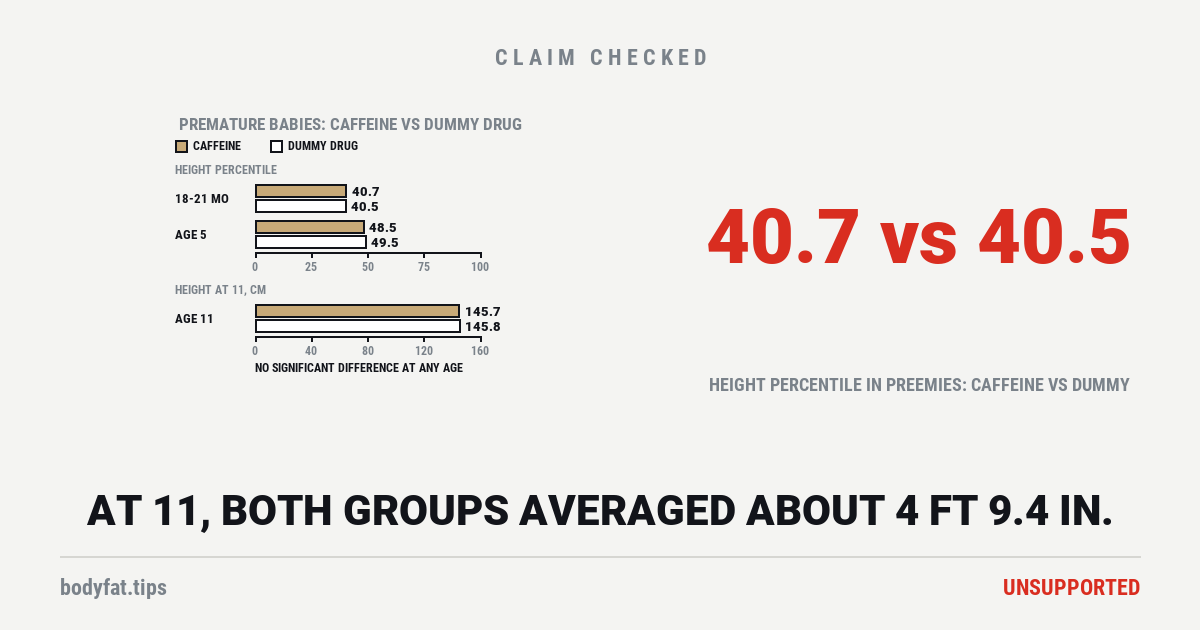
The largest test is a medical one. Caffeine is a standard drug for babies born very early, whose breathing stops and starts, and between 1999 and 2004 a trial in hospitals in North America, Europe, Australia and Israel randomly assigned 2,006 babies born weighing 1.1 to 2.8 lb (500 to 1,250 g) to caffeine or a dummy drug, by chance rather than by choice, given daily until the breathing problem passed [4]. At 18 to 21 months, counted from their due dates, 1,769 of them were measured: 886 given caffeine and 883 given the dummy. The caffeine group’s average height sat at the 40.7th percentile of the US growth charts and the dummy group’s at the 40.5th, a difference that was not significant (P = 0.88) [4]. A percentile says how many children out of 100 of the same age are shorter: at the 40th, 40 are.
Those babies got caffeine as medicine, at 5 mg of caffeine citrate per kilogram of body weight a day and up to 10, for weeks, at the age people grow fastest [4]. Caffeine citrate is half caffeine by weight [5], so that is 2.5 to 5 mg of caffeine per kilogram, by our arithmetic. And a newborn holds on to it: the time the body takes to clear half a dose is 50 to 103 hours in a newborn, against about four hours in an adult, by the European food safety authority’s figures [6]. That is not a teenager with a soda. But it is a randomised test of whether caffeine early in life slows growth, and the trial kept measuring. At 5, among 1,552 children measured, the caffeine group’s average height sat at the 48.5th percentile and the dummy group’s at the 49.5th (P = 0.48) [7]. At 11, in a follow-up at 14 of the hospitals, in Canada, Australia and the UK, with partial data from one in Sweden, 952 children were measured for height, 474 who had been given caffeine and 478 the dummy, and both groups averaged about 4 ft 9.4 in (145.7 cm with caffeine, 145.8 cm with the dummy; P = 0.95) [8]. At no age it measured did the trial find a clear sign on height.
A third trial, smaller and shorter, measured length in babies born only a few weeks early. In New Zealand, 132 of them were randomly assigned to a dummy drug or to one of four daily doses of caffeine citrate, from 5 to 20 mg per kilogram, until their due date [9]. How fast they grew in length did not differ significantly between the dummy drug and any dose. But the babies on the highest dose, 10 mg of caffeine per kilogram a day by our arithmetic, had significantly lower length scores, which compare a baby’s length with the average for its age, at two weeks and at their due date than the babies on the dummy [9]. That group was already a little shorter at birth, before any caffeine: a length score of 0.1, against 0.5 in the dummy group, and a quarter of its mothers, against an eighth in the dummy group, had been thought to have a baby growing too slowly in the womb [9]. At two weeks the two groups’ scores were −0.9 and 0.1, and at the due date −0.8 and 0.0 [9], so about half of the gap at the due date was there at birth, by our arithmetic from the groups’ averages. The authors note that the difference turned up in one dose group and one measure only, and judge it “unlikely that caffeine has a significant impact on overall neonatal growth” [9]. The trial ended at the due date, so it cannot say whether the gap lasted.
The one trial that took coffee away from children pointed the other way, faintly. In Guatemala, where coffee is one of the first drinks many children are given, a trial published in 1997 took 160 toddlers aged 12 to 24 months who drank coffee and showed signs of iron deficiency, and randomly assigned them to keep drinking it or to switch to a hot drink of sugar and colouring for five months [10]. The children were already short: on average more than two standard deviations below the reference for their age, the usual definition of stunting, which means shorter than about 98 in 100 children of that age in the reference.
Across the 139 who finished, 64 who kept their coffee and 75 who switched, the substitute group grew slightly more in length and weight, but not significantly [10]. The researchers then took a second look at the 96 children who had been drinking more than 3.4 fl oz (100 mL) of coffee a day. In them, length gain was 22% greater in the group switched to the substitute, with a P value of 0.07, just the wrong side of the line [10]. Among the anaemic children in that group, who were short of red blood cells, 11 switched and 18 kept their coffee, and weight gain was 46% greater on the substitute, a difference that did pass the line (P below 0.05) [10]. The authors concluded that stopping coffee went with “a modest increase in growth” in toddlers who had been drinking more than 3.4 fl oz a day [10]. That second look was an analysis the authors added after the main result, and the archived copy we read did not include the table of centimetres behind the 22%.
Two details matter. These toddlers took in 6.1 to 11.0 mg of caffeine per kilogram of body weight a day, about 9 on average, which the authors put at 5 to 18 times what American 6- to 10-year-olds took per kilogram; they reckoned 3.4 fl oz a day for a 20 lb (9 kg) toddler matched, per pound of body weight, four or five cups a day for a 132 lb (60 kg) adult [10]. And the children’s food stayed much the same through the switch, judged by how often they ate each kind, and the researchers detected no shift in the milk and juice they drank, so the authors ruled out milk being crowded out and suspected something in the coffee itself. They had no measure of how many calories the children took in [10].
Two school studies in Ethiopia, where coffee and tea are part of many children’s days, compared drinking with stunting, a height far below normal for age. In one town, 100 stunted teenage girls were more likely than 309 classmates who were not stunted to drink coffee or tea right with their meals: 69% against 45% [11]. In another, among 523 schoolchildren, coffee drinkers were not significantly more often stunted once other differences between the children were allowed for, and tea drinkers were less often stunted [12]. The first study’s authors note the disagreement themselves [11]. Both took a snapshot rather than following children over time, so neither can say which came first, and both were in places where stunting is common: 46% of the second study’s children were stunted [12].
| Who | What was compared | What height did |
|---|---|---|
| 81 girls in Pennsylvania, followed from 12 to 18 [2] | Their own caffeine: about 14, 35 or 77 mg a day | At 18: 5 ft 5.7 in, 5 ft 5 in and 5 ft 5 in (167, 165, 165 cm); P = 0.70 |
| 2,006 babies born very early [4] | Caffeine as hospital medicine or a dummy drug, randomly assigned, for weeks | Height percentile at 18 to 21 months: 40.7 against 40.5; P = 0.88. At 5: 48.5 against 49.5; P = 0.48 [7]. At 11: both groups about 4 ft 9.4 in (145.7 and 145.8 cm); P = 0.95 [8] |
| 132 babies born a few weeks early, New Zealand [9] | Caffeine at one of four doses or a dummy drug, randomly assigned, until their due date | Length growth not significantly different at any dose; lower length scores for their age at the highest dose only, in a group already a little shorter at birth |
| 139 iron-deficient toddlers in Guatemala [10] | Kept drinking coffee or switched to sugar and colouring, randomly assigned, for five months | Slightly more growth on the substitute, not significant; in the 96 heavier coffee drinkers, 22% more length gain, P = 0.07, and in the anaemic ones 46% more weight gain, P below 0.05, in a second look the authors added |
| 100 stunted girls and 309 classmates, an Ethiopian town [11] | Coffee or tea drunk right with meals | Commoner among the stunted girls: 69% against 45% |
| 523 schoolchildren, another Ethiopian town [12] | Coffee drinking; tea drinking | Coffee: not linked with stunting once other differences were allowed for. Tea: less stunting |
| 788 and 1,622 American children [13] | Their mothers’ caffeine in early pregnancy, top group against bottom | About 0.6 in (1.5 cm) shorter at 7 in one cohort; a gap reaching 0.9 in (2.2 cm) by 8 in the other |
What about caffeine before birth?
Google’s AI answer to this search does not mention the finding that points most clearly the other way [1]. Two pregnancy cohorts, analysed together by a US government research group in 2022, measured caffeine in mothers’ blood early in pregnancy and followed the children [13]. In 788 children whose mothers were pregnant between 2009 and 2013, with a typical intake under 50 mg a day, those whose mothers were in the top quarter for caffeine were about 0.6 in (1.5 cm) shorter at age 7 than those in the bottom quarter. In 1,622 children whose mothers were pregnant between 1959 and 1965, when a typical mother took about two cups of coffee a day, the gap between the highest and lowest fifths grew from about a quarter of an inch to just under an inch (0.68 to 2.2 cm) between ages 4 and 8 [13].
These are observations, not a trial, and the authors had no data on the fathers’ heights, the mothers’ diets or morning sickness [13]. Two other cohorts point different ways. In 7,857 children in Rotterdam, those whose mothers had taken six or more cups’ worth of caffeine a day in pregnancy, 540 mg or more, were shorter, though the gap narrowed as they grew, and at 6 they only “tended to be shorter” [14]. In an older study of about 500 children whose mothers were interviewed in 1974–75, caffeine in pregnancy was not linked with height among the newborn and infant measures, as its abstract reports it [15]. Nor are they the claim this page rates: they are about caffeine a mother takes before her child is born, not a child’s own coffee. How much caffeine regulators advise in pregnancy is on our caffeine before a workout page.
Does caffeine affect bone density?
This is the version of the claim most explanations rest on: caffeine leaches calcium, the bones come out weaker, and a weaker frame means a shorter adult. In young people it has been tested several ways.
The Pennsylvania girls added about 2 lb (900 g) of bone mineral on average between 12 and 18, and the three caffeine groups did not differ significantly in how much they gained, or in hip density at 18 [2]. Two studies of young women, 145 of college age followed over time and 177 aged 19 to 26 measured once, found caffeine was not a significant predictor of bone gain or density [16] [17]. A 2023 analysis of 2,994 Americans aged 8 to 19 found no significant difference in hip or spine density between those taking the most caffeine, over 43.5 mg a day, and those taking the least [18]. The same paper tried a genetic test, using gene variants that make people drink more coffee, and found no clear link with children’s bone density either; those variants were identified in adults, so it is a weaker test of children’s own drinking than it sounds [18].
The newest review we found, searched to June 2026, rated the direct evidence linking caffeinated energy drinks to young people’s bones as very low, and said any link is better seen as indirect, through crowded-out milk, lost sleep and poorer habits [19].
Soda complicates the picture, and it matters, because cola is where many children get their caffeine. In 460 high-school girls, those who drank carbonated drinks reported more broken bones, and among the physically active the cola drinkers most of all [20]. But in 1,335 Northern Irish 12- and 15-year-olds, soft drinks overall went with lower heel density in girls, and so did the non-cola and the diet ones, while cola was not significantly linked [21]. And in 228 German children followed for four years, caffeine-free soft drinks went with weaker bone measures as well as caffeinated ones, a link the authors traced mainly to lower protein intake [22]. If caffeine were the culprit, why did the caffeine-free drinks look no better? In these studies the drink, not its caffeine, is the better suspect. That is our reading of three observational studies, which cannot settle it. Cola and adult women’s bones are on our diet soda page.
Findings in the other direction come, again, from hospital caffeine, and there are several. In 109 very premature babies in Winnipeg, those given more caffeine for longer were more likely to show thin bones on X-ray: the odds rose by about a tenth for every extra 5 mg per kilogram of total dose [23]. It was a look back through records, the babies averaged about 8 mg per kilogram a day for two months, and its authors cite an earlier study that found no such link [23]. Two later studies lean the way the Winnipeg one did. In 268 premature babies in one hospital in Pakistan, all given caffeine, those on higher daily and total doses were more likely to show weak bones on a blood test [24]; in 42 premature babies, the 22 given caffeine had less bone mineral on a bone scan than the 20 who were not [25]. Our searches found five more hospital studies in which caffeine was used more often, or for longer, in premature babies with weak bones, or, in one of them, with worse ones [26] [27] [28] [29] [30]. A 2022 review that pooled studies of what goes with weak bones in premature babies lists one more, from a Chinese hospital, that found how long and how much caffeine the babies were given among the risk factors; we could not read it [31]. Where that review could pool a factor across studies, the ones that stood out were very low birth weight, being born early, blood infection, longer feeding by drip into a vein, bile backing up in the liver and slow growth in the womb; caffeine was not among the factors it pooled [31]. Allowing for the babies’ other differences is where the five part. In 504 babies born weighing under 3.3 lb (1,500 g) in Chinese hospitals, caffeine went into that analysis and did not stand out; being born before 32 weeks, low blood calcium, poor growth by discharge and blood infection did [26]. In 144 babies at a Turkish hospital, the analysis named anti-seizure drugs, and its summary, which is what we read, does not say whether caffeine was in it [27]. In 413 babies at another Turkish hospital, caffeine was not among the factors its authors analysed together; being a boy, longer feeding by drip into a vein and three or more blood transfusions stood out [28]. A study of 110 babies in India made no such analysis, saying too few of them had the disease [29], and the fifth, of 49 babies who all had weak bones, compared the 7 severe cases with the 42 mild ones [30]. One more study looked at the dose alone: in 152 babies born weighing under 2.2 lb (1 kg), all given caffeine for more than two weeks, a blood marker of weak bones did not differ significantly between higher and lower doses, and the dose did not stand out once other differences were allowed for [32]. None of these studies assigned the caffeine by chance, and where they allowed for how early the babies were born and other differences, they split: the Winnipeg and Pakistani studies above still found more caffeine going with weaker bones [23] [24], and the Chinese multicentre study and the dose study did not [26] [32].
For adults, a 2002 review found “no evidence that caffeine has any harmful effect on bone status” in people getting the recommended calcium [33]. That review was one of four that the caffeine committee of a science institute’s North American branch wanted experts to write, and the institute had them critiqued and edited before they went to the journal, as the issue’s introduction says [34]; by the institute’s own account in 2003, its branches were supported mainly by their industry members [33]. Adult bone has its own pages: calcium supplements and exercise for osteoporosis.
Does caffeine make you lose calcium?
Yes, a little, and mostly for a few hours. In a 2021 trial of 24 adults, 12 chewed caffeine gum, 800 mg over six hours, and 12 a dummy gum; caffeine raised how fast the kidneys cleared calcium by 77% over the nine hours measured [35]. That is a big dose, about six 8 oz cups of brewed coffee by Health Canada’s figure of 135 mg a cup, by our arithmetic [3]. The trial’s authors say a short-term rise like theirs would not be expected to disturb the body’s calcium much, while noting that repeated losses over years might [35].
Measured over whole days, the loss is small. In 170 calcium-balance studies, which add up every milligram of calcium going in and out of the body, in middle-aged women, caffeine went with slightly more calcium lost; raising intake by half above the group’s average predicted 6 mg a day more [36]. A 1995 analysis of 560 such studies in 190 women put it at about 4.6 mg a day for each 6 fl oz cup of coffee, coming from less calcium taken in and absorbed rather than more passed in urine, and said about 40 mg more calcium a day per cup would cover it [37]. A randomised trial gave 16 women on a hospital ward 400 mg of caffeine a day for 19 days and, in a separate period, a dummy, in random order, and found no significant effect on calcium absorbed, in urine or put back into the gut; the net balance dipped, but not significantly [38].
The researcher behind most of that work summed it up in 2002, in the review the industry-supported institute’s caffeine committee had sought [34]: a very small effect on absorption, none on 24-hour urinary calcium, and a loss that “as little as 1-2 tablespoons of milk” would cover [33]. Every one of these calcium studies was in adults, and all but the gum trial in women. None was in children.
Does coffee or soda crowd out milk, and does that cost height?
This is the most sensible version of the worry, and the one Google’s AI answer leans on [1]. It has two links, and only the first is solid.
Link one: children who drink soda drink less milk. In 170 Pennsylvania girls followed from 5 to 15, those already drinking soda at 5 drank less milk, and took in less calcium, for the next ten years [39]. Among the 81 teenage girls, the low-caffeine group drank more milk [2], though, as above, they did not end up with significantly more bone or height.
Link two: that more milk makes children taller. A 2019 review of 13 controlled trials of dairy in children found six with a height gain, one in which the dairy group grew less, and the rest with no significant difference, and called the height evidence “inconclusive”; the extra dairy did add bone mineral [40]. It was published in a supplement sponsored by a Spanish dairy trade body [40]. And in the Guatemalan trial that took coffee away, the toddlers’ foods stayed much the same and their milk and juice did not shift detectably, though nobody counted their calories [10].
Can I have caffeine at 16?
The guidance differs by country, and none of it is about height. The US academy of child and adolescent psychiatrists says there is “no proven safe dose of caffeine for children”, that paediatricians advise against routine caffeine under 12 and against energy drinks for all children and teens, and that they suggest at most 100 mg a day, about two 12 fl oz cans of cola, from 12 to 18 [41]. The effects and risks it lists include sleeplessness, jitteriness and anxiety, lost appetite, needing more to get the same effect, withdrawal, panic and too much sugar [41].
Health Canada sets 2.5 mg per kilogram of body weight a day for everyone under 18, about 147 mg for a 130 lb (59 kg) teenager by our arithmetic, and says the figure is precautionary: healthy older and heavier teenagers, 14 to 18, may handle caffeine much as adults do [3]. The side effects it names are insomnia, irritability, headaches and nervousness. Europe’s food safety authority found too little evidence to set a safe level for children and teenagers and used the adult figure of 3 mg per kilogram as a basis, saying the few studies of anxiety and behaviour in children support it; it added that about 1.4 mg per kilogram may delay sleep and shorten it in some children, especially near bedtime [6]. The US FDA gives no number for children. It passes on the advice that children under 2 avoid caffeinated drinks and the paediatricians’ advice against energy drinks, and lists a faster heart rate, palpitations, high blood pressure, anxiety, sleep and digestive problems and dehydration among the effects of too much in children and teens [42].
None of the four documents bases its advice for children on growth or height. The advice is about sleep, anxiety and the heart, which are better reasons to go easy at 12 than the one in the old warning.
This is journalism, not medical advice. Whether caffeine suits a particular child or teenager, especially one with a heart condition, anxiety or trouble sleeping, and any worry about how a child is growing, belong with their paediatrician.
How does caffeine affect the body?
The short version, from pages where we have done the reading: it does not dehydrate you at ordinary intakes (our dehydration verdict), it costs sleep when taken late and does not make you sleepy while it is working (our sleepiness verdict), it helps a hard workout (our pre-workout verdict), and coffee as a weight-loss drink is rated here. The question about caffeine and a named antidepressant that turns up in the same searches is one for whoever prescribed it.
Who these studies were done on
The 81 Pennsylvania girls were white, from one region, and drank little coffee; there were no boys [2]. The babies in the largest caffeine trial were born very early and got caffeine as hospital medicine, and those in the dosage trial were born a few weeks early [4] [9]. The Guatemalan toddlers were iron-deficient and already short [10], and the Ethiopian children lived where stunting is common [12]. The bone studies were of American, Northern Irish and German young people; the calcium studies were of adults. None of the height studies singled out teenagers drinking several energy drinks a day.
So read yourself against them. If you are a teenager who has a soda or a coffee most days, the Pennsylvania girls are the closest match, and their heights did not differ significantly by caffeine. If you take in a lot more than that, or you are wondering about a toddler’s cup, the evidence here is thinner, and what there is leans less comfortably.
If caffeine doesn’t stunt growth, why do the warning signs come from the very young and the poorly fed?
This section is the desk’s own reasoning, and it is labelled as such. Every finding on this page that leans toward the claim involves the very young, children in places where stunting is common, or both: the pregnancy cohorts, the Guatemalan toddlers, the Ethiopian schoolgirls, the premature babies’ bones, the highest dose in the newborn dosage trial, the young rats. Most also involve big doses for their size. Here are three ways to fit that together, each rated.
Answer one: the dose, per pound. Measured against body weight, the gap between a teenager’s cola and the studies that point toward harm is wide.
| Who or what | Caffeine, mg per kg a day |
|---|---|
| The Pennsylvania girls with the most caffeine [2] | About 1.3 (our arithmetic: 77 mg for a group averaging 132 lb, or 60 kg) |
| Health Canada’s limit for children and teenagers [3] | 2.5 |
| The European food safety authority’s basis for children and teenagers [6] | 3 |
| Premature babies in the caffeine trial [4] | 2.5, up to 5 (given as 5, up to 10, of caffeine citrate, which is half caffeine) |
| Babies born a few weeks early, on the highest dose in a dosage trial [9] | 10 (given as 20 of caffeine citrate) |
| Guatemalan toddlers drinking coffee [10] | 6.1 to 11.0 |
| Rat pups in one laboratory’s studies [43] [44] | 20 to 180 |
The Pennsylvania girls with the most caffeine took about 1.3 mg per kilogram a day, by our arithmetic from their group’s average weight [2]; the Guatemalan toddlers took 6.1 to 11.0 [10]; the rats in one Seoul laboratory’s studies 20 to 180 [43] [44]. The doses are measured. That dose explains the pattern is our surmise, and two findings cut against it. The newer pregnancy cohort found its gap at low intakes, with a typical intake under 50 mg a day [13]. And the biggest trial on this page gave caffeine to the youngest children here to take it themselves, 2.5 to 5 mg per kilogram a day, to newborns who take 50 to 103 hours to clear half a dose, and at 11 the two groups’ heights were within chance of each other [8] [6]. A big dose for their size, early in life, left no height gap that trial could detect.
Answer two: appetite, and food. In the rat studies, young rats given caffeine ate less, and the authors put their slower weight gain mainly down to that [44]; the same laboratory’s other study found food intake fell as the dose rose [43]. The paediatric endocrinologist quoted on the hospital system’s page says stimulants lower appetite a little in children too, though the same doctor adds that this does not translate into a meaningful effect on growth [1]. If caffeine stunts at all, eating less is the obvious route, and it would matter most where food is already short; in the Ethiopian study that linked coffee or tea at meals with stunting, a food-insecure home went with stunting too [11]. That is measured in rats and a hunch in children. One measurement sits near it: in the biggest trial on this page, premature babies given caffeine gained less weight than those on the dummy drug over their first three weeks of it, 0.8 oz (23 g) less at the widest point, after two weeks, and no significantly different amount from four to six weeks [45]; at 11 the two groups’ heights were within chance of each other [8]. The Guatemalan trial does not settle it either way: the toddlers’ food patterns stayed much the same when their coffee was taken away, but nobody measured how many calories they ate, and the authors themselves raised the possibility that caffeine burns energy a child does not make up [10].
Answer three: timing. The earlier the exposure, the more growing there is left to interfere with. In one of the Seoul studies the same caffeine shortened young rats’ leg bones but showed no significant difference in the bones of young adult rats [44]. For people, the university health publisher’s page makes the matching point: most growth happens before most people drink coffee regularly, and girls mostly reach their full height by 15 to 17 [1]. That is measured in rats and a surmise in people, and not every rat study agrees: in another laboratory, young rats given caffeine three days a week grew longer shin bones, though less dense ones, with less calcium in their thigh bones [46]. In people, the youngest children on this page to take caffeine themselves were the newborns in the biggest trial, and at 11 they were not significantly shorter [8].
Put the three together and here is what we think is true, stated plainly so you can disagree with it: the caffeine teenagers usually drink has not been shown to cost them height, and the evidence that leans the other way is about much bigger doses, per pound, in much younger bodies, or about children who are short of food.
What we could not find, and would like to: a study that followed children who take in a lot of caffeine, several coffees or energy drinks a day, from childhood into adulthood and measured how tall they ended up [47]. The Pennsylvania girls are the nearest thing, followed to 18, and their heaviest drinkers averaged 77 mg a day [2]; the premature-baby trial reached 11, with caffeine given only as a newborn’s medicine [8]. If you know of such a study, the corrections line on this site is open.
Where “coffee will stunt your growth” came from
The worry is older than coffee in children’s cups. In 1757 an English essay against tea complained that “Men seem to have lost their stature” [48].
The earliest coffee-and-children version we found is in a magazine. In September 1888 a writer in The North American Review warned that children allowed coffee freely “grow rapidly, but not aright”, and told a ten-year-old boy he would “never be anything but a runt” unless he quit [49]. Newspapers summed it up as “coffee drinking stunts the growth”, in an item that mocked it [50]. Twelve years later a seller made the warning loud. In November 1900 the same long advertisement ran in newspapers from Maine to Utah, headed “First Sixteen Years Determine Structure and Physical Health”. It warned parents against “such drugs, for instance, as coffee, which stunts their growth”, printed a reader’s letter blaming childhood coffee for stunting her own growth, and ended by selling a caffeine-free cereal “coffee” [51]. Its maker was best known for breakfast cereal [52]. A phrase search of the Library of Congress’s digitised newspapers for the advertisement’s words “coffee which stunts”, run on 20 October 2026 for 1900 and 1901, returned 32 pages, and every one carries the advertisement: 19 in November 1900 and 13 in November 1901 [51]. We could not trace who first said coffee stunts children’s growth; the 1888 article is the earliest dated version we found [47].
The advertising kept at it. A 1933 advertisement for the same drink, reproduced in a 2013 magazine article, said coffee “hampers proper development and growth” [52]. By 1944 a newspaper health column was telling readers there was “not the slightest evidence that tea or coffee stunts growth” [53]. The debunking is more than 80 years old.
Later the claim found a scientific-sounding reason. In 1982 a calcium-balance study linked caffeine with slightly more calcium lost [36], and some studies of women past menopause reported more osteoporosis among heavier caffeine drinkers, while others did not [2]. The university health publisher’s page that Google’s AI answer cites traces the stunting myth to just that, the idea that coffee causes osteoporosis [1].
Ask Google today and its AI answer opens “No, caffeine does not stunt your physical growth”, offers lost sleep and crowded-out milk as indirect routes, and gives teenagers a limit of 100 mg a day [1]. It credits that limit partly to the hospital system’s page, which, in the version we read, does not give it; the consumer health site it also cites does [1].
And the commerce has turned around. In 1900 the claim sold a coffee substitute. Today two of the pages the AI answer links are coffee roasters’ blogs telling readers the myth is false, beside the coffee they sell, and the results also include an energy-mint maker’s page headed “Does caffeine stunt growth?” [1]. The roasters are right about height, as far as the studies go. They are not the people to ask how much caffeine a 13-year-old should have.
None of this is aimed at the parents who said it. The warning was sold to earlier generations as fact, loudest by an advertiser, and parents have passed it on ever since to protect their children. The real reasons to go easy on caffeine at 12 are better ones.
What this is rated, and what the rating covers
Unsupported, of the tested kind — for the claim that caffeine in childhood or adolescence stunts growth, leaving people shorter.
It is rated Unsupported because where the claim has been tested it did not hold up. Girls followed to 18 ended up with heights not significantly different by caffeine intake [2]; premature babies randomly given caffeine sat at the same height percentile, within chance, as those given a dummy drug, as toddlers and again at 5, and were the same height, within chance, at 11 [4] [7] [8]; and taking coffee away from Guatemalan toddlers did not significantly change their growth overall [10]. The bone link it rests on was tested too and did not hold up in young people, and in adult women the calcium lost comes to a few milligrams a cup [18] [37].
Most of the tests are small, only the 81 girls were followed into their late teens, the longest trial stops at 11, and the intakes were modest, so a small effect, or an effect of heavy drinking, has not been ruled out. Two results leaned the other way. In the Guatemalan toddlers who drank the most coffee, stopping it went with 22% more length gain, P = 0.07, and in the anaemic ones with 46% more weight gain, which did pass the line, in an analysis added after the main result [10]; and in the newborn dosage trial, the highest dose went with lower length scores, at that dose only, in a group that was already a little shorter at birth [9]. And one of the two Ethiopian snapshot studies found coffee or tea at meals commoner among stunted girls, a link a snapshot cannot turn into a cause [11].
Each part, rated alone, in words. That caffeine raises the calcium in urine, at least for some hours after a large dose: Supported, in adults, by a randomised trial and the older balance studies [35] [36].
That this adds up to a meaningful calcium loss at ordinary intakes: Unsupported, of the tested kind; balance studies in adult women put it at about 4.6 mg a day per cup, covered by about 40 mg of calcium [37] [38] [33].
That caffeine in ordinary drinks lowers bone density in school-age children and teenagers: Unsupported, of the tested kind [2] [18]; two studies of young women found the same [16] [17], and the soft-drink findings do not follow the caffeine [21] [22]. Premature babies given caffeine as medicine are a different case, and there the studies lean the other way, though none of them assigned the caffeine by chance, and they disagree on whether caffeine still stands out once the babies’ other differences are allowed for [23] [24] [25] [26] [32].
That caffeinated drinks cost height by crowding out milk: Preliminary. Soda drinkers do drink less milk [39], but trials of extra dairy are inconclusive for height [40], and in the trial that removed coffee the toddlers’ milk and juice did not shift detectably [10].
That heavy coffee drinking slows growth in toddlers short of iron: Preliminary, on one trial’s second look: without coffee, 22% more length gain (P = 0.07) and, in the anaemic toddlers, 46% more weight gain (P below 0.05) [10]; two Ethiopian school studies disagree with each other [11] [12].
That caffeine in pregnancy goes with shorter children: Preliminary, on observational cohorts that point both ways: two analysed by one research group, with gaps of about 0.6 to 0.9 in by age 7 or 8 [13]; a Dutch one in which children of mothers taking 540 mg or more a day were shorter, a gap that narrowed by 6 [14]; and an older one that found no link with height in infancy [15].
That caffeine stunts growth through lost sleep: not rated. Caffeine can cost some children sleep [6], but no study on this page measured whether that costs height.
What is not rated here: sleep, heart rate and energy drinks as harms in their own right, which are the real reasons for the limits above; adult fracture risk; and the frame above, which is this desk’s reasoning from the evidence rather than a result the evidence delivered. It is marked as ours so that you can weigh it as ours.
This is journalism, not medical advice. A child’s growth, and how much caffeine suits them, belong with their paediatrician. How we read a study, and what each tier means, is set out here.
- Is Palm Oil Bad for You? Against Liquid Oils It Raised LDL About 9 mg/dL in 26 Trials. The Cancer Worry Rests on Animal Studies.
supported - Does Caffeine Dehydrate You? Not at Ordinary Intakes: in Trials, Coffee and Tea Hydrated About as Well as Water. The Extra Urine Shows Up at Big Doses.
unsupported - Does Losing Weight Lower Cholesterol? Mostly the Triglycerides. LDL Fell About 0.6 mg/dL per Pound Lost, and Not on Every Diet.
supported