Does Caffeine Dehydrate You? Not at Ordinary Intakes: in Trials, Coffee and Tea Hydrated About as Well as Water. The Extra Urine Shows Up at Big Doses.

Someone on a biology forum asked it the way most people do: “So why does coffee dehydrate us? What’s going on there?” The thread had about 180 replies when Google listed it in its results for “does caffeine dehydrate you” on 20 October 2026 [1]. The question takes the answer for granted. So do a lot of people: “will caffeine dehydrate you” is searched about 18,100 times a month in the United States (from a paid keyword database, pulled 20 October 2026) [1].
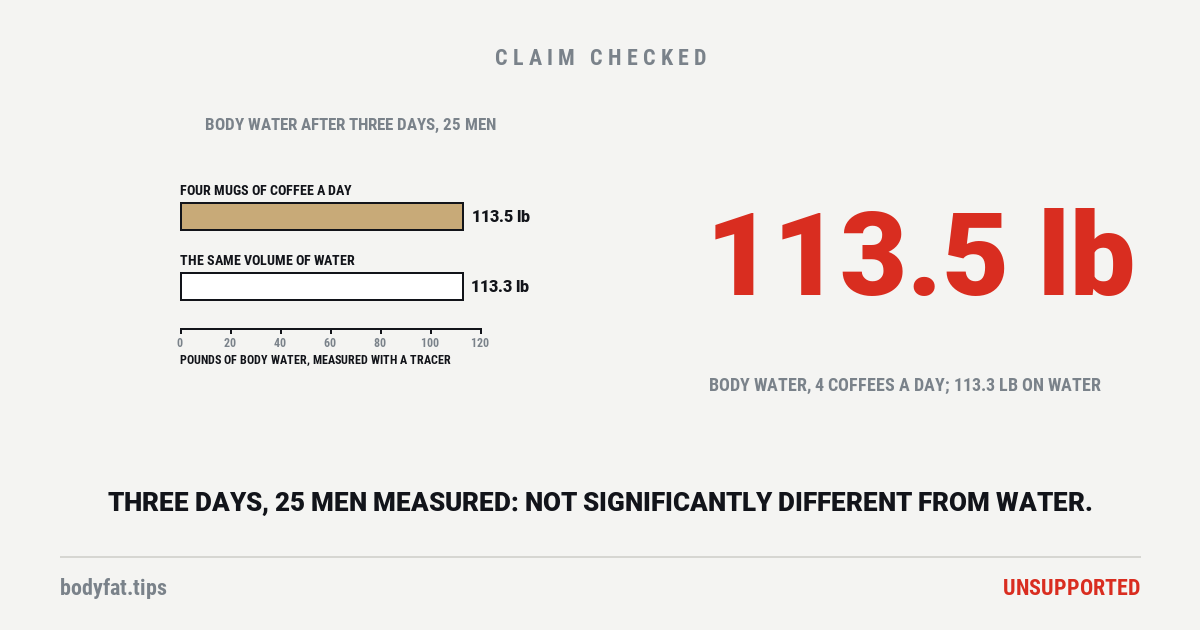
At the amounts people ordinarily drink, caffeinated drinks do not dehydrate you, and they count toward your fluids. Caffeine does make you pass a little more urine for a few hours; the water in the cup covers it. In a 2014 trial, 50 men who already drank coffee had four mugs of it a day for three days, and four mugs of water a day for three more. Their total body water, measured with a tracer in 25 of them, averaged 113.5 lb (51.5 kg) on coffee and 113.3 lb (51.4 kg) on water, not significantly different [2].
Ordinary, on this page, means what the trials gave: a few cups a day, up to about 400 mg of caffeine, a little more in one capsule trial. That is about the amount the FDA cites for most adults as “not generally associated with negative effects”, about two to three 12 fl oz cups of coffee [3]. The exceptions are real, and they sit at the other end: a lot of caffeine at once, especially after days without any. Those are below, with the trials that found them.
This is journalism, not medical advice. If a clinician has told you to limit fluids or caffeine, for heart failure, kidney disease, pregnancy, a heart rhythm problem or anything else, follow that advice, not this page.
Is coffee hydrating or dehydrating?
Start with the trial that measured the thing the claim is about: the water in the body. At a British university, 50 healthy men aged 18 to 46, who habitually drank three to six cups a day, lived through two three-day stretches with their food and fluids set for them [2]. In one they drank four 6.8 fl oz (200 mL) mugs of black instant coffee a day, dosed at 4 mg of caffeine per kilogram of body weight, 308 mg a day on average; in the other, four mugs of water [2]. Everything else they ate and drank was the same in both.
To measure body water the researchers used heavy water, a harmless form of water with a tag on it: drink a known dose, see how diluted it gets, and you know how much water the body holds. That was done in 25 of the men [2]. Body water did not change significantly over either stretch, and the two stretches were not significantly different [2]. Neither was urine over 24 hours, 81.5 fl oz (2,409 mL) a day on coffee and 82.1 fl oz (2,428 mL) on water, nor any of the blood and urine markers of hydration they checked [2].
Two things did move, and they belong here. On coffee the men passed more sodium in their urine, which is what caffeine does to the kidney. And they lost a little weight over each three days, about 0.9 lb (0.39 kg), on coffee and on water alike, which the authors put far short of dehydration [2]. The fences: men only, all of them used to coffee, three days, four cups. The trial was paid for by a not-for-profit coffee research institute whose members are five major European coffee companies, and one of its three authors was employed by a large soft-drink company when it was published [2].
A second team asked a blunter question with a longer menu. At three British universities, 72 men averaging 25 years old drank a litre (about 34 fl oz) of still water in half an hour on one morning, and a litre of three of 12 other drinks on others, then collected every drop of urine for four hours [4]. The measure, which they called the beverage hydration index, is simple: a drink that makes you pass more than water does is holding on to less of itself. Our page on electrolytes explains it in more detail. Coffee, with 212 mg of caffeine in the litre, hot tea with 179 mg, iced tea, cola and diet cola were all not significantly different from water at four hours; only whole milk, skimmed milk and an oral rehydration solution, the salt-and-sugar drink sold for dehydration, did better [4]. Each drink was tried by 15 to 17 of the men [4].
Three years later the same group tested caffeine on its own: 12 young men drank a litre of flavoured water with 0, 50, 200 or 400 mg of caffeine in it, and four hours of urine did not differ significantly between them [5]. Both studies were paid for, the second in part, by a European hydration research foundation whose scientific advisory board the lead author chaired; our electrolytes page records that the foundation’s funding partner was a large soft-drink company [4] [5].
Then the longer runs. In an 11-day trial, 59 young men took caffeine capsules, 3 mg per kilogram of body weight a day for six days; then, in three separate groups, 20 took a dummy capsule, 20 took 3 mg per kilogram and 19 took 6 mg per kilogram for five more days, with no other caffeine. Body weight, urine volume and colour, and blood measures of hydration were not significantly different between the doses on any day checked [6]. And in 30 men who rarely had caffeine, under 100 mg a day, four days at 5 mg per kilogram a day, a dose the authors put at about five espresso cups, did not significantly change total body water, measured with tracers, against four days of a dummy powder [7]. We read both as their abstracts.
| Who | What they drank | How long | What happened |
|---|---|---|---|
| 50 men who already drank coffee [2] | 4 mugs of coffee a day, about 308 mg of caffeine | 3 days | Body water (measured in 25), day-long urine and blood markers not significantly different from water |
| 72 men, 15 to 17 per drink [4] | A litre of coffee (212 mg) or tea (179 mg) at once | 4 hours | Urine not significantly different from water |
| 12 men [5] | A litre with 0, 50, 200 or 400 mg of caffeine | 4 hours | Urine not significantly different between the doses |
| 21 men aged 20 to 54 [8] | 4 or 6 mugs of tea (168 or 252 mg) | 12 hours | Blood and day-long urine not significantly different from water |
| 59 men: 20, 20 and 19 in three dose groups [6] | Capsules, 0, 3 or 6 mg per kilogram a day | 11 days | Weight, urine and blood measures not significantly different between doses |
| 30 men who rarely had caffeine [7] | Capsules, 5 mg per kilogram a day | 4 days | Body water not significantly changed |
| 10 adults who drank 1 to 3 cups a day [9] | One 6.8 fl oz cup with 537 mg | 3 hours | 8.7 fl oz (257 mL) more urine than after water, by our arithmetic: more than the cup held |
| 12 volunteers after 5 days without caffeine [10] | 6 cups of coffee, 642 mg, in place of some water | 1 day | 25.5 fl oz (753 mL) more urine, 1.5 lb (0.7 kg) lighter |
So is caffeine a diuretic or not?
Yes, a mild one, for a few hours. A diuretic is anything that makes the kidneys pass more water. Caffeine does it by blocking adenosine, a signal that helps the kidney pull sodium back out of the urine; less sodium pulled back means more water leaves with it [11]. That is the extra sodium the coffee drinkers passed [2].
How much more water? A 2015 meta-analysis, a study that pools the results of earlier ones, gathered 16 studies and 379 people, 246 men and 133 women, at a median dose of 300 mg [11]. Caffeine raised urine output by 109 mL on average, about 3.7 fl oz, or 16% [11]. As an effect size it came out at 0.29: on the scale where 0.2 is small, 0.5 moderate and 0.8 large, a small effect [11]. Its confidence interval, the range the true average probably sits in, ran from 0.11 to 0.48, so a real effect is likely [11].
Where you are matters. At rest the effect size was 0.54; in people exercising it was 0.10, not statistically significant [11]. By the authors’ analysis, neither the dose nor how long the studies ran explained why the studies’ results differed [11]. Which study counts most? The pooling’s chart prints each of its 28 results with its range but not its weight, so we worked the weights out from those ranges; that is our arithmetic, and it reproduces the pooled 0.29 and its range. No single study dominates. The 11-day trial of 59 men above carries the most, about 16%, through four results: its authors found no significant difference between the doses, but the pooling’s own calculation put one of the four at 0.70, significant on its own, and the other three between −0.11 and 0.28 [11] [6]. Next, at about 12%, is a 2005 study of drinking to recover after exercise in the heat, whose two results leaned, not significantly, toward less urine on caffeine [11]. The authors report no funding; one of the six declares consulting for a company that makes caffeinated chewing gum [11].
Now set that against what is in the cup. Four of the coffee trial’s mugs held 27 fl oz (800 mL) of water and about 308 mg of caffeine [2]. The pooled extra urine, at a median dose of 300 mg, was 3.7 fl oz [11]. By our arithmetic the cups bring about seven times the water the caffeine sends out. The pooled doses came as pills, coffee, tea and cola, so this is a rough comparison, and it is ours.
Can drinking too much caffeine dehydrate you?
For a few hours, yes, it can tip the other way. This is the part of the old warning that has something behind it.
In 2017 a lab in Arkansas and Greece gave 10 adults who drank one to three cups a day, eight men and two women, a single 6.8 fl oz (200 mL) cup on three mornings: water, instant coffee at 3 mg of caffeine per kilogram (269 mg on average), or instant coffee at 6 mg per kilogram (537 mg) [9]. Over the next three hours the strong cup produced 20.7 fl oz (613 mL) of urine, against 12.0 fl oz (356 mL) after water and 10.7 fl oz (316 mL) after the weaker coffee, which was not significantly different from water [9]. The gap between the strong cup and water, 8.7 fl oz (257 mL) by our arithmetic, is more than the cup held. The authors list the limits themselves: ten people, three hours, no collection after that [9]. The study was paid for by the Greek university’s graduate programme; the senior author declares consulting for a lab-testing company and grants from a food company’s research arm, and the first author consulting for a sports-drink company’s science institute [9].
An older German study went bigger and longer. Twelve volunteers gave up caffeine for five days, then spent a day on a set diet with mineral water, and a day on the same amount of fluid with six cups of coffee, 642 mg of caffeine, in place of part of the water [10]. On the coffee day they passed 25.5 fl oz (753 mL) more urine, weighed 1.5 lb (0.7 kg) less, and their body water, estimated by passing a small electrical current through the body, was 2.7% lower [10]. We read it as its abstract.
Not every high-dose test found it. In a trial published in 2022, 25 adults drank 6.8 fl oz (200 mL) of coffee carrying 0, 200 or 400 mg of caffeine, and their urine output in the session was not significantly different between the three: 14.9, 16.0 and 16.5 fl oz (440, 472 and 489 mL) [12]. Its abstract reports measurements over about 70 minutes, much shorter than three hours, and does not say over how long the urine was collected; we read it as its abstract.
Both doses that did it sat above the FDA’s 400 mg a day, one in a single cup, the other in a day after five days without any [3] [9] [10]. The health-library answer from a large US academic medical centre that appears in the same search results puts it the same way: high doses taken all at once may increase urine, more likely if you are not used to caffeine [1].
Do regular coffee drinkers get used to it?
That is the usual explanation, and the evidence for it is uneven. A 2003 review concluded that a large dose, at least 250 to 300 mg, raised urine output for a short time in people who had gone without caffeine for days or weeks; that “a profound tolerance” develops in regular tea and coffee drinkers; and that the caffeine in standard servings of tea, coffee and soft drinks “appear[s] to have no diuretic action” [13]. The idea is old. A 1928 study is titled for tolerance in people to the diuretic effect of caffeine and two related compounds, and the 2014 coffee trial’s authors describe it as suggesting that regular use builds tolerance [14] [2]. We could not read the 1928 paper itself.
A 2005 trial fits the story. Healthy volunteers given caffeine pills, the equivalent of 200 mg twice a day for a 154 lb (70 kg) person, passed more urine on the first day, 67.8 against 55.6 fl oz (2,004 against 1,643 mL), with p = 0.06, just the wrong side of the line researchers use for “probably not chance”, and made more trips to the toilet, 7.8 against 6.4 (p = 0.05). On days two and three there was no significant difference [15].
A 2025 trial does not fit it. People who almost never had caffeine and regular users scored 0.92 and 0.93 on the hydration index after caffeinated energy drinks, not significantly different [16]. There were only nine regular users, most of them light ones, which the authors list as a limit [16]. Neither does a 2020 trial, though it measured something softer: 11 people took 3 mg of caffeine per kilogram a day for 20 days, and the extra urination they reported against a dummy had not gone away after 20 days, rated on a questionnaire rather than measured [17]. So tolerance is plausible, and it has been measured unevenly.
Does tea dehydrate you?
Tea has been tested on its own. In a British trial, 21 men aged 20 to 54 spent four days at rest in a lab, drinking four or six 8.1 fl oz (240 mL) mugs of black tea with a splash of milk, 168 or 252 mg of caffeine, or the same volumes of boiled water, over 12 hours [8]. None of the blood or 24-hour urine measures differed significantly between tea and water [8]. Each mug held about 42 mg of caffeine by the lab’s own measurement [8]. The trial was paid for by a tea advisory panel funded by the UK tea industry’s trade association, and the lead author’s listed affiliation is a nutrition communications firm; the second author’s is the laboratory-services company through whose volunteer panel the men were recruited [8]. In the drinks trial above, hot and iced tea were not significantly different from water either [4].
Does espresso dehydrate you?
None of the trials on this page served espresso. The nearest is the four-day trial whose dose, 5 mg per kilogram a day, its authors put at about five espresso cups: body water was not significantly changed [7]. What espresso changes is the ratio, a lot of caffeine in very little water. The strong cup in the three-hour trial was 537 mg in 6.8 fl oz, and it was the one that sent out more than it brought [9]. The section below on why coffee counts takes that further, and marks where the reasoning is ours.
Does an energy drink dehydrate you?
One of the searches people run asks this of a named energy-drink brand, and a 2025 trial tested that brand’s drink among others [1] [16]. In a university lab in Atlanta, 14 men and 14 women drank a litre in half an hour: either all water, or 16.9 fl oz (500 mL) of one of three energy drinks with water before and after [16]. The two drinks with 280 mg of caffeine and little or no salt or sugar scored 0.86 and 0.91 on the hydration index, meaning more urine than water, and by four hours the first had produced 244 g, about 8.3 fl oz, more urine than the third [16]. The third, with 106 mg of caffeine plus salt and sugar, was not significantly different from water [16].
Look at who paid. The trial was funded by the company that makes the third drink, which is owned by a large consumer-goods group. The paper thanks the company’s principal scientist “for conceptualizing and reviewing the manuscript”, and says the sponsor had no role in carrying out the study or interpreting the data, a statement that does not mention the design or the writing. The lead author also declares past research funding and consulting fees from a large soft-drink company [16]. The same lab’s 2026 follow-up, paid for by the same company, tested a patent-pending sugar-free caffeinated electrolyte drink, then not on sale, with 210 mg of caffeine in a litre; the paper does not say whose drink it was. After more urine in the first hour, it was not significantly different from water from two hours on [18].
An older trial pointed the same way as the first two drinks. Twelve men who had gone 12 hours without fluid drank 25.4 fl oz (750 mL) of an energy drink with 240 mg of caffeine, or versions lacking its caffeine, its taurine or both; over six hours the caffeine added 8.2 fl oz (243 mL) of urine [19]. We read it as its abstract.
What about caffeine during exercise or in the heat?
This is where the warning has been loudest. In the 2015 pooling, the effect during exercise was an effect size of 0.10, not statistically significant, and the authors put that down to exercise itself turning the kidneys down [11]. In a 2009 trial, seven trained cyclists rode for two hours in dry heat of 97°F (36°C), with and without 6 mg of caffeine per kilogram beforehand: caffeine raised urine flow by 28% and the salt lost in sweat by about 14%, which the authors judged “not enough to affect dehydration or blood electrolyte levels” over that ride [20]. In 2004, ten athletes, seven of them women, rehydrated between twice-a-day practices in mild heat for three days with a caffeinated cola or the same brand’s caffeine-free version; the only difference found was urine colour at one time point [21]. We read both as their abstracts.
Two newer results point the other way, and a third points the same way as the older ones. In a 2025 trial in Taiwan, 14 male bodybuilders chewed caffeinated gum, 3 mg of caffeine per kilogram, or a dummy gum, then cycled in a room held at 86°F (30°C) until they had lost 2% of their body weight, the way they cut weight before a contest [22]. On caffeine they passed more urine during the ride and reached the 2% sooner. They also set their own pace, rated the work as easier on caffeine and did not burn significantly more energy, so the faster loss may not all be urine; the trial did not measure sweat [22]. And a 2026 pooling of side effects in caffeine trials in athletes, searched to July 2025, found that athletes on caffeine were more likely than on a dummy to report passing more urine, across 31 trials and 493 athletes, on the day of the test or the next day rather than during the exercise, and more likely still at higher doses. Those are the athletes’ own reports of urination, not measured urine or body water [23]. The third, from 2023, had people in Japan sweat off about 1% of their body weight with stepping exercise and then drink back the same volume of plain water, green tea or water with caffeine added. Two hours later they had held on to about the same share of each, 52.2%, 51.0% and 47.9%, differences the authors found not significant, and their urine output did not differ significantly either. A green-tea company paid for it in part and employed one of its authors [24].
Who these studies were done on
Mostly young and middle-aged men. The three-day coffee trial, the tea trial, the two capsule trials and the two four-hour drink tests from Britain were all of men, aged 18 to 54 at the widest where ages were given [2] [8] [6] [7] [4] [5]. Women appear in the smaller trials: two of the ten in the strong-coffee trial, seven of the ten athletes in the heat-practice trial, half of the 2025 energy-drink trial [9] [21] [16], and the three studies of older people below, which were all or mostly women.
Women are where the evidence disagrees with itself. In the 2015 pooling the effect in women was an effect size of 0.75, against 0.13 in men, which was not statistically significant; but the women’s figure rests on three results [11]. By our arithmetic from the pooling’s chart, about 58% of the weight behind that 0.75 is one study, which gave 37 women aged 31 to 78 a dose of 6 mg per kilogram of lean body mass and measured their urine for the next two hours, when it rose [11] [25]. The other two results come from one study of young women [11]. The 2025 energy-drink trial found the reverse: women held on to more of the caffeinated drinks than men did [16]. We rate the sex difference below as not settled.
People over 65 are the gap, and they matter here, because thirst gets less reliable with age, as our page on how much water to drink sets out. A 2025 Swedish experiment came closest: 26 adults aged 35 to 70, most of them women, drank 13.5 fl oz (400 mL) of coffee, and their copeptin, a blood marker for the hormone the body uses to hold on to water, fell by up to 27% over four hours [26]. Copeptin rises when the body is short of water, so a fall points the other way. But a sip of water, the control, lowered it slightly too; the authors could not tell whether the coffee or simply its water did it; and they stopped recruiting early because of frequent stomach side effects [26]. We found no published trial in people over 65 that compared a day or more of coffee or tea with water and measured body water or fluid balance [27]. The European clinical-nutrition society’s 2019 guideline for older people does not wait for one: it recommends offering older people a range of hydrating drinks, coffee and tea among them, says the research on which drinks hydrate was done in younger adults and “does not appear to have been carried out in older adults”, and sees “little reason to believe that these findings would not apply” to them [28]. That is a guideline’s judgement, not a trial. Two registered trials set out to collect measures of that kind in groups that included older people, and have not reported them. The Swedish study’s registry record describes, besides the four-hour test, a week with an extra litre of coffee a day, set against a week with three extra litres of water and a week of usual drinking, with the concentration of blood and urine measured after each; the water and usual weeks were published in 2019, and we found no report of the coffee week [26]. And a California trial gave 81 women past menopause caffeine pills, 200 or 400 mg a day, or dummy pills, for a week each; its registry plans, in every week, two 24-hour urine collections and two readings on a body-composition scale that it names as its measure of hydration, and the one paper from it, on the 56 women aged 58 to 84 who finished, reports anxiety, depression, sleep and stress [29].
None of the trials on this page included children or pregnant women. The FDA lists dehydration among the effects of too much caffeine in children and teens [3]. How much caffeine regulators advise in pregnancy is on our caffeine before a workout page.
If caffeine makes you pee more, how can coffee still count?
This section is the desk’s own reasoning, and it is labelled as such. Caffeine raises urine output. Coffee still did about as well as water on body water. Both are measured. Here are three ways to fit them together, each rated.
Answer one: the cup brings more water than the caffeine sends out. Four mugs carried 27 fl oz of water and about 308 mg of caffeine [2]; the pooled extra urine at about that dose was 3.7 fl oz [11]. That is arithmetic, not a measurement: two measured figures from different studies, set side by side by us.
Answer two: the extra comes early, and the day evens it out. In the pill trial, urine on the first day was higher by a margin just short of significance (p = 0.06), and on days two and three there was no significant difference [15]. In the 2026 energy-drink trial it showed in the first hour and not from two hours on [18], and in the coffee trial urine over 24 hours was not significantly different from water [2]. That the extra is front-loaded is measured in short tests; that a normal day evens it out is a surmise with one three-day trial beside it.
Answer three: concentration decides when the toll outgrows the cup. The 537 mg cup of 6.8 fl oz sent out more than it brought [9]; 400 mg spread through a litre made no significant difference to urine [5]. But 400 mg in 6.8 fl oz did not show it in a shorter session [12]. So this is a surmise from two small trials, with a shorter one against it.
Put the three together and here is what we think is true, stated plainly so you can disagree with it: a caffeinated drink counts as water, minus a small toll that only outgrows the cup when a lot of caffeine comes in a little liquid, or after days without any.
What we could not find, and would like to: a published trial in people over 65, whose thirst and kidneys work differently, that compared their usual coffee or tea with the same volume of water over several days and measured body water. The nearest are two registered trials whose results on it are unpublished: the Swedish study, which took adults up to 70 and whose registered week of extra coffee has not been reported, and the California trial of caffeine pills in women aged 58 to 84, whose planned 24-hour urine collections have not been published [26] [29] [27]. If you know of a report of either, or of another trial, the corrections line on this site is open.
Where “coffee doesn’t count” came from
We could not trace who first said that caffeinated drinks do not count toward your fluids. What we can show is how the idea grew, dated. The kidney effect is old pharmacology: the 1928 study above is titled for the diuretic effect of caffeine in people, and for tolerance to it [14].
The rider arrived in professional advice. In 1999 a review in the journal of the main US dietitians’ association told its readers that the average sedentary man must consume at least 12 cups (2,900 mL) of fluid a day and the average woman 9 cups (2,200 mL), “in the form of noncaffeinated, nonalcoholic beverages, soups, and foods”, and listed “the natural diuretics caffeine and alcohol” among the things that may make chronic mild dehydration more likely [30]. In 2007 a sports-science review opened by saying that dietitians, exercise physiologists and athletic trainers commonly told exercising adults to avoid caffeine because it is a diuretic [31]. In 2011 the tea trial’s authors reported that British food-safety and nursing advice still suggested drinking water alongside tea and coffee [8]. The eight-glasses rule picked up the same rider, as our water page shows.
Then it was headlined. In September 2017 the university behind the three-hour trial put out a release titled “Research on Coffee Consumption Shows Adverse Effect on Fluid Balance”, saying that habitual drinkers “who drink more than two cups of strong coffee could experience caffeine-induced diuresis” [32]. The trial had given its high dose in one 6.8 fl oz cup, to ten people, and measured three hours [9]. Today the question itself is the spread: the forum thread, and related searches about espresso, tea, muscles and skin [1].
And it sells, mostly by reassuring. In the results for the question on 20 October 2026: a smart-water-bottle seller says coffee is not dehydrating, then advises a “1:1 rule”, an equal amount of water for every cup of coffee; an electrolyte-powder brand says coffee is not to blame and that “75 percent of people” are dehydrated, likely from an electrolyte imbalance, a figure whose only link goes to the brand’s own page; a sweat-patch hydration sensor company; and a gummy maker selling a hydration gummy [1]. The worry has moved from the coffee to the bottle.
None of this is aimed at anyone who has poured a glass of water to make up for a coffee. It does no harm. At ordinary intakes it is just not needed, and some of the people telling you it is are selling the glass.
What this is rated, and what the rating covers
Unsupported, of the tested kind — for the claim that coffee, tea and other caffeinated drinks dehydrate you, so they don’t count toward your fluids, at the intakes people ordinarily drink. Big doses at once are rated separately below.
What was tested: coffee, tea, colas and caffeine capsules against water or a dummy, up to 6 mg of caffeine per kilogram a day, about 450 mg for a 165 lb (75 kg) person by our arithmetic, in trials lasting four hours to 11 days, with body water measured directly in two of them [2] [7] [6] [8] [4] [5]. What it found: no significant difference from water in body water, in urine over the day or in blood markers of hydration. Unsupported here does not mean coffee beats water, or that the question is closed for older adults, children or pregnancy, which these trials did not include; the longest of them ran 11 days [6] [27].
Each of the other claims on this page, rated alone, in words. That caffeine makes you pass more urine for a few hours: Supported, by a pooling of 16 studies that found a small rise, larger at rest [11], and by single trials at high doses [9] [10]. That coffee and tea count toward your daily fluids about as well as water: Supported, by small trials in men, from four hours to three days, several of them paid for by coffee, tea or drinks interests [2] [8] [4].
That a large dose at once, around 500 mg or more, or a heavy day after days without caffeine, leaves you short of fluid for a few hours: Preliminary, on two small trials of 10 and 12 people, with a shorter trial at 400 mg finding no significant difference, and the 2015 pooling, searched to 2013, finding no clear link between the dose and measured urine; a 2026 pooling of athletes’ own reports did find extra urination reported more often at higher doses [9] [10] [12] [11] [23]. That regular drinkers become tolerant to the effect: Preliminary, on a review’s reading of older studies and one pill trial, against a 2025 trial that found no significant difference between regular and rare users, and a 2020 trial in which reported urination had not faded after 20 days [13] [15] [16] [17].
That caffeinated energy drinks low in salt and sugar make you pass more urine than water over a few hours: Preliminary, on two small trials, one of them paid for by the maker of a competing drink [16] [19]. That women are more affected than men: Preliminary, on a subgroup of three results that a 2025 trial contradicted [11] [16].
That caffeine dehydrates you during exercise or in the heat: Preliminary. The 2015 pooling’s exercise results, searched to 2013, found no significant rise in urine; of two small trials in heat, one found 28% more urine flow and judged it too little to affect dehydration, and the other found a difference only in urine colour at one point; a 2025 trial in 14 bodybuilders found more urine and a faster 2% loss of body weight on caffeine, at a pace they chose themselves; a 2026 pooling found athletes on caffeine more often reported passing more urine later that day or the next, which is their report, not a measurement of fluid lost during exercise; and a 2023 trial found caffeinated water and green tea held on to about as well as plain water after a sweat. Small trials and self-reports, pointing both ways [11] [20] [21] [22] [23] [24].
What is not rated here: whether caffeine dries out your skin or “dehydrates your muscles”, which people also search and none of the trials on this page measured; whether caffeine interacts with an antidepressant named in the same searches, which is a question for whoever prescribed it; alcohol; whether coffee helps with weight loss or drinking water does, which have their own verdicts; and the frame above, which is this desk’s reasoning from the evidence rather than a result the evidence delivered. It is marked as ours so that you can weigh it as ours.
This is journalism, not medical advice. If a clinician has told you to limit fluids or caffeine, follow that advice; if you are older, pregnant or caring for a child, the trials here were not about you. How we read a study, and what each tier means, is set out here.
- Does Losing Weight Lower Cholesterol? Mostly the Triglycerides. LDL Fell About 0.6 mg/dL per Pound Lost, and Not on Every Diet.
supported - Foods That Lower Cholesterol Do Lower It, Mostly by Single Digits. The Diet Said to Match a Statin Fell Short of a Low Dose, With the Food Delivered.
established - Is Fruit Sugar Bad for You? Told to Eat More Fruit or Less, People With Type 2 Diabetes Showed No Clear Difference in Blood Sugar.
supported