Does Losing Weight Lower Cholesterol? Mostly the Triglycerides. LDL Fell About 0.6 mg/dL per Pound Lost, and Not on Every Diet.

“Shedding excess pounds can significantly lower cholesterol levels.” That line sits under a 50-second short called “How To Lower Your Cholesterol”, posted on 27 October 2023 by a physicians’ explainer channel run by two orthopaedic surgeons, with guest specialists. It had 1,968,915 views when we read its numbers on 10 October 2026 [1].
We read the description, not the video, so what is said on camera is not what this page checks. The description lists five steps, with weight loss fourth, and ends that step with “Aim for a healthy weight through a balanced diet and regular exercise” [1]. It is a question plenty of people ask outright: “does losing weight lower cholesterol” is searched about 2,900 times a month in the United States (from a paid keyword database, pulled 10 October 2026) [2].
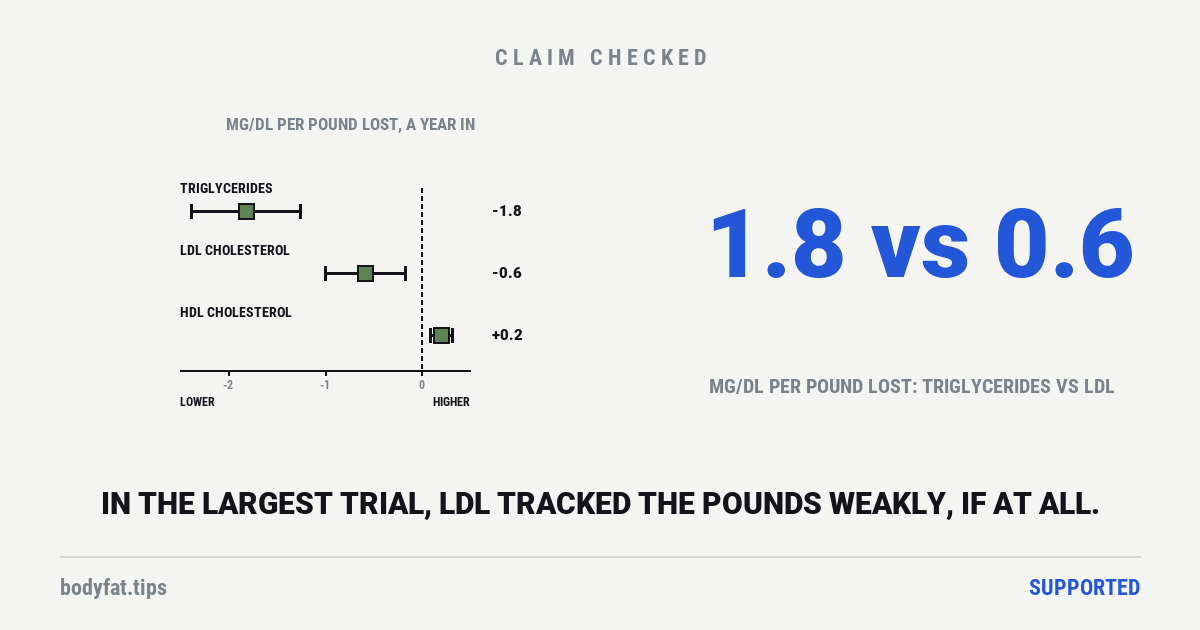
Yes, but most of the change is in the triglycerides, not the LDL. Pool 30 trials of diet, exercise or both, and a year in, each pound lost went with triglycerides about 1.8 mg/dL lower and LDL about 0.6 mg/dL lower [3]. HDL was a little higher too, about 0.2 mg/dL per pound, at six months as well as at a year [3]; an older pooling of 70 dieting studies found it lower in people measured while they were still losing [4]. And in the largest trial of weight loss by diet and activity, how much LDL fell was linked only weakly, if at all, to how much weight people lost, including among people not taking cholesterol drugs [5].
A cholesterol test reports four numbers, and they do not all move together. LDL is the cholesterol that cholesterol guidelines and drugs mainly target. HDL is the kind often called good cholesterol. Triglycerides are a type of fat carried in the blood, measured on the same test. Total cholesterol is all the cholesterol in the blood added together, LDL, HDL and the rest; triglycerides are counted separately. All four are reported in mg/dL, milligrams per decilitre, the unit on an American lab report.
How much does losing weight lower cholesterol?
The firmest per-pound figures come from a 2020 pooling, a meta-analysis that combines trials to get one estimate, done to inform a guideline of the Endocrine Society. It gathered 73 randomised trials and 32,496 people with overweight or obesity, lasting six months or more, that tested diet and exercise, weight-loss drugs or surgery, and asked how much each number on the test moved for every kilogram (2.2 lb) lost [3].
For diet, exercise or both, in 30 trials and 2,434 people, a year in: triglycerides were 4.0 mg/dL lower for every kilogram lost, LDL 1.28 lower, total cholesterol 1.66 lower and HDL 0.46 higher [3]. Per pound, that is about 1.8, 0.6, 0.75 and 0.2 mg/dL, by our conversion. The confidence interval, the range the true average probably sits in, ran from about 1.3 to 2.4 mg/dL per pound for triglycerides and from about 0.2 to 1.0 for LDL, again our conversion of the paper’s figures [3]. Those are ranges for an average across trials, not a forecast for any one person.
| How the weight came off | Triglycerides | LDL cholesterol | HDL cholesterol |
|---|---|---|---|
| Diet, exercise or both: 30 trials, 2,434 people [3] | 1.8 lower (4.0 per kg) | 0.6 lower (1.28 per kg) | 0.2 higher (0.46 per kg) |
| Weight-loss drugs: 35 trials, 16,333 people [3] | 0.6 lower (1.25 per kg); range includes no difference | 0.8 lower (1.67 per kg) | 0.2 higher (0.37 per kg) |
| Weight-loss surgery: 8 trials, 377 people [3] | 1.1 lower (2.47 per kg) | 0.15 lower (0.33 per kg); range includes no difference | 0.2 higher (0.42 per kg) |
Three things to know before leaning on those numbers. At six months the LDL figure was 0.35 mg/dL per kilogram with a range that reached zero, so no difference at all was still possible; the paper’s own discussion calls it “nonsignificant” and says the results stayed significant at a year “except for LDL”, while its table’s range for the one-year LDL figure stays clear of zero [3]. Its conclusion settles on “more modest changes in LDL-C” [3].
Second, most of the diet trials in its list compared one weight-loss diet with another, low-carbohydrate against low-fat, by our reading of that list, and the per-kilogram figures compare whole trials, not people [3]. The authors flag both: the link is measured study by study, and the lipid changes “may be due to other aspects of the intervention than weight loss” [3]. Third, before printing a pooled figure we look for the biggest study inside it. The largest diet-and-exercise trial in the list had 419 people, about one in six of the 2,434, by our arithmetic, so no single trial carries the result [3].
The US guidelines say the same in plain words. The 2013 obesity guideline’s evidence review found triglycerides at least 15 mg/dL lower after about 7 lb (3 kg) lost, and LDL about 5 mg/dL lower and HDL 2 to 3 mg/dL higher after 11 to 18 lb (5 to 8 kg) [6]. The 2026 cholesterol guideline says weight reduction brings “greater reductions in TG levels”, about 1.3 to 4.0 mg/dL per kilogram, and “only modest LDL-C lowering”, about 0.3 to 1.7 [7]. By our matching, the ends of both ranges are the 2020 pooling’s figures for drugs, surgery and diet [3], so the two are not independent of each other. The same guideline adds that lipids are “rarely the primary outcomes” of weight-loss trials, and that “it is difficult to isolate the exact impact of weight loss, dietary composition changes, and physical activity” [7].
Does losing weight lower cholesterol and triglycerides?
Triglycerides most of all. The largest trial of weight loss by diet and activity, Look AHEAD, enrolled 5,145 American adults with type 2 diabetes and overweight or obesity [8]. An analysis of all of them after a year found that the more weight people had lost, the more their triglycerides and HDL had improved; LDL was the exception, with a P value of 0.79, nowhere near the line researchers use for “probably not chance” [5]. Among people not taking cholesterol drugs the link with LDL was statistically clear but weak, a correlation of 0.06 on a scale where 0 is no link and 1 a perfect one; grouped by how much they lost, though, their LDL improvement did not differ clearly between the groups [5]. People who lost 5 to under 10% of their weight, about 16 lb (7.25 kg) on average, had 2.2 times the odds of a 40 mg/dL fall in triglycerides compared with people whose weight held steady, with a range from 1.71 to 2.83 [5].
The 2026 cholesterol guideline puts the general figure at a 20 to 30% fall in triglycerides for a 5 to 10% weight loss [7]. It also describes the cholesterol test typical of obesity as “elevated TG, reduced HDL-C, and increased small cholesterol-depleted LDL particles” [7]. Hold on to that description; the section below on why LDL moves so little comes back to it.
What happens to HDL while you are losing weight?
In the randomised trials, it went up. In the 2020 pooling’s 30 diet-and-exercise trials, HDL was 0.46 mg/dL higher for every kilogram lost when it was measured at six months, the same figure as at a year [3]. A different kind of evidence found a dip. A 1992 pooling of 70 studies of weight loss by dieting found HDL about 0.27 mg/dL lower for every kilogram lost while people were still losing (0.007 mmol/L), and about 0.35 mg/dL higher per kilogram once their weight had settled at the new level (0.009 mmol/L); the mg/dL figures are our conversion [4]. We read that study as its abstract, which does not say how many of the 70 were randomised trials, and its dip is in people measured during the losing itself, while the 2020 pooling measured randomised trials at six months and a year. So a lower HDL in the middle of a diet is possible, and is what the older pooling found during the losing; by six months, the diet-and-exercise trials found HDL up.
Once weight held, the gain lasted in Look AHEAD. Averaged over four years, HDL rose 3.67 mg/dL in the group given the weight-loss programme against 1.97 mg/dL in the comparison group, and the gap was as large at year four as at year one [9]. What exercise does to HDL, with or without weight loss, is on our HDL verdict.
Does the way you lose it matter?
For LDL, more than the pounds do. The clearest test is DIETFITS: 609 American adults aged 18 to 50 without diabetes, 305 assigned a healthy low-fat diet and 304 a healthy low-carbohydrate diet, for a year [10]. They lost 11.7 lb (5.3 kg) and 13.2 lb (6.0 kg), a difference within chance [10]. LDL went down 2.1 mg/dL on the low-fat diet, with a range that crossed zero, and up 3.6 mg/dL on the low-carbohydrate diet [10]. Triglycerides fell 10 and 28 mg/dL; HDL rose 0.4 and 2.6 mg/dL [10]. At a year, saturated fat was 9.0% of calories on the low-fat diet and 14.5% on the low-carbohydrate one [10]. Similar weight lost; LDL moving in opposite directions.
A 2020 pooling of 38 trials and 6,499 adults, DIETFITS among them, found the same split. At six to twelve months, low-carbohydrate diets took off 2.9 lb (1.30 kg) more than low-fat diets, with triglycerides 8.9 mg/dL (0.10 mmol/L) lower and HDL 1.9 mg/dL (0.05 mmol/L) higher, and LDL 2.7 mg/dL (0.07 mmol/L) higher [11]. Two of its studies ran past a year, and there the differences were not clear [11]. Its largest trial enrolled 811 people, of whose four diet groups the pooling used three, and its next largest is DIETFITS itself [11], so the pooling is not wholly a separate check on the trial above.
The nearest test of the pounds alone gave both groups the same kind of diet. In the first-year report of PREDIMED-Plus, on 626 Spanish adults aged 55 to 75 with overweight and the metabolic syndrome, a cluster of a large waist, raised blood pressure, blood sugar and blood fats, both groups ate a Mediterranean diet with free olive oil and nuts; 327 were also asked to cut calories, coached to move more and given behavioural support, and 299 were not [12]. The first group lost 7.1 lb (3.2 kg), the second 1.5 lb (0.7 kg). Triglycerides and HDL improved more in the first group, while total and LDL cholesterol fell in both groups “without between-group differences” [12]. The pounds were not the only difference, though: the first group also kept more closely to the diet, on 10 of 17 measures, ate fewer calories and moved more [12]. It is an early report on 626 of the trial’s people [12].
The 2026 guideline gives the diet side its own line: mostly plant-based eating patterns have the strongest evidence for lowering LDL, lower-carbohydrate patterns go with more weight and triglyceride loss, and on ketogenic diets “LDL-C can be increased substantially in some individuals” [7]. Our carnivore diet verdict looks at what happened to LDL on an all-meat diet, and our saturated fat verdict at the fat the guideline steers people away from.
Surgery takes off the most weight and, per pound, moved LDL the least. In the 2020 pooling’s 8 surgery trials and 377 people, LDL was 0.15 mg/dL lower per pound lost (0.33 per kg), with a range that reached zero, while triglycerides were 1.1 mg/dL lower per pound (2.47 per kg) [3]. The 2013 guideline, on surgery that took off 20 to 35% of body weight, found triglycerides lower and HDL higher but “changes in total cholesterol or LDL levels are inconsistent”, and graded that evidence low [6]. A 2026 pooling of surgery and drug trials split the operations: gastric bypass, and biliopancreatic diversion, an operation that bypasses more of the gut, lowered LDL more than the comparison groups did, while the sleeve operation, which removes most of the stomach, did not clearly do so [13]. Read that comparison with care. The pooling labels every comparison group as lifestyle change, but its two longest surgery trials, in Rome and in Cleveland, were in people with type 2 diabetes and set surgery against medical treatment for the diabetes; it counts each of them several times, at later follow-ups; and its only evidence on biliopancreatic diversion is the Rome trial’s 20 people given that operation [13]. Observational studies, which follow surgery patients without a randomised comparison, report falls in LDL, the 2026 cholesterol guideline says [7].
Is semaglutide effective in treating high cholesterol?
It was tested for weight, and its blood-fat results are small for LDL. In STEP 1, 1,961 adults without diabetes were assigned two to one to weekly semaglutide (1,306) or a dummy injection (655) for 68 weeks [14]. The semaglutide group lost 33.7 lb (15.3 kg) and the placebo group 5.7 lb (2.6 kg) [14]. LDL ended 3% below where it started on the drug and 1% above on placebo, a difference of about 4%; on the group’s starting LDL of about 110 mg/dL that is about 4 mg/dL, by our arithmetic [14]. Triglycerides ended 22% lower on the drug against 7% on placebo, and HDL 5% higher against 1% [14]. The drug’s maker funded and designed the trial [14].
An older weight-loss drug shows why per-pound figures for drugs are hard to read. The 2013 guideline found that orlistat, which blocks the absorption of some dietary fat, gave about 7 lb (3 kg) more weight loss than placebo with LDL 8 to 12 mg/dL lower [6]. That is more than the diet trials’ per-pound figure would predict for that much weight, by our arithmetic, which suggests, on our reading, that a drug can move blood fats by its own route. This page does not rate the drugs; how the two best-known injections compare, and which has a heart-outcome trial, is on our tirzepatide and semaglutide verdict.
Does it last, and what happens when the weight comes back?
Look AHEAD is the long answer, and its LDL result needs reading with care. Of its 5,145 adults with type 2 diabetes, 2,570 were assigned an intensive programme of calorie cutting and activity and 2,575 diabetes support and education [8]. The programme group lost 8.6% of their weight in the first year against 0.7%, and were 6.0% down against 3.5% when the trial stopped, after a median of 9.6 years [8].
Averaged over the first four years, triglycerides fell 25.6 mg/dL in the programme group against 19.8 in the comparison group, a gap that was no longer significant by year four [9]. LDL fell more in the comparison group, 12.8 against 11.3 mg/dL, because more of them were started on cholesterol drugs: among people not taking one at the start, 53% of the comparison group had begun by year four against 47% of the programme group [9]. Adjusted for the drugs, the LDL falls were 9.2 and 8.8 mg/dL, not clearly different [9]. A statin is the standard cholesterol-lowering tablet, and our statin verdict covers one of its side effects. Over ten years LDL averaged 1.6 mg/dL lower in the comparison group, which used more statins [8].
The same trial, read another way, looked at regain. Grouping the programme’s participants by what their weight did over four years, its researchers did not find losing weight and regaining it associated with worse blood pressure, blood sugar or blood fats than never losing it, and again no clear link between how much weight people lost and how much their LDL changed; its authors add that the rising use of statins over the four years “may have made it difficult to detect an effect” [15]. These are 1,428 people from the same trial’s programme group, grouped by what their weight did, not a second trial.
Across trials, a 2023 pooling followed people after weight-management programmes ended: 82 trials and 19,003 people reported cholesterol [16]. At the end of the programmes the weight gap against the comparison groups was 4.4 lb (2.0 kg), and cholesterol measures were lower by a standardised difference of 0.19, the gap expressed in units of how much people varied; 0.2 is what researchers call small [16]. Each kilogram regained shrank the advantage [16]. How long it lasted depends on the model: one put the difference still there at one and five years, while another put the median time for it to disappear at 12 months [16].
How fast does cholesterol drop after losing weight?
Google’s related searches for this question include lowering cholesterol in 7 days and in 30 days [2], and nobody can honestly promise a date, including us. The trials measured at months, not days. In the 2020 pooling, the LDL figure per kilogram was clearer at a year than at six months, while HDL was already up at six months [3]; the 1992 pooling found HDL lower in people measured while still losing [4].
Fast, large losses can even push cholesterol up for a while. In a 1991 study of six women on a very-low-calorie diet who lost 66.8 lb (30.3 kg) over five to seven months, total cholesterol fell from 212 to 140 mg/dL (5.49 to 3.62 mmol/L) in the first one to two months, rose to 230 mg/dL (5.95) while they were still losing, and came back down to 190 mg/dL (4.92) once their weight held; the mg/dL figures are our conversion [17]. The authors suggested the rise came “possibly from mobilization of adipose cholesterol stores”, cholesterol released from the fat being lost [17]. Six women, read as an abstract; the 2026 cholesterol guideline also lists rapid weight loss among the causes of a raised LDL [7]. Our reading, marked as ours: a cholesterol test taken in the middle of a fast weight loss may not show where the numbers will settle.
How can a slim person have high cholesterol?
Because a high LDL is often not a weight problem. About a quarter of American adults have an LDL of 130 mg/dL or more [7]. Some of the highest come from familial hypercholesterolaemia, an inherited condition that raises LDL and is found in children as well as adults, caused by variants in genes called LDLR, APOB and PCSK9; the 2026 guideline puts it at 1 in 250 to 300 people and says as many as 90% of them are not diagnosed [7]. It treats an LDL of 190 mg/dL or more as severe and in a category of its own [7].
The weight-loss trials point the same way from the other side. In Look AHEAD, how far LDL moved was at most weakly linked to how much weight was lost [5] [15], and in DIETFITS the diet chosen moved LDL more than the pounds did [10]. If your LDL is high at a healthy weight, or a close relative had heart disease young, that is a question for a clinician, not a reason to diet.
What foods raise cholesterol the most?
The 2026 guideline’s advice on food starts with fat: eating patterns that limit saturated fat while adding unsaturated fat lower LDL more consistently than cutting dietary cholesterol does [7]. The foods have their own pages: saturated fat, eggs and the foods that lower cholesterol, which rates oats, nuts, plant sterols and the rest.
Does losing weight prevent heart attacks?
That is a different question from cholesterol, and the largest trial did not find it. In Look AHEAD, 403 people in the programme group and 418 in the comparison group had a heart attack, stroke, hospital stay for chest pain or death from cardiovascular causes: 1.83 against 1.92 per 100 person-years, a hazard ratio of 0.95 [8]. A person-year is one person followed for one year, so the rates allow for how long each person was in the trial. A hazard ratio compares how often something happens over time in two groups: 1.00 means no difference, 0.95 means 5% fewer. Its range ran from 0.83 to 1.09, which ruled out the 18% fewer events the trial was built to find [8]. The authors offer reasons: the weight gap shrank to 2.5% by the end, and the comparison group used more statins [8].
A 2017 pooling of weight-loss diet trials, 24 trials and 15,176 people, found new cardiovascular events 7% fewer, a risk ratio, which reads the same way, of 0.93, with a range from 0.83 to 1.04 [18]. Its own chart gives Look AHEAD 82% of the weight in that result, so it is mostly the trial above counted again [18]. The same pooling found deaths from any cause 18% fewer, 0.82 with a range from 0.71 to 0.95, about six fewer deaths per 1,000 people [18]. Look AHEAD carries about 55% of that figure, and on its own its range included no difference, 0.86 from 0.71 to 1.05; without it, the other 33 trials still found fewer deaths, 0.78 with a range from 0.63 to 0.96 [18].
The favourable heart findings come from looking inside the trial afterwards. People in Look AHEAD who lost at least 10% of their weight in the first year had 21% fewer heart events than people whose weight held or rose (0.79, from 0.64 to 0.98) [19]. That is a post hoc analysis, one not planned before the data came in, and its authors say the findings “should be interpreted cautiously” because people who lose more may differ in other ways [19]. The 2023 pooling of programmes found imprecise evidence of less heart disease lasting at least five years, in the trials that counted it, 7,889 people [16].
So the cholesterol rating on this page does not stand in for this one. Whether weight-loss drugs cut heart attacks is on our tirzepatide and semaglutide verdict, and what lowering LDL does to plaque already in the arteries is on our plaque verdict.
Who these studies were done on
Look AHEAD was American adults aged 45 to 76, all with type 2 diabetes, 59% of them women, with an average body-mass index of 36 [8]. DIETFITS was adults aged 18 to 50 without diabetes, 57% women [10]. STEP 1 was adults without diabetes, 73% of the semaglutide group women, average age 46 [14]. PREDIMED-Plus is Spanish adults aged 55 to 75 with the metabolic syndrome [12]. The 2020 pooling’s people averaged 48 years old with a body-mass index of 36.3, and many of its trials were in people with type 2 diabetes [3].
So read yourself against them. If you carry a lot of extra weight and your triglycerides are high, these trials were about people like you, and they found the triglycerides and HDL improving. If your problem is a high LDL at an ordinary weight, they were mostly not about you, and the lever that moved LDL in them was the diet more than the scale.
If losing weight barely moves LDL, why does it move triglycerides so much?
This section is the desk’s own reasoning, and it is labelled as such. Triglycerides fall with every pound in the poolings; LDL barely moves and, in the trials that could separate the two, followed the diet more than the weight. Here are three ways to fit that together, each rated.
Answer one: the weight caused the triglyceride problem, not the LDL one. The guideline’s picture of the cholesterol test in obesity is high triglycerides, low HDL and more small LDL particles [7]. A high LDL level is not in that picture, though the same guideline’s list of causes of a raised LDL does include obesity and weight gain, beside a diet high in saturated fat [7]. If losing weight mostly undoes what the weight did to triglycerides and HDL, it should move those most, and LDL less. The picture is the guideline’s description; the inference from it is ours.
Answer two: LDL follows the plate more than the scale. With similar weight lost, LDL went in opposite directions on low-fat and low-carbohydrate diets [10]; with the same kind of diet in both groups, a weight-loss programme did not lower LDL more [12]; and in the largest trial the amount lost did not clearly predict the LDL change, though its authors say the statins many people started may have hidden an effect [5] [15]. That is measured in three trials. That it holds in general is a surmise, and two findings cut against it: the 2020 pooling still found a small fall in LDL for each pound lost [3], and among Look AHEAD’s people not taking cholesterol drugs, LDL did track the weight lost, if weakly [5].
Answer three: some cholesterol comes out of storage while you lose. In six women losing weight fast, total cholesterol rose partway through and fell again once their weight held [17], and in a 1992 pooling HDL was lower in people measured during the losing [4]. If stored cholesterol is released as fat is lost, a test taken mid-diet would understate the benefit. That is a hypothesis from six women, which its authors offered as “possibly” [17].
Put the three together and here is what we think is true, stated plainly so you can disagree with it: losing weight mostly repairs the part of the cholesterol test that the weight damaged, the triglycerides and HDL; for LDL, what you eat is the bigger lever.
What we could not find, and would like to: the main result of PREDIMED-Plus, the trial built to show whether a diet-and-exercise weight-loss programme, against the same diet without it, cuts heart attacks, strokes and heart deaths. It enrolled 6,874 people and lists its end date as 22 December 2024 [20]; by 17 October 2026 we found no report of that result [21]. It would show whether moving triglycerides and HDL, with LDL where the diet alone puts it, protects the heart. If you know of a report, the corrections line on this site is open.
Where “shed pounds, lower cholesterol” came from
The research is real, and old. In 1992 a pooling of 70 studies found that weight lost by dieting went with lower total and LDL cholesterol and triglycerides, with HDL dipping during the loss and rising after [4]. The framing came with the guidelines. The 2013 US obesity guideline told clinicians to counsel that “even modest, sustained weight loss of 3%–5%” brings “clinically meaningful health benefits”, and that greater losses “improve LDL–C and HDL–C” [6]. The same guideline’s evidence put that LDL improvement at about 5 mg/dL for 11 to 18 lb [6].
Then it spread in its shortest form. The channel’s short says “significantly” [1]. Ask Google today and its AI answer opens “Yes, losing weight can lower your cholesterol levels”, and says “a modest loss of 5% to 10% of your body weight” helps reduce LDL and total cholesterol [2]. The triglycerides, where most of the change is, come second in that answer [2].
And it sells. For this search the AI answer cites, among others, a weight-loss surgery centre’s blog, which says surgery’s faster weight loss “can quickly reduce LDL cholesterol levels”, and a telehealth company that prescribes weight-loss injections, which tells readers that as they shed pounds their cholesterol should improve, “with the bad LDL cholesterol dropping and the good HDL cholesterol rising” [2]. The telehealth company’s version is broadly what the trials found, if smaller than it sounds: about 0.6 mg/dL less LDL and 0.2 mg/dL more HDL for each pound lost, a year into diet-and-exercise trials [3]. The surgery claim is half right. Per pound, surgery moved LDL the least of the three methods, with a range that reached zero [3]; but it takes off far more pounds, and in a 2026 pooling of trials gastric bypass lowered LDL more than the comparison groups did, which in its two longest surgery trials were given medical treatment for type 2 diabetes, while the sleeve operation did not clearly do so [13].
None of this is aimed at anyone trying to lose weight. The triglycerides and HDL improve, and that is worth having. It is the promise that the scale will fix an LDL number that the trials did not keep.
What this is rated, and what the rating covers
Supported — for the claim that losing weight lowers cholesterol in adults with overweight or obesity, read as the whole cholesterol test: triglycerides fall most, HDL rises a little, and LDL falls only a little on average.
It is rated Supported because a pooling of randomised trials and the largest single trial agree on the direction for triglycerides and HDL, and the pooling finds a small average fall in LDL [3] [5]. The two US guidelines say the same, but they summarise much of that same evidence rather than adding to it: the 2026 guideline’s per-kilogram figures come from the 2020 pooling, and the 2013 guideline built Look AHEAD into its review [7] [6]. It is not Established because the LDL part is small, depends on how the weight comes off, and in the trials that could separate weight from diet did not clearly follow the pounds [10] [12] [15]; because much of the evidence is in people with type 2 diabetes; and because the advantage shrinks as weight comes back [16].
Each part, rated alone, in words. That losing weight lowers triglycerides: Established, in the 2020 pooling and the separate trials on this page, with both guidelines’ summaries agreeing; of the per-pound figures, only the one for weight-loss drugs had a range reaching zero [3] [6] [7] [5] [14].
That it raises HDL: Supported, by a little, about 0.2 mg/dL per pound at six months and at a year in the trials, and still higher after four years in Look AHEAD; a 1992 pooling found a dip in people measured while still losing [3] [9] [4].
That it lowers LDL and total cholesterol a little on average: Supported, about 0.6 mg/dL of LDL per pound a year into diet-and-exercise trials, and about 5 mg/dL for 11 to 18 lb in the 2013 guideline’s review [3] [6].
That the pounds themselves, rather than the change of diet that comes with them, lower LDL: Preliminary, on a conflicting record: the poolings find a small fall per pound; in the largest trial LDL was linked only weakly, if at all, to the amount lost, and its authors say rising statin use may have hidden an effect; a trial of the same kind of diet with and without a weight-loss programme found no clear difference in LDL between the groups; surgery’s per-pound LDL figure had a range reaching zero; and on a low-carbohydrate diet LDL rose as weight fell [3] [5] [15] [12] [10].
That losing weight through diet and exercise prevents heart attacks: Preliminary. The largest trial found no clear fall in heart events, and a pooling mostly made of it agrees; fewer deaths from any cause in that pooling, which held without the largest trial, and fewer heart events among the people who lost the most, point the other way, the second from an analysis after the fact [8] [18] [19].
“Significantly”, the short’s word, is not a rating. If it means a large fall in LDL, the trials did not find one, and the 2026 guideline calls the LDL fall “only modest” [7].
What is not rated here: the weight-loss drugs themselves, which have their own pages; exercise without weight loss, which is on our HDL page; how much weight loss improves blood sugar, which is on our insulin resistance verdict; and the frame above, which is this desk’s reasoning from the evidence rather than a result the evidence delivered. It is marked as ours so that you can weigh it as ours.
This is journalism, not medical advice. Whether your cholesterol needs treating, and whether to start or stop a statin, belongs with a clinician who knows your numbers, your family history and your heart risk. How we read a study, and what each tier means, is set out here.
- Foods That Lower Cholesterol Do Lower It, Mostly by Single Digits. The Diet Said to Match a Statin Fell Short of a Low Dose, With the Food Delivered.
established - Is Fruit Sugar Bad for You? Told to Eat More Fruit or Less, People With Type 2 Diabetes Showed No Clear Difference in Blood Sugar.
supported - Dark Chocolate Benefits: Cocoa Shaved About 1.8 mmHg Off Blood Pressure in Short Trials. The 21,442-Person Heart Trial Used Capsules, and Missed Its Main Goal.
preliminary