Can High Blood Pressure Cause Headaches? At 180/120, Treat It as an Emergency. Below That, It Is a Poor Guide to Your Reading

Headaches come first. On a family-medicine practice’s list of the top ten symptoms of high blood pressure, posted in October 2023 and updated in May 2026, the first entry opens: “One of the most common complaints associated with hypertension is headache pain” [1]. A US nonprofit for older adults starts its own list of “surprisingly subtle” symptoms with early-morning headaches at the back of the skull [1].
Plenty of people want to know: “can blood pressure cause headaches” is searched about 14,800 times a month in the United States (from a paid keyword database, pulled 20 October 2026) [2]. Ask Google and its AI answer is more careful than the lists. It opens by saying mild to moderate high blood pressure does not usually cause headaches, and that dangerously high blood pressure can [2].
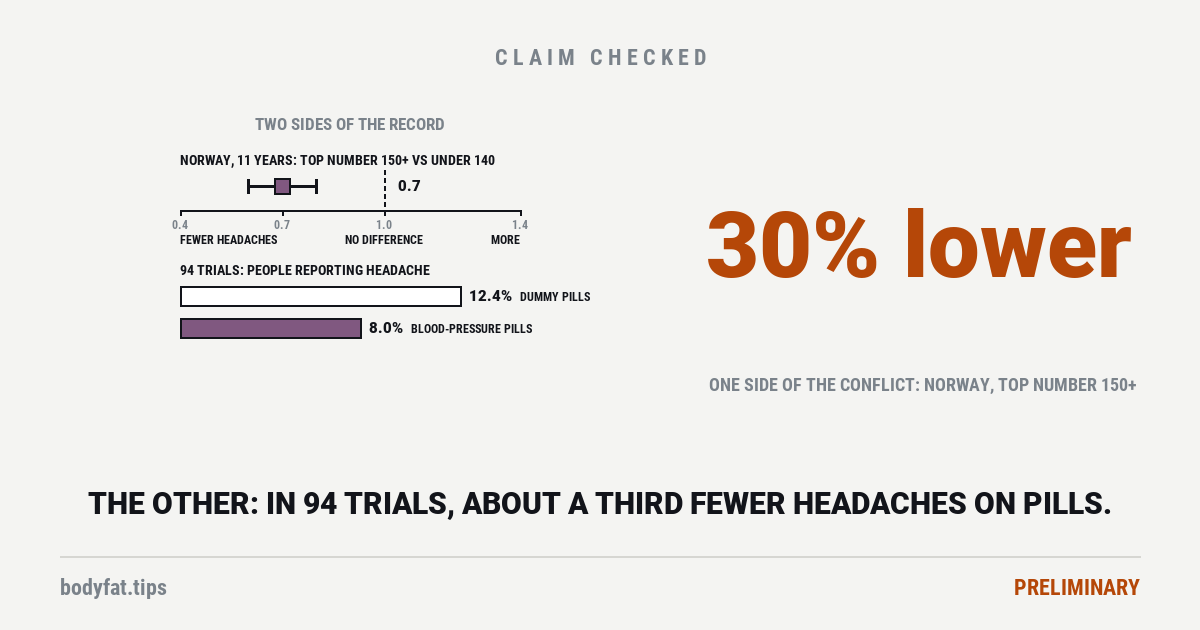
At crisis levels, 180/120 or higher, it can, and you should treat that pairing as an emergency. Below that, the evidence points both ways. The international classification of headache disorders lists a headache caused by blood pressure at those crisis readings, and says milder high blood pressure does “not appear to cause headache” [3]. Norwegians with higher readings were less likely to report headaches eleven years later, and 24-hour monitors did not catch the pressure rising with the pain [4] [5] [6]. Yet in 94 placebo-controlled trials, blood-pressure pills cut reported headaches by about a third [7].
Two numbers make a reading. The top one, systolic, is the pressure while the heart beats; the bottom one, diastolic, the pressure between beats. Both are in mmHg, millimetres of mercury. “180/120” means a top number of 180 and a bottom number of 120.
When is a headache with high blood pressure an emergency?
Two cases come first. A sudden, severe headache with no known cause, or a headache that comes with sudden numbness or weakness of the face, arm or leg, confusion, trouble speaking, a change in vision or a loss of balance, can be a stroke. The American Stroke Association’s warning signs say to call 911 immediately, even if the symptoms go away, and they attach no blood-pressure reading to any of it [8].
And if you are pregnant, or have given birth in recent weeks, the line is lower. The 2025 US guideline calls a reading of 160/110 or more severe in pregnancy, and says that once a second reading within 15 minutes confirms it, medicine should bring it down within 30 to 60 minutes [9]. The American College of Obstetricians and Gynecologists lists a headache that will not go away among the symptoms of preeclampsia, a high-blood-pressure disorder of pregnancy that can also develop in the weeks after childbirth, and says to call your obstetrician right away [10]. On our reading of the two: in pregnancy or in the weeks after it, a headache that will not go away means calling your obstetrician or maternity unit right away, whatever the reading. If you cannot reach them at once, or the reading is 160/110 or more, call 911.
For everyone else, the American Heart Association’s patient pages give the rule. If a reading is above 180/120, wait at least a minute and take it again; both of its current pages say so [11] [12]. If it is still that high and you have chest pain, shortness of breath, back pain, numbness, weakness, a change in vision or difficulty speaking, call 911: “Do not wait to see whether your blood pressure comes down on its own” [12]. Without any of those, “or any other new and concerning symptoms”, the association calls it severe hypertension: contact your health care professional as soon as possible [12].
Headache is not on that list, and the association’s current symptoms page does not mention headache at all [11]. Until April 2024 the association’s earlier symptoms page said that if your pressure is unusually high and you have a headache and feel unwell, you should wait five minutes, take it again, and call 911 if it is still 180/120 or higher [11]. We keep that rule, as the desk’s own caution rather than the association’s current advice: a bad headache with a reading of 180/120 or higher that stays that high on a second reading is a reason to call 911. The European guideline lists headache among the possible symptoms of a hypertensive emergency [13], and on our reading a bad new headache is one of the “other new and concerning symptoms” the association’s own pages leave room for [12]. If in doubt, calling is the safer mistake.
The guidelines behind those pages put it in clinical terms. The 2025 US guideline defines a hypertensive emergency as pressure above 180/120 with signs of new damage to organs such as the brain, heart or kidneys, and puts the death rate in hospital at about 10% [9]. The European guideline draws its line at 180/110 and lists headache among the possible symptoms [13].
Can high blood pressure cause headaches?
At crisis levels, the headache classification says yes. Its entry for a headache caused by high blood pressure needs a top number of 180 or more, or a bottom number of 120 or more, usually during a sudden rise; the headache is often on both sides and throbbing, and it goes away when the pressure comes down [3]. At its worst this is hypertensive encephalopathy, when pressure overwhelms the brain’s control of its own blood flow and the brain swells, with confusion, drowsiness, trouble seeing or seizures [3]. The encephalopathy entry warns that someone whose pressure is usually normal can reach that state at readings as low as 160/100 [3].
Below crisis levels, the classification is plain. Mild high blood pressure (140 to 159 over 90 to 99) and moderate (160 to 179 over 100 to 109) “do not appear to cause headache”. It adds that whether moderate high blood pressure makes headaches more likely “remains controversial, but there is some evidence that it does” [3].
The guidelines say much the same. The heart association’s symptoms page says that for most people high blood pressure “has no signs or symptoms”; until April 2024 its earlier symptoms page said outright that “The best evidence indicates that high blood pressure does not cause headaches or nosebleeds” [11]. The European guideline calls high blood pressure “predominantly an asymptomatic condition”, one without symptoms, found by screening [13]. In the 2025 US guideline’s text, by our search, the word headache appears five times, and never as a symptom of ordinary high blood pressure or of a hypertensive emergency: the five are a rare adrenal tumour, a hormone disorder, two drugs’ side effects in pregnancy and the criteria for preeclampsia [9].
So that is the official position. What did the studies find when they went looking?
| Kind of study | Points toward blood pressure causing headaches | Points away |
|---|---|---|
| Following people for years [4] [14] | None among the cohorts on this page | Norway: a top number of 150 or more went with a 30% lower risk of non-migraine headache 11 years on |
| One-time surveys [4] [15] [16] [17] [18] [19] [7] [20] | Iran: more headaches with high blood pressure; Norway: slightly more in men with a bottom number over 90; four of sixteen earlier surveys counted by the 2005 trial pooling, the largest of 11,710 patients | Nepal, China, Italy and a Brazilian clinic: no clear link |
| Monitors, home readings and a treadmill test [5] [6] [21] [22] [23] | Greece: people who got a headache on the treadmill had bigger rises in the bottom number; Sweden: home readings about 0.4 mmHg higher for each step on a five-step headache scale; Rome: night-time rises in people woken by headaches | Poland and Brazil: readings during headaches were not clearly higher than at other times |
| Randomised trials of blood-pressure pills [7] [24] [25] | About a third fewer people reported headaches on pills than on dummy pills | No link with the fall in the top number, and a link with the fall in the bottom number that rested on one unusual trial; one class of pill lowered pressure without clearly cutting headaches |
Do people with high blood pressure get more headaches?
The biggest test followed people forward. In a Norwegian county, 22,685 adults had their blood pressure measured in 1984–86 and answered questions about headaches eleven years later [4]. It is a cohort study, one that measures people and follows them for years. To start with people who had no headaches, the researchers took those who said they had not used a painkiller in the past month, a stand-in they list among the study’s weaknesses [4].
People whose top number had been 150 or more were 30% less likely to report a non-migraine headache than people under 140: a risk ratio of 0.7, where 1.0 would mean no difference [4]. The confidence interval, the range the true average probably sits in, ran from 0.6 to 0.8. The bottom number pointed the same way. Leaving out the 3,678 people who had ever taken blood-pressure pills gave the same result. For migraine there was no clear link overall [4].
The same paper also has a result that points the other way. In a one-time snapshot of the later survey, men whose bottom number was over 90 had slightly more headaches, an odds ratio of 1.2, another way of comparing how common something is in two groups, where 1.0 again means no difference [4]. Among women, migraine was a little more common at a bottom number over 90. The authors’ caution about snapshots applies here: a headache “may influence the value of the measured blood pressure” [4].
A later analysis started from that later survey and followed people to 2006–08: each 10 mmHg higher on the top number went with lower odds of headache, 0.90 [14]. It used the same county’s health surveys, so it is a second look at the same population, not an independent check. We read it as an abstract, which does not say how many people it included.
Elsewhere, one-time surveys mostly found no clear link. In Nepal, among 2,100 adults, 78.9% of those with high blood pressure had headaches against 86.6% of the rest; once age and other differences were allowed for, the gap was no longer clear, an odds ratio of 0.8 with a range from 0.5 to 1.1 [16]. In China, among 4,987 adults, no link with any headache disorder stayed clear after the same kind of adjustment [17]. In an Italian town, 58% of people with high blood pressure had had headaches against 55% of the rest [18]. At a Brazilian hypertension clinic, 1,763 patients, headache was not clearly more common at the severe stage: an odds ratio of 1.02, with a range from 0.79 to 1.30 [19].
Other studies point the other way, and they belong on the page. Before 2005, by the count of the 94-trial pooling’s authors, sixteen observational studies had looked: four found a clear link between blood pressure and headache, one a weak link, ten no sign of one, and one, the largest, the reverse; that one is the Norwegian cohort above [7]. The biggest of the four, 11,710 patients with mild to moderate high blood pressure, found headaches reported more often the higher the reading, whether or not people were treated; its first author’s listed workplace was a drug company’s medical department [20]. The other three found high blood pressure more common among 1,343 patients with severe headache than in a sample of the general population, an odds ratio of 1.51 [26]; headache more common among Swedish women with high blood pressure, treated or not, though it was commonest at both the lowest and the highest readings [27]; and high blood pressure going with severe headache in women, among 1,809 volunteers recruited outside clinics [28]. We read all four as abstracts.
Three more point the same way. In Rafsanjan, Iran, a survey of 9,933 adults aged 35 to 70 found high blood pressure went with more headaches: odds ratios of 1.22 for occasional headaches and 1.50 for headaches classed as chronic [15]. The chronic-headache link held even in people whose pressure was under control on treatment, which, on our reading, a pressure-causes-headache account would not predict. At a headache centre in Florence, 28% of 1,486 patients had high blood pressure, more than in the general population, though its authors warn that people who reach a headache centre are not like everyone else [29]. And a 1976 London clinic study found waking headache more common in untreated patients, and complaints of headache tending to fade over a year of care [30].
Does the headache come when the pressure goes up?
If blood pressure caused the headaches, the pressure should be higher when the headache starts. Two studies used 24-hour monitors, a cuff worn all day and night that takes readings every so often, while people kept a headache diary.
In Poland, 150 people with mild to moderate high blood pressure, average age 48: readings during headaches were not clearly higher than at other times, readings just before the pain were not clearly different from those at its start, and most people’s highest readings came when they had no headache [5]. The authors note one exception: some who had their highest readings during a headache were at 180/110 or above. In Brazil, 76 people with mild high blood pressure, 25 of whom had a headache while wearing the monitor: the top number averaged 139.4 during the headache against 137.0 over the 24 hours, a gap within chance [6]. Its authors’ advice to clinicians: discourage patients from relying on the symptom to know their blood pressure [6].
One experiment points the other way. In Greece, 150 people, some with headaches and high blood pressure, some with headaches alone and some with neither, walked a treadmill to push their pressure up [21]. The 35 who got a headache had higher bottom numbers and bigger rises in them, though headaches were not clearly more common in one group than another [21].
Two more studies point the same way as the treadmill, each with limits. The largest we found that matched headaches to readings at all, in southern Sweden, asked 454 people being treated for high blood pressure, average age 62.5, to take their own reading at home every evening for eight weeks and rate that day’s headache on a five-step scale [22]. On days with more headache the readings were a little higher, by 0.38 mmHg on the top number and 0.39 on the bottom for each step of the scale, or about 1.5 mmHg on the top number from “not at all” to “very much”, by our arithmetic; for women, the link with the top number was not clear. Its authors conclude that “there may exist an association, between slightly increased BP levels and more headache” [22]. A same-day link cannot say which came first, and a headache may push the reading up, as a later section shows. And a 1992 study from Rome monitored people with high blood pressure who were often woken by headaches at night: their pressure rose at night, unlike that of people with only occasional headaches, and the headaches went when treatment was timed to bring the night-time pressure down [23]. We read it as an abstract, which does not say how many people it included.
What happened to headaches in trials of blood-pressure pills?
This is the strongest evidence for the claim, and it is randomised. A 2005 pooling of 94 trials, 17,641 people given a blood-pressure pill and 6,603 given a placebo, a dummy pill, found headaches reported by 8.0% on the pills against 12.4% on placebo [7]. That is an odds ratio of 0.67, with a range from 0.61 to 0.74: about a third fewer, or one person in thirty spared a headache. Each of the four kinds of pill it tested showed it: water pills, beta-blockers, which damp the effects of adrenaline, and two kinds that act on a hormone that tightens blood vessels [7].
We could not open its list of trials, so we cannot name the largest; the authors report that the result did not come from a handful of trials [7]. They left out a fifth kind, calcium-channel blockers, which relax the walls of blood vessels, because those can cause headaches themselves [7].
Its authors concluded that a higher blood pressure causing headache is “likely”, since the kinds of drug tested share no known action except lowering pressure. They also wrote that whether higher pressure itself causes headache “remains unresolved” [7]. Their own test of whether bigger falls in pressure brought fewer headaches found a link with the bottom number that depended on one unusual trial and was no longer clear without it, and no link with the top number [7]. The authors add that the test lacked the power to show such a link, because every trial set one drug against placebo and the falls in pressure varied little from trial to trial [7].
Later poolings add to it. A 2012 review of 198 drug-against-placebo comparisons, 43,672 patients, found fewer headaches overall, an odds ratio of 0.75, with beta-blockers strongest and calcium-channel blockers showing no clear reduction (0.95, with a range from 0.79 to 1.15); the differences between kinds of drug were “unrelated to differences in mean SBP”, how far each lowered the top number [24]. A 2026 pooling of 716 short trials, 159,362 people with an average starting reading of 158/100, looked at side effects; all but calcium-channel blockers clearly cut headaches against placebo [25]. We read both as abstracts, and the 2026 one does not say how many of its trials reported headaches. The poolings’ searches overlap, the 2026 one covering every year the 2005 one did, so they are not independent checks of one another [7] [25].
One drug’s own trials found what the claim predicts. Seven placebo-controlled trials of irbesartan, a hormone blocker, pooled after the fact, 1,987 people on the drug and 686 on placebo, found that a higher bottom number predicted headaches and that the drug cut them: 17% had headaches on it, against 22% on placebo; the authors, two of whom were at a drug company’s pharmaceutical research institute, concluded mild to moderate high blood pressure “is not asymptomatic” [31]. A third author had been an investigator in trials that company sponsored, and the first had been its consultant. The paper prints no funding statement and does not say who ran or paid for the seven trials [31].
If higher readings don’t bring headaches, why do blood-pressure pills prevent them?
This section is the desk’s own reasoning, and it is labelled as such. The studies that followed people or watched their pressure through a headache found little sign of blood pressure bringing headaches on, with the two small exceptions described above. The trials found the pills preventing them. Here are three ways to fit those together, each rated.
Answer one: the pills prevent headaches by another route. The same drugs are given to prevent migraine. A 2023 pooling of 50 trials in people with migraine, average age 39 and 79% women, found fewer headache days a month on each of the five kinds of blood-pressure pill it covered, by 0.4 to 1.8 days, clearly so for four of the five; water pills were not among them [32]. Beta-blockers did best in the poolings of blood-pressure trials, and in the 2012 review the differences between kinds of pill did not follow how far each lowered the top number [7] [24]. That much is measured. That another route explains all of the benefit is a surmise, and two findings cut against it: in the migraine trials, calcium-channel blockers cut headache days too, by 1.8 a month [32]; and water pills, which no migraine pooling on this page covered, cut reported headaches in the blood-pressure trials, 7.3% against 11.4% on placebo [7].
Answer two: pressure matters a little, for some people. The irbesartan trials found the bottom number predicting headaches; the treadmill study found headaches with bigger rises; the Iranian survey, the Norwegian men’s snapshot and four earlier surveys found links between high blood pressure and headache; and in Sweden, home readings ran a little higher on days with more headache [31] [21] [15] [4] [7] [22]. That is measured, weakly, and in designs that cannot say which came first.
Answer three: higher pressure dulls pain. The Norwegian researchers’ own explanation for their result is hypertension-associated hypalgesia: in people with higher pressure, the body’s pressure sensors may also turn down pain signals [4]. If that is right, higher pressure could cause some headaches and still go with fewer of them overall. It is a hypothesis the cohort’s authors offer, resting on studies we did not read.
Put the three together and here is what we think is true, stated plainly so you can disagree with it: for ordinary high blood pressure, a headache is a poor messenger and the cuff is the reliable one, and at 180/120 the number itself is the warning.
What we could not find, and would like to: a study as large as the Norwegian one that put 24-hour monitors on adults with high blood pressure and matched their headaches to the readings before and during them. The two we found that did this and give their size had 150 and 76 people and were published in 2000 and 2001 (a 1992 study of night-time headaches, read as an abstract, does not say how many it monitored or for how long); they are the two the headache classification cites [5] [6] [3] [33]. The Swedish study above was larger, but one home reading a day cannot show what the pressure did as a headache began [22]. If you know of a larger one, the corrections line on this site is open.
What does a high blood pressure headache feel like?
At crisis levels, the classification describes it: usually on both sides of the head, throbbing, and worse with physical activity; with encephalopathy, it comes with confusion, drowsiness, trouble seeing or seizures [3]. Its criteria say nothing about the time of day or the back of the head.
The waking, back-of-the-head version has a long history. In 1913 an American physician’s clinical study of high blood pressure described a throbbing headache present on waking and wearing off during the morning, and wrote that his patients reported it “so commonly that I have almost come to look on it as a typical hypertensive symptom”, as a 2005 paper quotes him [7]. We read that quotation there, not in the 1913 paper. The 1976 London study, above, also found waking headache more common in untreated patients [30].
What are 10 warning signs of high blood pressure?
There is no reliable list. The heart association’s symptoms page: “For most people, high blood pressure has no signs or symptoms” [11]. Its earlier page, until April 2024, was blunter: if you were looking for a list of symptoms, “you won’t find them here” [11]. The European guideline’s word is asymptomatic [13].
A headache may even follow the diagnosis rather than the pressure. A 1953 study of 200 patients with high blood pressure found headaches in 74% of the 96 who had been told they had it, against 16% of the 104 who had not; the two groups’ pressures were comparable, a 2005 paper adds [7], and a 2003 editorial gives the same counts [34]. The study’s author concluded that knowing about the diagnosis raised the complaint [34]. We read the study only through those two papers.
Can a headache raise your blood pressure?
It may. In a second look at four emergency-department migraine trials in New York, 97 of 729 patients arrived with a top number of 150 or more or a bottom number of 95 or more [35]. None was given a blood-pressure drug. Within an hour of migraine treatment, the bottom number had fallen in 73% of them and the top number in 78%; of 14 with a top number of 180 or a bottom number of 110 or more, 8 were below that level an hour later [35]. There was no untreated group to compare with, so, on our reading, some of the fall may simply be the second reading, and the authors say their data “cannot inform” which came first, the headache or the pressure [35].
Readings fall on their own, too. Among hospital patients with readings above 180/120 and no symptoms, the 2025 guideline says pressure falls without any drug in 40% to 50% [9]. In US emergency departments, 6.1% of visits began with a reading of 180/120 or more; 92% of those patients had no organ damage diagnosed, and about one in five of them came in with a complaint about the nervous system, most often a headache other than migraine [36]. An earlier emergency-department study found the symptoms usually blamed on high blood pressure common among patients with raised readings, and concluded that “their prevalence appears unrelated to BP value” [37].
How to get rid of a high blood pressure headache fast?
If the reading is 180/120 or higher and you feel unwell, or the headache is sudden and severe, or you are pregnant or have recently given birth and the headache will not go away, whatever the reading, it is not a home job: follow the rules at the top of this page [12] [9] [10] [8]. Otherwise, the evidence on this page says the headache often has its own cause. In the emergency-department analysis, treating the migraine brought most readings down within an hour [35]; that was hospital treatment with no untreated comparison group, not a home recipe. If headaches keep coming and your readings run high, take both to a clinician.
What brings blood pressure down in minutes?
Often, time and a second reading. The heart association’s first step for a high reading is to wait and take it again [12], and readings fall without treatment in a large share of hospital patients [9]. The 2025 guideline also warns against lowering pressure aggressively in the short term when a very high reading comes with no sign of organ damage [9]. How to take a reading that means something is on our home-measuring verdict, and why a clinic reading can run high is on our white-coat verdict. Lasting falls take weeks, not minutes: what each lifestyle change is worth is on our verdict on lowering blood pressure naturally, and two drinks sold for blood pressure have their own verdicts, beetroot juice and hibiscus tea.
Can low blood pressure cause headaches?
Possibly, for one kind, and the evidence is thin. A British survey of 7,383 adults set out to test whether readings in the low-normal range bring symptoms such as tiredness, dizziness and headache: lower readings went with more tiredness and feeling faint, but their link with headache was explained by age [38]. Among middle-aged Swedish women, headache was commonest at both the lowest and the highest fifth of readings [27]. We read both as abstracts. The other comparisons on this page are between normal and high readings, not low ones: in Norway, people whose top number was under 140 had more headaches later than those at 150 or more [4], and among 5,221 German teenagers aged 11 to 17, those with headaches had a top number 1.5 points lower, 114.0 against 115.5, both in the normal range [39]. The Norwegian authors explain their result the other way round, as higher pressure dulling pain [4].
One kind of low pressure has its own entry. In orthostatic hypotension, a drop in pressure on standing up, the classification describes pain mostly in the back of the neck, sometimes spreading up the back of the head, coming only when upright; it notes that 75% of patients reported neck pain when asked [3]. That entry sits in the classification’s appendix, for criteria still being tested. A headache from low pressure of the fluid around the brain and spine, which turns up in the same searches, is a different condition and is not what these studies measured.
Who these studies were done on
The cohort was Norwegian adults aged 20 and over [4]. The surveys were adults aged 18 to 65 in Nepal and China, 35 to 50 in an Italian town and 35 to 70 in Iran [16] [17] [18] [15]. The monitor studies were 150 Polish patients, average age 48, and 76 Brazilian patients with mild high blood pressure [5] [6]; the home-reading study, 454 Swedish patients on treatment, average age 62.5, 187 of them women [22]. The 2026 pooling’s trials averaged 54.6 years old, 44% women [25]; the migraine trials averaged 39, 79% women [32]. The emergency studies were US patients: those with very high readings and no organ damage averaged 61, and the migraine patients had a median age of 35, 85% of them women [36] [35]. The finding of slightly lower readings with headache in the young comes from teenagers [39].
So read yourself against them. If you have ordinary high blood pressure and headaches, these studies were about people like you: the ones that followed people or watched their pressure through a headache found little sign of it bringing the headaches on, and the trials of pills point the other way. If you are pregnant, they were not about you: in the criteria the US guideline reprints, a new headache that medicine does not relieve is one of the features that can define preeclampsia [9], and that belongs with whoever is looking after the pregnancy, right away, whatever the reading [10], as the top of this page says.
Where “headaches are a warning sign” came from
The research is old. The 1913 description of a waking, throbbing “hypertensive” headache, quoted above, is the earliest source this page could trace [7]. The framing then hardened into a named diagnosis: the headache classification gives “headache attributed to arterial hypertension” its own entry, with a threshold of 180/120, while saying milder high blood pressure does not appear to cause headache [3].
We could not trace who first put headaches on the lists of warning signs. Today they lead two of the lists this search turns up, a family-medicine practice’s top ten and an older-adults nonprofit’s subtle symptoms [1]. A primary-care practice’s answer to how to get rid of one “instantly” opens: “A headache caused by high blood pressure is your body’s warning light” [1]. Google’s AI answer, by contrast, says mild to moderate high blood pressure does not usually cause headaches [2].
And it sells. The nonprofit’s symptom page links its own guide to the best home blood-pressure monitors, whose “Visit Site” buttons are marked in the page’s code as sponsored links; the primary-care practice offers same-day appointments; a consumer health website’s page on the question carries a link to a prescription-refill service with a note that it may receive a commission; and a clinical-trial recruitment company’s page calls headaches “one of the most common symptoms of hypertension” beside an invitation to check eligibility for trials [1].
None of this is aimed at anyone who reached for a cuff because their head hurt. Checking is sensible, and a very high reading with a headache is exactly when the 911 caution at the top of this page applies. It is the list that turns an ordinary headache into a sign of an ordinary reading that the studies did not support.
What this is rated, and what the rating covers
Preliminary — for the claim that raised blood pressure causes headaches in people with ordinary high blood pressure, below crisis levels.
It is rated Preliminary, on a conflicting record. In its favour: randomised trials find about a third fewer headaches on blood-pressure pills than on placebo, their authors call a causal link likely, and several studies found more headaches with higher pressure: one drug’s trials, analysed by authors who included a drug company’s researchers; a treadmill experiment; two surveys on this page and four earlier ones; and a study of same-day home readings [7] [24] [25] [31] [21] [15] [4] [20] [22]. Against it: in Norway higher readings went with fewer headaches years later, surveys in Nepal, China and Italy and a Brazilian clinic found no clear link, 24-hour monitors did not find headaches arriving with higher readings, and in the 94 trials the pills’ benefit showed no link with the fall in the top number and a link with the bottom number that rested on one unusual trial, while in the 2012 review the differences between kinds of pill did not follow it [4] [14] [16] [17] [18] [19] [5] [6] [7] [24]. The headache classification’s own wording sits between the two [3].
It is not rated Unsupported because the trial evidence in its favour is large and randomised, and its authors call the question unresolved rather than settled against [7]. It is not rated Supported because the studies that tested the link most directly, by following people for years or matching headaches to readings, mostly did not find it. The exceptions: a link of about 0.4 mmHg for each step on a five-step headache scale in the largest study of same-day home readings, a design that cannot say which came first, and a small 1992 study, read as an abstract, in which night-time headaches came with night-time rises [4] [5] [6] [22] [23].
Each part, rated alone, in words. That blood pressure at crisis levels, 180/120 or higher, can cause a headache: Supported, by the headache classification’s criteria and its account of brain swelling in hypertensive encephalopathy, and by the European guideline’s list of symptoms [3] [13]. Not Established, because that is clinical description, and in emergency departments how often symptoms were reported did not track the reading, while a headache may push the reading up [37] [35]. Whichever came first, treat the combination as an emergency, as the top of this page says.
That low blood pressure causes headaches: Preliminary, on a thin and conflicting record. In its favour, mainly an appendix entry for neck and head pain on standing in orthostatic hypotension, and a Swedish survey in which headache was commonest in the lowest fifth of readings as well as the highest, though its abstract does not say how low that fifth was; against it, a British survey built to test low readings, where the link with headache was explained by age [3] [27] [38]. The Norwegian and German comparisons were of normal readings and do not bear on it [4] [39].
That a headache pushes the reading up: Preliminary, on one analysis of emergency-department migraine trials with no untreated comparison group, whose authors say it cannot settle which came first [35].
What is not rated here: which pill to take, which belongs with a prescriber; headaches in pregnancy, above; the “warning light” remedies some pages offer, from herbal teas to breathing, which no study on this page tested; and the frame above, which is this desk’s reasoning from the evidence rather than a result the evidence delivered. It is marked as ours so that you can weigh it as ours.
This is journalism, not medical advice. A severe headache with a reading of 180/120 or higher needs urgent care; so does a headache that will not go away in pregnancy or soon after, at any reading, and a sudden, severe headache at any reading. All three are at the top of this page. If you get headaches and your readings run high, see a clinician: the headache may have a cause of its own, and the readings need attention either way. How we read a study, and what each tier means, is set out here.
- Vibration Plate Benefits: The Three Biggest Randomised Bone Trials We Found With Results, 1,086 People, Showed No Clear Gain. Stronger Legs Are Another Matter.
preliminary - Exercise for Osteoporosis: Lifting and Jumping Left Women About 1% Ahead on Bone Density, by Our Reading. Fewer Fractures Is Less Certain
supported - How to Calculate Max Heart Rate: 220 Minus Age Missed 70 of 230 Adults by Over 10 Beats in One Lab (Our Count)
established