Can Fatty Liver Be Reversed? The Fat, Yes, Within Weeks. In a Year-Long Study, the Scarring Moved Both Ways.

In December 2022 a physician’s health-video channel posted a thirteen-minute video called A Science-Backed Way to Reverse Fatty Liver FAST. By 10 October 2026 it had 5,039,469 views. Its description makes the promise in a line: if you have been told you have fatty liver, the good news is that it is “fully reversible”, and you can start seeing changes in weeks.
Five more videos on the liver sit among the channel’s sixty most watched, with another 3,926,189 views between them. And when you ask a search engine how to reverse fatty liver, its AI answer cites five videos. Three are this channel’s.
Is it true? Mostly. And the part that is true is the part worth hearing first. The part that is not quite true is the part that decides how the disease ends.
Can fatty liver be reversed?
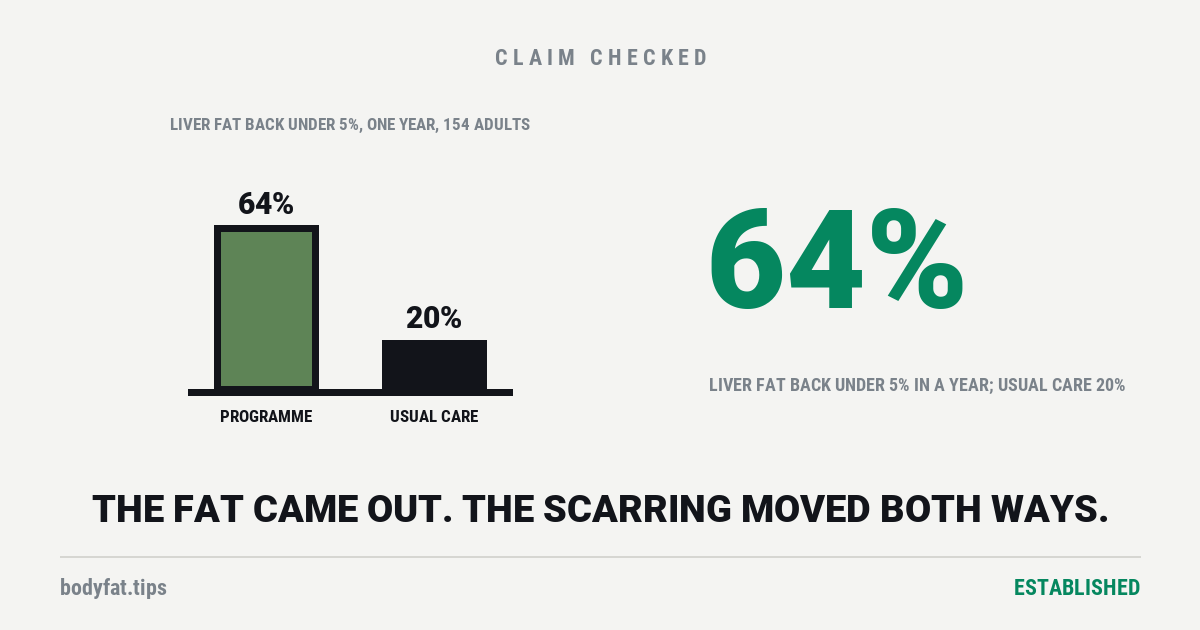
Yes, for the fat. In a year-long randomised trial in Hong Kong, 64% of the people given a lifestyle programme had their liver fat back under the line that defines the disease, against 20% of those left to usual care [2]. Liver fat starts falling within days of eating less, or eating less sugar [6] [7]. Pooled across the 11 randomised trials in a 2019 review that measured it, weight-loss programmes cut it by an amount researchers would call very large [1].
The scarring is a different story. In a study that followed 293 people through a year of diet and walking, the scarring moved both ways: of the 113 who had some to begin with, 56 improved by a stage, and of the 180 who had none, 36 developed some, every one of them among people who had lost under 5% of their weight [4]. And scarring, not fat, is the part that predicts who dies or needs a transplant [13]. “Fully reversible” is true of one layer of the liver, and not, as a rule, of the others.
First, the name changed: fatty liver is now MASLD
If your scan report said MASLD and you searched for fatty liver, you are in the right place. In 2023 the American, European and Latin American liver associations renamed non-alcoholic fatty liver disease (NAFLD) as metabolic dysfunction-associated steatotic liver disease, MASLD [10]. Steatotic means fatty. The new name needs fat in the liver plus at least one heart-and-metabolism risk factor from a list that includes raised blood pressure and abnormal blood fats [10]. One reason given for dropping the old words: in the experts’ survey, 61% found “non-alcoholic” stigmatising, and 66% found “fatty” stigmatising [10].
The renaming keeps three layers of the disease apart, and this page needs them apart.
The fat (steatosis). Fat filling more than about 5% of the liver, the line used in the trial above [2]. This is MASLD itself, and most of the claim is about it.
The inflammation (MASH, formerly NASH). Fat plus inflamed, damaged liver cells, seen on a biopsy: a sliver of liver taken out with a needle and read under a microscope [4] [10].
The scarring (fibrosis). Scar tissue laid down after the damage, graded in stages from 0, none, to 4, cirrhosis [13].
How much weight do you have to lose to reverse fatty liver?
In 2019 an Oxford team pooled 22 randomised trials of programmes designed to make people with fatty liver lose weight: 2,588 adults, followed for a median of six months [1]. The programme groups lost about 8.0 lb (3.61 kg) more than the comparison groups, and in the 11 trials that measured liver fat, 765 adults, it fell further, by an effect size of 1.48. An effect size of 0.8 is what researchers call large; 0.2 is barely there. So 1.48 is very large [1]. We added up the review’s chart of those 11 trials ourselves, and it gives the same figure. They measured the fat different ways, by ultrasound, an MRI scan or a biopsy, and they were not all diets: four tested weight-loss drugs, one a balloon placed in the stomach, and one was the Hong Kong trial described next [1]. The behavioural programmes, diet with or without exercise, moved the fat; in the trials of weight-loss drugs alone, the review found no evidence that it moved [1].
But back to normal? The cleanest test of that is the Hong Kong trial. It took 154 adults found to have fatty liver in a population screening and randomly assigned them to a dietitian-led programme at two community centres or to usual care, for a year [2]. Liver fat was read by MRI spectroscopy, a scan that measures the share of the liver that is fat. In the programme group 64% were back under 5%, against 20% of the controls; the range the true difference probably sits in runs from 30 to 58 points [2]. The programme group lost 12.3 lb (5.6 kg), the usual-care group 1.3 lb (0.6 kg) [2].
How much was enough? Of the people who lost more than 10% of their weight, 97% were back to normal. Of those who lost 3 to 4.9%, 41% were [2]. We read this trial’s summary only; its full text is paywalled.
A second Oxford review pooled 43 studies and 2,809 people to put a price on it. Each 2.2 lb (1 kg) lost went with liver fat about 0.77 of a percentage point lower, and bigger losses went with the inflammation clearing too; the link to scarring was the weakest [3].
| Layer | What the studies found | Who, and for how long |
|---|---|---|
| Fat | Back under 5% in 64% of a lifestyle programme’s group, against 20% on usual care [2]; a very large pooled fall across the 11 trials of a 2019 review that measured it [1] | 154 adults in Hong Kong, one year; 765 adults in 11 trials, from a review of 22 that ran a median of six months |
| Inflammation (MASH) | Cleared in 26 of the 29 people who lost 10% or more of their weight, and in 10% of those who lost under 5% [4]; in two small trials, one of diet and exercise and one of a weight-loss drug, the odds of still having it were about a seventh of the comparison groups’ [1] | 293 adults in Havana, one year, no comparison group; two randomised trials |
| Scarring (fibrosis) | No change in the six trial comparisons pooled in 2019, of six to twelve months [1]. In Havana, of those who had scarring, improved by a stage in 13 of the 16 who lost 10% or more and in 33 of the 73 who lost under 5%; of those who had none, 36 of the 132 who lost under 5% developed some, and none of the 48 who lost more [4] | Six comparisons in the 2019 pooling; the same 293 in Havana |
How long does it take to reverse fatty liver?
Weeks for the fat, and the first drop comes within days.
In Newcastle, 11 adults with type 2 diabetes spent eight weeks on 600 calories a day, a liquid diet plus vegetables, measured by a research team at weeks one, four and eight. Their liver fat fell by 30% in the first week and was in the normal range, 2.9%, by week eight. They lost 33.7 lb (15.3 kg) [7]. Nine of the eleven were men, and nobody was assigned to another diet for comparison [7]. It was a research diet, not a plan to copy at home.
In San Francisco, 41 children aged 9 to 18 who ate and drank a lot of sugar were given all their food for nine days: the same calories, with starch swapped in for most of the sugar [6]. Their liver fat fell from a median of 7.1% to 3.8%, and it fell in all but one of the 38 who had both scans [6]. They lost 2.0 lb (0.9 kg) on average. The authors list the missing control group as the study’s first limitation [6].
In Stockholm, a randomised trial put 74 adults with fatty liver on a low-carb high-fat diet, the 5:2 diet (500 to 600 calories on two days a week), or a hepatologist’s standard advice for 12 weeks [5]. From starting levels of 12% to 17%, liver fat fell by 7.2 percentage points on low-carb, 6.1 on 5:2 and 3.6 on the advice. The two diets did not differ from each other; both groups lost about 16 lb, 16.1 lb (7.3 kg) and 16.3 lb (7.4 kg) [5].
So can fatty liver be reversed in two weeks? The fat starts going in days. In the two feeding studies it was down 30% in the adults’ first week, and the children’s median fell from 7.1% to 3.8% in nine days [7] [6]. Back to normal took eight weeks on 600 calories a day [7], and a year of a community programme for most of the Hong Kong group [2]. What about flushing it out? In these studies the fat left the unglamorous way, by eating less, or eating less sugar [7] [6].
Can fatty liver be reversed without losing weight?
Partly. In the San Francisco study, the nine children who lost no weight at all still saw their liver fat fall, from 9.7% to 6.3% [6]. And a 2023 pooling of 14 randomised exercise trials, 551 adults, found that people who exercised had about three and a half times the odds of a meaningful fall in liver fat, 30% or more; the effect held without a 5% weight loss, and it took the equivalent of about 150 minutes of brisk walking a week [8].
What you eat matters as well as how much. A six-month trial on the sugar verdict found liver fat rose in the people drinking cola, and overeating saturated fat added more liver fat than overeating sunflower oil in trials on the seed-oil verdict.
And if you are not overweight? In the Hong Kong trial, people with a body mass index under 25, the trial’s cut-off for obesity in Asian adults, went back to normal liver fat about as often as heavier people: 67% of the programme group against 18% of their controls. Half of them got there by losing 3 to 5% of their weight; heavier people needed 7 to 10% [9].
What foods help heal fatty liver?
The trials here tested whole diets, not single foods, and the diets worked mostly through the weight they took off. Low-carb and 5:2 did equally well in Stockholm [5]. The European guideline recommends a Mediterranean-style diet, less ultra-processed food and no sugary drinks, and says there is little evidence that diet quality on its own changes hard liver outcomes such as cirrhosis [11]. The 5:2 diet is a form of intermittent fasting, which has its own verdict.
What happens to the scarring?
The study that put a number on diet and scarring, and the one the European guideline cites for it, was done at a liver hospital in Havana [4] [11]. From 2009 to 2013 it enrolled 293 people whose biopsy showed steatohepatitis, gave them a low-fat diet 750 calories below their needs and a target of 200 minutes of walking a week, and biopsied them again after a year; 261 had both biopsies, and the study filled in the missing results statistically [4]. Nobody was assigned to anything else; the authors call it a cohort study, not a trial [4].
Over the year, the inflammation cleared in a quarter of them. The scarring needs two counts, because 180 of the 293, three in five, had no scarring at the start and so could not improve [4]. Of the 113 who had some, 56 improved by at least one stage, about half, and 10 got worse. Of the 180 who had none, 36 developed some. Averaged over everyone, the scarring score barely moved, by a hundredth of a stage [4]. (The split by starting scarring is our count from the paper’s chart; it matches the paper’s table.) The difference tracked weight loss. Among the 29 people who lost 10% or more, the inflammation cleared in 26; of the 16 of them who had scarring, 13 improved and none got worse [4]. Among the 73 with scarring who lost less than 5%, 33 improved and 7 got worse; all 36 people who developed new scarring had lost less than 5%, and of the 48 without scarring who lost 5% or more, none did [4]. The average loss among those who finished was 10.1 lb (4.6 kg), and 29 people is 10% of the cohort [4].
A smaller cohort in New Hampshire, 45 people with the inflamed form who had a second biopsy for their care, a mean of 4.6 years after the first, found the same line at 10%: the scarring improved in 63% of those who lost 10% or more of their weight, against 9% of those who lost less. It had no comparison group either, and a quarter of the 45 had had weight-loss surgery [24].
The trials pooled in 2019 did not reproduce that: the six comparisons that biopsied scarring, after six to twelve months, found no change [1]. Outside that pooling, we read two small randomised trials, and they point different ways. In Missouri, 16 adults with the inflamed form cut calories and did supervised interval training for about ten months, losing 17.2 lb (7.8 kg), about 6% of their weight; against 8 left to standard care, their scarring on a second biopsy did not change [23]. In Kazakhstan, a 2019 trial of 80 adults with severe inflammation and type 2 diabetes reports that fat and scarring improved on a regimen of calorie restriction and walking, against conventional drug treatment. Everyone knew which group they were in, its summary gives fat and scarring as one result, and the registration number it prints belongs to a different study, of atherosclerosis at the same university, so it is not one of this page’s sources (its title is Severe nonalcoholic steatohepatitis and type 2 diabetes: liver histology after weight loss therapy in a randomized clinical trial). The European guideline says the evidence that lifestyle weight loss helps advanced scarring or cirrhosis is insufficient [11]. In a small 2025 trial in people who already had cirrhosis, 12 weeks of a total diet replacement and 12 of stepped food reintroduction took off 26.2 lb (11.9 kg) more than standard care and cut liver fat by 6 percentage points; liver stiffness, a scan measure of scarring, did not change [15].
A 2026 pooling of 26 studies, 1,963 people biopsied twice, puts the share whose scarring improved by a stage at 17%. Its summary links weight loss of more than 3% to the inflammation clearing, and reports no such link for scarring [22]. We read its summary only.
Why dwell on the scar, when the fat is the part that comes out? Because the scar predicts the ending. In 619 people with a biopsy, followed for a median of 12.6 years, those with stage 3 scarring died or needed a transplant at 3.76 times the rate of people with none, and those with stage 4, cirrhosis, at 10.9 times; that multiple is a hazard ratio, how many times the rate [13]. No other feature on the biopsy, inflammation included, predicted those outcomes once scarring was counted [13].
Can a fatty liver go back to normal and stay there?
On the little that has been measured, it stays reversed as long as the weight stays off. Only two of the 22 trials in the 2019 pooling followed people after the programme ended, one for six months and one for five years, and by then the groups’ liver blood tests could no longer be told apart [1]. The European guideline describes the usual pattern in longer studies: the most weight comes off by six months, some returns, the net loss settles near 5% at one to two years, and part of the liver fat comes back with it [11].
The Hong Kong trial is the brighter exception. Among its people who were not overweight to begin with, the programme group was still more likely than controls at six years to have kept the weight off and to have normal liver blood tests [9]. Why is keeping weight off the hard part? That has its own verdict.
Does any of this apply to you?
| If you are | What the studies found | Who was in them | What is missing |
|---|---|---|---|
| Overweight | 61% back under 5% liver fat after a year, against 21% on usual care; half of them got there by losing 7 to 10% of their weight [9]. Across the 11 trials in the 2019 review that measured it, a very large fall in liver fat [1] | 38 people per group in Hong Kong with a body mass index of 25 or more, the cut-off the trial used for obesity in Asian adults [9]; the review’s 22 trials averaged 45 years of age, two-thirds men, about 7% with diabetes [1] | The Hong Kong trial read as its summary only |
| Not overweight | 67% back to normal, against 18% of controls; half got there by losing 3 to 5% of their weight [9] | 39 people per group in Hong Kong with a body mass index under 25 [9] | One trial, summary read only |
| Living with type 2 diabetes | Losing under 7% of weight: inflammation cleared in 0 of 76. Losing 10% or more: in 12 of 14 [4]. Liver fat normal after eight weeks on 600 calories a day [7] | A third of the Havana cohort [4]; 11 adults, 9 of them men [7] | Neither study had a comparison group |
| A woman | Only 3 of 173 women in Havana lost 10% of their weight. At 7 to 10%, inflammation cleared in 5 of 11 women and 11 of 14 men [4] | 59% of the Havana cohort [4] | Too few women reached 10% to say what it does for them |
| Already scarred | In Havana, of 16 people with scarring who lost 10% or more, 13 improved a stage, and of 73 who lost under 5%, 33 did [4]. On placebo plus lifestyle advice in two drug trials, 13 to 22% improved a stage [20] [21] | Havana, mild to advanced scarring short of cirrhosis; the drug trials’ placebo groups, moderate to advanced [20] [21] | Havana had no comparison group, and it counts milder scarring than the drug trials did [4] |
| Living with cirrhosis | After 12 weeks of a total diet replacement and 12 of food reintroduction, liver fat fell 6 points; liver stiffness did not change [15] | 17 adults in Oxford [15] | The European guideline calls the evidence insufficient [11] |
| A child or teenager | Liver fat fell from a median 7.1% to 3.8% in nine days with most sugar swapped for starch [6] | 41 Latino and African-American children aged 9 to 18 [6] | No comparison group; nine days |
| Someone who drinks more than a little | — | Fatty-liver trials enrolled people who drank little, by the old definition of the disease [10]; Havana and the US milk thistle trial set limits [4] [16] | The new name puts heavier drinkers in a separate group, MetALD [10] |
Read the table for its blanks as much as its numbers. The European guideline’s rule for the scar, lose 10%, rests on one cohort, in which 29 people lost that much, 16 of them with scarring to improve, and only three of the 29 were women [11] [4]. If you drink more than a little, these trials were not done on people like you, and alcohol has its own verdict on weight.
This is journalism, not medical advice. Which layer a particular liver is in is a question for tests, and if you have a diagnosis, the person to ask what it means for you is the clinician who made it.
What about milk thistle and the “best supplements”?
The same channel has a 2024 video titled Best Supplements to Reverse Fatty Liver (Science-Backed), at 583,095 views, and a 2023 review of milk thistle at 341,602. Their descriptions do not name the supplements or say how the milk thistle review comes out, and we have not watched them.
Milk thistle has been tested where it counts: against a dummy pill, with a biopsy before and after. In a 48-week US trial of 78 people, the share whose liver score, a biopsy grade of fat, inflammation and cell damage, improved by two points was 15% and 19% on two strengths of a branded extract and 12% on placebo, a gap chance explains easily; the scarring improved most in the placebo group [16]. A 48-week trial of 99 people in Kuala Lumpur also missed its main measure, 32.7% against 26.0%, though a secondary one, scarring improving by a stage, favoured the extract, 22.4% against 6.0% [17]. The extract’s maker was involved in both: it took over sponsoring the US trial and paid the pathologist who read its biopsies, and it is listed as a collaborator on the Malaysian one [16] [17].
Poolings of the trials report lower liver blood tests on milk thistle [18] [19], and the US and European guidelines both conclude that in the trials it did not improve what the biopsy shows [12] [11]. The 2024 pooling also reports that the fat itself graded better on milk thistle, which it calls an improvement in “liver histology” [18]. That rests on less than it sounds. Its chart pools six small trials, 393 people, where its text says seven and 492. Three of the six gave milk thistle mixed with other ingredients, vitamin E among them, and at least three graded the fat by ultrasound, not biopsy [18]. Two of the six go in with figures we could not match to the trials’ own reports. One is the US biopsy trial above, entered with 50 people on placebo where it had 25; in its own report the fat improved in 23% and 19% of people on the two strengths and 12% on placebo, a gap chance explains [16]. The other gave milk thistle alone or a placebo, with a diet, to 52 adults with severe obesity awaiting weight-loss surgery, and its own report has less fat on ultrasound after eight weeks on milk thistle [25]. So as a way to reverse fatty liver, milk thistle would rate Preliminary here: the two trials that biopsied the liver missed their main measure, and the evidence on the fat itself is small, short and mixed. As a way to lower liver blood tests, Preliminary too.
The European guideline’s view of food supplements for this disease in general is that they cannot be recommended [11]. Berberine has its own verdict, which includes a six-month trial in people with fatty liver. Coffee comes up too: the guideline notes that coffee drinkers have healthier livers in observational studies, which watch people rather than assign them [11]; coffee and weight is a separate verdict.
What about the drugs?
Context, not advice, and no doses. Since March 2024 the US Food and Drug Administration has approved two medicines for the inflamed and scarred form, MASH with moderate to advanced scarring short of cirrhosis: resmetirom, a drug that acts on a thyroid-hormone receptor in the liver, and semaglutide, the weight-loss injection [20] [21]. Both came through its accelerated route, which approves on biopsy results and requires a later trial to show that patients actually do better [20] [21].
Their trials are useful here for a reason that has nothing to do with the drugs. Everyone in them, the placebo groups included, got lifestyle advice. After a year on resmetirom’s placebo, a dummy treatment, scarring improved by a stage in 13 to 15% of people; after 72 weeks on semaglutide’s, in 22%, and the inflammation cleared in 34% [20] [21]. On semaglutide itself the figures were 37% and 63%, with a 10.5% weight loss [21]. Semaglutide and tirzepatide are compared on their own verdict.
If the fat comes out in weeks, why does the scar barely move?
This section is the desk’s own reasoning, and it is labelled as such. The fat in a fatty liver answers a diet within days [6] [7]. The scar, in the same kind of people, moves both ways over a year and averages out to almost nothing; among those who lose 7% or more of their weight it moves only one way, toward better [4], and in the trials pooled in 2019 it did not move against a comparison group [1]. Three explanations are on offer. Here is what each is worth.
Answer one: most people never lose enough to move it. In Havana, 29 of 293 people, 10%, lost a tenth of their weight in the year [4]. The US guideline puts the share of people who reach effective weight loss in structured programmes at 10% or fewer at one year, and says fewer than half of those keep it off for five [12]. That is measured, in two places. The dose that moves the scar is a dose few people get.
Answer two: the trials stop before the scar would move. The 22 randomised trials pooled in 2019 ran a median of six months [1], and the longest in the Cochrane review two years [14]. The regulator, approving the first drug, noted that the disease usually takes years or decades to progress [20]. That a longer diet trial would see the scar move is a surmise. The trial that would check it is the one we could not find, below.
Answer three: the ruler wobbles. A stage of scarring is read by a pathologist off a sliver of liver. When the regulator approved resmetirom, its figures came as ranges, because different pathologists read the same biopsies differently: on the higher dose, the share whose inflammation cleared came out anywhere from 24% to 36%, and the share whose scarring improved from 24% to 28%, depending on the reader [20]. In Havana, among the 205 people who lost under 5% of their weight, 1.8% on average, the scarring moved a stage in 76: of the 73 who had some, 33 improved and 7 got worse, and of the 132 who had none, 36 developed some [4]. In the drug trials, where everyone started with moderate to advanced scarring, 13% to 22% of people on placebo improved by a stage [20] [21]. Those numbers are measured. Our reading of them is a surmise: that much of the movement in people whose weight barely changed is the ruler, a stage read differently off a different sliver; and that a ruler like that, used on people who start with some scarring, shows improvement, because people who start with none can only move up. It would help explain why Havana’s low losers with scarring improved more than twice as often as the placebo groups, 45% against 13% to 22%, though Havana also counted milder scarring, where a one-stage move is easier to see. It is why we read Havana’s big losers against its small losers, 13 of 16 improving and none worse against 33 of 73 and 7 worse, rather than against zero.
Put the three together and here is what we think is true, stated plainly so you can disagree with it: a fatty liver reverses in layers, fastest in the layer that matters least, and the layer that predicts how the disease ends moved both ways in people whose weight barely changed, and one way, toward better, in the people who lost the most.
What we could not find, and would like to: a randomised trial that runs a diet programme for years, checks the liver at the end, and counts what scarring predicts: cirrhosis, liver cancer, transplants and deaths. The Cochrane review of lifestyle trials found follow-up of two years at most and asked for trials of at least eight [14]; we found none since. The nearest, an Italian trial published in September 2026, followed 286 people for 18 months and counted sudden heart and blood-vessel events, fewer with its most intensive programme, a rate 0.36 times that of standard care; its liver measures were scans, not events [26]. We would also like the Havana analysis repeated in women, of whom three lost a tenth of their weight [4]. If you know of either, the corrections line on this site is open.
Where “fully reversible” came from
Start with the numbers everyone quotes: 5% of your weight for the fat, 7 to 10% for the inflammation, 10% for the scar. The American liver association’s 2023 guidance gives a version of that ladder [12]. The European guideline of 2024 makes it a strong recommendation and cites one study for it, the Havana cohort, which it calls “a stringent interventional trial with histological endpoints” [11]. The study itself has no comparison group, and its 10% rung rests on 29 people, three of them women; for the scar, on the 16 of them who had any [4].
Then the videos. The 2022 video’s description promises “fully reversible” and cites no study. A 2025 video on the same channel, The FASTEST Way to Reverse Fatty Liver, Naturally, at 585,938 views, lists its references, among them the nine-day sugar study in children and the Stockholm diet trial [6] [5]. Its promise is changes in days to weeks, which for the fat is what those studies found. Another, 5 Simple Drinks to Reverse Fatty Liver FAST, at 1,155,935 views, does not name the drinks in its description.
By October 2026 the claim had reached the machines. A search engine’s AI answer to “how to reverse fatty liver” opens with the 5-to-10% weight loss and cites three of this channel’s videos among its sources. The searches behind it are not small: about 12,100 a month for “can fatty liver be reversed”, 9,900 for “how to reverse fatty liver” and 2,400 for “how long does it take to reverse fatty liver” (from a paid keyword database, pulled 10 October 2026).
And where it lands. Among the top results for “can fatty liver be reversed” is a company that sells full-body MRI scans, whose answer ends by inviting the reader to book one, and a clinical-trial recruiter inviting readers to enrol. The supplements video sits beside a European guideline that says supplements cannot be recommended for the disease [11].
None of this is aimed at anyone with a fatty liver who has been trying to lose weight. The fat really does come out, and the people who say “reversible” are right about the layer most people have. The trouble is only the word “fully”, and what gets sold in its shadow.
What this is rated, and what the rating covers
Established — for the claim that losing weight through diet takes the fat out of a fatty liver, measurably within weeks, and for many people back below the line that defines the disease.
It is rated Established because liver fat fell with weight-loss programmes in the 11 randomised trials of a 2019 pooling that measured it [1], fell further with more weight lost across 43 studies [3], returned to normal in 64% of a programme group in a year-long randomised trial [2], fell on two different diets in a 12-week randomised trial [5] and fell within days in two feeding studies [6] [7]; and because the US and European guidelines both recommend weight loss to reduce it [11] [12].
What the other parts of the claim would rate alone. That large weight loss clears the inflammation: Supported, on two small randomised trials, one of diet and exercise and one of a weight-loss drug, the Havana cohort and a 2026 pooling [1] [4] [22]. That the scarring improves with large weight loss: Preliminary, because in the two cohorts on this page, neither with a comparison group, it improved most with the largest losses [4] [24], while the six trial comparisons pooled in 2019, of six to twelve months, saw no change [1]. That fatty liver is fully reversible, scar included: Unsupported. Over a year in Havana, the scar moved both ways: half of those with scarring improved by a stage, while a fifth of those with none developed some [4]. In the trials pooled in 2019 it did not move [1], and the Cochrane review found no trial long enough to show whether reversing it changes how the disease ends [14]. That milk thistle reverses it: Preliminary, on small, short trials that disagree; that it lowers liver blood tests: Preliminary [16] [17] [18] [19] [25].
What is not rated here: the drugs, which are context; any single food, drink or supplement other than milk thistle; and the frame in the section above, which is this desk’s reasoning from the evidence rather than a result the evidence delivered. It is marked as ours so that you can weigh it as ours. How we read a study, and what each tier means, is set out here.
- The No-Sugar Diet: Cutting Sugar Lost 1.8 lb in the Trials Pooled for the WHO. Swapping It for the Same Calories Changed Nothing. The Sugar Was Never the Point.
supported - Going Vegan Cost Over-65s 2.5 lb of Lean Mass. Protein Fell, So Did Weight
preliminary - How Many Calories to Lose a Pound? 3,500 Is a Conversion, Not a Speed
unsupported