Do Parasite Cleanses Work? One Seller Told Buyers 90% of Americans Have Parasites. In 129,732 Rounds of Lab Tests Doctors Ordered, 1.7% Found One That Causes Disease.

In July 2026 a large health-video channel posted two long videos about an outbreak of Cyclospora, a gut parasite that causes weeks of diarrhea. The first, on 13 July, promised viewers “the truth about the ‘natural parasite cleanses’ flooding your feed right now.” By 7 October it had 1,157,045 views. The second, four days later, had 765,755. Both videos’ descriptions said the same thing about the cleanses: no study in people shows any herb treats Cyclospora.
When a channel that size spends part of an outbreak video warning viewers off a supplement, the supplement has traveled a long way. “Parasite cleanse” is searched 110,000 times a month in the US (from a paid keyword database, pulled 10 October 2026), and advertisers compete hard for those searches.
The pitch is two sentences long. One seller put the first on its homepage, where the FDA quoted it in a 2017 warning letter: “FACT: OVER 90% OF AMERICANS HAVE PARASITES.” The second was on the same site: “Deworm YOURSELF and your family twice per year” [1].
So there are two claims here. Most of us carry parasites. A course of herbs from the supplement aisle clears them out. The first claim has been measured, and it fails. The second has, as far as we can find, never been tried on the people it is sold to. Here is each, with the numbers.
Do most Americans have parasites?
No. The best counts come from the laboratories that run the stool tests doctors order, and they find parasites rarely, even in people who were sick enough to be tested.
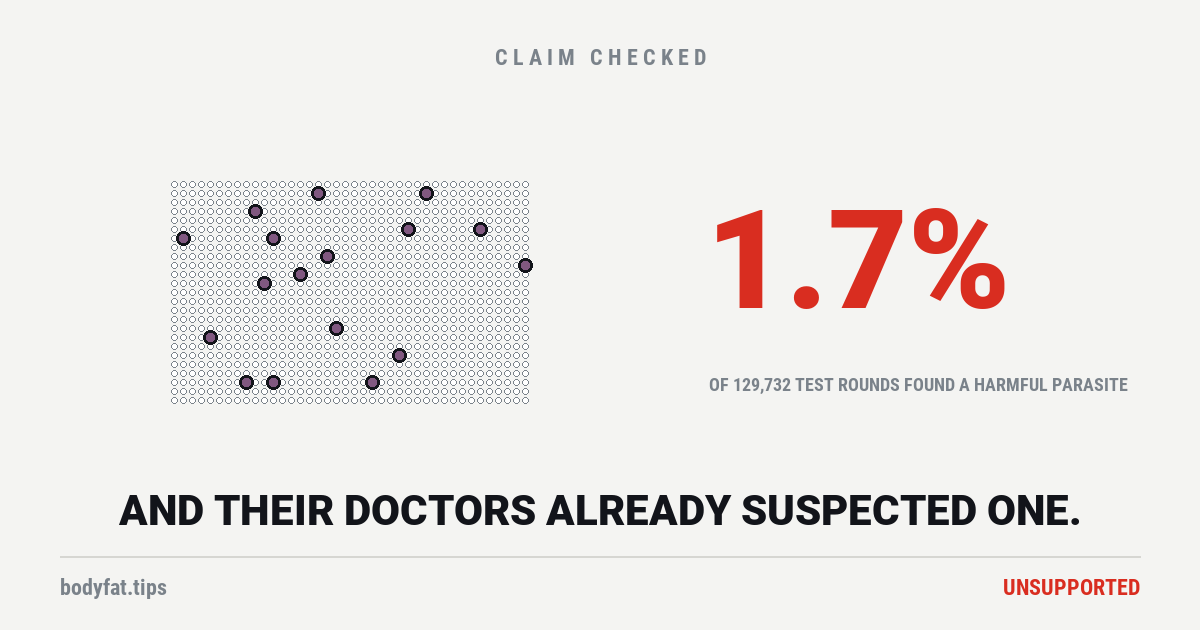
Between 1997 and 2006 a national referral laboratory in Salt Lake City, the kind that runs tests for hospitals and clinics across the country, looked for parasites in 129,732 rounds of testing that included a microscope exam, each one patient’s samples for one illness [2]. In 2,261 of them, 1.7%, the microscope or an antigen test found a parasite known to cause disease [2]. Worms of any kind turned up 123 times, by our count from its table: fewer than one round in a thousand [2]. The authors summed it up in their first sentence: parasitic infection “is uncommon in the United States” [2].
And those were not random Americans. They were people whose doctors suspected something: diarrhea that would not stop, a trip abroad, a check before a transplant [2]. If 98.3% of the people doctors are worried about come back with no disease-causing parasite, 90% is not a number about the rest of us.
Has better testing changed that? A little. In 2025 the same laboratory added an AI system that pre-screens every slide, and the worms it found more than tripled [3]. Over six months it tested 43,545 patients and found worms in 104 [3]: about one in 420, by our arithmetic, among people sent for a test.
| Laboratory and years | What was counted | What was found |
|---|---|---|
| State public health laboratories, 1987 [4] | 216,275 stool samples | Any parasite in 20.1%, including harmless species; the CDC warned against reading it as the country’s rate |
| A national referral laboratory, 1997 to 2006 [2] | 129,732 rounds of microscope testing | A disease-causing parasite in 1.7%; worms 123 times |
| The same laboratory with AI-assisted screening, March to September 2025 [3] | 43,545 patients | Worms in 104 patients |
The biggest public count is older, and it is the one closest to the sellers’ figure. In 1987 the CDC tallied 216,275 stool samples examined by state laboratories and found a parasite in 20.1% [4]. Its own report explains why that is not 20% of Americans. After Giardia, the two commonest finds were species it calls “nonpathogenic”: harmless lodgers that live in the gut without causing disease [4]. Two-thirds of the hookworms came from five states with large refugee populations, which the authors read as infections caught abroad [4]. And because the survey did not record who was tested, they warned that the results “may have been influenced by selection bias” and that conclusions about how common parasites are in the country “should be drawn with caution” [4].
Parasites in America are real. They just have names, symptoms and tests. The gut parasite that makes the most people ill is Giardia, which the CDC puts at more than a million illnesses a year, usually starting with diarrhea, with symptoms that last two to six weeks [5]. The most common worm is the pinworm, which mostly affects children, the people who look after them, and people in care homes [6]. Neither is 90% of anybody. Counting gut lodgers of doubtful harm can push the number up; how far, and why it does not help the sellers, is in the section on where the claim came from.
How do you know if your body has parasites?
A test, and usually more than one. For gut parasites the standard is a stool sample examined under a microscope, often called an O&P, for “ova and parasites”, ova being eggs [7]. One sample can miss them: laboratory guidance puts the chance of catching a disease-causing parasite in a single sample as low as 50 to 60%, and above 95% with three [7]. Antigen tests, which detect a protein a particular parasite makes, find Giardia more reliably than the microscope does [2]. Pinworm needs a different test altogether, a strip of tape pressed to the skin around the anus, because stool samples usually miss it, and there is no blood test for it [6].
Symptoms will not do it. The seller quoted above listed diarrhea, chronic constipation, skin disorders and allergies as signs of parasites [8], a list that fits most people at some point in a year. The FDA’s reply, in its 2020 letter to the same seller, was that parasitic infections are diseases “not amenable to self-diagnosis” [8].
Even the one kind of worm medicine sold without a prescription in the US works on that rule. The FDA’s regulation for over-the-counter worm medicines, written in 1986, names one active ingredient, for one worm: pyrantel pamoate, for pinworm [9]. It requires the package insert to tell buyers that the pinworms “must be visually identified before taking this medication” [9]. The regulator’s own self-treatment route starts with seeing the worm.
So, plainly: if you think you have a parasite, the answer is a clinician and a stool test, not a kit. This page is journalism, not medical advice.
What is in a parasite cleanse?
One recipe goes back to 1993. A book published that year, The Cure for All Cancers, held that cancer is caused by an intestinal parasite and prescribed a mixture of cloves, black walnut and wormwood to kill it [10]. We have not read the book; that summary is McGill University’s science office’s [10]. All three are still on the shelf. A “Parasite Purge” the FDA warned about in 2018 listed black walnut hulls beside neem leaf, garlic, pumpkin seed and elecampane root [11]. A seller it warned in 2023 offered a “Parasite Killer Bundle” that included papaya seed powder, and “Parasite Killer” capsules, sold “with the intention of killing everything in the digestive tract”, whose label listed clove powder, wormwood and black walnut hull among its ingredients, beside papaya seed, epazote and a plant called Mimosa pudica [12].
What the label cannot tell you is how much of anything is inside. At that 2023 seller, FDA inspectors found no specifications set for the finished “Parasite Killer”, nothing defining what a capsule should contain or how strong it should be, and a master manufacturing record without a complete list of its components [12]. The FDA has turned up on this site before over the same word: in 2018 it warned a detox-tea seller whose site promised to “Detoxify: Parasites”, which is in our detox tea verdict.
Has anyone tested a parasite cleanse?
Not on the people who buy one, as far as we can find. We found no trial that gave a parasite cleanse, as sold, to people who had not been diagnosed with a parasite. We searched two medical databases, the main US trial registry and the open web for one. Nor could we find a trial in people of any of the 1993 formula’s three herbs against a gut parasite. What we found for them was in lab dishes and animals: the section on worms in a 2020 review of wormwood cites sheep, rats, mice and cultures, and no trial in people [13].
One commercial herbal dewormer was tested the way it was sold, in goats. In a 2009 US Department of Agriculture trial, goats given it at the maker’s recommended dose got no measurable benefit, and ended up more anemic than goats given nothing [14].
What happened when herbs were tested on people who had parasites?
This is where herbs deserve a fair hearing. Some plants kill some parasites, and medicine knows it. Half of the 2015 Nobel Prize in medicine honored the discovery of artemisinin, a malaria drug from Artemisia annua, a plant of the same genus as wormwood [15] [13]. The other half honored avermectin, the parent of ivermectin, found in bacteria living in soil [15]. Natural is not the problem. The prize announcement records that the plant extract’s results were “inconsistent”, and that the drug came from extracting its active component [15].
The trials of herbs in people with a confirmed infection are few, small and mixed. A 2023 systematic review, a search for every study on a question read to the same rules, screened 5,393 articles on plants against human gut parasites and found three randomised trials (in which a coin-toss decides who gets which treatment) in patients with a diagnosed infection, two from India and one from Pakistan [16]. None of the three used black walnut, wormwood or clove [16]. The review’s count of three leaves out four trials in the table below that are indexed as randomised, written in English and tested against a gut parasite: the two papaya trials (the Kenyan one randomised whole schools, one to each group), the Thai formula and the mint trial. Three more in the table are indexed as randomised: the epazote juice trial, in Spanish, a language the review left out unless it had a translation, and the two myrrh trials, against a blood fluke, a worm that lives in veins rather than in the gut, which the review does not mention. Here is what the trials we read found.
| Herb | Who, and how many | Compared with | What happened |
|---|---|---|---|
| Papaya seeds in honey, one dose [17] | 60 Nigerian children with parasites but no symptoms | Honey alone | Clear stools a week later: 23 of 30 against 5 of 30 |
| Ground papaya seeds in daily school porridge, two months [18] | Three Kenyan schools, one per group; 243 children finished | Plain porridge; a single dose of albendazole | Roundworm eggs down 63.9%; down 78.8% on albendazole; up on plain porridge |
| Pippali Rasayana, two Indian plants, 15 days [19] | 50 Indians with Giardia | Dummy pill | Cleared in 23 of 25; a fifth of the dummy group recovered on their own |
| Pumpkin seeds with areca nut [20] | 45 Chinese villagers with a confirmed tapeworm | Each ingredient alone; no dummy group | 40 passed the whole tapeworm |
| A Thai traditional herbal formula [21] | 25 Thai patients with mixed worms | Mebendazole; dummy pill | Eggs down 93.7% on the herbs, 87.5% on the drug, in groups of 10 |
| Mint (Mentha crispa) [22] | 96 Brazilians with Giardia | Secnidazole, a prescription drug | Cured 47.8% against 84.0% on the drug |
| Epazote, powdered plant [23] | Mayan farmers in Chiapas, Mexico, with worms | Controls; details not in the summary | No significant effect on hookworm, whipworm or roundworm, even at doses far above traditional ones |
| Epazote (paico), a traditional worm herb, as fresh juice, three days [24] | 60 children near Huaraz, Peru, with roundworm | A single dose of albendazole; no untreated group | Roundworm eggs gone from one stool sample 15 days later in 86.7% on each; mild side effects, mostly diarrhea, in 7 of 30 on each |
| Myrrh, marketed as a drug since 2001 [25] [26] | People with a blood fluke, in two trials: 1,131 screened; 104 randomised | Praziquantel | Cured about 9% against 63 to 80% on the drug; 9 to 16% against 74 to 76% |
| Oregano oil, six weeks [27] [28] | 14 adults | No comparison group | Organisms gone in some; two of the three species were harmless ones [4] |
Read down the table and two things stand out. First, herbs can work against some parasites in people who have them: papaya seeds twice, in African children; an Ayurvedic preparation against Giardia; pumpkin seed with areca nut against tapeworm [17] [18] [19] [20]. Second, when a herb was set against the drug for the same infection, the drug mostly won. Mint cured Giardia a little over half as often as secnidazole [22]. Myrrh, marketed as a drug for a blood fluke (a worm that lives in the veins around the gut and passes its eggs in stool), cured about 9% of people against 63 to 80% on praziquantel [25], and in a second trial 32 of the 34 people myrrh had failed were cleared by praziquantel [26]. Papaya porridge cut roundworm eggs by less than one dose of albendazole [18]. There are two exceptions. A Thai formula came out a few points ahead of mebendazole, with ten people in each group [21]. And in a Peruvian village, fresh epazote juice cleared roundworm eggs from 86.7% of 30 children, as often as a single dose of albendazole did in 30 others [24]. That is one small trial, judged on one stool sample per child 15 days later, of juice squeezed from the fresh herb; the dried, powdered plant did nothing against roundworm or two other worms in Mexico [23]. Epazote also carries a danger the Peruvian trial’s own authors name: ascaridole, the main compound behind its action on parasites, is also the main one behind its toxic effects [24]. In 2024 doctors in Morocco, where the plant is a traditional remedy for fever, described a four-year-old girl who died after repeated high-dose infusions of it, given for a fever; no toxicology test was done, and the doctors attribute her death to the plant [29]. Epazote is on the label of the 2023 “Parasite Killer” [12].
The oregano oil row is there because a plain web search we ran for parasite-cleanse trials returned its patent first. Its 14 adults had no comparison group; two of its three organisms were species the CDC calls nonpathogenic; and the tablets came from the supplement company two of its three authors worked for, which had filed a patent on the use two years before the paper appeared [27] [28] [4].
Rated on its own, the claim that a particular herb can clear a confirmed gut infection would be Preliminary here: a handful of small trials, several without a dummy group, pointing different ways; the 2023 review found that none of its three trials reported how it was randomised or blinded [16]. That is a different claim from the one on the shelf. Every trial on this page measured parasites in people who had them.
Do papaya seeds kill parasites?
In children who have worms, two African trials say they can reduce them. In a Nigerian trial published in 2007, 60 children whose stool showed parasites, though they had no symptoms, were given one dose of dried papaya seeds in honey or honey alone; a week later 23 of 30 on the seeds had clear stools, against 5 of 30 on honey [17]. We could read only that trial’s summary [17].
In Kenya in 2015, ground papaya seeds went into a daily school porridge for two months [18]. Roundworm eggs, counted per gram of stool as a measure of how heavy an infection is, fell 63.9% on the papaya porridge and 78.8% on a single dose of albendazole, and rose on plain porridge [18]. The weak point is the design: each group was one school, so differences between the three schools cannot be told apart from the porridge, and the follow-up stopped at two months “due to funding limitations” [18].
A second Kenyan trial set the papaya porridge against praziquantel for a blood fluke in 400 children; it was completed in March 2022 and had posted no results when we checked on 10 October 2026, and we found no paper [30]. Papaya seed powder is sold in parasite kits [12]. Both trials counted worms in children who had them; neither can say what a kit does for an adult who has none. Rated alone, papaya seeds against worms in children who have them would be Preliminary.
Does manuka honey kill parasites?
In a lab dish, a little. A 2018 study found manuka honey slowed Giardia growing in culture, and its authors said tests in living bodies were still to come [31]. We found no trial of manuka honey against a gut parasite in people. Honey does appear in one trial on this page, as the dummy: in the Nigerian papaya trial, 5 of the 30 children given honey alone also had clear stools a week later [17].
What about ivermectin or albendazole?
They are real antiparasitic drugs, which is exactly why they are not a cleanse. In the US, albendazole and mebendazole for roundworm, whipworm and hookworm are prescription drugs, and the CDC says treatment takes one to three days and works whatever the species [32]. Ivermectin is a prescription drug approved for two worm infections, one of them in the gut; for the gut infection, its label reports cure in 64 to 100% of patients in the studies behind the approval [33]. Each is used for a diagnosed infection. Nothing on this page tells anyone to take any of them.
There is one setting where whole groups get worm medicine without a test first, and the reason is worth knowing. The World Health Organization recommends deworming children and women without testing each one only where at least 20% of them are already infected, and twice a year only where more than half are [34]. Below 20%, it says, mass treatment is not required [34]. That rule is built on a measured prevalence, the share of people actually found infected. The seller kept the shape of it, “deworm yourself and your family twice per year”, and put a guess of 90% where the measurement goes [1]. That comparison is ours.
Veterinary worm medicine is turning up in hospital case reports, mostly from people using it against cancer [35]. In 2026 doctors in Illinois described a 55-year-old woman with no symptoms who took fenbendazole, a veterinary worm medicine, every day for four weeks as a “parasite cleanse” she found online, worried by the chickens on her farm [35]. Her ALT, a liver enzyme that leaks into the blood when liver cells are damaged, went above 3,300 units per liter, against a normal ceiling of 49 [35]. She recovered over about four weeks [35].
What are the side effects of a parasite cleanse?
The side effect one seller advertised is feeling ill. “I feel like I have the flu! Why????” runs a question on the website the FDA wrote to in 2020. The answer: “This is from your body detoxing. [It] is removing parasites” [8].
Medicine has a real reaction of that shape, the Jarisch-Herxheimer reaction: chills and a fever within a day of starting antibiotics for syphilis, Lyme disease and a few related bacterial infections [36]. It is not a sign that a herbal cleanse is working, and this year the belief that it was kept one man from accepting what had poisoned him.
In August 2026 emergency doctors and poison specialists from Oregon and Washington described a 64-year-old man found confused and then unresponsive after about three months of a “parasite cleanse” of coffee enemas and rising doses of amygdalin, a compound sold as an alternative cancer remedy, which he had taken to clear “brain fog” [37]. It was cyanide poisoning; an antidote brought him round within half an hour [37]. He had followed the advice of an unlicensed “wellness entrepreneur” in another state, told his doctors his symptoms were “a Jarisch-Herxheimer reaction resulting from a successful parasite cleanse”, and left the hospital the next morning [37]. We read that report as its first page, which the publisher shows free [37].
Case reports like these two show that a harm happens, not how often. Three more harms sit in the sources above. Taken for a long time, wormwood oil may cause convulsions, sleeplessness and hallucinations, a 2020 review notes [13]. Epazote, on the 2023 kit’s label, can poison: doctors in Morocco attribute a child’s death to infusions of it [29]. And a capsule made with no specification for what it should contain, like the 2023 “Parasite Killer”, has nothing to check a batch against [12].
Can your body clear parasites on its own?
Some, yes. The CDC says someone with Giardia may not need medication to recover [5]. In the trials above, a fifth of the dummy group in the Indian Giardia trial recovered without treatment, and 5 of 30 children given honey alone had clear stools a week later [19] [17]. Pinworms are different: repeat infections are common, and the CDC says to treat everyone in the household [6]. Which one you have is a question for a test, which is the whole point.
If most people who buy a cleanse have no parasite, why do people say it worked?
This section is the desk’s own reasoning, and it is labelled as such. The laboratory counts say disease-causing parasites are uncommon in the US [2] [3]. Yet one seller’s site ran a page of “REAL parasites from REAL people” [1]. Three explanations fit what we read. Here is what each one is worth.
Answer one: some of them had something, and it went away on its own. In the Indian Giardia trial a fifth of the dummy group recovered within 15 days [19]; in the Nigerian trial 5 of 30 children on honey alone had clear stools within a week [17]; the CDC says someone with Giardia may not need medicine to recover [5]. A herb taken during that stretch gets the credit. The clearance rates are measured. That they explain cleanse testimonials is a surmise.
Answer two: what came out was not a worm. In 1985 a researcher whose field trial found a traditional worm remedy did nothing suggested that belief in it might come from old worms passing on their own just after a dose [23]. That was in a farming community where the people treated had worms to pass. In a country where few people do [2] [3], what passes during a cleanse is more likely to be something else, and laboratory guidance notes how closely food residue and mucus can resemble parasites, even under a microscope [7]. Two case reports from American meetings of gut specialists describe exactly that. In 2018 doctors in Massachusetts described a 49-year-old woman who had for years been passing what she called “rope worms”, and brought pictures of long, black, soft material that tests had found free of parasites many times over; she had been taking Mimosa pudica, sold as a herbal supplement, which she said increased the “parasites in the stool” [38]. In 2025 doctors described a 60-year-old woman in the southern US who took the same plant “to detox from parasites” and had phone pictures of long, gelatinous “worms”; her stool tests found no parasite, and the authors explain that its seeds form “viscous stringy structures” when wet “which can be mistaken as worms” [39]. The plant is on the label of the 2023 “Parasite Killer” [12]. We read both reports as their published abstracts, which is all a meeting report prints. That is a surmise with two published observations and two case reports behind it.
Answer three: the instructions make every outcome a success. The FDA’s 2020 letter quotes the seller’s own questions and answers. Seen no worms? “Yes, if you’re taking [it] as directed, it’s working. Remember that 70% of parasites are microscopic”, so “Judge the effectiveness by the way you feel overall” [8]. Feel ill? “This is from your body detoxing” [8]. Feel fine? Take the full 30 days “even after you’re feeling GREAT” [8]. There is no result that counts against the product. That is an observation about how it is sold, not a measurement of what it does, and we mark it as one.
Put the three together and here is what we think is true, stated plainly so you can disagree with it: a parasite cleanse cannot fail in the buyer’s eyes, because it is sold without a test before and without a test after.
What we could not find, and would like to: a trial that gave a parasite cleanse, as sold, to adults with no diagnosed infection, beside a dummy kit, with stool tests before and after; or a study that collected what cleanse users pass and had a laboratory identify it. Either would settle what this section can only reason about. If you know of one, the corrections line on this site is open.
Where “everyone has parasites” came from
We could not trace who first put a percentage on it. The oldest dated version we found is a bulk email of 7 August 1998, preserved in the public archive of a web-standards mailing list: “85% – 95% of Americans have ‘PARASITES’ eating away at the insides of their bodies,” with quotes attributed to scientists at a military research institute and the National Institutes of Health, no source given, and an invitation to reply for more [40].
The remedy had arrived five years earlier, in the 1993 book that blamed cancer on a gut parasite and prescribed cloves, black walnut and wormwood [10]. The real measurement available by then said something else: the CDC’s 1987 count of parasites in a fifth of the stool samples sent to state laboratories, many of them harmless species, with a warning not to read it as the country’s rate [4].
By 2017 the claim was on a seller’s homepage as “FACT: OVER 90% OF AMERICANS HAVE PARASITES”, which is how the FDA quoted it [1]. By 2020 the same seller offered a “Parasite Cleanse For Children” [8].
How does anyone get to 90%? By stretching the word. The same seller’s site declared that “BACTERIA, VIRUSES and FUNGUS (mold, yeasts) are ALL in the very broad parasite category” [8]. Even among single-celled gut organisms, the count depends on which ones you include. DNA tests find one called Blastocystis in 7% of 139 members of 50 families in Boulder, Colorado [41], 30% of 616 healthy Belgians [42] and 56% of 105 healthy Irish adults [43]. Whether it ever causes disease is disputed. The CDC’s 1987 report noted that its ability to cause disease had been “strongly questioned” [4], the 2011 laboratory study counted it as harmless [2], and in the Belgian study it was more common in healthy people than in people with inflammatory bowel disease, and went with a richer mix of gut bacteria [42]. A lodger found more often in healthy guts is a long way from an infection that needs clearing.
In 2026 it is a search habit. In search results pulled on 10 October, the top twenty for “parasite cleanse” included a lab-testing company’s “parasite cleanse protocol”, a supplement seller’s guide to detoxing your body from parasites, and a video pairing herbs with a full-moon detox. The summaries Google showed under two of the twenty read “Parasite cleanses are dietary supplements that work to detoxify the human body of parasitic infections” (a health center’s page) and “Parasites are more common than most of us think” (the full-moon video). Ask the question instead, “do parasite cleanses work”, and the AI answer at the top says no, citing mostly hospital blogs. People search the phrase “parasite cleanse” more than a hundred times as often as they ask whether cleanses work: 110,000 a month against 1,000 (from a paid keyword database, pulled 10 October 2026).
None of this is aimed at anyone who has bought a cleanse. Feeling unwell and wanting it gone is reasonable. A 90% figure with no source, sold together with the remedy for it, is not.
What this is rated, and what the rating covers
Unsupported — for the claim that over-the-counter herbal parasite cleanses rid the body of parasites most people carry, as they are sold: to people who have not been diagnosed with an infection.
Unsupported has two kinds on this site, and this claim is both at once. Its premise was tested and does not hold up: of 129,732 rounds of parasite testing doctors ordered, 1.7% found a parasite that causes disease, and the most sensitive recent screen found worms in about 1 in 420 patients tested [2] [3]. The product itself is the untested kind, with nothing tested in its favor: we found no trial of a cleanse in people without a diagnosed infection; the 1993 formula’s three herbs have no human trial against a gut parasite that we could find; and the herbs that were tried on infected people gave mixed results and mostly lost to the drug [16] [18] [22] [25] [26]. What the two kinds mean is set out here.
Rated on their own, two narrower claims would each be Preliminary: that a particular herb can clear a confirmed gut infection, and that papaya seeds reduce worms in children who have them [16] [17] [18].
What is not rated here: the 1993 claim that a gut parasite causes cancer, which this page reports and does not test; timing a cleanse by the moon; castor oil, a laxative when swallowed, whose workings are in our castor oil verdict; and the prescription drugs, which regulators approve for diagnosed infections. The frame in the section above is this desk’s reasoning from the evidence rather than a result the evidence delivered, and it is marked as ours so that you can weigh it as ours. How we read a study, and what each tier means, is set out here.
This is journalism, not medical advice, and nothing on this page tells anyone to take or stop a medicine. If you think you have a parasite, the person to see is a clinician, and the thing to ask about is a stool test, or, for a child itching at night, the tape test for pinworm [6] [7].