Sauna Benefits: The Numbers Are Striking. They Are Also All Finnish.

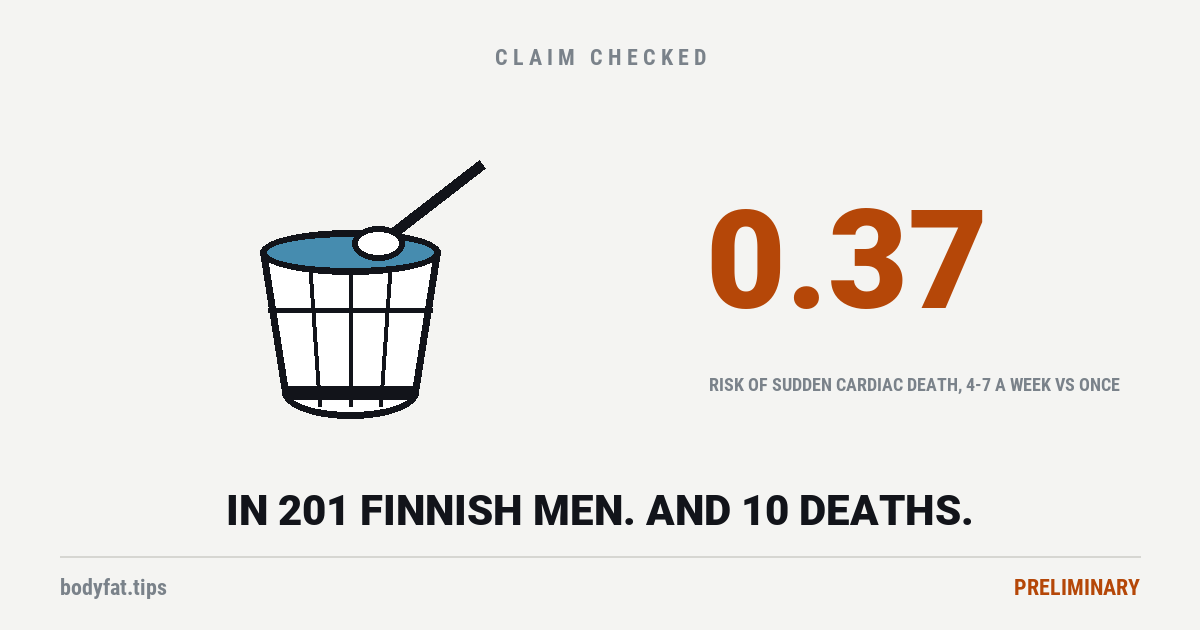
Finnish men who took a sauna four to seven times a week were 63% less likely to die suddenly of a cardiac event than men who went once. [1]
That is a startling number, it comes from a good journal, and it is the reason you have read a hundred articles about sauna.
Now look at the column nobody quotes.
| Saunas / week | Men | Deaths | Adjusted risk |
| 1 | 601 | 61 — 10.1% | reference |
| 2–3 | 1,513 | 119 — 7.8% | 0.78 |
| 4–7 | 201 | 10 — 5.0% | 0.37 |
Ten deaths
The 63% reduction is real arithmetic on real data. It is also calculated from 201 men, among whom 10 died suddenly. [1]
That is not fraud and it is not a mistake — it is simply how big the number underneath the headline is. It shows up in the confidence interval, which runs from 0.18 to 0.75. Translated: the true reduction could plausibly be 82%, or it could be 25%. Both are consistent with what they found.
One more thing the table will not tell you: the 63% is not a sum you can do on it. The raw death rates, 5.0% against 10.1%, come to about half. The 63% is the statistical model’s estimate after allowing for age, fitness, blood pressure and nine other factors; allowing for age alone, it was 51%. [1] Adjusting for fitness and the rest made the number bigger, not smaller.
The study has real strengths, and they are worth stating. It followed 2,315 men for a median of 20.7 years. The link got stronger the more they went, and stronger the longer they stayed — a dose-response pattern, which is one of the better signs that something real is happening rather than a fluke. Real is not the same as caused, though. A study like this watches what people already do; it can show that frequent saunas and fewer sudden deaths go together, not that the sauna is doing the work.
A companion analysis from the same Kuopio study followed 1,688 people aged 53 to 74 for 15 years: men from the original group, examined again in 1998–2001, and women invited to join at that visit. For deaths from cardiovascular disease (disease of the heart and blood vessels), it found the same shape, the risk falling steadily as sessions rose, with no threshold. [2]
That shape came from the men. The paper’s title says “men and women”, but among the women, two to three sessions a week carried about the same risk as once a week (hazard ratios of 0.88 to 1.03 across the paper’s four statistical models, where 1.00 means no difference), and none of the 73 women who went four to seven times died of cardiovascular causes, too few deaths to estimate anything. The top group’s figure rests on 8 deaths, all of them men. The authors put the women’s result down to small numbers, and their test for a difference between the sexes found none. So this study neither shows the pattern in women nor rules it out. [2]
All of it is Finland
Search the literature for sauna and mortality and you get Finnish paper after Finnish paper, nearly all of them drawn from one long-running study in and around Kuopio, in eastern Finland — the same region, and largely the same research group, whose name is on essentially all of it.
That is not a criticism of the work. Finland is where a sauna is ordinary life (the men in the first study averaged about two a week, and 201 of the 2,315 went four or more times), so Finland is where the question can be asked. But it means what looks like a pile of studies is closer to one body of evidence examined repeatedly than several independent teams arriving at the same place from different directions.
Those are very different things, and only one of them is replication.
The 2025 review below sets one other long-term study beside the Finnish one, and it is about hot baths, not saunas. [3] Among 30,076 Japanese adults aged 40 to 59, free of heart disease, stroke and cancer at the start and followed from 1990 to 2009, those who took a bath almost every day had a 28% lower risk of heart disease and stroke than those who bathed twice a week or less. That is another link rather than proof, and the range the true answer probably sits in runs from 16% to 38% lower. It found no link with sudden cardiac death, the outcome the Finnish headline is about, though with 53 such deaths in the whole study it could not see much either way. [4]
Then the randomised trials showed up
Here is the part that should give any sauna enthusiast pause, and it is recent.
A 2025 review pooled 20 randomised controlled trials of passive heating — saunas, hot baths, hot yoga — run for between two and fifteen weeks, and measured what actually changed in the body. [3]
Most of those trials did not use a Finnish sauna. Only three of the 20 did, and one more a similar dry sauna at 176 to 194°F (80 to 90°C). Six tested Japanese “Waon” therapy, a far-infrared sauna held at 140°F (60°C), most of them in people with heart failure. The rest were hot baths, spa and hot-spring water, hot yoga and heated trousers, and most of the people in the pool already had heart failure, artery disease or another condition. [3]
The answer was: almost nothing. No significant pooled effect on arterial stiffness, on blood vessel function, on resting heart rate, on fasting glucose, on HbA1c (long-term blood sugar), on total, HDL or LDL cholesterol, or on triglycerides. [3] The review’s summary lists heart rate variability (how much the gap between heartbeats varies; more is generally healthier) and C-reactive protein (a marker of inflammation) as well, but its results section shows only three trials measured the first and two the second, and it did not pool either. One of the three, an infrared trial in heart failure, found heart rate variability rose. [3]
That is a long list of nothing. It is not a direct test of what the Finnish men did — different heat, mostly sicker people, weeks rather than decades — but it is what happened when researchers assigned people to regular heat at random and went looking for the machinery. Mostly, they did not find it. Even the slight dip in pooled cholesterol, too small to count, leaned on a single trial of sauna added to exercise; without it, the pooled change was essentially zero. [3]
Blood pressure was the near-miss. Overall systolic pressure, the top number, dropped about 2.5 points, but the range still included zero, so it did not count. It did reach significance in two subgroups — whole-body heating, and people who already had heart problems or were at risk. [3] The authors flagged high variability between studies and told readers to be cautious, which we are passing on rather than quietly dropping.
So which is it?
Both findings can be true at once, and the honest answer is that we do not know which explanation wins.
Maybe sauna works through something nobody measured. Maybe a few weeks is too short to shift markers that took decades to matter. Or maybe — and this is the one that will not go away — men who take four saunas a week are men who are well enough to take four saunas a week.
Statistical adjustment helps with that, and it does not solve it. You cannot adjust for a lifetime of being the sort of person who is fine.
The bit advertisers pay $2.62 a click for
Every sauna death figure on this page comes from a traditional Finnish sauna: a hot room, roughly 176°F (80°C) and up, that heats the air around you. The randomised trials above mostly did not use one, and six of them were infrared.
An infrared cabin is a different machine. It runs far cooler and heats you directly rather than heating the room. Whether that produces the same effects is a genuine, open question — and it is open because the long studies have not been done. Searching for randomised trials of infrared saunas turns up short physiological comparisons, not long-term health outcomes: the six in the 2025 review ran two to four weeks, in Japanese patients, most of them with heart failure, and they sit inside the pool that came back close to empty. [3]
Google’s keyword data put US searches for “infrared sauna benefits” at about 27,100 a month, and the going rate for an ad click on that search was about $2.62, more than three times the rate on plain “sauna benefits”. That is a lot of demand pointed at a product whose long-term outcome evidence, in the healthy people buying it, does not currently exist.
To be precise, because the distinction matters: that is an absence of evidence, not evidence of absence. Infrared saunas have not been shown not to work. They have not been shown to work either, and the Finnish mortality data is not transferable to them.
How often, if you are going anyway
The research never tested a routine. It sorted the men two separate ways, and the top group in each was four to seven sessions a week and sessions lasting more than 19 minutes. [1] Each was linked to lower risk, but in separate analyses; this study never looked at the two together. Frequency was measured against men who went once a week and session length against sessions under 11 minutes, and the 12 men who never used a sauna were left out, so the study says nothing about starting from zero.
One honest wrinkle: longer sessions were linked to fewer heart deaths, but the duration finding did not reach significance for dying of anything at all. [1] We mention it because it is the sort of detail that usually gets smoothed away.
The verdict
Preliminary. The Finnish observational data is genuinely intriguing — two decades of follow-up and a clean dose-response — but it comes from one country and largely one group, the headline figure rests on ten deaths, and when randomised trials went looking for the machinery underneath it, they mostly came back empty.
This is not us telling you to stop. A sauna is pleasant, low-risk for most healthy people, and possibly does something good. What it is not, yet, is proven medicine — and the version being sold hardest is the one with the least long-term evidence behind it.
If you have a heart condition, that conversation is with a clinician, not an article. We read research; we are not your doctor.
Related: all the habits we have checked · does sauna burn fat · do cold plunges burn fat · how many steps a day · magnesium benefits
Five descriptions of the evidence were corrected on 18 September 2026 after an independent editorial review. The page said every number on it came from a traditional Finnish sauna. Most of the 2025 review’s 20 randomised trials did not use one: three used a Finnish sauna, six a far-infrared sauna at 140°F (60°C), and most of the rest hot water. The page now says so, in the trials section and the infrared one. The page said the 2018 companion study, “this time including women”, found the same shape; its own table by frequency shows it in the men only, and the page now says what the study found for women and what it cannot settle. A section heading put the infrared market at “$27,000 a month in advertising”, a figure that matches no source we hold; it now gives the $2.62 cost per click from our 7 August 2026 keyword pull, and the 27,100 a month are now called searches, not people. The evidence panel said the funding was not stated; both Finnish papers name non-profit foundation funders and declare no conflicts, and the panel now says who paid. And the search snippet presented the 63% as fewer deaths: it is the statistical model’s estimate after allowing for age, fitness, blood pressure and nine other factors, the raw death rates halve, and the page now shows both.
Also changed: the dose section now says the top frequency and session-length groups were analysed separately, against men who already used a sauna every week; heart rate variability and C-reactive protein came off the list of pooled null results, because only three and two trials measured them and the review did not pool them; a Japanese study of daily bathing, which the 2025 review sets beside the Finnish one, is now source [4]; the provenance chain now names a 2015 press release, a 2023 hospital article and a 2025 infrared sauna maker’s page, where it had quoted a sentence we could not find in print; and a related link now carries the title of the page it leads to. The rating is unchanged.