Does Sweating Burn Fat? No — 84% of It Leaves Through Your Lungs

No. And the reason is better than a flat no, because it involves you having the wrong organ in mind entirely.
Fat does not leave through your skin. It leaves through your mouth.
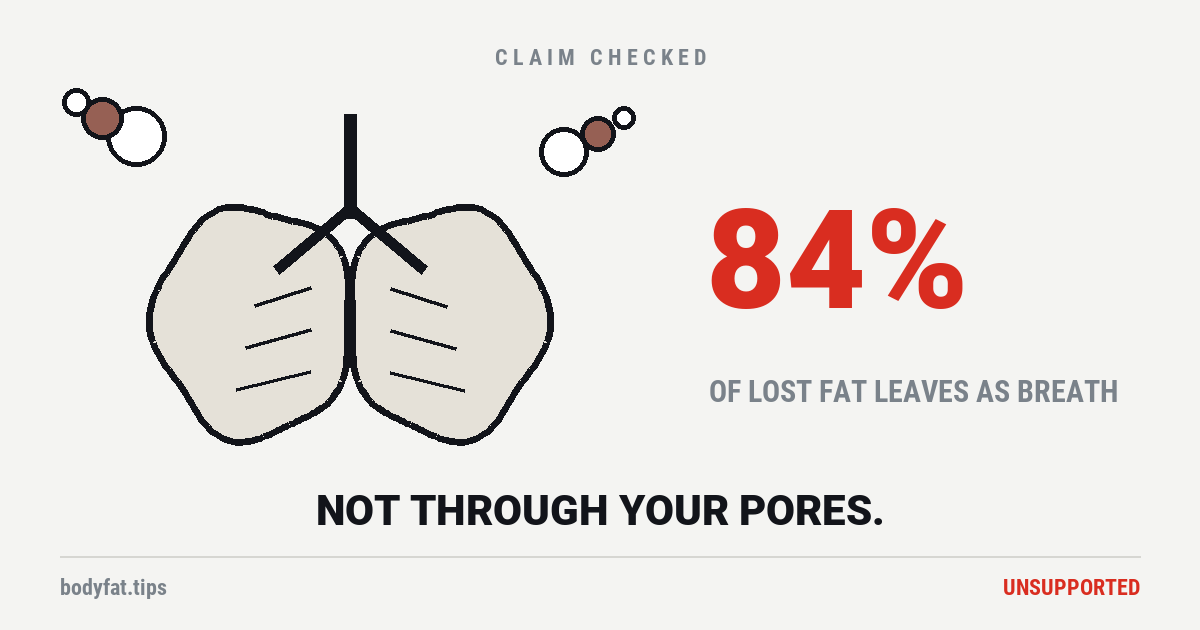
84% of it is exhaled
Work out the chemistry of burning fat and it lands somewhere most people find genuinely surprising. Oxidise 10 kg of fat and 8.4 kg of it leaves your body as carbon dioxide, through your lungs [1].
The other 1.6 kg becomes water — which can then leave in urine, faeces, sweat, breath or tears [1]. Sweat is one exit among several, for the smaller share.
The full accounting, since it is worth seeing: losing that 10 kg takes 29 kg of inhaled oxygen and produces 28 kg of carbon dioxide and 11 kg of water [1]. Your lungs are doing the heavy lifting. As the lead author put it in the University of New South Wales press release that announced the paper, none of this is obvious to people because the carbon dioxide we breathe out is invisible [3].
So which organ is getting the fat out of you? The one you are using right now without thinking about it. Your lungs are the exit, not the furnace. The fat is burned inside your cells, and most of its mass leaves by that exit, as carbon dioxide [1].
Can you breathe it out faster, then? According to the university’s press release, that was one of the questions the authors had been asked most often. The answer is no: breathing more than your metabolism needs leads to hyperventilation, which can bring on dizziness, a pounding heart and passing out [3]. What sends more carbon out is burning more. In the paper’s own worked example, swapping one hour of rest for an hour of jogging raises the carbon a person breathes out that day by about 20%, and its conclusion lands on the old refrain: eat less, move more [1].
There is essentially no fat in sweat
This is the part that ends the argument.
Eccrine sweat — the kind that produces most of your sweat — is water and electrolytes. Sodium and chloride at 10 to 90 mmol/L each (millimoles per litre, a measure of how much is dissolved), then lactate at 5 to 40, urea at 4 to 12, potassium at 2 to 8 and ammonia at 1 to 8, with trace metals such as iron, copper and zinc down in the micromolar range, a unit a thousand times smaller [2].
Lipid is not a meaningful constituent. Your apocrine glands — a different, far less numerous set — do secrete lipids. The glands responsible for a soaked shirt do not [2].
You cannot sweat out something that is not in the sweat.
So why does the scale move?
Because you are lighter when you are drier. That is the entire mechanism, and it reverses the moment you drink.
We have now checked this claim in three different costumes. The sauna version loses you about a pound and a half of fluid in an hour, and the researchers who measured it called it fluid in their own conclusion. The neoprene-wrap version sells on how wet you get. And the low-carb version is the same water arriving as a first-week miracle.
Same trick, three products. A scale that moves because you are dehydrated is not reporting fat, and everyone selling you the sweat knows which number you will step on afterwards.
The part that is true, and gets stretched
Sweating hard during exercise is not meaningless. It is a signal that you are producing heat, and producing heat generally means you are working.
But it is a signal, not a measure. How much you sweat depends on the temperature, the humidity, what you are wearing, how hydrated you are and how your body happens to be built. Two people doing identical work in the same room will not produce identical puddles, and the wetter one has not necessarily burned more fat.
Which is why the trick works so well in reverse: put on a rubber suit and you can sweat enormously while doing almost nothing at all.
What to actually do
Stop using sweat as a scoreboard. It measures your cooling system, not your energy expenditure, and the two come apart the moment anything about your environment changes.
Do not weigh yourself straight after a hot session and count the difference. Rehydrate and the number comes back, because it was water, and the researchers who measure this say so plainly.
And if a product is selling you extra sweat as the mechanism — a suit, a belt, a wrap — it is selling you the one part of the process that has no fat in it.
Breathe out. That is where most of it goes. Eating less and moving more, not breathing harder, is what sends more of it there.
This page was corrected on 15 September 2026 after an independent editorial review. The evidence panel said industry funding was “not reported in the sources read.” It is reported in the sweat-composition review itself: the Gatorade Sports Science Institute, a division of PepsiCo, paid for that review and employs both of its authors. The panel now says so. The page also called the lungs “the fat-burning organ” and closed on “Breathe out,” which made breathing sound like a way to lose fat. The BMJ analysis calls the lungs the primary excretory organ for fat, meaning the main way out: most of its mass leaves as carbon dioxide once it has been burned in the body’s cells. The authors’ own press release, now listed as a source, says breathing more than your metabolism needs causes hyperventilation, not weight loss. Both passages now say that.
The provenance chain named those same two papers as the research the claim came from and the place it spread, when both refute it. We could not trace a founding study, and the chain now says so; it names a dated record of the practice instead, a February 1998 CDC report on wrestlers sweating weight off in saunas, steam rooms and vapor-impermeable suits, published after three college wrestlers died doing it in late 1997. Also changed: the sweat figures now follow the order of the review’s table (lactate and urea come above potassium, not below it); a line the page credited to the paper is now credited to the press release it came from; the chain no longer calls sweat the only visible way water leaves the body; and three phrases now claim no more than the sources do (“most” of your sweat rather than “nearly all”, one exit “among several” rather than five, and a wetter person has not necessarily burned more fat). The rating, Unsupported, is unchanged.