Blue Zones: Ten Places Carry the Name. Three Have the Data, Two Are Fading.

The pitch is irresistible. Five or so places on earth where people routinely reach a hundred, and if you eat what they eat and live how they live, so might you.
In 2025 a team ran a scoping review of the peer-reviewed research on them — a map of what has been studied, rather than a pooling of results. [1] They found ten regions that have been called Blue Zones. Here is how those ten actually stand up.
| Region | Status |
| Ogliastra · Okinawa · Nicoya | Well characterised — higher longevity than national averages; fading in Okinawa and Nicoya |
| Ikaria · Cilento | High life expectancy |
| A Dutch municipality | More exceptionally long-lived than neighbours |
| Martinique / Guadeloupe | A higher rate of deaths at 110-plus than mainland France (21–24 per million, against 3) |
| Menorca | inconclusive |
| Rugao | More reach 90–99; fewer reach 100 |
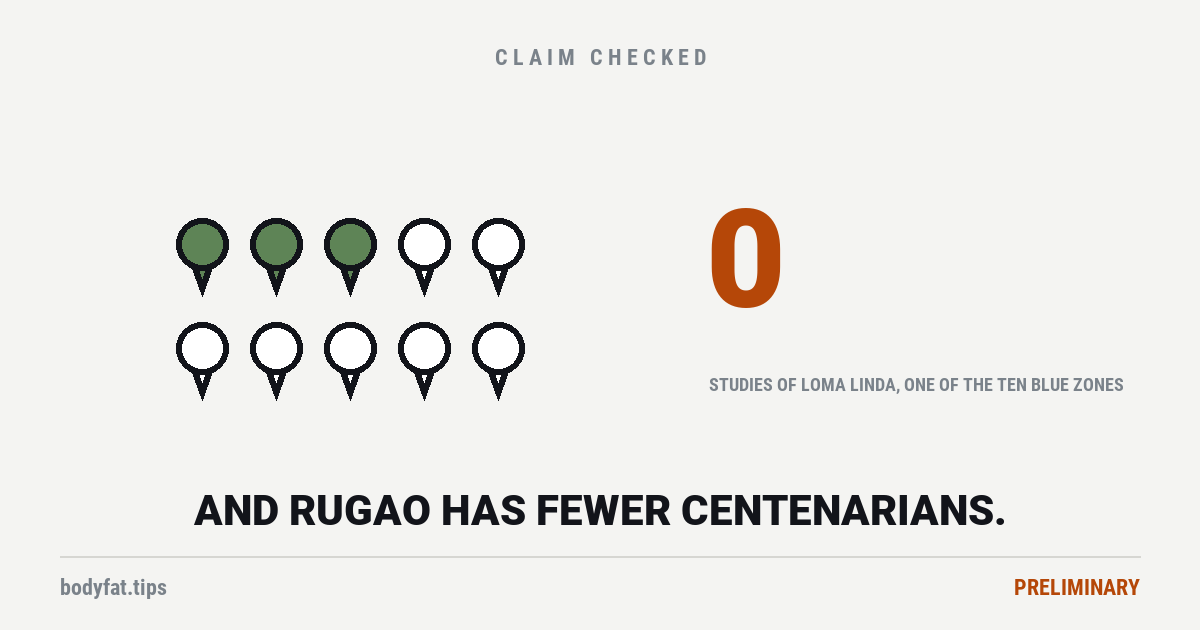
| Loma Linda | No studies have been conducted |
Start at the bottom
“No studies have been conducted in Loma Linda.” [1]
That is a direct quote. A region that has been cited as a Blue Zone for the better part of two decades has, on a systematic search of the scientific literature up to February 2025, nothing published examining it as one.
The review itself notes the town’s Seventh-day Adventist community [1], and the Adventists have been studied, just not as a place. 34,192 of them across California, followed from 1976 to 1988, could expect at 30 to live about 7 years longer than other white Californians if they were men, and about 4 years longer if they were women [5]. That is a finding about a religious community’s way of life, observed rather than tested and measured statewide, not about a Blue Zone.
And one line above it: Rugao has fewer centenarians. [1] People in its central zone are more likely than others in the region to reach their nineties, but fewer go on to 100, and the review keeps Rugao under investigation rather than dropping it [1].
Neither of those is a small clerical matter. Loma Linda is one of the five places the Blue Zones brand calls its original Blue Zones. Rugao is a later candidate, studied as a possible one since 2007.
Three of them, though, are real
This is where a lazier article would declare the whole thing a hoax, and we are not going to, because the review does not support that either.
Ogliastra in Sardinia, Okinawa, and Nicoya in Costa Rica are the three the review rates well characterised, with official data showing higher longevity than their national averages. [1] Ikaria and Cilento show high life expectancy. A Dutch municipality has more exceptionally long-lived residents than its neighbours. Those are real findings from real data.
But that advantage belongs to particular generations, and in two of the three it is fading. In Okinawa, people born before the Second World War have lower death rates than their peers elsewhere in Japan; people born after it have higher ones [3]. The defence itself says Okinawa “no longer qualifies” as a Blue Zone [2].
In Nicoya, the advantage was found only in men born before 1930 [2]. Nicoyan men born in 1905 died at rates 33% lower than other Costa Ricans once past 60; men born in 1945 died at rates 10% higher, and the hotspot has shrunk to a small corridor in the south of the peninsula [4]. The Sardinian zone, the defence says, “remains intact” [2].
So the honest summary is not “Blue Zones are fake”. It is that ten places now carry the label, three of them have the data behind it, and two of those three are losing it.
The argument about whether anyone is as old as they say
There is a live scientific dispute here, and it is worth understanding rather than picking a side in.
The challenge goes like this: exceptional-age records tend to cluster where birth registration was poor and where there is an incentive to keep a dead relative’s pension arriving. The best-known version of that argument remains a preprint — it has not been through peer review — though it did win an Ig Nobel prize in 2024, which is an award for research that makes you laugh and then think.
We are not going to build a verdict on an unpublished manuscript. What we can do is read the published rebuttal, which is more interesting anyway.
The defenders concede the hard part
In 2025, two researchers — one of them associated with the original Sardinian work — published a defence of Blue Zones demography in The Gerontologist. [2] Their conclusion is unambiguous: the regions have been extensively validated by cross-checking multiple independent documentary sources, and the age data are “valid and reliable”.
Read the sentence they use to get there, though:
“As discovered a century and a half ago, most self-reported claims of exceptional longevity are false.” [2]
That is the defence talking. Both sides of this argument agree that when somebody says they are 110, the base rate says they are probably not. The defence adds that a Blue Zone was never about 110-year-olds: it is defined by the share of people who reach 90 [2]. The disagreement is only about whether the checking done in these specific places was good enough to catch it.
Which is a much narrower question than the one the concept is usually sold on, and it is not settled.
Not even inside the field. A 2024 study of Okinawa, co-written by the demographer who coined the term “Blue Zone”, judged there was “a fairly high risk” that ages in the island’s family registers, rebuilt after most were destroyed in the war, may differ somewhat from people’s real ages, and called for them to be checked again from individual records. It still concluded that the older generations’ advantage was too large to be explained away that way [3].
And the defence’s own case for Ikaria cites an unpublished 2009 report for National Geographic [2] — the kind of document this page will not build a verdict on — while the review, which counted only peer-reviewed studies, keeps Ikaria under investigation [1].
The Blue Zones brand, for its part, calls the defence “independent confirmation” on its website, and says it “was not published or produced by Blue Zones” (checked 18 September 2026). The paper declares no conflict of interest. Its acknowledgments thank the brand’s founder for comments on earlier drafts, and it describes the founder joining a 2007 visit to check the ages of claimed centenarians in Nicoya [2]. Thanking a reader of drafts is ordinary. “Independent confirmation” is the brand’s phrase, not the paper’s.
The leap, and who is making it
Here is the part that gets least attention, and it matters most to you.
Suppose the ages are all correct. Suppose Ogliastra, Okinawa and Nicoya really did produce more centenarians among people born before the Second World War. That still does not tell you why.
The review’s summary names five factors associated with longevity in these regions: diet, physical activity, climate, genetic factors and geographical isolation. [1] Its tables add others, from family ties and sleep to community life, and it warns that some of these factors rest on small or unrepeated studies, so they remain hypotheses [1].
Read that list again. Three of the five are things you cannot adopt. You cannot move your genes. You cannot take up their climate. You certainly cannot arrange to have been born somewhere isolated enough to grow its own dialect, which is how the defence describes the island zones [2].
The two you can copy — diet and activity — are listed alongside three you cannot, with no ranking between them. Turning that into a programme means setting the other three aside. Is there a case for doing that?
The defence makes one. Studies that looked in these populations for the gene variants linked to long life elsewhere found no excess of them, it notes, and that “does seem to make it more likely that lifestyle, diet, exercise, and community practices play a more important role” — while conceding in the same paragraph that it “does not disprove a genetic contribution” [2]. So the case rests on an absence: genes that were looked for and not found in excess. It is not a measurement of anybody’s diet.
The review is more cautious. The traditional diets have been associated with longer life, it says, “although there is still insufficient evidence in this regard” [1]. And neither paper reports anyone taking up these habits and being followed to see whether they lived longer. The review set aside the engineered “Blue Zones” projects, such as the one in California’s Beach Cities, as outside its scope [1].
The verdict
Preliminary. Three of the ten regions are well characterised, and two of those three are fading; one has never been studied as a Blue Zone; one gets more people to 90 but fewer to 100; and whether the recorded ages are trustworthy is the subject of an active argument in the journals right now.
That is not a hoax and it is not a blueprint. It is an interesting observation about a handful of places, wrapped in a much larger claim that the evidence does not carry.
None of which makes beans, walking and seeing your friends a bad idea. It just means the reason to do them is not that a hundred-year-old in Sardinia does.
Related: ikigai · all the habits we have checked · how many steps a day · sauna benefits · is olive oil good for you
Several statements on this page were corrected on 18 September 2026 after an independent editorial review. The page said Ogliastra, Okinawa and Nicoya “show” higher longevity than their national averages, which is how the scoping review’s summary puts it; the review’s full text and the published defence both report that the advantage in Okinawa and Nicoya is fading, and the defence says Okinawa no longer qualifies as a Blue Zone. The page now says whose longevity it was, and adds a 2024 study of Okinawa and a 2023 study of Nicoya as sources [3] and [4]. A section headed “The leap nobody is defending” said nothing in the literature justified setting climate, genes and isolation aside; the defence makes that argument, from the absence of an excess of known longevity genes, and the section now reports it with the defence’s own caveat. A line about nobody marrying in from outside “for three hundred years” had no source and has been removed.
The evidence panel said the sources did not state their funding. The defence does: one author’s research is supported by Protective Life Corporation, a US insurance company, and the US National Institute on Aging, and the other’s by the University of Sassari, and its acknowledgments thank the founder of the Blue Zones brand for comments on drafts. The panel now says so, and the dispute section notes the acknowledgment; it also now says that a Blue Zone is defined by the share of people reaching 90, that a 2024 Okinawa study called for ages there to be checked again, and that the defence’s Ikaria evidence includes an unpublished report. Also corrected: the review is a scoping review of peer-reviewed studies, not a systematic review of everything published; Rugao has more people reaching 90 but fewer reaching 100, not fewer centenarians than average; Loma Linda has never been studied as a Blue Zone, which is narrower than “never been studied”, since the Seventh-day Adventists behind its name were studied across California (now source [5]), and it is one of the brand’s five original Blue Zones rather than one of ten the concept was built on; and Martinique and Guadeloupe have a higher rate of deaths at 110-plus than mainland France, not more deaths. The headline and search description changed to match. The rating is unchanged.