Fish Oil Benefits: For Your Heart, the Real One Needs a Prescription

There is a genuine, well-evidenced benefit to omega-3. The American Heart Association wrote a science advisory recommending it.
It requires four grams a day, a prescription, and a blood test result most people buying fish oil have never had. [2]
The capsule in your cupboard is a different proposition, and it has been tested about as thoroughly as anything in nutrition.
One fence before the evidence: this page rates the heart claim. Omega-3 in pregnancy is a separate question with a different answer — a 2018 Cochrane review found about 11% fewer births before 37 weeks, across 26 trials, and rated that high-quality evidence [6] — and we have not rated it here.
What 86 trials and 162,796 people found
In 2020 Cochrane — the organisation that exists to pool trials without a commercial stake in the answer — updated its review of omega-3 and cardiovascular disease. Eighty-six randomised trials. Doses from half a gram to more than five grams a day. Follow-up from one year to more than seven. [1]
| Outcome | Result | Certainty |
| Dying of anything | little or no difference | High |
| Cardiovascular events | little or no difference | High |
| Stroke | probably little or no difference | Moderate |
| Cardiovascular death | probably little or no difference | Moderate |
| Coronary heart disease deaths | may be slightly lower (10%) | Low |
| Coronary heart disease events | may be slightly lower (9%) | Low |
| Eating fish, rather than capsules | little evidence | — |
Look at the right-hand column, because it is the part that almost never gets quoted. Certainty is a separate judgement from the result: it is how much confidence the evidence itself deserves, given how the trials were run and how consistent they were.
On dying of anything, and on cardiovascular events, the answer is little or no difference — at high certainty. That is the strongest grade Cochrane issues. It does not mean the question is closed forever, but it does mean more trials of the same kind are unlikely to change the answer.
Two small signals survived, both at low certainty. Coronary heart disease deaths came out about 10% lower, with a number needed to treat of 334; coronary heart disease events about 9% lower, with a number needed to treat of 167. That last figure means: if 167 people take fish oil, one of them avoids an event who otherwise would not have. The other 166 get nothing.
Cardiovascular death as a whole came out 8% lower on paper. The reviewers read that same evidence as “probably makes little or no difference”: in the best-run trials the effect moved closer to none at all, and the grade stops at moderate rather than high only because the range of plausible answers still takes in a benefit worth having. [1]
And one line from the review deserves its own paragraph, because it undercuts the advice everybody gives: “There is little evidence of effects of eating fish.” [1]
The biggest trial of the capsule people actually buy
VITAL is the one designed to answer the consumer question directly: 25,871 healthy older adults, a one-gram fish oil capsule a day carrying 840 mg of EPA and DHA, the two omega-3s fish oil is sold for, versus placebo, for a median of 5.3 years. [3]
Major cardiovascular events: 386 on omega-3, 419 on placebo. Hazard ratio 0.92, and a p-value of 0.24 — comfortably inside the range you get from chance. Cancer: no difference either.
There is one result in VITAL worth being careful with. Total heart attacks came out significantly lower on omega-3, a hazard ratio of 0.72. [3] That is a real number and an interesting one.
It is also a secondary endpoint inside a trial whose primary endpoint was null. Trials measure many things; some of them come out significant by chance, which is precisely why one outcome is nominated in advance as the one that counts. When the headline result is negative and a sub-result is positive, the honest description is “worth following up”, not “fish oil prevents heart attacks”.
So what is the real benefit?
Triglycerides. A type of fat in your blood, separate from cholesterol, and high levels are their own cardiovascular risk factor.
The American Heart Association’s 2019 advisory is unambiguous: at 4 grams a day, omega-3 agents reduce triglycerides by 30% or more in people with very high levels. In the milder range, EPA-only and EPA-plus-DHA work about equally and neither raises LDL cholesterol. [2]
Note the dose. The advisory is explicitly about pharmacological amounts — above 3 grams a day of combined EPA and DHA. A standard supermarket fish oil capsule contains a fraction of that, and the label figure is usually total fish oil rather than actual EPA and DHA, which makes the gap wider than it looks.
There is also a trial showing hard outcomes at that dose. REDUCE-IT randomised 8,179 patients to 4 grams a day of a purified prescription EPA drug or placebo, and cut major cardiovascular events from 22.0% to 17.2% — a 25% relative reduction. [4]
Every word of the entry criteria matters, though. Those patients had established cardiovascular disease or diabetes with risk factors, were already taking a statin, and were selected for elevated triglycerides. It is a prescription drug trial in high-risk patients. It is not evidence for a gram of fish oil in a healthy forty-year-old, and it is regularly cited as though it were.
Its result has not been repeated with the other kind of prescription omega-3. STRENGTH gave 13,078 statin-treated, high-risk patients with high triglycerides 4 grams a day of an EPA-plus-DHA prescription, against corn oil. It was stopped early, when an interim look found little chance of benefit: 12.0% had a major cardiovascular event on the drug, 12.2% on corn oil. [7]
REDUCE-IT’s placebo is the other open question. It was mineral oil, chosen to match the drug’s colour and consistency, and the trial’s own paper argued that the small cholesterol difference between the groups was unlikely to explain a 25% benefit. [4] A later substudy, paid for by Amarin, which makes the drug, reported that in the first year, among people taking the mineral oil, LDL cholesterol rose about 11% and C-reactive protein, a blood marker of inflammation, about 22%, while the drug group barely moved. Its authors called the effect of that on the headline result “uncertain”. [8]
Both sides have since put numbers on it. A Danish team took the cholesterol, triglyceride and inflammation changes seen in both arms of REDUCE-IT and asked what they should have done to heart risk, using 5,684 people from a Copenhagen population study who would have qualified for the trial. Those changes predicted about a 12% lower risk, where the trial found 25%, and the team concluded the different placebos explain part of the gap between REDUCE-IT and STRENGTH, but not all of it. [9] A review of 80 studies that used mineral oil as a placebo found its effects on those markers inconsistent and concluded it does not meaningfully change the result; six of its ten authors were Amarin employees. [10]
Nobody has settled it, and this page will not pretend to. What it does mean is that the one positive trial at this dose has an open question over its comparison group, and the trial with a different drug and a different placebo found nothing. Both trials were paid for by the companies whose drugs they tested; one found a benefit and one did not.
The side effect now on the prescription label
This is the part of the fish oil story that has genuinely changed, and the marketing has not caught up.
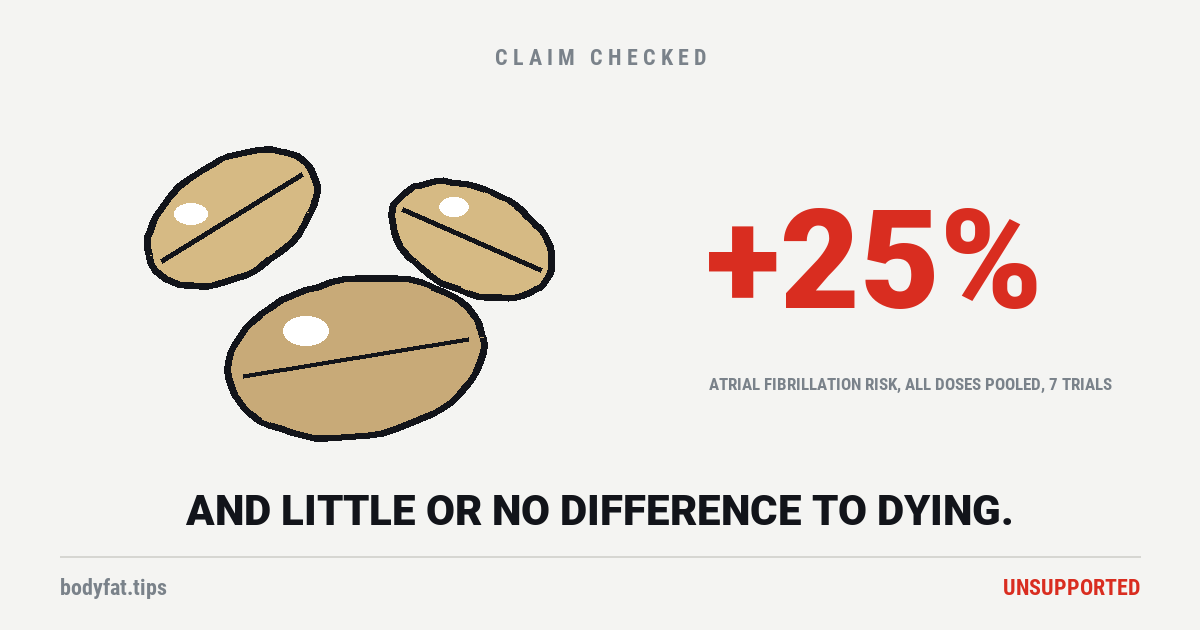
In 2021, researchers pooled seven cardiovascular outcome trials covering 81,210 patients and looked specifically at atrial fibrillation — an irregular heart rhythm that raises stroke risk and often needs lifelong treatment. [5]
Omega-3 supplementation was associated with a 25% higher risk of atrial fibrillation. Hazard ratio 1.25, confidence interval 1.07 to 1.46.
And it was dose-dependent, which is the detail that makes it credible rather than a fluke. Above one gram a day: hazard ratio 1.49. At one gram a day or below: 1.12 — smaller, but with a confidence interval of 1.03 to 1.22, which still does not include “no effect”. The test for whether the two doses differed came out at p < 0.001, and a meta-regression found the risk climbing with every extra gram. [5]
We should report the tension here rather than tidy it away. Cochrane’s review found little or no difference in “arrhythmia” as a category, one that includes atrial fibrillation — risk ratio 0.99, though at low certainty. [1] The 2021 analysis asked a narrower question, about atrial fibrillation specifically, in a smaller set of trials: five of its seven are also in Cochrane’s pool, and the other two reported after Cochrane’s search. Both are on the record. The narrower, dose-responsive one is the one we would want a doctor to know about.
A larger analysis has since gone further. Published in 2026, it pooled 35 trials and 114,592 people, including atrial fibrillation counts that some trials had never published. It found a clear increase in one group only: people already at high cardiovascular risk taking more than 1.5 grams a day, where about 8 more in every 1,000 developed atrial fibrillation. At lower doses, and in lower-risk people, it found no increase it could tell apart from chance. The project was part-funded by the omega-3 industry’s own advocacy group, and three of its authors disclosed ties to omega-3 businesses. [11]
Put the two atrial fibrillation analyses side by side and they agree at the top of the dose range and disagree at the bottom. The top is where regulators have acted. In September 2023 the European Medicines Agency’s safety committee added atrial fibrillation as a common side effect of omega-3-acid ethyl ester medicines, the prescription capsules for high triglycerides, and said the risk is highest at 4 grams a day. [12]
The verdict
Fish oil supplements do not protect your heart, and that finding carries Cochrane’s highest certainty grade on both dying and cardiovascular events. The largest trial in healthy adults missed its primary endpoint. Small signals on coronary events survive at low certainty and a number needed to treat of 167.
Against that, more atrial fibrillation, and the risk rises with the dose. Above a gram a day, the 2021 pooling found 49% more. At a gram a day or less it found 12% more, and the larger 2026 analysis found no increase below 1.5 grams that it could tell apart from chance.
The real benefit is narrow and it is genuine: at four grams a day, omega-3 lowers triglycerides substantially, and the American Heart Association recommends it for exactly that. If you have high triglycerides, that is a conversation with your doctor about a prescription — not a reason to buy a bigger tub. Ask which one, too: the prescription trial that cut heart events used EPA alone, the EPA-plus-DHA trial found nothing, and the atrial fibrillation risk is highest at the 4-gram dose.
If you do not, the honest summary is that you are taking a supplement with a high-certainty null on the outcome you care about and a dose-dependent signal, faint or absent at supplement doses, on one you have probably never considered.
Choosing between fish oil and krill oil? We checked that one too: across 64 randomised trials, krill oil and fish oil did the same things to triglycerides and cholesterol.
Related: fish oil vs krill oil · do testosterone boosters work · ashwagandha benefits · berberine benefits · how to increase testosterone naturally
This page was corrected on 18 September 2026 after an independent editorial review. The evidence panel said industry funding was “not stated in the sources relied on here”. It was stated, and it mattered: REDUCE-IT, the one trial on this page with a positive heart result, was paid for and analysed by Amarin, the company that makes the drug it tested. The panel now gives the funding of every source. The Cochrane table also showed cardiovascular death as “8% lower” at moderate certainty, when the reviewers read that same evidence as “probably makes little or no difference”. The table now uses the reviewers’ own words for every outcome and adds coronary deaths, the second of the two small signals they did find.
Also added: STRENGTH, the 4-gram EPA-plus-DHA trial that found no benefit, and the published dispute over REDUCE-IT’s mineral-oil placebo; a 2026 analysis of 35 trials that found the atrial fibrillation risk clear only at high doses in high-risk patients, so the verdict now gives that risk by dose rather than as a single 25%; the European Medicines Agency’s 2023 labelling decision, which is why the heading no longer says nobody mentions this side effect; a line saying this page rates the heart claim and not omega-3 in pregnancy, which the headline now says too; a link to our krill oil page, which an old note said was still to come; and a provenance chain rebuilt on the 1999 trial, the 2002 recommendation and the FDA label claim that the heart advice actually came from. The rating is unchanged.