4.66sleepiness (1 to 9) after ten days of 450 mg of caffeine a day, against 4.72 after ten days of dummy pills and 5.27 in the two days after switching to them; 20 men who normally had 300 to 600 mg a dayMOSTLYSupported

Why Does Caffeine Make Me Sleepy? It Doesn’t While It’s Working. Going Without It Does, and the Next Cup Mostly Just Gets You Back to Normal.
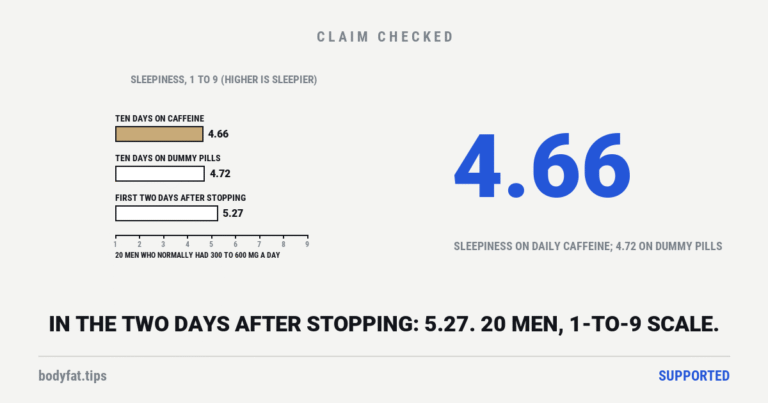
Three bars of sleepiness on a 1-to-9 scale in 20 regular caffeine users: 4.66 after ten days of caffeine, 4.72 after ten days of dummy pills and 5.27 in the two days after switching from caffeine to dummy pills; beside them the figure 4.66

Caffeine doesn't make you sleepy while it works. Going without it does, once you're used to it: regular users grew sleepier within a day or two of swapping it for dummy pills, and the next cup mostly just got them back to normal. In the trials we read that followed people for hours after a single dose, the caffeine group did not end up sleepier than the dummy group.
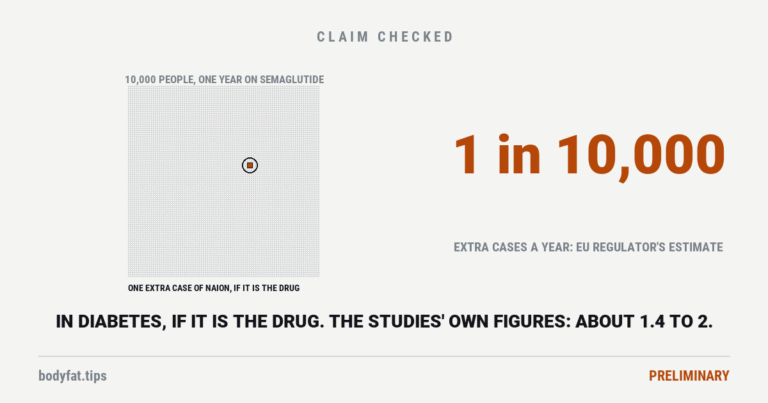
1 in 10,000extra NAION cases per year on semaglutide in type 2 diabetes, the EU regulator's estimate from records studies; the trials are too small to confirm or rule it outMAYBEPreliminary

Does Ozempic Cause Vision Loss? The FDA Now Warns of a Rare Optic-Nerve Stroke on Every GLP-1 Drug: 10 Trial Cases Against 5, and Cause Not Shown

A grid of 10,000 small squares, one person each for a year on semaglutide, with one square circled: about one extra case of the optic-nerve stroke NAION, the European regulator's estimate for people with type 2 diabetes, if the drug is the cause; beside it the figure 1 in 10,000

On 9 November 2026 the FDA required a warning about NAION, a rare stroke of the optic nerve, on every GLP-1 drug, Ozempic, Wegovy, Mounjaro and Zepbound among them. It calls the risk potential: across 126 trials it counted 10 cases on the drugs against 5 on placebo. In type 2 diabetes, records studies find NAION about twice as often on semaglutide, roughly one extra case per 10,000 people a year. Sudden vision loss, or sight that worsens quickly, in either eye needs same-day care.

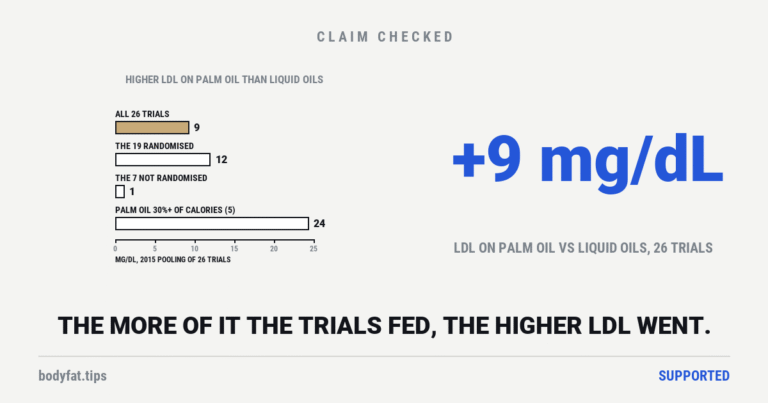
9 mg/dLhigher LDL on palm oil than on liquid vegetable oils, pooled across 26 trials (0.24 mmol/L); about 12 mg/dL in the 19 randomised onesMOSTLYSupported

Is Palm Oil Bad for You? Against Liquid Oils It Raised LDL About 9 mg/dL in 26 Trials. The Cancer Worry Rests on Animal Studies.

Bars of how much higher LDL was on palm oil than on oils low in saturated fat in a 2015 pooling: about 9 mg/dL across 26 trials, 12 in the 19 randomised, 1 in the 7 not randomised and 24 where palm oil was 30% or more of calories; beside them the figure +9 mg/dL

Eaten in place of liquid vegetable oils, palm oil raised LDL cholesterol about 9 mg/dL in a pooling of 26 trials, more in the randomised ones and at higher doses. Against butter it may do better. We found no trial that counted heart attacks, and the cancer worry rests on animal studies of a refining contaminant.

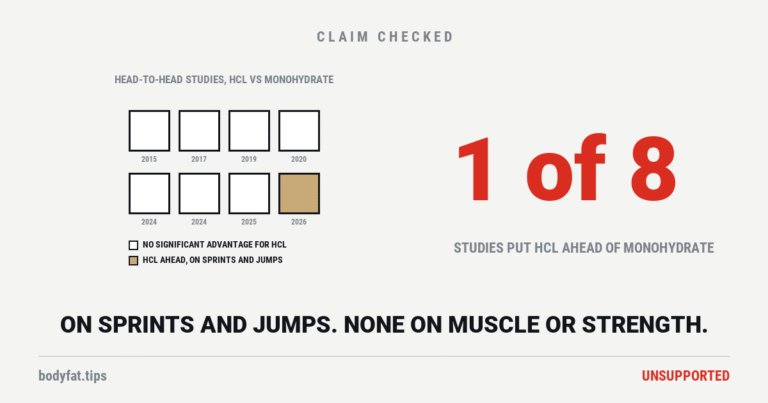
1 of 8studies against monohydrate put HCl ahead, on sprints and jumps; none on muscle or strengthNOUnsupported

Creatine HCl vs Monohydrate: Eight Studies Compared Them, and Only One Put HCl Ahead, on Sprints, Not Muscle

Eight tiles in date order from 2015 to 2026, one per study comparing creatine HCl with monohydrate: seven open, no significant advantage for HCl, and the 2026 tile filled, HCl ahead on sprints and jumps; beside them the figure 1 of 8

Creatine HCl dissolves 38 times better in water. In eight small studies against monohydrate, seven found no significant advantage and one found HCl ahead on sprints and jumps; none found more muscle or strength. The absorption claim rests on a patent's two-hour blood test.

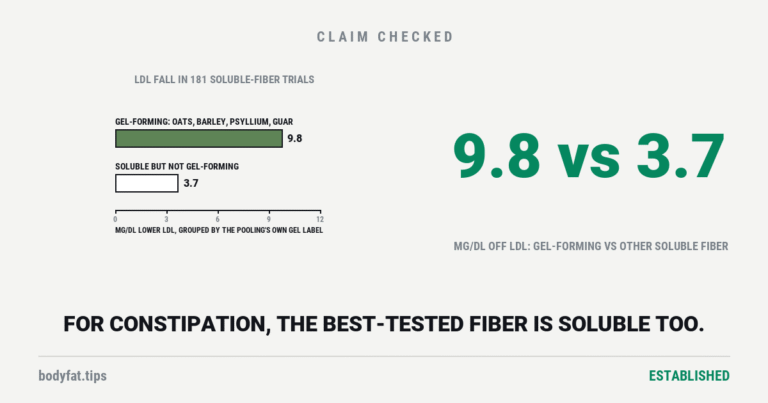
9.8 mg/dLlower LDL in the 141 gel-forming comparisons, of 199, as its authors labelled them, in a 2023 pooling of soluble fiber supplement trials; the 54 comparisons of soluble fibers that do not gel: 3.7YESEstablished

Soluble vs Insoluble Fiber: The Gel-Forming Kind Lowers LDL, About 10 mg/dL in Trials. For Constipation, the Best-Tested Fiber Is Soluble Too.

Two bars of LDL cholesterol lowering in a 2023 pooling of 181 soluble-fiber trials: 9.8 mg/dL for the gel-forming fibers in oats, barley, psyllium and guar, and 3.7 for soluble fibers that do not form a gel; beside them the figure 9.8 vs 3.7

In a 2023 pooling of fiber-supplement trials, the gel-forming soluble kinds lowered LDL cholesterol about 9.8 mg/dL and the soluble kinds that do not gel about 3.7. For constipation the best-tested fiber is psyllium, a soluble one; wheat bran, the classic insoluble fiber, had one small trial in the newest pooling we could read. Most foods carry both kinds.

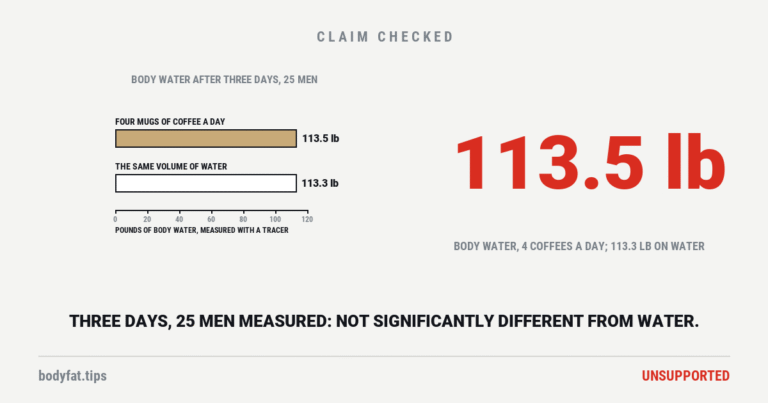
113.5 lbaverage total body water on four mugs of coffee a day for three days, against 113.3 lb (51.4 kg) on water, in 25 of 50 men who already drank coffee: not significantly differentNOUnsupported

Does Caffeine Dehydrate You? Not at Ordinary Intakes: in Trials, Coffee and Tea Hydrated About as Well as Water. The Extra Urine Shows Up at Big Doses.

Two bars drawn to scale from zero: 113.5 pounds of body water after three days of four mugs of coffee a day and 113.3 pounds after three days of water, in 25 men measured with a tracer; beside them the figure 113.5 lb

Caffeine makes you pass a little more urine for a few hours: about 3.7 fl oz on average across 16 studies. At ordinary intakes the cup brings more water than that. In 50 men drinking four mugs of coffee a day for three days, body water, measured in 25 of them, was not significantly different from three days on water. Big doses at once are another matter.

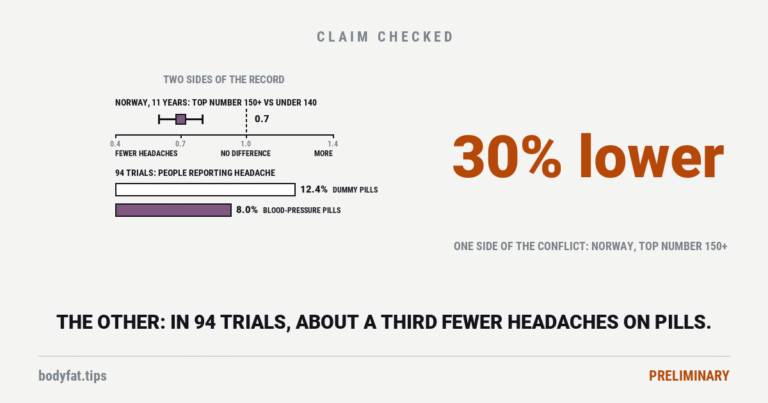
30% lowerOne side of the conflict: risk of non-migraine headache 11 years later for Norwegian adults whose top number was 150 or more, against under 140. The other: in 94 trials, blood-pressure pills cut reported headaches by about a thirdMAYBEPreliminary

Can High Blood Pressure Cause Headaches? At 180/120, Treat It as an Emergency. Below That, It Is a Poor Guide to Your Reading

Two charts: a risk ratio of 0.7, range 0.6 to 0.8, for non-migraine headache 11 years later in Norwegian adults whose top number was 150 or more against under 140; and bars of 12.4% on dummy pills against 8.0% on blood-pressure pills reporting headache in 94 trials; beside them the figure 30% lower

At 180/120 or higher, high blood pressure can cause a headache, and you should treat the pairing as an emergency. Below that the record conflicts: blood-pressure pills cut reported headaches by about a third in 94 trials, while Norwegians with higher readings were less likely to report headaches 11 years later, and 24-hour monitors did not find headaches arriving with higher readings.

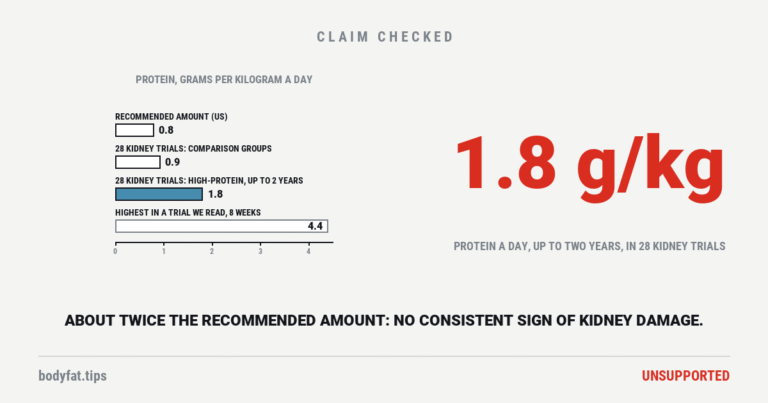
1.8 g/kgprotein a day, about twice the recommended amount (comparison groups 0.9 g), for up to two years in 28 trials of adults without kidney disease; in the 18 that measured filtration before and after, the change was not significantly differentNOUnsupported

How Much Protein Is Too Much? At About Twice the Recommended Amount, for Up to Two Years, Trials Found No Consistent Sign of Damage to Healthy Kidneys

Bars to scale of protein in grams per kilogram a day: the recommended 0.8, the comparison groups' 0.9 and the high-protein groups' 1.8 in 28 kidney trials of up to two years, and 4.4 in an eight-week trial; beside them the figure 1.8 g/kg

There is no official upper limit for protein. In 28 trials, adults without kidney disease ate 1.8 against 0.9 g per kilogram a day, about twice the recommended amount, for up to two years; in the 18 that measured filtration before and after, the change was not significantly different, and no consistent sign of damage appeared. Decades are untested in trials, the long studies of ordinary eaters point both ways, and damaged kidneys are a different question.

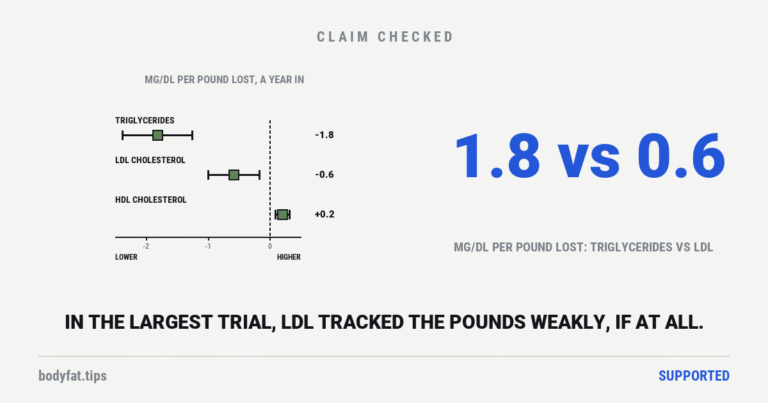
1.8 mg/dLlower triglycerides per pound lost (4.0 per kg) a year into 30 diet-and-exercise trials; LDL fell about 0.6 mg/dL per pound (1.28 per kg)MOSTLYSupported

Does Losing Weight Lower Cholesterol? Mostly the Triglycerides. LDL Fell About 0.6 mg/dL per Pound Lost, and Not on Every Diet.

Chart of what moved for each pound lost a year into 30 diet-and-exercise trials: triglycerides about 1.8 mg/dL lower, LDL about 0.6 lower and HDL about 0.2 higher, each with its range; beside it the figures 1.8 vs 0.6

Losing weight lowers cholesterol, mostly the triglycerides: about 1.8 mg/dL per pound in a year of diet-and-exercise trials. LDL fell about 0.6 mg/dL per pound and rose on a low-carb diet in one trial; in the largest trial it was linked only weakly, if at all, to the pounds lost. HDL was up about 0.2 mg/dL per pound at six months and a year.

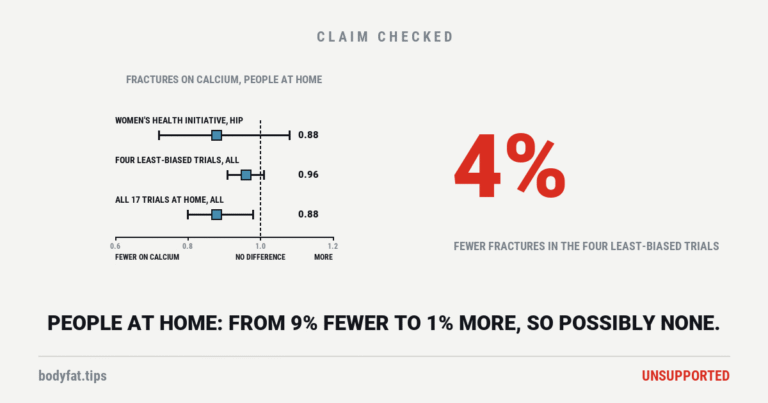
4%fewer fractures on calcium in the four least-biased trials, 44,505 people living at home; the range ran from 9% fewer to 1% moreNOUnsupported

Should You Take Calcium Supplements? The Trial That Cut Hip Fractures Was in French Care Homes. At Home, the Best Trials Found No Clear Drop.

Chart of fracture ratios on calcium against a dummy pill in people living at home: the Women's Health Initiative's hips 0.88 (0.72 to 1.08), the four least-biased trials 0.96 (0.91 to 1.01), and all 17 trials at home 0.88 (0.80 to 0.98); the least-biased result sits nearest no difference. Beside it the figure 4%

Calcium supplements raise bone density by 1 to 2%, once. In the largest, least biased trials of adults living at home, fractures were not clearly fewer; the trial that cut hip fractures was done in French care homes. The heart-attack worry is contested, the kidney-stone risk is measured, and calcium from food goes with fewer stones, not more.