1,086people in the three biggest randomised bone-density trials we found with results (710, 202 and 174), each setting a plate against no plate or a dummy for 12 to 24 months: none found a significant gain at the hip or spine (our sum)MAYBEPreliminary

Vibration Plate Benefits: The Three Biggest Randomised Bone Trials We Found With Results, 1,086 People, Showed No Clear Gain. Stronger Legs Are Another Matter.
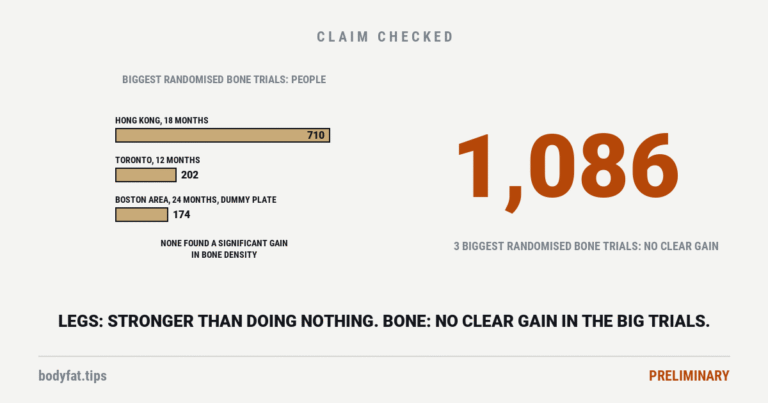
Bars to scale: the three biggest randomised bone-density trials of vibration plates we found with results, 710, 202 and 174 people over 12 to 24 months, each setting a plate against no plate or a dummy; none found a significant gain in bone density. Beside them the figure 1,086, our sum

Standing on a vibration plate makes older legs stronger than doing nothing, but not clearly stronger than ordinary exercise. For bone, the evidence conflicts: the three biggest randomised trials we found with results, 1,086 people, showed no clear gain at the hip or spine. In 20 trials a plate on its own took off no significant weight or fat, and ‘10 minutes equals an hour’ fails when measured.
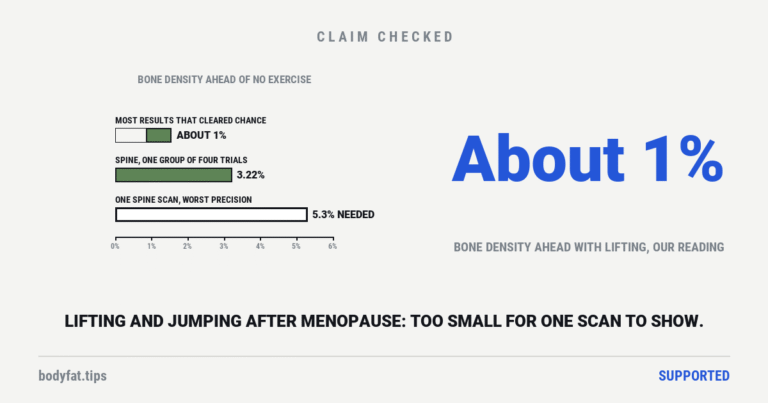
About 1%higher bone density at the spine and hip in most of the Cochrane review's pooled results that cleared chance, for women past menopause who did weight training or impact exercise, against no exercise; our reading, with about 3% at the spine in one group of four trials; part of it bone the comparison groups lostMOSTLYSupported

Exercise for Osteoporosis: Lifting and Jumping Left Women About 1% Ahead on Bone Density, by Our Reading. Fewer Fractures Is Less Certain

Bars: in most of the pooled trial results that cleared chance, women who lifted or jumped ended up about 1 percent ahead on bone density, by our reading, and 3.22 percent at the spine in one group of four trials; one person's spine scan needs about 5.3 percent at the worst precision allowed

Across dozens of trials, women past menopause who lifted weights or did impact exercise ended up ahead on bone density, partly by losing less: about 1% in most of the pooled results that cleared chance, and about 3% at the spine with programmes mixing several kinds of exercise, which came out 1.07% behind at the total hip (our reading). That is well below what one scan can confirm in one person at the worst precision allowed, fewer fractures is less certain, and whether walking alone does less is unsettled.

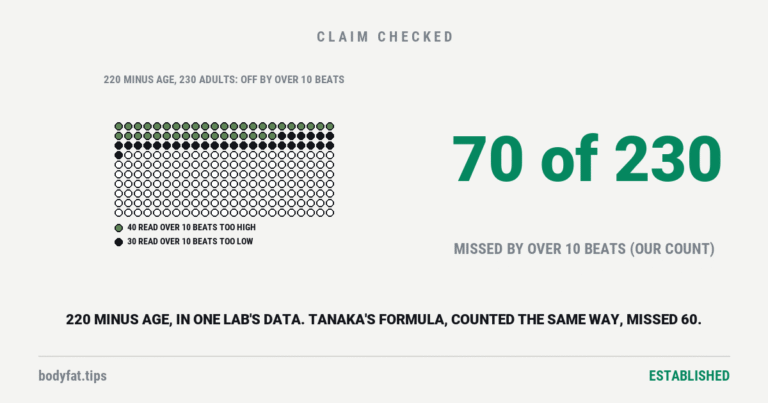
70 of 230adults, mostly recreational athletes, that 220 minus age missed by more than 10 beats a minute in one US lab (our count from its published data); Tanaka's formula, rounded to a whole beat as 220 minus age always is, missed 60YESEstablished

How to Calculate Max Heart Rate: 220 Minus Age Missed 70 of 230 Adults by Over 10 Beats in One Lab (Our Count)

A grid of 230 dots, one for each adult, mostly recreational athletes, tested in one US lab; 70 are filled, 40 in one tone where 220 minus age read more than 10 beats too high and 30 in another where it read more than 10 too low; beside it the figure 70 of 230, our count from the lab's published data

220 minus age is close to the average of a mixed group of healthy adults and off by more than 10 beats a minute for many of them: by our count of one lab's published data on 230 adults, mostly recreational athletes, it missed 70, and Tanaka's formula, counted the same way, missed 60. Age explains less than half of why one person's maximum differs from another's. The only way to know yours is to measure it, and some people should not try that alone.

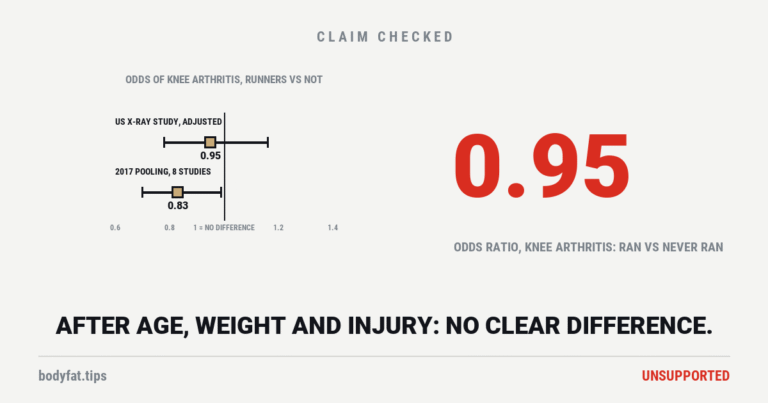
0.95odds of knee arthritis on X-ray, runners against people who never ran, after age, sex, weight, past injury and other activities, in 2,637 US adults; 1 means no difference (range 0.78 to 1.16)NOUnsupported

Is Running Bad for Your Knees? For Recreational Runners, No. That It Protects Them Is Less Certain.

Two odds ratios with their ranges against a line at 1, no difference: a US X-ray study adjusted for age, sex, weight, past injury and other activities, 0.95 (0.78 to 1.16), and a 2017 pooling of eight studies of recreational runners, 0.83 (0.70 to 0.99); beside it the figure 0.95

In studies of thousands of people, recreational runners did not have more knee arthritis than people who did not run; in a US study that X-rayed the knees of 2,637 adults, the difference shrank to one chance could explain once age, weight and past injury were allowed for. Former elite athletes are a less clear story, and the claim that running protects the knee rests on weaker evidence than the headlines suggest.

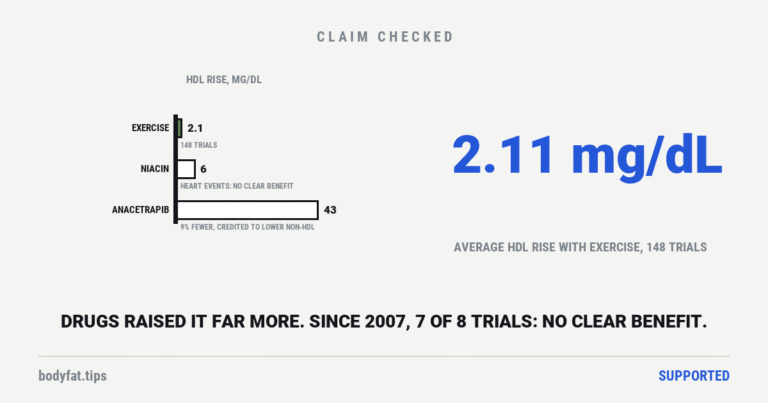
2.11 mg/dLaverage rise in HDL cholesterol with exercise training across 148 randomised trials, most of the exercise groups aerobic; about 3.5% of the starting levelMOSTLYSupported

How to Raise HDL: Exercise Lifts It About 2 mg/dL. Two Pills Approved Partly to Raise It Lost Approval After Heart Trials Found No Clear Benefit.

Three bars of the HDL rise in mg/dL: exercise 2.1 across 148 trials; niacin 6, with no clear heart benefit; anacetrapib 43, with about 9% fewer coronary events credited to lower non-HDL cholesterol; beside it the figure 2.11 mg/dL

Exercise raised HDL cholesterol by about 2 mg/dL across 148 randomised trials, aerobic exercise most reliably, and losing weight, quitting smoking and eating fat in place of carbohydrate raise it too. Drugs raised it far more; in seven of eight large heart trials of drugs aimed at HDL since 2007 that bought no clear benefit, and the eighth's small benefit is credited to the LDL-type cholesterol it lowered. Low HDL is a warning sign. Raising the number is not the same as fixing what it warns about.

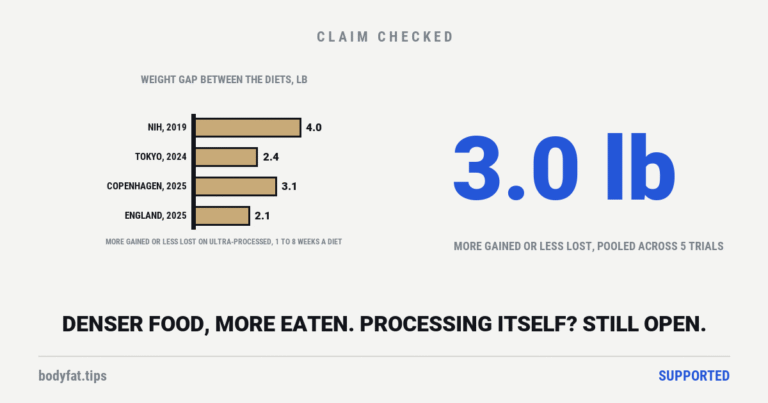
3.0 lbmore weight, or less lost, on ultra-processed than on less-processed diets, pooled by a 2026 review across five small trials (1.37 kg), at low certainty; one week to six months, 9 to 50 people eachMOSTLYSupported

Are Ultra-Processed Foods Bad for You? In Short Feeding Trials, People Gained More or Lost Less. Why Is Still Open.

Horizontal bars of the weight gap between ultra-processed and less-processed diets in four feeding trials, in pounds: NIH 2019 4.0, Tokyo 2024 2.4, Copenhagen 2025 3.1, England 2025 2.1; beside it the figure 3.0 lb, a 2026 review's pooled estimate

In every feeding trial we read that let weight move and reported it, people put on more, or lost less, on ultra-processed diets than on less-processed ones; a 2026 review pooled five small trials at about 3 lb. In three of the five, those diets were also denser in calories, and when an NIH trial took the density and the foods easiest to overeat out, most of the overeating went. The links to disease and death come from cohorts.

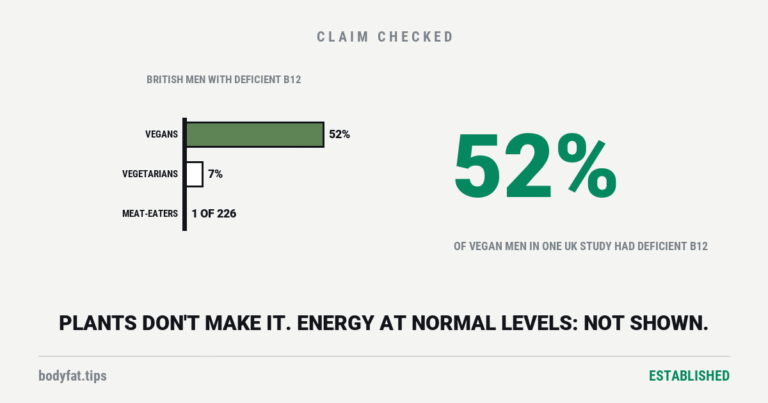
52%of vegan men in a British study had B12 levels in the deficient range (below 118 pmol/L); 7% of vegetarians and one of 226 meat-eaters didYESEstablished

Do You Need a B12 Supplement? If You Eat No Animal Foods, Yes. Energy at Normal Levels: Not Shown.

Three bars for the share of men in a British study with B12 below the deficiency line: vegans 52%, vegetarians 7%, meat-eaters one man of 226; beside it the figure 52%

If you eat no animal foods, you need vitamin B12 from a supplement or a fortified food: in a British study, 52% of vegan men had levels in the deficient range. Over 50, US advice is to get most of it the same way. For energy in people whose levels are normal, small placebo-controlled trials of B12 on its own found no clear benefit.

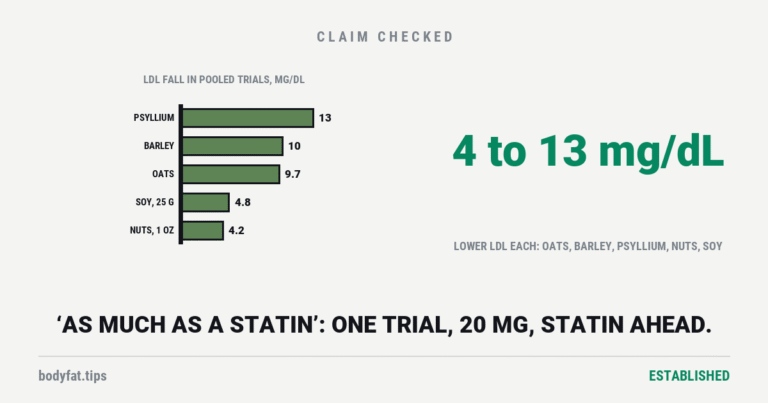
4 to 13 mg/dLlower LDL from each food in pooled trials: about 4 for an ounce of nuts or 25 g of soy protein, about 10 for oats or barley and 13 for psyllium; plant sterols about 8 to 12%YESEstablished

Foods That Lower Cholesterol Do Lower It, Mostly by Single Digits. The Diet Said to Match a Statin Fell Short of a Low Dose, With the Food Delivered.

Horizontal bars of the LDL fall in pooled trials, in mg/dL: psyllium 13, barley 10, oats 9.7, 25 g of soy protein 4.8 and an ounce of nuts 4.2; beside it the figure 4 to 13 mg/dL

Oats, barley, psyllium, plant sterols, nuts, soy and unsaturated fats each lower LDL cholesterol by a few percent in pooled trials, sterols by up to about 12%. Combined as the Portfolio diet, with the food delivered, they lowered LDL 28.6% against 30.9% for 20 mg of lovastatin in the first month of a trial of 46 people; completed, with 34 people trying each treatment for a month, the trial found the statin significantly better, 33.3% against 29.6%. Advised to eat that way at home, people's LDL fell about 13%, against 3% on a standard low-fat diet.

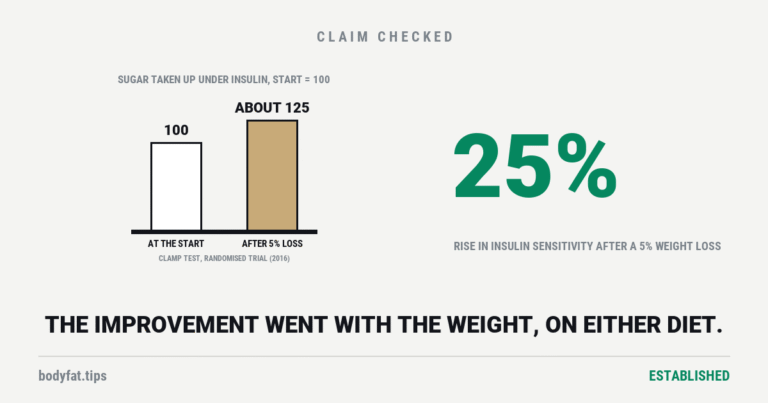
25%more sugar taken up under insulin, measured by the clamp, after a 5% weight loss in a randomised trial of adults with obesity; about double in the nine who went on to lose 11 to 16%YESEstablished

How to Reverse Insulin Resistance: A 5% Weight Loss Improved It by About a Quarter. In Pooled Type 2 Diabetes Trials, Low-Carb’s Lead on Blood Sugar Had Halved by 12 Months.

Two bars indexed to 100 at the start: sugar taken up under insulin rose to about 125 after a 5% weight loss in a randomised clamp trial; beside it the figure 25%

In a randomised trial, losing 5% of body weight raised insulin sensitivity by about a quarter. Of three trials here that matched the weight loss on different diets, none found a clear difference in the muscle; in the largest, a liver measure improved two to three times as much on keto. In type 2 diabetes, low-carb pulled ahead on blood sugar for about six months, and by a year that pooled lead had roughly halved. “Once and for all” did not hold where it was tested: after the low-carb diets ended, fasting insulin did not stay down.

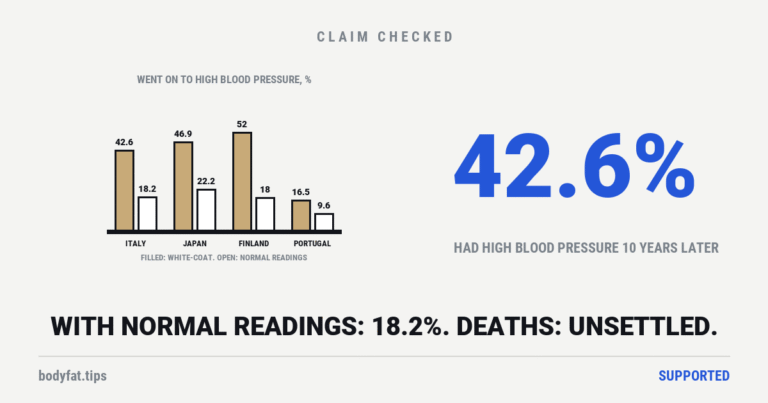
42.6%of 225 people with white-coat hypertension in Monza, Italy, had high blood pressure at the clinic and outside it ten years later, against 18.2% of people with normal readings (2009)MOSTLYSupported

White Coat Hypertension: In Four Studies, High Blood Pressure or Pills for It Followed Roughly Twice as Often. The Death Risk Is Unsettled.

Paired bars for four cohorts, the share who went on to high blood pressure with white-coat hypertension against normal readings: Italy 42.6 and 18.2, Japan 46.9 and 22.2, Finland 52 and 18, Portugal 16.5 and 9.6; beside it the figure 42.6%

In four studies, people with white-coat hypertension went on to high blood pressure, or to pills for it, roughly twice as often as people with normal readings: 43% to 52% against 18% to 22% in three population studies. The link to heart attacks and strokes is weaker. On deaths the studies disagree, and a registry analysis behind the scariest figure was retracted. And no trial we found was designed to test pills for it.