How Much Protein to Build Muscle: The Famous 1.62 Ceiling Was Never Statistically Significant

Protein supplementation works. Across 49 randomised trials and 1,863 people, those taking it gained more fat-free mass — everything in the body that isn’t fat — than those who didn’t. [1]
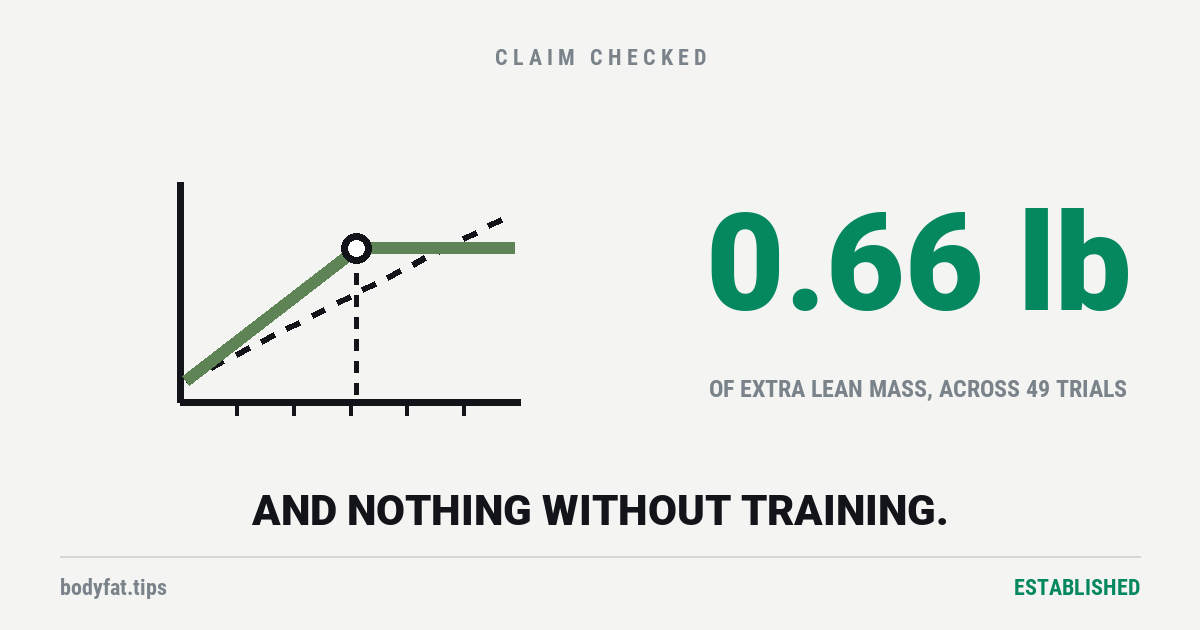
The amount was 0.66 lb (0.30 kg). That is the whole effect, over an average of thirteen weeks of training. Two-thirds of a pound. [1]
Which is real, and worth having, and nowhere near what the tub is implying.
| Situation | Extra lean mass | Source |
| Lifting weights | +0.66 lb | 49 trials |
| Dieting | +0.79 lb | 14 comparisons |
| Neither | nothing | 7 comparisons |
| Over 50, no training | nothing | 28 studies |
Without training, it does nothing
This is the finding that should change what you buy, and it comes from two separate meta-analyses that were not looking for the same thing.
The first sorted trials by what the people in them were doing. Taking more protein than the recommended amount helped if you were dieting (+0.79 lb) and helped more if you were lifting (+1.7 lb). If you were doing neither, the result was 0.08 kg with a range from −0.59 to +0.75 — a range that sits squarely on top of zero. [2] The authors put it plainly: “The RDA for protein is adequate to support lean mass in adults during nonstressed states.”
The second looked only at older adults, 28 studies of them. Protein on its own moved nothing — not total lean mass, not arm and leg lean mass, not grip strength, not knee strength. Add resistance exercise and two of those four turned significant. [3]
Two research teams, two populations, one answer. The protein is not the stimulus. It is the material. Without something asking the body to build, there is nothing for the material to become.
The famous number was never statistically significant
If you have read anything about protein you have met 1.62 grams per kilogram of bodyweight — about 132 g a day for someone weighing 180 lb. It is quoted everywhere as the point where more protein stops helping.
It comes from the same 49-trial review. And here is what the authors actually wrote about it: the plateau analysis “is presented as a segmental regression despite not being statistically significant (p=0.079)”. [1]
Unpack that. They tested whether a bent line — rising, then flattening at a ceiling — described the data better than a plain straight one. It didn’t do so convincingly. p = 0.079 is just the wrong side of the line researchers use for “probably not chance”. They published the number anyway, clearly labelled, which is the honest thing to do.
Everyone downstream dropped the label.
And the ceiling itself has a range: 1.03 to 2.20 g/kg. [1] For that 180 lb reader, somewhere between 84 g and 179 g a day. That is not a target. That is most of the plausible range of human protein intake.
The more you already eat, the less it adds
Buried in the same paper: how much protein people were already eating before the study significantly changed how much the supplement helped (p = 0.045, across 22 studies and 988 people). [1]
Which is the least surprising finding here and the one most reliably left out of the marketing. A supplement that closes a gap does more for someone with a gap. If you are already eating well over the recommendation, you are buying the flat part of the curve.
If you are over 45, read this bit twice
Protein is marketed hardest at older adults, on the sarcopenia argument — muscle loss with age. So this is worth stating carefully, because the two papers do not say quite the same thing.
In the 49-trial review, the fat-free mass benefit in people over 45 was 0.06 kg with a range of −0.14 to +0.26 — nothing. In people under 45 it was +1.2 lb. The gap between the two age groups was itself statistically significant. [1]
The older-adult review is more encouraging, but only on one condition: protein plus resistance exercise did increase arm and leg lean mass (+1.2 lb) and grip strength. Protein alone did not. And the lean-mass benefit showed up only in people who were already frail or sarcopenic (+1.9 lb). [3]
Worth knowing before you weigh that: the authors record that “Most studies (n = 22) had some risk of bias” — 22 of their 28 — and the trials disagreed with each other enormously. [3] This is not a settled corner of the literature. It is a noisy one with a consistent direction.
Where it clearly earns its keep
One situation comes out of all this looking genuinely good, and it is probably the one you are in if you are on this site.
Dieting. When people were in a calorie deficit, eating more than the recommended protein preserved an extra 0.79 lb of lean mass (0.36 kg) compared with eating the recommended amount — from 14 comparisons, the largest subgroup in that analysis. [2]
Losing weight costs you some lean mass along with the fat. Protein reduces the bill. That is a modest, real, well-evidenced benefit, and it does not need a single exaggeration to be worth acting on.
The verdict
Established. Three meta-analyses, three research teams, 49 and 18 and 28 studies, all finding the same significant effect in the same direction. Protein supplementation increases lean mass and strength when it is paired with resistance training. That is about as settled as nutrition science gets.
What is not established is the size everyone imagines, or the ceiling everyone quotes, or the idea that it does anything at all on its own.
So: if you lift, or you are dieting, more protein helps by a small and measurable amount. If you do neither, three papers here agree that the recommended intake is enough and the tub is selling you the flat part of a curve.
The training is the active ingredient. The powder is the supporting cast, and it has spent a long time being billed as the lead.
Related: does protein keep you full · how much creatine should you take · does lifting weights burn fat · does cardio burn muscle · collagen benefits · every claim we’ve checked