Does Cardio Burn Muscle? No — the People Doing Both Still Gained

No. And the number that settles it is sitting in the middle of a meta-analysis that people usually quote to argue the opposite.
The people doing both still built muscle
Twenty-one studies, 422 effect sizes, comparing lifting alone against lifting plus cardio against cardio alone [1].
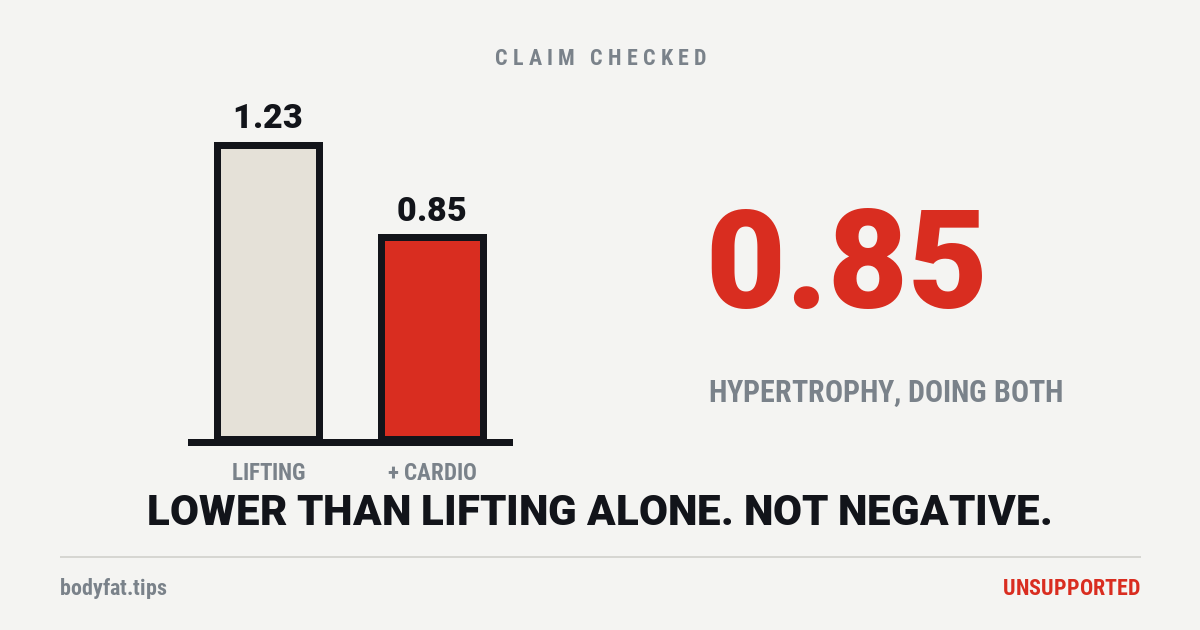
Hypertrophy came out like this. Lifting alone: 1.23. Lifting plus cardio: 0.85. Cardio alone: 0.27 [1].
Look at the middle number. Not negative. Not zero. 0.85 — a substantial positive effect. The people doing cardio alongside their lifting gained muscle.
Strength tells the same story: 1.76 lifting alone against 1.44 concurrent [1]. Lower, and still firmly pointing up.
So the honest version of the claim is not “cardio burns muscle.” It is “cardio can cost you some of the muscle you would otherwise have built.” Those are different sentences, and only one of them should change what you do on a Tuesday.
Where the interference is real
Power is the exception, and it is worth knowing if you play a sport.
On power, all three groups differed significantly from each other: 0.91 for lifting alone, 0.55 concurrent, 0.11 for cardio alone [1]. If you are training to jump or sprint or throw, that gap is the one to take seriously.
Running interferes. Cycling mostly doesn’t.
This is the finding that should change what people actually do, and almost nobody repeats it.
From the same analysis, verbatim: resistance training concurrently with running, but not cycling, resulted in significant decrements in both hypertrophy and strength [1].
Learn More:

Same amount of cardio, different machine, different outcome. The likely reason is unglamorous — running is eccentric, it involves landing, and landing does damage that your legs then have to repair instead of growing. Cycling is concentric and lands on nothing.
If you are worried about your legs and you like cardio, that is a fairly actionable sentence.
And it is a dose, not a switch
The interference scaled with how much you did. Endurance frequency correlated with worse muscle outcomes at −0.26 to −0.35, and session duration at −0.29 to −0.75 [1].
Longer, more often, worse. Which means the question was never whether cardio is allowed. It is how much, of what kind, next to what else.
We are not going to hand you a threshold, because the paper reports correlations rather than a cut-off, and inventing “keep it under three sessions a week” would be exactly the fake precision we correct in other people.
The part that inverts the whole question
There is a second literature that the gym-floor version of this argument does not know exists.
A review in Exercise and Sport Sciences Reviews opens by naming the assumption directly — “current dogma suggests that aerobic exercise training has minimal effects on skeletal muscle size” — and then argues the opposite: that aerobic exercise alters protein metabolism and induces skeletal muscle hypertrophy [2].
Cardio alone scored 0.27 for hypertrophy in the meta-analysis [1]. Small. Also positive. In people who are untrained or older, riding a bike is not muscle-neutral — it builds some.
Which makes “cardio burns muscle” roughly the opposite of what the measurements say.
What to actually do
Do your cardio. Your heart, your blood pressure and your ability to recover between sets all want it, and the muscle cost at ordinary volumes is a slightly smaller number, not a negative one.
If you are chasing size or power specifically: bias toward cycling over running, keep the sessions from sprawling, and put the hard cardio as far from your leg training as your week allows.
And if someone tells you they skip cardio to protect their gains, the measured cost they are avoiding is the difference between 1.23 and 0.85 — while the thing they are giving up is the cardiovascular system.