Hydroxyapatite Toothpaste: It Matched Fluoride in Three Cavity Trials. The Paste’s Maker Funded All Three

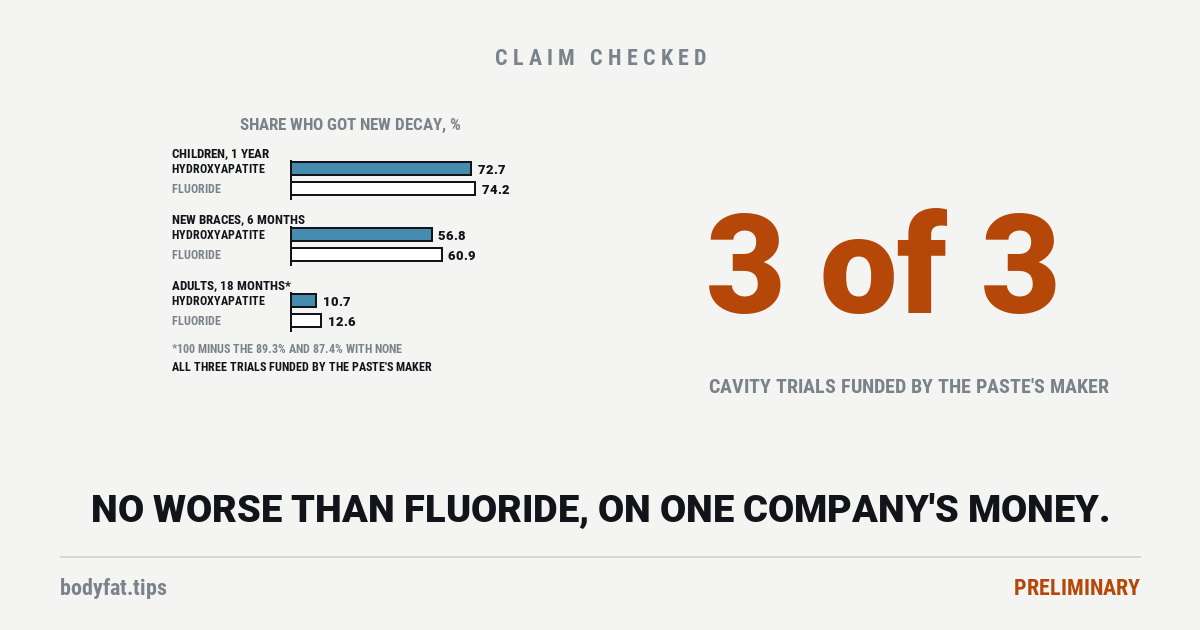
Is hydroxyapatite toothpaste as good as fluoride? In the three trials that put a fluoride-free one up against fluoride and counted new tooth decay, it did no worse [1] [2] [3]. All three were funded by the same company, Dr. Kurt Wolff of Bielefeld, Germany, which makes the paste they tested [1] [2] [3].
Is it better than fluoride? Not on cavities, in those trials. The only pooling we found by researchers with no declared ties to a maker, a 2025 review from Athens, combined two of the trials and got a risk ratio of 0.98 [4]. A risk ratio compares the chance of new decay on one paste with the chance on the other: 1.00 means the same, and 0.98 is about as close to the same as a result gets.
So the claim this page rates, that hydroxyapatite toothpaste prevents cavities as well as fluoride, is Preliminary. The three results agree with each other. There are only three, none ran longer than 18 months, and every one ran on one company’s paste and money.
Is nano-hydroxyapatite safe? The European Union’s scientific committee on consumer safety says yes, in toothpaste at up to 29.5%, for the rod-shaped particles it was shown; its opinion does not cover needle-shaped ones [5]. Swallowed particles, it found, dissolve in stomach acid [5]. Whether the nano kind prevents cavities is a separate question, and the independent review of it called the evidence inconclusive [6].
Is fluoride bad for you? The worry on record is about drinking water. A 2024 federal review concluded, with moderate confidence, that water carrying more than 1.5 milligrams of fluoride per liter, over twice the level the US recommends, is associated with lower IQ in children, and found too little data to judge the recommended level itself [7]. For toothpaste, the documented risk sits with young children who swallow it: faint white flecks or streaks on the teeth, called fluorosis [8].
And NASA? In 1972 a NASA scientist was granted a patent on a way to grow mineral crystals onto a damaged tooth. The dental professor working on it for the Japanese company that bought the patent spent the next decade trying to make it work and never did, so the company’s founder put the mineral straight into toothpaste and sold it first as a whitener [9]. The idea of rebuilding teeth with their own mineral came from NASA. The toothpaste came from the company.
Three trials, one company
The first ran in Germany, in 147 people who had just had braces fitted and were judged at high risk of decay. Over about six months, new early decay showed up on the outer surfaces of the upper front teeth and premolars of 56.8% of those on hydroxyapatite and 60.9% of those on a fluoride paste of 1,400 ppm, parts per million, the strength printed on a tube. The difference was not significant [2]. “Early decay” here counts from the earliest visible change in the enamel, a chalky patch often seen only once the tooth is dried. The study was “exclusively funded” by Dr. Kurt Wolff, which supplied its Karex toothpaste as the test paste [2].
The second ran in Poland, in 207 young children with baby teeth, who brushed three times a day for 336 days, the midday brushing supervised by an adult. Of the 177 who finished, new early decay appeared in 72.7% of the children on hydroxyapatite and 74.2% of those on a children’s fluoride paste of 500 ppm [1]. The test paste was identical to the company’s Kinder Karex, and the company funded the trial [1].
The third, also in Poland, followed 189 adults aged 18 to 45 with healthy teeth for 18 months [3] [10]. Of the 171 who finished, 89.3% on hydroxyapatite and 87.4% on a 1,450 ppm fluoride paste had no new decay, counted as decayed, missing and filled tooth surfaces, the standard tally [3]. The company funded it with the two universities, and three of its 15 authors work for the company [3].
What “no worse” means here
Each was a non-inferiority trial. That design does not ask whether the new paste is better. It asks whether it is worse by more than a set amount, and the two Polish trials set that amount at 20 percentage points [1] [3].
In the children, the worst case the data allow is hydroxyapatite 9.8 points worse. That figure is the top of the range the true answer probably sits in, and it sat under the 20 the trial allowed [1]. It does not rule out a paste a few points worse. It does not show a better one.
The Athens review read four trials and could pool two of them, 354 people, for that risk ratio of 0.98, with a range from 0.85 to 1.12: anywhere from 15% less decay to 12% more [4]. It judged the German trial’s risk of bias low and both Polish trials’ unclear. Its fourth trial, 50 Iranian patients just out of braces, measured the white spots brackets leave behind rather than new decay, and found a local nano paste ahead of fluoride [4] [11].
The other reviews that pooled these trials were written with the company. A 2021 review had two of its scientists among three authors and a small company grant for computer costs [12]. Its 2024 update had the same two, and every author had taken company travel grants [13]. A 2026 review has three company employees among its four authors, and it counts the same three trials [14].
Micro or nano?
All three trials tested the same company’s paste: microcrystalline hydroxyapatite in the two whose ingredient lists we checked, and a paste comparable to its Karex range in the third [2] [1] [3]. A good share of what Americans search for is the other kind, nano-hydroxyapatite, made of far smaller particles. The search figures are at the bottom of this page.
The nano kind has an independent review of its own, by dental researchers in Bern. It found five studies in people and five in mouth appliances, could not pool the ones in people, and rated the evidence very low; six of the studies were funded or published by the products’ makers [6]. In the appliance studies, which put slabs of enamel in a removable mouthpiece worn by volunteers, sodium fluoride slowed the mineral loss under acid and nano-hydroxyapatite did no better than a paste with no fluoride at all [6]. Its conclusion: no conclusive evidence either way on whether it works.
Its safety is a different story. The EU’s committee could not conclude on nano-hydroxyapatite in oral care in 2021 [15], called it safe at up to 10% in toothpaste in 2023 [16], and at up to 29.5% in 2025, for uncoated rod-shaped particles, finding any uptake through the lining of the mouth negligible [5]. Safe and effective are separate findings. Only the first has a regulator behind it.
The trial that used both
The biggest trial we found didn’t ask hydroxyapatite or fluoride. It asked hydroxyapatite and fluoride. 610 Italian schoolchildren aged 4 to 7 got either a paste with both or an ordinary fluoride paste of the same strength, for two years [17]. The children on both got fewer new cavities. In the younger group’s baby teeth, they averaged 0.18 new severe lesions, open cavities into the layer under the enamel, against 0.27 on fluoride alone [17].
That points somewhere the market does not: at the two together. But the maker of that paste, Curasept, helped fund the trial and produced and supplied every toothpaste in it [18]. One trial, with a maker’s hand on it, is a lead rather than a finding.
And fluoride’s own record
Fluoride toothpaste has been tested against plain toothpaste in children for more than half a century. A Cochrane review pooled 70 trials and 42,300 children: those on fluoride paste ended up with about a quarter fewer decayed, missing or filled tooth surfaces, 24%, with a range of 21% to 28% [19]. Its 2019 successor counted 96 studies and rated the benefit of the common strengths, 1,000 to 1,500 ppm, over a paste with no fluoride with high and moderate certainty in children and teenagers; the benefit grew with strength [20]. Its searches ended in August 2018 [20].
The cost is fluorosis. A 2014 review in the American Dental Association’s journal found that young children who swallow a pea-sized amount or more can get mild fluorosis, and its advice was that every child use the appropriate amount [8]. That is the genuine point in hydroxyapatite’s favour for a toddler who swallows toothpaste: the EU committee found swallowed particles dissolve in the stomach [5].
If it works as well as fluoride, why can’t an American tube say so?
This section is the desk’s own reasoning, and it is labelled as such.
Answer one: the rulebook. The FDA’s list of ingredients a toothpaste may sell as fighting cavities has three entries, and all three are fluorides [21]. NASA’s own history of the product says that rule kept its first maker out of the US market [9]. Getting onto the list would take evidence, and three trials of one company’s paste are not much of it. The rule is documented; the last sentence is our inference.
Answer two: the design. None of the three trials had a group on plain toothpaste, and you can see why: nobody hands children a paste known to do less. But without one, “no worse than fluoride” cannot tell both worked from neither did much in these people. About three in four of the children got new early decay within a year on either paste; close to nine in ten of the adults got none on either [1] [3]. Fluoride’s half of the comparison rests on 70 trials run elsewhere [19]. That is arithmetic and design, not a measurement.
Answer three: the demand is not really about cavities. In Japan it sold first as a whitener, and its first maker says its biggest selling point in much of Europe is sensitivity [9]. In the US it sells as the toothpaste without fluoride, two years after a federal review tied high fluoride in water to lower IQ [7]. If that is right, a cavity trial is not the question most buyers are asking. This one is a hunch, with the search figures at the bottom of this page on its side.
The derived line: hydroxyapatite is a reasonable toothpaste for someone who has already decided against fluoride. On this evidence, it is not a reason to decide against fluoride.
What we could not find, and would like to: a trial with no maker’s money in it that puts a fluoride-free hydroxyapatite paste, nano or micro, against both fluoride and a plain paste, and counts new cavities for two years or more. The three that counted new decay against fluoride ran 18 months at most, and one company funded all three [22]. If one has been published and we missed it, tell us and we will correct this page.
Who these studies were done on
Young Polish children with baby teeth [1]; German patients with new braces [2]; Polish adults aged 18 to 45 with healthy teeth [10]; Italian schoolchildren aged 4 to 7 [17]. In two of the trials the children brushed three times a day. None of these was done in the US or in older adults. If you are weighing the other things people put in their mouths instead, our verdict on oil pulling covers one, and xylitol, the sweetener in some toothpastes, is on our sugar alcohols page.
Where the “NASA toothpaste” came from
In the 1960s Bernard Rubin, a scientist growing crystals for electronics at NASA’s short-lived Electronics Research Center in Cambridge, Massachusetts, noticed that his gel-grown crystals formed the way the mineral in bone and teeth does. He and a colleague patented a method to grow brushite, a mineral that turns into hydroxyapatite, onto a damaged tooth and cap it there. The patent was granted in 1972 [9].
In 1974 Shuji Sakuma founded Sangi in Tokyo, came across the patent in a list of NASA patents, and bought it. By the company’s account, the dental professor on the project spent a decade without getting it to work, so Sakuma proposed putting the mineral straight into toothpaste. Sangi launched Apadent in 1980 and sold it as a whitener, because it could not yet make medical claims. Japan recognised hydroxyapatite as an anti-cavity ingredient in 1993 [9]. NASA tells the story itself now, on its Spinoff pages, partly from the company’s own history [9].
The modern claim comes from somewhere else: the three trials the German company funded, and above all the adult one, which its journal’s press office sent out in July 2023 as a toothpaste that “can prevent cavities as effectively as fluoride”. The release credited an international team and Polish clinicians. It did not mention that a toothpaste company funded the trial and employed three of its authors [10] [3].
“Hydroxyapatite toothpaste” is searched about 90,500 times a month in the United States, “nano hydroxyapatite” about 33,100 and “is fluoride bad for you” about 14,800, while “hydroxyapatite vs fluoride”, the question this page answers, gets about 2,400 (from a paid keyword database, pulled 17 November 2026) [23]. Those are the database’s averages over the past year. None of this is aimed at anyone choosing a toothpaste.
What this is rated, and what the rating covers
Preliminary — for the claim that hydroxyapatite toothpaste prevents cavities as well as fluoride.
Preliminary rather than Supported because the evidence is three trials, about 540 people between them, each run on one company’s paste and money, none longer than 18 months and none with a plain-toothpaste group [2] [1] [3]. They agree with each other, and the one independent pooling found no difference [4]. The same question asked of fluoride against plain toothpaste would be rated Established [20].
The other parts, rated alone, in words. That it beats fluoride on cavities: Unsupported, tested in those three trials and not better [2] [1] [3]. That adding it to a fluoride paste beats fluoride alone: Preliminary, one trial of 610 children, funded in part by the paste’s maker [17] [18]. That nano-hydroxyapatite is safe in toothpaste: the EU’s safety committee says yes, for the particles it was shown [5].
This is journalism, not medical advice. A dentist who knows your teeth, or your child’s, is the person to ask. How we read a study, and what each tier means, is set out here. This page’s derived section is the desk’s reasoning from the evidence rather than a result the evidence delivered.
- Does Castor Oil Help Hair Growth? Tested on Eyelashes and on Bald Patches, It Did Not Clearly Beat the Comparison
preliminary - How to Get Rid of Cellulite: Twelve Weeks of Daily Glute Exercises Left It Where It Was. Nothing Tested So Far Melts It.
unsupported - Grounding Sheets: Engineers Measured the Current. It Was Nanoamperes, and It Only Tracked You Moving.
preliminary