Red Light Therapy: 3 Inches Off the Waist. Body Fat Percentage Did Not Move.

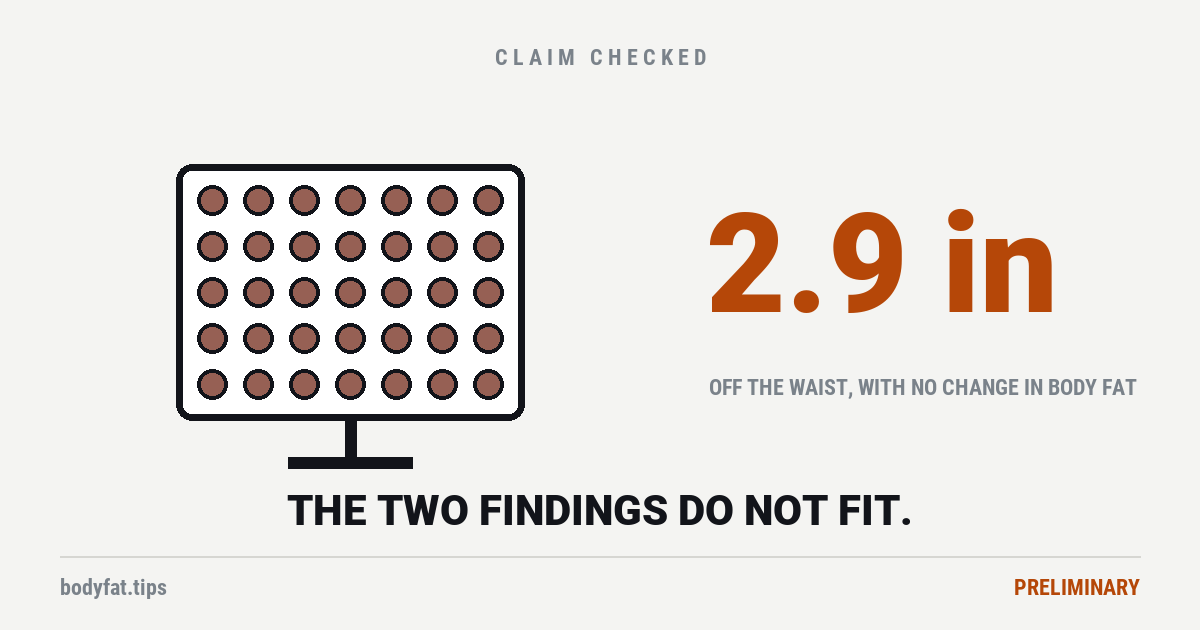
Nearly three inches came off the waist. 2.9 in (7.28 cm), pooled across eleven randomised trials, and it is one of the more solid findings in the paper. [1]
In the same analysis, the percentage of the body that was fat did not change at all. [1]
Both of those are true. Working out how they can both be true is the whole story.
| Measure | Result |
| Waist | −2.9 in · 7.28 cm |
| Weight | −7.8 lb · 3.54 kg |
| BMI | −1.18 |
| Body fat percentage | no change · p = 0.57 |
| Waist-to-hip ratio | no change |
| Insulin | no change |
Three inches of waist, no change in body fat
The waist result is the strongest thing in the review. It comes from seven studies and 347 patients, the trials agreed with each other completely, and the reviewers rated their risk of bias as low. [1]
The body-fat-percentage result comes from the same review and lands at −0.28, with a range running from −1.25 to +0.69. [1] That range includes zero, and comfortably — meaning the device does nothing to body fat percentage is still entirely on the table. Waist-to-hip ratio did not move either.
So you are asked to believe that three inches left the waistline while the proportion of the body made of fat stayed put. We are not going to invent a mechanism that reconciles those, because the paper does not offer one and neither does anyone selling the device.
Some of the trials had people dieting at the same time
Here is the detail that changes how you read every number above.
The comparison is described as being against “exercise, dietary changes, and sham PBM” [1] — three different things, pooled. And the evidence table shows at least one trial running light plus exercise plus diet against exercise plus diet.
That is a perfectly reasonable question to ask. It is just not the question a person buying a panel thinks they are getting an answer to. Losing 7.8 lb (3.54 kg) more than a group who also dieted is a different claim from losing 7.8 lb more than a group sat in front of a switched-off device.
The reviewers rate their own results very low to moderate
This is the part we would want quoted back at anyone citing this study at you.
The authors ran GRADE, the standard system for rating how much confidence a body of evidence deserves. Their verdict on their own findings: “The quality of our results ranged from ‘very low’ to ‘moderate’.” [1]
The reasons they list are “the flawed methodology of the selected studies, inconsistent results due to significant heterogeneity, imprecise results due to wide confidence intervals and small sample size, and other bias due to publication bias.” [1]
And in the footnotes of their own quality table, one line explains a downgrade as: “Publication bias due to funding support.” [1] That is their judgement, not ours — their funnel plots did not show significant asymmetry — but it is their judgement, printed in their own table.
And nearly all of it comes from two countries
One more line from the limitations, which will sound familiar if you read our sauna verdict: “Most studies were conducted in Brazil and Egypt.” [1]
That is not a criticism of Brazilian or Egyptian research. It is the same structural problem the Finnish sauna data has — when a literature clusters in a couple of places, what looks like many independent confirmations is closer to one research community checking its own work.
The skin claim, which is the better one
Set the fat aside. Red light for skin has a genuinely interesting trial behind it, and a genuinely interesting flaw.
137 women, aged 40 to 65, ten sessions over four weeks. Wrinkle volume around the eyes fell 31.6% with red light. [2] That is a real number from a real randomised trial with objective measurement, not a satisfaction survey.
Now the design. It was split-face: red light on one side, amber light on the other. Every participant got light on both sides. There was no untreated side. [2]
So the trial can tell you that red and amber perform about the same — 31.6% versus 29.9%, which is close enough to be nothing. It cannot tell you whether either of them beats doing nothing at all, because nobody in the study did nothing.
And in the same trial, on the same faces: “None of the treatments improved skin hydration and viscoelasticity.” [2] Wrinkle volume moved. The other two skin measures did not.
The verdict
Preliminary. There are real randomised trials here and some of the numbers are large. But the most direct measure of fat did not move, some trials tested the device on top of dieting, the reviewers grade their own evidence between very low and moderate, most of it comes from two countries, and the best skin trial had no untreated comparison.
None of which means the panels do nothing. It means the evidence is not yet good enough to tell you what they do — and that is a meaningfully different sentence from the one printed next to the discount code.
If you already own one and like it, nothing here says stop. If you are about to spend several hundred dollars on one to lose fat, the measure that would tell you whether that works is the one that came back null.
Related: collagen benefits · sauna benefits · do cold plunges burn fat · does sweating burn fat · all the habits we have checked