Does Protein Keep You Full? Yes — But a Potato Beat Everything

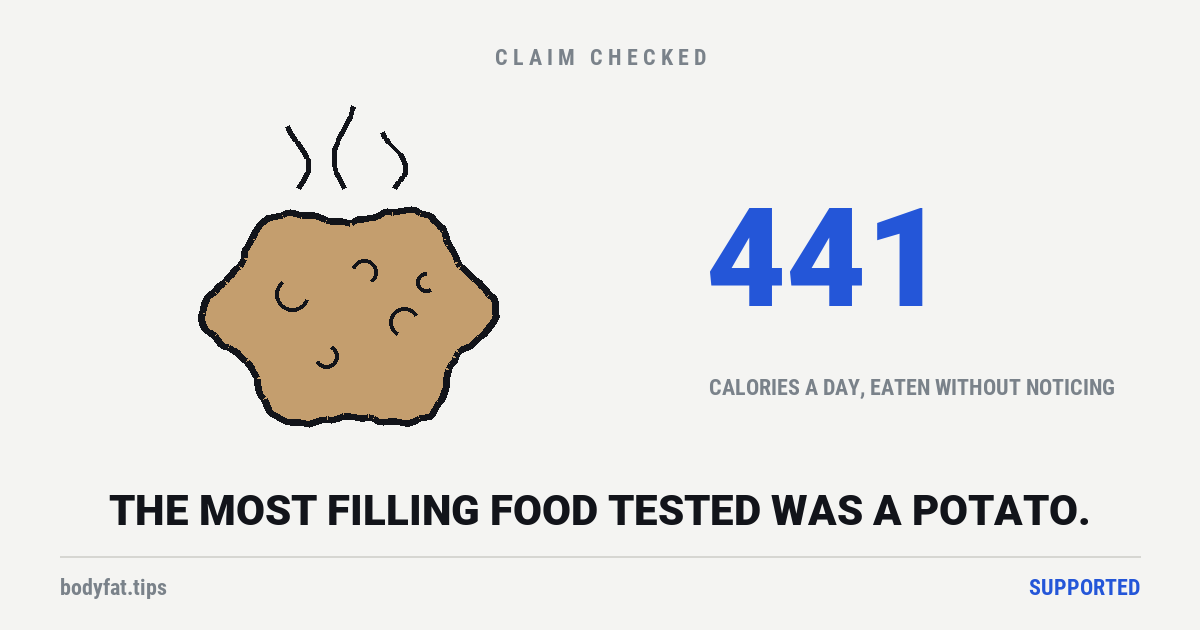
Yes, and by a margin worth having: about 441 calories a day, eaten without anyone noticing they were eating less [1].
Then there is the awkward part, which is that the most filling food anyone has ever put on a ranked list is a boiled potato [3].
Both of those are true. Here is how they fit together.
The study that isolated protein properly
The problem with most protein research is that high-protein diets are usually also low-carb diets, so you can never tell which lever did the work.
A team at the University of Washington fixed that. They put nineteen people through three phases and held carbohydrate constant at 50% of calories the entire time [1]. Only protein moved — from 15% of calories up to 30%, with fat coming down to make room.
Phase two is the one to watch. Protein went up, but the calories were matched to phase one exactly. Same energy, different composition.
Satiety went up markedly anyway [1].
That is the finding in its cleanest form: identical calories, and people felt fuller. Not because they ate more, because of what they ate.
Then phase three let them eat as much as they wanted for twelve weeks. They spontaneously ate 441 calories a day less, lost 10.8 lb (4.9 kg), and 8.2 lb (3.7 kg) of that was fat [1].
Nobody was on a diet. Nobody was counting. They just stopped earlier.
The detail that makes this weirder than it looks
Your appetite is partly run by two hormones. Leptin tells your brain there is fuel in reserve; ghrelin is the one that makes you want lunch.
Over those twelve weeks, leptin went down and ghrelin went up [1].
Both of those changes should have made these people hungrier. Both are exactly what happens when you lose weight and your body starts arguing about it — the well-documented reason so much lost weight comes back.
And they kept eating less anyway, for three months, with the hormones pulling the other way the whole time.
So does that mean protein wins? Not quite.
In 1995 a group in Sydney did something nobody had bothered to do: they ranked actual foods against each other for fullness.
Thirty-eight foods, each served at exactly 240 calories so the comparison was fair, with satiety measured every fifteen minutes for two hours. White bread was set at 100% and everything else scored against it [3].
The winner was boiled potatoes, at 323%. The loser was a croissant, at 47% — a seven-fold gap between the best and worst food on the list [3].
And when they checked which nutrients actually predicted the scores, protein was there — but it was third [3]:
Water content was the strongest predictor. Fibre was second. Protein was third, at roughly half the strength of water. And fat ran the other way — more fat, less full.
Which reframes the whole thing. Protein does make food more filling. It is just not the biggest lever on the board, and a food that is bulky and wet and fibrous can beat a protein-dense one that is dry and small.
A boiled potato is mostly water, has fibre, and has almost no fat. It wins on three of the four.
How strong is the evidence, honestly?
Here is a rare thing: a meta-analysis that argues against its own conclusion in the title.
The paper is called “The Effects of Increased Protein Intake on Fullness: A Meta-Analysis and Its Limitations” [2].
The result was clear enough — higher-protein preloads beat lower-protein ones on fullness, comfortably [2]. A separate count of 28 studies pointed the same way [2].
But only five studies were strict enough to pool [2]. And the authors close by warning that extending their finding beyond “tightly defined conditions” — to real eating behaviour, to body weight, to health outcomes — must be done cautiously [2].
That is researchers telling you not to oversell them. It is also why this verdict says Supported and not Established: a large, repeatable effect sitting on a small pile of studies.
What to actually do
Put protein in the meal you most often overeat after. On this evidence the effect shows up at the next meal, not at the end of the week.
But stop treating fullness as a protein-only problem. Water and fibre both predicted it at least as well [3], which is a roundabout argument for the least fashionable advice in nutrition: eat the potato, eat the vegetables, and be suspicious of dry, dense, low-water food that disappears in four bites.
And note what the 441-calorie finding was not. It was not a shake, a bar, or a powder. It was the protein content of ordinary meals moved from 15% to 30% [1]. If you want the separate question of how much protein you actually need, that has its own verdict.