Does Metabolism Slow With Age? Yes — at 60, Not 30

Yes — starting at about sixty.
Not thirty. Not twenty-five. Not, whatever you have been told, at twenty-one.
6,421 people, 29 countries, 8 days to 95 years
This is one of those rare cases where somebody just went and measured it properly, at scale, with the gold-standard method.
Doubly labelled water is the technique you use when you want the real number rather than a questionnaire: you drink water with traceable isotopes and researchers work out your energy expenditure from how fast they leave. Expensive, awkward, and almost impossible to fool. Pooling the world’s database gave 6,421 people across 29 countries, from eight days old to ninety-five [1].
Four life stages came out of it, and only one of them matches the popular story.
The curve nobody describes correctly
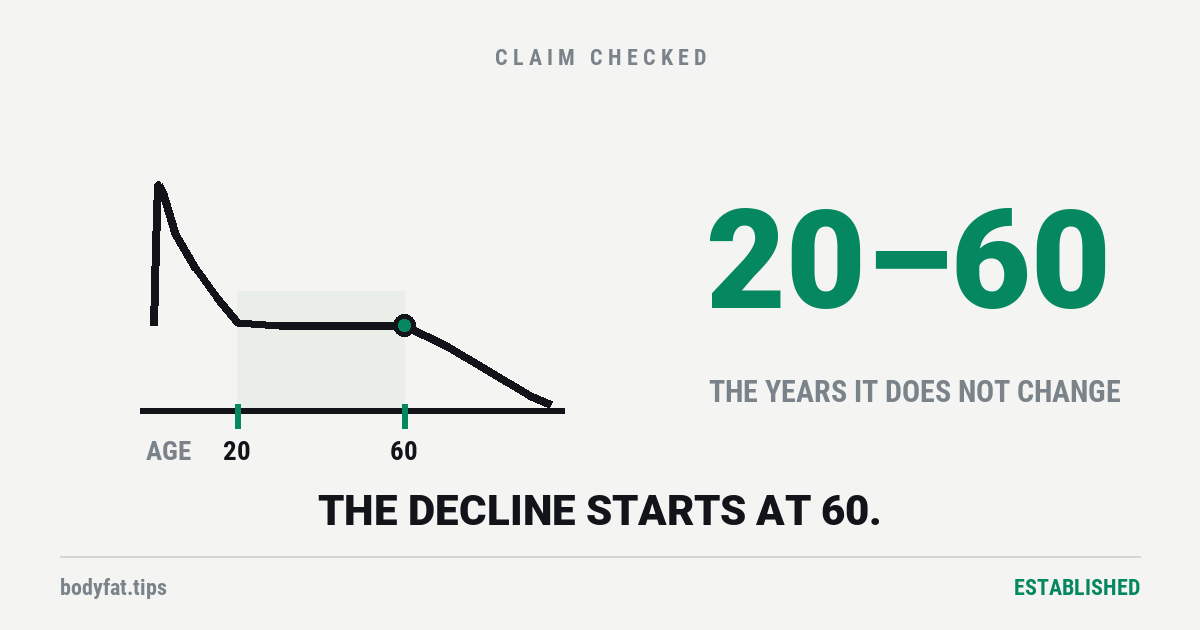
Infancy. Expenditure climbs 84.7% a year from birth, peaking around age one at roughly 50% above adult levels, pound for pound [1]. A one-year-old is the most metabolically expensive human there is.
Childhood to twenty. A long slow decline of about −2.8% a year, arriving at adult levels around age twenty [1].
Twenty to sixty. Flat. Stable. Nothing happens. And the paper adds a detail worth pausing on — it stays stable “even during pregnancy” [1].
Sixty onwards. Now it falls, at about −0.7% a year. By ninety-plus, expenditure is around 26% below middle-aged adults [1]. Real, measurable, and four decades later than the folklore says.
So does it slow at 25? At 21? In your 20s?
No, no, and no. Those are three of the most common ways people search for this, and the answer to all three is the same flat line.
Learn More:



Twenty is roughly where the childhood decline stops. It is the beginning of the plateau, not the beginning of the slide. If you turned twenty-five and felt something change, the change was not this.
And for women specifically — another question people ask a lot — the answer is the same age, sixty. Nearly two-thirds of the people in this dataset were female [1]. This is not a finding derived from men and assumed to generalise.
The uncomfortable part
Here is what the finding actually costs you, and most coverage of it skips this bit.
If your metabolism is genuinely flat from twenty to sixty, then the weight a lot of people put on across their thirties and forties was not caused by a slowing metabolism. It cannot have been. The engine did not change.
What changed was everything else. How much you move without noticing. Portion sizes that crept. Sleep. Alcohol. Desk jobs. Children. The gradual replacement of accidental activity with sitting down.
That is a less comfortable explanation than a metabolism betraying you on schedule, which is exactly why the metabolism version travels better. But it is also the only version that leaves you anything to work with.
How do I get my old metabolism back?
You still have it.
That is the honest answer to what is, judging by search behaviour, one of the most common questions people bring to this topic. If you are between twenty and sixty, the thing you are trying to recover has not gone anywhere. Measured pound-for-pound against your fat-free mass, it is doing what it did at twenty-two [1].
Which also means no product can give it back to you, because nothing took it. That is the whole business model of an entire supplement aisle, resting on a decline that starts four decades later than advertised.
What to actually do
Stop treating your age as the explanation, at least until sixty. It is the one variable in this that the best data available says is not moving.
After sixty it does move, and the number is worth knowing: about 0.7% a year. That is slow enough to be invisible year to year and large enough to matter across decades, and the response to it is the boring one — hold onto muscle, because the whole measurement is scaled to fat-free mass in the first place.
Before then, if something has changed, look at the inputs. The engine has an alibi.