Does Chewing Gum Burn Calories? Yes, but Not Enough to Move the Scale

Yes. Chewing is muscular work and muscular work costs energy, so the answer was never going to be no.
The interesting part is how much.
A handful of calories an hour
Thirty young adults, crossover design: each was measured on a day with gum and a day without. Their average age was 21.5, and their average body mass index (a weight-for-height score) was 23.9, inside the normal-weight range. Fasting energy expenditure, worked out from the oxygen they used and the carbon dioxide they breathed out, averaged 1.23 kcal a minute on the gum day against 1.17 without (p = 0.016; a kcal is what a food label calls a calorie). After breakfast: 1.46 against 1.42 (p = 0.037) [1].
Those are real, statistically significant differences. Now do the subtraction: 0.06 kcal a minute more before breakfast, 0.04 after. Over an hour, roughly 3.6 calories and 2.4. (That step is our arithmetic, from their measured figures.)
Here is the part we could not check, and it matters. Nobody chewed through the whole measurement. The day’s gum came as three 20-minute sessions [1]; in the same lab’s companion study, one sat inside a 45-minute fasting measurement and two inside the three hours after breakfast [3] [5]. If the averages above cover only the minutes spent chewing, an hour of chewing costs about 2.4 to 3.6 calories. If they cover the whole measurement, the chewing minutes cost more: up to roughly 8 to 11 calories an hour (our arithmetic again, on those session lengths). Which it is sits in the paper’s methods section, behind a paywall that neither a direct download nor a web browser got us past.
Either way, an hour of continuous chewing buys you somewhere between a third of a single almond and an almond and a half. (One almond is about 7 calories, by the US Department of Agriculture’s figures.)
The number everyone quotes: seven people, twelve minutes
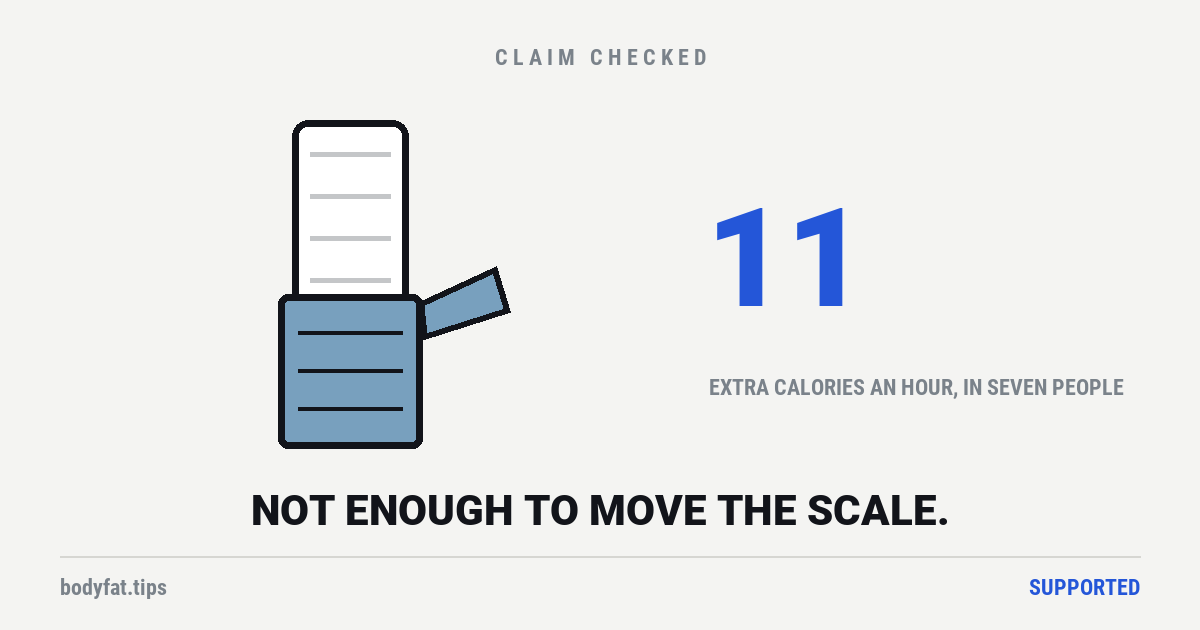
You will see “11 calories an hour” everywhere. It comes from a 1999 research letter in the New England Journal of Medicine [4].
There is no abstract indexed, but the letter itself is readable on the journal’s website. Seven non-obese adults sat at rest, breathing into a face mask that left their jaws free to move. Each then chewed calorie-free gum for 12 minutes, in time to a metronome. Energy use rose in every one of them, by 11 calories an hour on average (from 7 to 17, depending on the person), and it was back to its resting level in the 12 minutes after the gum came out [4].
So the number is sound, as far as seven people and twelve minutes can carry it. The letter then went one step further. Chew gum through your waking hours, it said, change nothing else, and a loss of more than 11 lb (5 kg) of body fat a year “might be anticipated” [4]. That is a projection, not a measurement. The trial that actually put gum on the scale comes next.
So does it help you lose weight?
No, and this is the best-run study in the whole file.
Two hundred and one overweight and obese adults, eight weeks, randomised. The gum group chewed a minimum of ninety minutes a day. Adherence was better than 95%, which almost never happens in a behavioural trial [2].
The result: “virtually no changes in weight or BMI in either group.” Waist circumference did fall about half an inch (1.4 cm) inside the gum group, but there was no significant difference between the groups, which is the comparison that counts [2].
The authors’ own sentence: chewing gum on a regular schedule for eight weeks “did not facilitate weight loss.”
Ninety minutes a day. Ninety-five percent adherence. Nothing.
The appetite angle is more interesting, and less settled
Here is where the idea keeps its dignity. Gum does seem to do something to hunger.
A 2025 systematic review gathered nine randomised trials and counted how many found an effect. Hunger was significantly suppressed in five of seven. Desire to eat fell in three of five, and desire for something sweet in three of four [3].
But watch what happens when you move from what people felt to what they ate. Energy intake reached significance in only two of seven trials [3].
Feeling less hungry and eating less are not the same measurement, and the gap between them is where a lot of diet advice quietly lives. The reviewers’ own verdict on body weight is blunt: it “has not been proven.”
What to actually do
Chew gum if you like gum. If it genuinely stops you walking to the cookie jar, that is worth more than anything the chewing burns — not because of chewing, but because you did not eat the cookie.
Do not count it as exercise. At an hour of chewing per almond and a half, even on the generous reading, the arithmetic is not close, and the one properly powered trial put ninety minutes a day into it for eight weeks and got nothing on the scale.
The claim is true and it is trivial. Those two things sit together more often than the internet lets on, and telling them apart is most of the job.
This page was corrected on 16 September 2026 after an independent editorial review. The evidence panel said industry funding was “not reported in the sources read.” The weight-loss trial’s own acknowledgment, which we should have found, says the work was funded by a grant from the Wrigley Science Institute and that Wm. Wrigley Jr. Company supplied the gum, Wrigley’s Extra [2]. The 2015 energy-expenditure paper’s funding statement is behind a paywall we could not get past; a 2009 Wrigley press release announcing earlier work by the same authors said that study was “supported by an unrestricted research grant from the Wrigley Science Institute” [6] — the company’s wording about that earlier study, not the 2015 paper’s own statement. The 2025 review declares no external funding and no conflicts [3]; its seven authors’ 2026 paper from a probiotic chewing-gum trial that ran from June 2023 to February 2025 (NCT05882149) says that research was funded by Biopolis S.L. and Chic-kles Gum S.L. The panel and the provenance chain now say so.
Also corrected: the headline said gum burns “about 3.6 an hour.” That was our subtraction from the 2015 study’s fasting figures alone, and it treated gum-day averages, which the page had called rates “while chewing,” as the cost of each chewing minute — something the parts of the paper we can read do not establish. The after-breakfast figures give 2.4; if the averages cover whole sessions, the chewing itself cost up to roughly 8 to 11 an hour. The page now gives both readings and says what we could not check. An earlier version also said we could not read the 1999 letter behind “11 calories an hour”; it is readable on the journal’s website, and the page now reports what it measured and the fat-loss projection it made. The almond comparison is recomputed, the 2025 review is described as a count of trials rather than a pooled analysis, and the search description no longer says the energy study used a metabolic chamber (it used indirect calorimetry). The rating is unchanged: chewing gum does burn calories, and not enough to matter.
- Does Drinking Water Help You Lose Weight? A Little. Just Not How They Said.
preliminary - Natto Benefits: Linked to Fewer Heart and Stroke Deaths. No Trial We Found Has Tested It
preliminary - Hydrogen Water Benefits: Small, Mixed Shifts in Blood Markers, and No Significant Win in the Three Biggest Trials
preliminary