Do Waist Trainers Work? Nine in Ten Took It Off Before the Trial Ended

No. And the way we know is better than a flat denial, so stay with it.
Somebody did run the trial. Sweden, primary care, 77 people randomised after losing weight on a very low calorie diet — half fitted with a soft corset, half not, for nine months [1].
Here is what happened to the people wearing it.
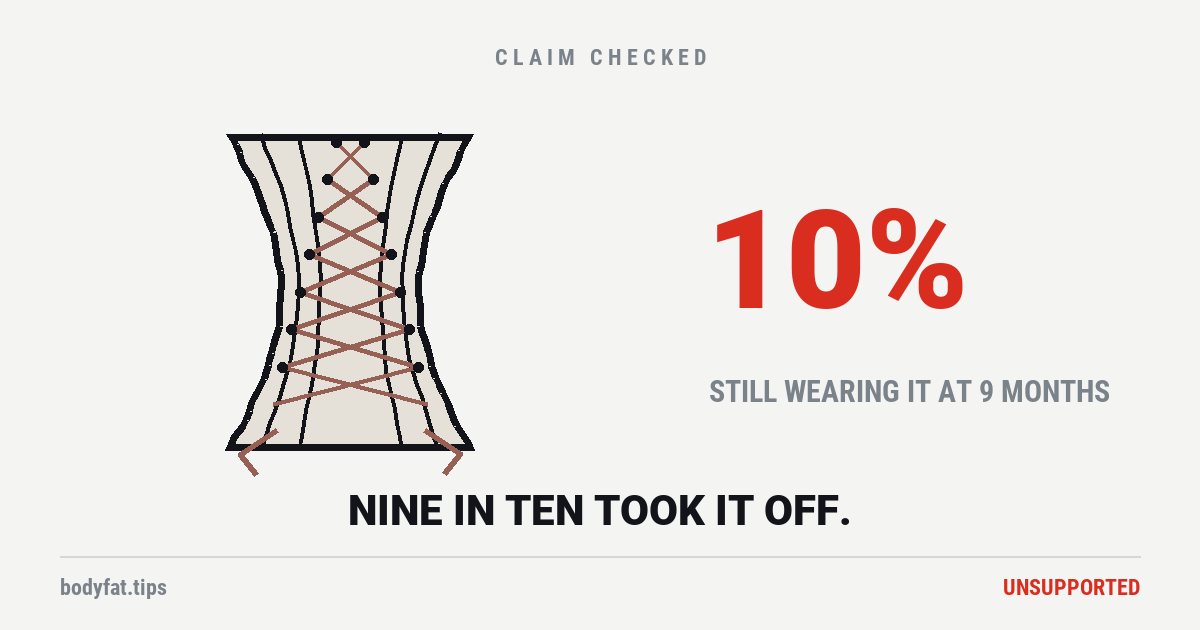
100% → 33% → 20% → 15% → 10%
That is compliance at the start, then at two months, three, five and nine [1]. Everyone began wearing it. Nine in ten had taken it off before the study ended.
And the bar was not high. The prescription was 12 to 16 hours a day; the researchers were willing to count you as compliant at five hours a day, five days a week. One in ten managed that.
The authors’ own verdict, and you should read it twice: “Corset treatment suffered from poor compliance and could therefore not be evaluated.” They went further — corset treatment “does not appear to be an option for sustained weight control” [1].
The weights, for completeness: at twelve months the corset group was down 25.8 lb (11.7 kg) against 20.5 lb (9.3 kg) (p = 0.23), and at twenty-four months 13.4 lb (6.1 kg) against 9.7 lb (4.4 kg) (p = 0.94) [1]. Neither difference is statistically significant, and with 90% of the corset group not wearing the corset, the comparison was never really a comparison.
There is a second trial, and it did not test the garment alone
We went looking for trials of waist trainers, waist trimmers and compression garments for fat loss. The Swedish study is one of two randomised trials we have found, and it was designed as a weight-maintenance question, not a fat-loss one. Our first search missed the other, from Mutsu City in Japan, published in 2023 [3].
Sixty-nine adults aged 30 to 65, half of them men, all with a body mass index (weight scaled for height) of 25 or more, were randomised. One group was asked to wear a high-waisted compression garment every day for twelve weeks and, alongside it, to set goals, weigh themselves daily, and sit down for a 30-minute session with a public health nurse. The other group got only the three health-information booklets that both groups received [3].
And the garment was not a waist trainer as most people picture one. It was a pair of high-waisted shaping bottoms made by the Japanese company ATSUGI, and the authors describe its pressure as minimal compared with a tight girdle or corset [3].
After twelve weeks the garment group had lost 3.7 lb (1.7 kg) and the other group 0.9 lb (0.4 kg), a gap of 2.9 lb (1.3 kg) on the right side of the line researchers use for “probably not chance” (p < 0.05) [3]. The paper puts the effect size at 0.64 — researchers call 0.2 small and 0.8 large — with a 95% confidence interval, the range the true answer probably sits in, of 0.50 to 0.78. That range is far narrower than we would expect from a trial of 69 people, and the paper does not say how it was calculated. Waist size fell further in the garment group too, but the paper does not report that difference as statistically significant.
So does that trial show the garment works? Three things stand in the way. There was no group that wore the garment without the programme, or followed the programme without the garment, so nobody can say how much of the gap the garment made. It measured weight, not fat. And the company that makes the garment was close to the study: ATSUGI supplied the garments, three of the twelve authors worked for ATSUGI or an affiliated company, a fourth worked in the university department whose budget paid for the trial, and that department, the authors declare, was “cofounded by Hirosaki University and ATSUGI Co., Ltd.” The authors say the funders had no role in the study’s design, analysis or write-up [3].
A product category this large should have produced at least one trial that tests the garment on its own. We have not found one.
Absence of evidence is not proof it fails. But when a thing is sold this hard and studied this little, the absence is doing the talking.
One more garment trial was registered and has not reported. An industry sponsor, Feelwell Compression, put it on the registry in January 2019 to test a custom-fitted compression garment in adults with a body mass index of 35 or more, with both groups following the same mobility programme; its main outcomes included mobility, pain and quality of life, with fat mass a secondary one [4]. It was due to finish in July 2020. The record has not been updated since February 2019 and holds no results, and we found no publication from it in PubMed or Europe PMC.
There is no direct mechanism either
Say the compliance problem vanished. What would a waist trainer actually do?
Squeeze the middle. That is the direct mechanism, in full. A garment that compresses tissue changes the shape of the tissue while it is on, and the tissue returns when it comes off. Nothing about external pressure removes stored triglyceride from a fat cell.
Both trials were built on an indirect idea instead: the garment as a reminder. The Swedish authors cited a 1981 report that weight lost while patients’ jaws were wired shut could be kept off with a nylon cord tied round the waist, “prohibiting overeating”, and reasoned that a corset “could have similar effects” [1]. The Japanese team expected their garment to “function as a motivational tool” [3]. That is the trials’ own rationale, not a finding: the corset went unworn, and the Japanese garment was never tested apart from the programme it came with.
And the fallback claim — that it drives fat loss from that area — runs into a wall we already walked into. We checked whether you can burn fat off one chosen body part, and the answer was no regardless of what you do to that part. Compression is not a special case.
The sweat is not the fat
The neoprene version — the sauna belt, the trimmer — sells on how wet you get.
Sweat is water. You weigh less immediately after and you weigh the same again once you drink. We went through this in detail on why the first week of a low-carb diet looks so impressive: a scale that moves because you are drier is not a scale reporting fat.
Wrapping a body part in rubber makes that body part sweat more. It is the one claim in this category that is completely true and completely irrelevant.
The one measured effect is not a good one
Here is the part the marketing does not carry. Abdominal compression does something measurable, and it is acid reflux.
Fourteen men with reflux disease, a weightlifting belt inflated to a constant 50 mmHg, measured with high-resolution pH monitoring and manometry. The belt raised pressure inside the stomach by about 6.9 mmHg fasting and 9.0 mmHg after a meal. After the meal, the share of time the oesophagus sat in acid rose roughly eight-fold at every sensor from under half an inch to about 2 inches (1.1 to 5.5 cm) above the oesophageal sphincter, the muscle ring that keeps stomach contents down, and the number of reflux episodes doubled, from 2 to 4. Before the meal, the belt made no difference to acid in the oesophagus [2].
And the clearance time — how long acid sat in the oesophagus before being cleared — went from 23 seconds to 81 seconds [2].
Read the limits with us: fourteen people, all of whom already had oesophagitis or Barrett’s oesophagus, and a lifting belt rather than a waist trainer. Each test ran for 20 minutes fasting and 90 minutes after a meal, and the authors caution against stretching a short-term result to long-term wear. It does not establish that waist trainers harm healthy people: when the same Glasgow group put a belt on volunteers without reflux disease, extra acid showed up only about half an inch (1.3 cm) above the junction where the oesophagus meets the stomach lining, and at none of the sensors higher up — “little evidence”, they wrote, of more acid in the oesophagus itself [2]. What the patient study does establish is that squeezing the abdomen is not physiologically inert — there is a measured effect, and it points the wrong way.
You will also find claims that waist training collapses your lung capacity by 30 to 60 percent. We tried to source that figure. WebMD states it, on a page medically reviewed in November 2024 that lists a 2016 post by the American Board of Cosmetic Surgery among its sources. That post gave the number as “an estimated 30-60%”, cited no study, and is no longer on the board’s website. We found no study behind it either. We are not repeating a number we cannot stand behind, even one that would help the argument.
Who is answering this question right now
When we pulled Google’s US results for “do waist trainers work” on 25 July 2026, the first two pages included Reddit, Facebook, Quora, TikTok, two YouTube shorts, a fashion magazine, the shapewear brand SKIMS and three shops selling corsets and waist trainers. Three health sites made the cut: WebMD on page one, Cleveland Clinic and GoodRx on page two.
That is not a conspiracy. It is just what happens when a question has enormous commercial value and almost no research attached — the vacuum gets filled by whoever benefits from the answer.
The bottom line
A waist trainer changes your shape while you are wearing it. That is a real thing and if you want the silhouette under a dress for an evening, buy one and enjoy it. Shapewear is a legitimate product doing a legitimate job. The exception is reflux. The authors of the belt study say reflux patients should be advised to avoid tight clothing round the waist, above all after meals, when its effect is strongest [2]. If you have reflux, or have been told you have oesophagitis (an inflamed oesophagus) or Barrett’s oesophagus (a change in its lining, usually from long-term reflux), ask your doctor before you wear one to dinner.
What it does not do is remove fat, from your waist or anywhere else. The corset trial could not evaluate it because almost nobody could stand to wear it. The garment trial that did report weight loss measured weight rather than fat, and never tested the garment apart from the goal-setting and daily weighing it came with. There is no mechanism by which pressure removes fat. And in a study of people who already had reflux disease, a tight belt made acid reflux markedly worse after a meal.
The product is fine. The promise attached to it is the problem, and the people making that promise have yet to back it with a trial that tests the garment on its own.
This page was corrected on 15 September 2026 after an independent editorial review. It called the Swedish corset trial the entire evidence base and said no second trial had been found. That was wrong. A randomised trial from Mutsu City in Japan, published in 2023, gave 35 adults a light high-waisted compression garment together with goal-setting, daily weighing and a nurse session, and over twelve weeks they lost 2.9 lb (1.3 kg) more than 34 adults who received only health booklets. The page now reports that trial and what it cannot show: the garment was never tested on its own, fat was not measured, and, by the authors’ own declaration, the garment’s maker supplied the garments, employed three authors directly or through an affiliate, and cofounded the university department that funded the study. We also removed the line saying nobody was hiding a drawer of positive trials, and added an industry-registered garment trial that has posted no results.
Also corrected: the page’s search-results description called the corset trial’s participants women, when 20 of the 77 randomised were men, and said trials show the waist returns within hours, which none of our sources measured. The reflux study is now described as what it was, 14 men who already had reflux disease, with its eight-fold figure given as acid exposure after a meal, the same group’s result in volunteers without reflux, and the authors’ advice to reflux patients. The funding row now says the corset trial used Cederroth’s diet product and gives the funding of the reflux study and the new trial; the lung-capacity figure’s trail and the search-results paragraph are now sourced and dated; and the provenance chain’s spread step now shows where the claim spreads rather than repeating the trial. The rating is unchanged: no trial has tested the garment on its own or measured fat.