Is Canned Tuna Healthy? Yes — But You’re Probably Draining the Best Part

Yes. And the thing most likely to be wasting the good part of it isn’t the can — it’s what you do at the sink.
The worry behind this question is usually that canning cooks the fish to death and destroys the omega-3s, leaving you with expensive protein in a tin. So we went to the USDA’s reference database and pulled the numbers [1].
What is actually in the tin
| Canned, drained | Omega‑3 (EPA+DHA) | Calories | FDA/EPA |
|---|---|---|---|
| Pink salmon | 1.08 g | 138 | Best Choice |
| Albacore, in water | 0.86 g | 128 | Good Choice |
| Light tuna, in water | 0.27 g | 116 | Best Choice |
| Albacore, in oil | 0.24 g | 186 | Good Choice |
Start with the top line. Canned pink salmon carries 1.08 grams of EPA and DHA per 100 grams — the two omega-3s that actually do the work [1]. That is not a degraded, apologetic version of fresh fish. That is a serious dose from a tin that costs about two pounds and keeps for four years.
So the premise of the question is wrong. Canning does not empty the fish out.
But look at the bottom two rows, because that is where the real story is.
The oil is the leak
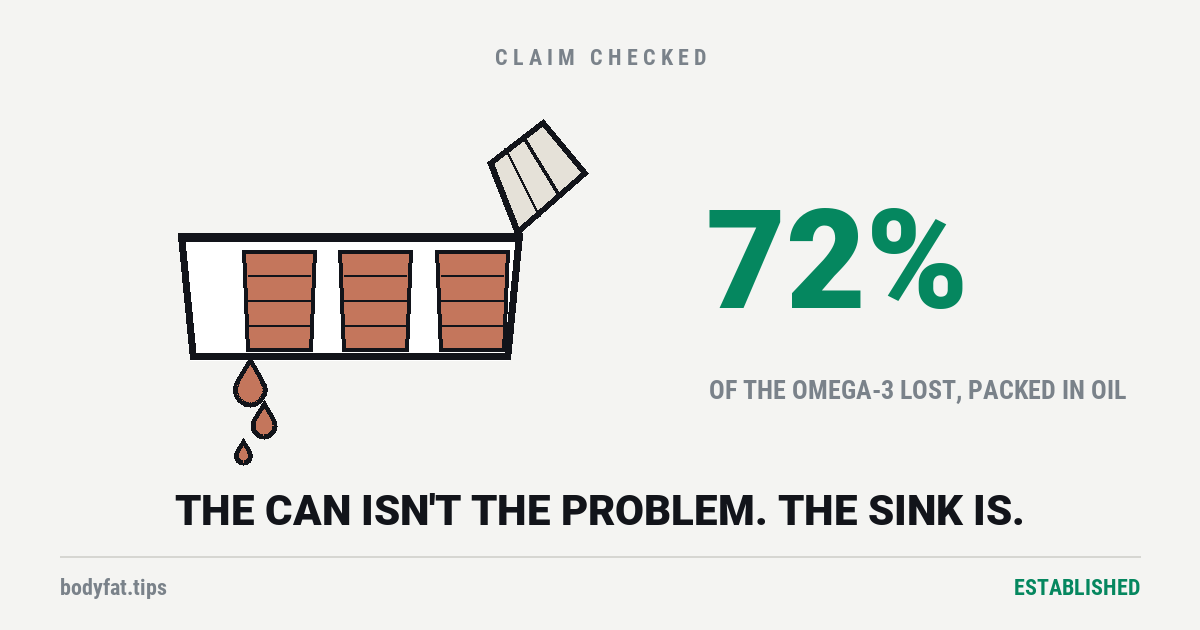
Albacore tuna canned in water: 0.86 g of omega-3.
The same fish canned in oil: 0.24 g [1].
Same species. Same can. Roughly 72% less omega-3 — and 45% more calories while it is at it.
The mechanism is embarrassingly simple. Omega-3s are fats, and fats dissolve in other fats. Pack fish in oil and its omega-3 migrates out into that oil. Then you open the tin, tip it over the sink, and pour most of the reason you bought it down the drain.
Pack the same fish in water and the fat has nowhere to go, because oil and water don’t mix. It stays in the fish. You drain off water that never held anything you wanted.
Which makes this one of the rare cases where the option that sounds more premium is the one that fails you. “Packed in olive oil” reads as the good tin. It is the one that empties out — unless you use the oil, in which case you keep what dissolved into it.
The mercury question, which is real
This is the part where the honest answer is not simply “eat more”.
The FDA and EPA publish a joint advisory sorting fish into three lists by mercury [2]. It is worth knowing exactly where tuna lands, because the two kinds are not in the same place:
Canned light tuna (including skipjack) is a Best Choice. Albacore — the white one — is only a Good Choice, as is yellowfin [2].
The guidance attached to those lists: two to three servings a week from Best Choices, or one serving from Good Choices [2]. For anyone pregnant or breastfeeding a serving is four ounces.
And the list nobody quotes, the one to actually avoid, is where the mercury really sits: king mackerel, marlin, orange roughy, shark, swordfish and Gulf tilefish [2]. Canned tuna is not in that company and never has been.
So now put the two datasets together
Here is the awkward bit. The tuna with the most omega-3 — albacore in water, at 0.86 g — is also the tuna with the mercury caveat. The tuna you can eat most often, light tuna, carries only 0.27 g [1][2].
You are being asked to pick between the good stuff and the frequent stuff.
Except you are not, because there is a row that wins on both counts. Canned pink salmon has more omega-3 than any of the tunas, and it is a Best Choice [1][2]. So do sardines and anchovies, both also Best Choices [2].
That conclusion is not ours. It falls straight out of putting a nutrient table next to a federal advisory, which apparently nobody does, because the entire internet is arguing about tuna.
What to actually do
Buy it in water, not oil — or buy it in oil and use the oil in the meal instead of pouring it away. That single choice is worth more than everything else on this page [1].
If you want omega-3, reach past the tuna. Canned pink salmon beats every tuna in the table and sits on the safer list, and sardines are on that list too.
If you eat albacore, treat it as the once-a-week tin rather than the everyday one. If you eat light tuna, the advisory is comfortable with two to three servings a week [2].
And stop paying a premium for the tin that drains away three-quarters of what you were buying.