Is Erythritol Bad For You? The One Sweetener Worth Watching

This is the one in the sweetener aisle we would not wave away.
Not because it has been shown to hurt anyone — it has not. But because unlike every other sweetener scare, this one arrived with a mechanism attached, and a mechanism is a different kind of problem from a correlation.
It also arrived with a confound big enough to swallow the headline, and that part went almost entirely unreported.
What the 2023 study found
Researchers at the Cleveland Clinic ran metabolomics — a broad sweep of the small molecules circulating in blood — on patients being assessed for heart problems, and asked which ones predicted heart attacks, strokes and death over the following three years [1].
Erythritol came out near the top. They then checked it in two more groups: 2,149 patients in the US and 833 in Europe. In each, the quarter of patients with the most erythritol in their blood had heart attacks, strokes and deaths pile up at 1.80 and 2.21 times the rate of the quarter with the least [1]. That ratio is what researchers call a hazard ratio — one group’s events divided by the other’s. In both groups the whole plausible range for it sat above 1, which is to say “the two quarters were no different” was not one of the answers the data left open.
Then they went looking for a mechanism, and found one. At levels you actually reach in blood, erythritol made platelets more reactive in the lab and increased clot formation in living animals [1]. Platelets are the cells that form clots; clots are how heart attacks and most strokes actually happen.
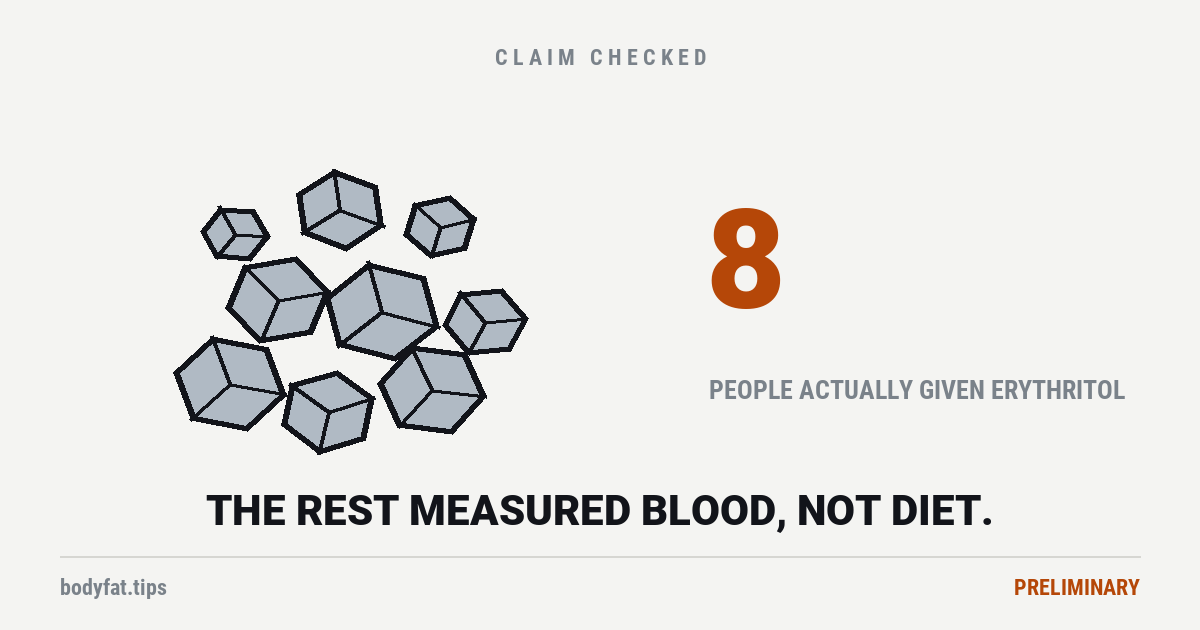
And in eight healthy volunteers, drinking erythritol pushed plasma levels up and kept them above the threshold linked to that platelet effect for more than two days [1].
Laid out like that it sounds close to settled. It is not, and here is why.
The cohorts measured blood. Not diet.
Read the study design again: they measured how much erythritol was circulating in people’s blood. At no point did they measure how much erythritol those people ate [1].
That would not matter if blood erythritol only came from food. It does not.
Your body makes erythritol. It is synthesised internally through the pentose-phosphate pathway, a normal route of glucose metabolism [2]. Everyone has some in them, including people who have never knowingly eaten the stuff.
And now the detail that ought to have been in every headline. Elevated plasma erythritol has been associated with metabolic disorders — and weight loss has been linked to decreased plasma erythritol [2]. In one analysis of people who had bariatric surgery, the change in their BMI predicted the change in their fasting erythritol [2].
So put it together. The study population was people already in a cardiac clinic. High blood erythritol tracks metabolic dysfunction. Metabolic dysfunction causes heart attacks.
Which means a finding of “high circulating erythritol predicts cardiac events in cardiac patients” is entirely compatible with erythritol being a marker of the problem rather than a cause of it — a warning light rather than the fault.
Nobody has untangled this yet. The researchers studying endogenous production say plainly that the processes regulating it “remain unclear” [2].
There is a real counterpoint, and it belongs here. The same Cleveland Clinic group published a companion paper on xylitol the following year, and in it they state that sugar alcohols are made in the body “at levels over 1000-fold lower than observed following consumption as a sugar substitute” [3]. If that holds, what you eat swamps what you make, and the confound shrinks.
Does it settle it? No — because the cohorts drew blood after an overnight fast, and fasting is where the home-made fraction shows up. But it does cut the other way too: that eight-person dosing study found erythritol still elevated more than two days after a single drink, so a fasting sample from someone who eats the stuff daily is carrying a dietary signal as well.
Both of those are true at once. Which is the whole reason this page says unresolved instead of picking a side.
Somebody did test the direction. Three times. They disagree.
You cannot randomly assign people to have high erythritol for twenty years. But you can do the next best thing, and researchers have.
It is called Mendelian randomisation, and the trick is elegant: the gene variants you inherit were dealt at birth, before any lifestyle could confound them. If the variants that nudge erythritol levels up also track with heart disease, that points at cause. If they do not, the association was probably something else riding alongside.
Three such studies exist. Here is all three, including the one that makes our own argument look better and the two that do not.
The strongest of them, in Diabetes in 2024, ran the analysis in both directions and concluded flatly: “we did not find supportive evidence from MR that erythritol increases cardiometabolic disease” [4]. It also found erythritol may decrease body mass index — which is precisely what you would expect if erythritol levels are following metabolic health around rather than driving it.
Two later studies disagree. One reported higher genetically predicted erythritol tracking with coronary heart disease and ischaemic stroke [5]; the other reported the same direction and called the evidence “suggestive” [6].
Now look at the size of what they found. The second study’s odds ratio for coronary heart disease was 1.0020 [6]. An odds ratio of 1.0020 means two-tenths of one percent higher odds. That is a number a statistical test can separate from zero and no human being could ever experience. “Statistically significant” and “big enough to matter” are different claims, and here they have come completely apart.
The other study also flagged a problem in its own results — a test for whether its gene variants were affecting the outcome through some route other than erythritol came back positive for the clotting outcomes, and its answers for those flipped depending on which method was used [5]. The authors report it themselves. We are not catching them at anything; we are reading what they wrote.
So: the one design built to answer “marker or cause” has been run three times and produced a null, a tiny positive, and a positive with an acknowledged flaw. That is not a settled answer in either direction. It is the definition of the tier at the top of this page.
What that does and does not excuse
It does not dispose of the platelet work. That part did not rely on the cohorts at all — it put erythritol on platelets and watched what happened, and then watched clots form in animals [1]. The confound explains the epidemiology. It does not explain the biology.
Nor does it dispose of the dosing finding. Eight people is a small study, and it measured blood levels rather than health outcomes — but it does establish that eating the stuff raises circulating levels a great deal, and for longer than you would guess [1].
The authors’ own conclusion is the fair summary: “Studies assessing the long-term safety of erythritol are warranted” [1]. Warranted is not the same word as demonstrated.
One disclosure, because we report these everywhere. The study’s senior author holds patents relating to cardiovascular diagnostics, consults for a therapeutics company, and is eligible for royalties in that field [1]. That is not an accusation and it does not make the platelet experiments wrong. It is context you are entitled to have.
And a technicality that matters
Erythritol is a sugar alcohol, not a non-sugar sweetener. The WHO’s 2023 guideline — the one behind every “WHO says avoid sweeteners” headline — explicitly excludes polyols.
So if you switched to erythritol because of that guidance, you switched to something the guidance never covered, on the basis of a document that does not mention it. Which is its own small comment on how this information reaches people.
What to actually do
If you use erythritol occasionally, there is no demonstrated harm to act on, and the strongest evidence against it can be explained by your body making the stuff itself.
If you use a lot of it daily — and it is the bulk sweetener in most “keto” and “zero sugar” baked goods, often several grams a serving — this is the one sweetener where we would say the question is genuinely open, and moderating is a reasonable response to an open question.
If you already have cardiovascular disease, that is a conversation for your cardiologist rather than a website. The people in these cohorts were cardiac patients, and they are the group for whom the finding, if it is real, would matter most.
And note what this page is not doing: telling you a scare is nonsense. That is what we concluded about aspartame, where two expert bodies had actually looked. Here they have not looked yet. Those are different situations and they deserve different answers.
The version published on 30 July 2026 stated in its evidence panel that “the causal direction has not been tested at all.” That was wrong. Three Mendelian randomisation studies had already tested it — one in Diabetes in 2024 finding no supportive evidence for causation, and two in 2025 finding positive associations, one of them at an odds ratio of 1.0020. We found them the same day while researching a neighbouring article, and they are now reported in full in their own section. The first version also gave the endogenous-production confound a clearer run than the evidence supports: the same research group has published that sugar alcohols are made in the body at levels over 1000-fold lower than after eating them, and that counterpoint was missing. It has been added. The verdict is unchanged at Preliminary — if anything the added evidence is what Preliminary is for, since the design built to settle the question has now been run three times and disagreed with itself.