Black Tea vs Green Tea: Green Has Nearly 5 Times the Catechins, No Clear Winner in Trials

Ask which tea is healthier and most of what comes back says green. A health publisher’s January 2026 explainer puts it in one line: “Green tea retains more antioxidants than black tea.” One tea seller’s blog says green tea “retains high levels of catechins” that black tea’s processing converts into other things [1]. Plenty of people are asking: “black tea vs green” is searched about 9,900 times a month in the US, the database’s figure for the past year, and each of the four latest months in the pull read 8,100 (from a paid keyword database, pulled 23 October 2026) [1].
Green tea does carry more catechins, nearly five times as many by the US Department of Agriculture’s measurements [2]. But where trials gave people one tea or the other, cholesterol came out level over four weeks, and so did a test of artery function after a single cup. In the longest such trial we found, six months in smokers and former smokers, each tea was set against a dummy tea and never against the other: black tea’s fall in the top blood-pressure number reached statistical significance only in women, a single subgroup result, and green tea’s change did not reach it in women or in men [3]. Poolings of each tea’s trials put both at a point or two off that number. The case for green as the healthier cup rests on smaller things: a urine marker of DNA damage that fell on green tea and not on black in two open trials, and in the blinded six-month one only in women who still smoked; a few single-meal tests; and cohort studies in Asia, where green tea’s links to a longer life are clearer and few people drink black.
A few cautions first, as far as our sources support them. Both teas carry caffeine, black usually more per cup [4]. If a clinician has told you to limit caffeine, in pregnancy, with a heart-rhythm problem, or for sleep or anxiety, count the caffeine in either tea: a fast heartbeat, palpitations, sleep disruption and anxiety are on the US Food and Drug Administration’s list of signs of too much, and it asks anyone pregnant, trying to become pregnant or breastfeeding to talk to their provider about a limit [5].
If you take the blood thinner warfarin, ask before drinking tea in large amounts. A 1999 case report describes a man whose clotting test fell out of range after he began drinking half a gallon to a gallon of green tea a day, and recovered when he stopped [6]; a 2009 letter in the same journal is titled “Interaction between warfarin and black tea”, and we could read only its title [7]. Green tea at high doses has also lowered blood levels of nadolol, a beta-blocker, according to the US integrative-health centre [8]. And if your iron runs low, tea with meals is worth asking about: in a 1999 Swiss study, black tea served with a bread meal cut the iron absorbed from it by 79% to 94%, with or without milk [9], and a green tea extract added to a meal cut absorption from 12.1% to 8.9% in ten young women [10].
No tea replaces a prescribed blood-pressure or cholesterol medicine; the effects below are a point or two of blood pressure. And brewed tea is not the concentrated green tea extract linked to liver injury: the US centre says no safety concerns have been reported for green tea drunk as a beverage by adults, and that the rare liver injuries came mainly from extract tablets and capsules [8]. That story is on our green tea and weight page. This is journalism, not medical advice.
Which is healthier, green tea or black tea?
The cleanest test is simple to describe: give similar people one tea or the other and measure the same things. It has been done, a handful of times, by small teams, mostly over one drink to four weeks, and once for six months.
| Trial | What was measured | What happened |
|---|---|---|
| 13 adults with raised blood pressure, five cups a day for a week of each [11] | 24-hour blood pressure | Neither tea differed significantly from the same caffeine in hot water |
| 45 volunteers, six cups a day for 4 weeks [12] | Cholesterol; how easily LDL oxidises | Unaffected by either tea; green slightly raised the blood’s antioxidant activity |
| 64 smokers, six cups a day for 4 weeks [13] [14] | Cholesterol; LDL oxidation; inflammation markers | Not changed significantly by either tea |
| 154 smokers and former smokers (146 finished), four 12 oz cups a day for 6 months, against a dummy tea; blinded [3] [15] | Clinic blood pressure; urine markers of damage | Women: top number lower on black against the dummy, not significantly on green; men: neither significantly; the two teas never compared with each other. Urine DNA marker lower on green only in women who still smoked; a fat-damage marker lower on black only in women who had quit |
| 40 young women, one cup a day for 3 days [16] | Blood pressure and blood sugar over an hour | No significant difference on either tea from warm water |
| 21 women past menopause, one 17 oz drink [17] | Artery widening two hours later | Rose on both, about equally |
| Two groups of 16 and 13 volunteers, one strong cup [18] | Aortic stiffness and wave reflections over three hours | Black stiffened the aorta for about 90 minutes and green did not; both raised wave reflections, a related measure |
| 18 young adults, one fatty breakfast [19] | Blood fats over three hours | Triglycerides and total cholesterol lower after green than after black |
| 143 smokers, four cups of decaf a day for 4 months [20] | A urine marker of oxidative damage to DNA | Fell 31% on green; did not fall on black |
| 113 men with prostate cancer, six cups a day for 3 to 8 weeks [21] | Prostate tissue; the same urine marker | Most tissue markers not significantly different from water on either; one inflammation marker in the tumour, and the urine marker, lower on green only. The green brew carried far more of the polyphenols measured |
Start with blood pressure. In Perth, 13 adults whose top number ran 130 to 150 drank five cups a day of green tea, black tea, or the same caffeine in hot water, a week of each in random order, and wore a monitor for 24 hours at the end of each week [11]. Against the caffeine drink, the top number came out 1.7 points higher on green tea and 0.7 higher on black, neither difference significant [11]. The confidence interval, the range the true average probably sits in, ran from 1.6 lower to 5.0 higher for green: a week in 13 people cannot see a small effect either way.
The longest trial of both teas we found ran six months [22], and it came from the same Arizona team as the four-month smokers’ trial below. It randomised 154 smokers and former smokers aged 40 to 80 to four 12 oz cups a day of green tea, black tea or a dummy tea, all flavoured with citrus and packed in plain white bags so that nobody knew which they had; 146 finished [15] [3]. Blood pressure was taken in the clinic, at least three readings at a sitting. Set against the dummy tea in the paper’s adjusted table, women’s top number fell 10.8 points more on black tea, with a range from 2.6 to 19.1, and 4.4 points more on green, with a range running from 12.2 lower to 3.3 higher, so green’s was not statistically significant; in men, neither tea’s difference was significant, and black’s ran 7.7 points the wrong way [3]. The paper never tested the two teas against each other [3].
Read it with care. The paper’s own summary puts black tea’s fall in women at 4 points, which matches the raw before-and-after averages in its tables, 127.0 to 122.9, rather than the adjusted 10.8, and the paper does not explain the difference [3]. The result rests on splitting women from men, and the women given green tea started lower than those given black, 119.3 against 127.0. It is also one of only two significant results among the 20 comparisons of a tea against the dummy in the paper’s table, five measures for each tea in each sex; the other is a liver enzyme, lower on green tea in women (our count) [3]. At the line researchers use for “probably not chance”, 20 comparisons would be expected to turn up about one such result by luck alone (our arithmetic). Neither of the trial’s two papers gives cholesterol, and its registry record, filed in 2016, years after the trial ended, lists only two urine markers as its outcomes, not blood pressure, while the blood-pressure paper names blood pressure, blood sugar and two liver enzymes as its primary end points, the measures a trial is built around [3]. It appeared in a journal that the US National Library of Medicine leaves out of MEDLINE, its main index of journals, and neither paper is in PubMed. The green tea carried about twice the catechins of the black, 137.5 mg a cup against 66.7 [15]. The US Department of Defense and the National Cancer Institute paid for the trial, and the tea came from a company belonging to a multinational that sold tea, the same one behind several other trials on this page [3].
Cholesterol next. Two Dutch trials gave volunteers six cups a day, about 30 fl oz (900 mL), of green tea, black tea or water for four weeks. In 45 volunteers, neither tea affected cholesterol, nor how easily their LDL, the cholesterol that builds up in artery walls, oxidised; green tea slightly raised the blood’s overall antioxidant activity [12]. In 64 smokers, neither tea changed cholesterol, LDL oxidation or markers of inflammation significantly [13] [14]. A tea company was close to both: the second was supported in part by the research arm of a multinational company that sold tea, which also supplied the tea, and the journal’s page gives that company’s laboratory as the one affiliation of all six authors of the first [13] [12].
Then the arteries. In Berlin, 21 women past menopause drank 17 oz (500 mL) of water, green tea or black tea, on separate mornings, and had an ultrasound of the artery in the arm two hours later [17]. The measure, flow-mediated dilation, is how far that artery widens once a cuff is released, a test of how well its lining works. Against water, it rose 5.0 percentage points on green tea and 4.4 on black; the gap between the teas, 0.66, could easily be chance [17]. The researchers had asked whether green tea is “superior to black tea”; their answer was that the two are “equally effective” [17].
Some single-meal tests did lean green. After a deep-fried breakfast, 18 young adults had lower blood fats over the next three hours with green tea than with black [19]. In Athens, one strong cup of black tea stiffened the aorta for about 90 minutes and green tea did not, though the two teas were tested on different groups of 16 and 13 people, and both raised blood pressure for a while [18]. On a related measure, wave reflections, how strongly the pulse wave bounces back from the arteries, both teas raised it, by 5.0% on black and 6.6% on green, each less than caffeine alone did [18]. In Nigeria, a cup a day for three days moved neither blood pressure nor blood sugar significantly on either tea [16].
Two longer trials pointed the same way, on a different measure. In Arizona, 143 heavy smokers drank four cups a day of decaffeinated green tea, decaffeinated black tea or water for four months. A urine marker of oxidative damage to DNA, called 8-OHdG, fell 31% on green tea and did not fall on black [20]. The smokers knew which tea they had, and the tea was supplied by a company belonging to the same multinational [20]. In Los Angeles, 113 men awaiting surgery for prostate cancer drank six cups a day of green tea, decaffeinated black tea or water for three to eight weeks. Most of the tissue markers the trial was built around showed no significant difference from water on either tea, but one, a marker of inflammation in the tumour, came out lower on green tea and not on black, and so did the same urine marker; green tea, and not black tea or water, was also followed by a small, statistically significant fall in PSA, the blood test for prostate cancer [21]. The two brews were far from equal: the green delivered 1,010 mg a day of the tea polyphenols the team measured, the plant compounds that include catechins, and the decaffeinated black 80 mg, though black tea’s main ones, the thearubigins, were not measured, and by a cruder test of all such compounds the black brew held 77% of the green’s. Its black tea group was also closed early, at 26 men [21]. The blinded six-month Arizona trial measured the same urine marker and found it lower on green tea only in women who still smoked, not in men or in women who had quit; black tea there lowered a urine marker of damage to fats in women who had quit [15]. A marker of damage in urine is not a heart attack prevented, and none of these trials counted those.
One more study turned up in our web search, and it found what the claim predicts. In an Indian village, 60 people with mild high blood pressure drank green or black tea, 30 each, and the top number fell 23 points on green and 16 on black [23]. The groups were not assigned at random, the paper gives no dose, preparation or length of time, and its table prints identical starting figures for the two groups’ bottom numbers, 93.16 with a spread of 7.00 [23]. It is weak evidence, and it is in green’s favour.
What’s actually different in the cup?
The same leaf makes both. To make green tea, the fresh leaves are heated soon after picking, which stops their enzymes working. To make black tea, the leaves are rolled and left in the air, and those enzymes turn catechins, the bitter plant compounds green tea is richest in, into larger ones called theaflavins and thearubigins. All of them belong to the family of plant compounds called flavonoids.
The US Department of Agriculture’s database puts numbers on it. For tea brewed from a gram of leaf in 100 mL, about 3.4 fl oz, of boiling water, green tea averaged 131.7 mg of catechins and black tea 28.2 mg: nearly five times as many in green [2]. But black tea’s catechins did not vanish. Its cup held 81.3 mg of thearubigins and 4.8 mg of theaflavins, and the total flavonoids came to 137.9 mg for green against 118.4 mg for black, about a sixth more in green [2]. Those totals are our sums of the database’s figures. A 2014 pooling summed it up the same way: catechins are “about 80 to 90 %” of green tea’s flavonoids and “20 to 30 %” of black’s [24].
Real cups vary. The Berlin team measured their own brews, Darjeeling green and Darjeeling black, and found the green carried about 1.8 times the catechins, not five [17]. So “more antioxidants?” More catechins, yes. Whether that matters inside a person is what the trials above were for, and in them neither tea made LDL harder to oxidise [12] [13], while the DNA marker in urine favoured green in two open trials and, in the blinded one, only in women who still smoked [20] [21] [15].
Black tea vs green tea for blood pressure
Blood pressure comes as two numbers in mmHg, millimetres of mercury, the scale it has always been measured on: systolic, the top number, while the heart pushes, and diastolic, the bottom, between beats. Most of the trials of each tea compared it with a dummy drink or water, not with the other tea, and several teams have pooled them. A pooling, or meta-analysis, combines trials into one estimate.
| Pooling | What went in | Green tea | Black tea |
|---|---|---|---|
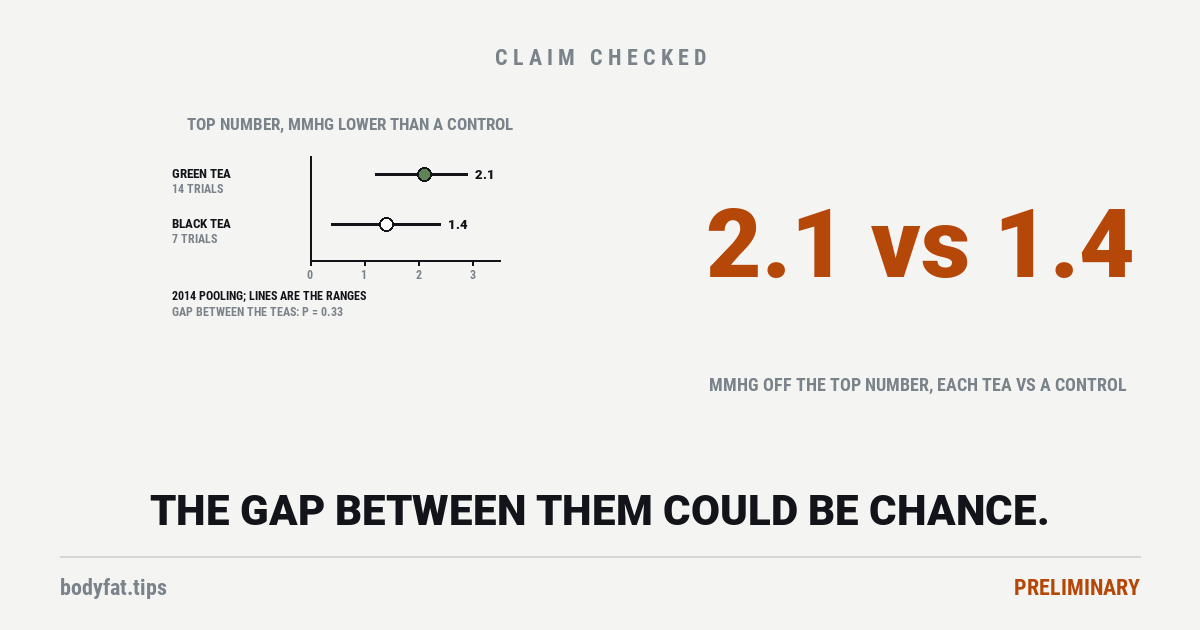
| 2014 [24] | 21 longer trials of drinks and extracts, 14 of green and 7 of black, one method for both teas | 2.1 lower; range 1.2 to 2.9 | 1.4 lower; range 0.4 to 2.4 |
| 2025 and 2021 [25] [26] | The newest pooling of each tea; read as summaries | 1.08 lower (36 trials) | 1.04 lower (13 trials) |
| 2020 [27] | 14 trials of the drink only, 4 weeks or longer | Not split by tea | Not split by tea; no significant fall overall |
| 2013 [28] | 11 trials of 3 months or more; none of both teas | 3.18 lower (2 trials of extract capsules) | 1.85 lower (2 trials) |
The 2014 pooling, which ran both teas through one method, found the top number about 2.1 points lower on green tea and 1.4 lower on black, over the longer trials, 14 of green tea and 7 of black, each against a control: a dummy drink or water in all seven black tea trials and in eight of the green ones, a weaker green tea in four and no tea at all in two [24]. Green’s figure is bigger. But green’s range ran from 1.2 to 2.9 and black’s from 0.4 to 2.4, so the two overlap almost entirely. The paper did test whether the type of tea made a difference, and the gap between the two was not statistically significant: P = 0.33, nowhere near the line researchers use for “probably not chance” [24]. Before leaning on a pooled figure we look for the biggest trial inside it. Here it is 240 Japanese adults given a green tea drink with extra catechins against a weaker one, though it carries under a tenth of green’s weight in the paper’s chart, the share of the pooled figure each trial counts for: 7.7%, by our arithmetic. Black’s figure leans harder on a single trial: more than half its weight, 52.6%, is the six-month Perth trial below [24].
The newest pooling of each tea comes out almost identical: 1.08 points off the top number for green tea across 36 trials [25], and 1.04 for black tea across 13 [26]. We could read only the summaries of both, so their lists of trials are not checked here [25] [26].
Now a pooling that a tea seller would not have chosen to publish. A 2020 review paid for by an unrestricted grant from the same multinational took only trials of the drink, no extracts, lasting four weeks or more: 14 trials, 798 people [27]. It found no significant effect on blood pressure or cholesterol. In adults at risk, the top number came out 0.4 points the wrong way, with a range from 3.0 lower to 3.85 higher [27]. It had too few trials to split by tea, and its authors put the null result down mostly to trials too small and too short [27].
And one pooling that seems to settle it for green. A 2020 review of brewed tea in people with raised blood pressure reported the top number down 6.22 points on green tea and 2.67 on black, and wrote that green’s effect was “more pronounced” [29]. Its chart shows how. Green’s figure rests on two trials, and one of them is entered four times, at 4, 8, 12 and 16 weeks of the same people; those four rows carry 79.80% of green’s weight, by our sum of the chart’s figures [29]. That trial gave 200 Egyptian patients four cups of green tea or hot water a day, four months of each, and they knew which they had [30]. The black tea figure has the same flaw on a smaller scale: one six-month trial appears twice [29].
That six-month trial is worth reading on its own. In Perth, 111 adults were randomised to three cups a day of a black tea powder made up as a drink, or a dummy matched for taste and caffeine, and 95 were analysed [28] [31]. After six months, their 24-hour top number was 2.0 points lower on the tea, with a range from 4.0 to 0.0 [31]. Australia’s national medical research council and the same multinational paid for it [31]. For scale, our blood pressure verdict sets foods and habits that move it against each other, and hibiscus tea has its own page.
Is green or black tea better for cholesterol and blood sugar?
Cholesterol tells the same story as blood pressure. Pooled, green tea took 4.55 mg/dL off LDL across 31 trials [32], and black tea 4.64 mg/dL across 10 [33]. The green tea trials were almost all extract capsules or extract-fortified drinks, and the biggest was a year-long trial of 1,075 American women past menopause, 538 given decaffeinated extract capsules and 537 a dummy, 936 of whom finished the cholesterol study [32] [34]. We read only the black tea pooling’s summary [33].
A 2013 Cochrane review, from the network that grades each trial’s design, took trials of three months or more and kept the two teas apart; none of its 11 trials gave people both [28]. It found LDL about 17 mg/dL (0.43 mmol/L) lower on black tea and about 25 mg/dL (0.64 mmol/L) lower on green, and the top blood-pressure number 1.85 points lower on black and 3.18 on green [28]. The bigger green figures came from a few trials, most of them capsules of extract, and were “not stable to sensitivity analysis”: they did not survive the reviewers’ check of dropping the trials that did not say how they kept the allocation hidden [28]. And the largest of the green tea trials behind the cholesterol figure gave a capsule containing theaflavins, black tea’s own compounds, beside the green tea catechins [28]. The milligram conversions are ours. For what moves cholesterol most, see our foods verdict.
Blood sugar is where significance and size come apart. A 2019 pooling that compared coffee and teas together found fasting blood sugar 2.1 mg/dL lower on green tea, across 11 studies and 786 people [35]. Black tea’s figure was bigger, 3.6 lower, but it came from three studies and 155 people, and its range ran from 8.8 lower to 1.7 higher, so “no effect” stayed on the table [35]. Green tea’s result counts as significant because more people were studied, not because its number is larger. On HbA1c, the three-month measure of blood sugar, green tea’s pooled difference was zero [35].
Do tea drinkers live longer?
Trials last weeks. To ask about years, researchers follow large groups of people, called cohorts, and compare the ones who drink tea with the ones who don’t. That finds an association, which cannot by itself show the tea is the reason: tea drinkers differ from other people in many ways. The results come as hazard ratios, where 0.88 means a death rate 12% lower over the years followed.
Green tea’s best-known result is Japanese. In the Ohsaki study of 40,530 adults, those drinking five or more cups a day had a death rate 12% lower among men and 23% lower among women than those drinking less than one, over up to 11 years [36]. It also asked about black tea, which varied less in how much people drank, and found only a weak or null link with deaths from any cause; there were too few deaths among the heavier black tea drinkers to look at heart disease or cancer [36].
Black tea has its own. In UK Biobank, 498,043 British adults, nine in ten of the tea drinkers who were asked drank black tea; over a median of 11.2 years, those drinking two to three cups a day had a death rate 13% lower than non-drinkers, and the figure stayed between 9% and 12% lower up to ten cups or more [37]. The journal later corrected the paper’s reading of its sugar analysis, in four places: the link was most consistent in people who took their tea without added sugar or who added milk, and inconsistent, or less clear, in those who added sugar or no milk [38].
Where both teas are drunk, green tends to come out ahead, with a catch. In 12 Asian cohorts, 528,504 people, five or more cups of green tea a day went with a death rate from heart disease and stroke 21% to 22% lower; for black tea the link was “weak, with no clear trends” [39]. Black tea drinkers were too few for the team to analyse each cohort separately or to look above two cups a day [39]. A 2015 pooling of 18 cohorts found deaths from heart disease and stroke 33% lower in the heaviest green tea drinkers and 12% lower in black, a figure whose range reached no difference; for cancer deaths it was the other way round, 21% lower for black and not significantly different for green [40]. For stroke, a 2009 pooling found three or more cups of either tea went with a 21% lower risk, “regardless of their country of origin” [41].
So the comparison across these studies is mostly a comparison between countries. Green tea is drunk where diets, genes and health systems differ from where black tea is drunk, and no cohort can swap them.
Black tea vs green tea caffeine: which has more?
Usually black, by the cup. The USDA’s figures come to about 47 mg in an 8 fl oz cup of brewed black tea and 28 mg in green, our arithmetic from its per-100 g values; its six green tea samples ran from about 19 to 43 mg a cup [4]. The FDA’s table gives 71 mg for 12 fl oz of black tea and 37 mg for green [5].
The leaves themselves carry about the same. Across 37 commercial teas brewed the same way, green leaves gave 16.3 mg of caffeine per gram and black leaves 17.7 [42]. So the gap in the cup has to come from how it is made up: how much leaf, how hot, how long. In one Turkish lab, black tea from cup-sized bags gave 39 mg per 200 mL (about 7 fl oz) against 24 from loose leaf, and longer steeping raised caffeine [43]. The Berlin brews, made the same way for both teas, had about 27% more caffeine in the black [17]. And no, the caffeine in a cup of either does not dry you out: our caffeine and hydration page has the trial. For caffeine and exercise, see our pre-workout caffeine page.
Is it better to drink black tea or green tea at night?
At night the difference that matters is the caffeine, and green tea usually has less per cup [4] [5]. We found no published trial that set black tea against green tea for sleep [22]. A registered study run by a Scottish university with a tea company as collaborator gives some volunteers black tea and others green, each against caffeine-only and dummy versions of the same tea, with sleep among its measures; it finished in May 2025 and has posted no results [22]. Green tea also carries a little more theanine, an amino acid with what one team calls a “relaxing effect”, 6.6 mg per gram of leaf against 5.1 in black [42]; this page does not rate what that does for sleep. How long caffeine lingers before bed is on our caffeine and sleepiness page. Decaffeinated versions of both teas exist, though the FDA notes that “decaffeinated” does not mean caffeine-free [5].
Green tea or black tea for weight loss?
Briefly, because it has its own page. A 2024 pooling of 22 tea and coffee drinking trials found green tea took off about 2.7 lb (1.23 kg) more than a placebo drink, at low certainty, and counted black tea, with coffee and sour tea, among the drinks that “were not” effective [44]. The same pooling is behind our coffee and weight verdict.
What is black tea good for?
By the trials, about what green tea is good for. A six-month trial found the top blood-pressure number 2.0 points lower on black tea [31], and a second, in smokers and former smokers, found it lower against a dummy tea only in women, a subgroup result that may be chance [3]; pooled trials put LDL about 4.6 mg/dL lower [33]; the artery lining worked better two hours after a cup, as it did after green [17]; and in a half-million Britons, mostly black tea drinkers, regular drinkers died at lower rates [37]. All of it is small, and the last is an association. And if you need iron, black tea with meals cuts how much you absorb [9], as a green tea extract did too [10].
What is the healthiest tea to drink daily?
Between these two, the trials do not pick a winner. If you like one, the evidence gives you no reason to switch. If caffeine is the issue, green or decaffeinated is the lower-caffeine cup [4]. In the largest cohort, the link with a longer life was clearest in people who took their tea without added sugar or with milk [38], which is an association, not a test. Teas from other plants are a different question; hibiscus has its own verdict, and this page rates no others.
Who these studies were done on
The head-to-head trials were groups of 13 to 154 adults in Australia, the Netherlands, Germany, Greece, China, Nigeria and the US, some of them smokers or former smokers, one of them women past menopause, one of them men with prostate cancer [11] [13] [17] [18] [19] [16] [20] [21] [3]. The green tea poolings lean on extract capsules; the black tea trials are more often the drink itself [32] [28] [27]. The cohorts that found green tea’s strongest links were in Japan, China, Korea and Singapore; black tea’s largest was in Britain [39] [37].
So read yourself against them. If you drink black tea, the trials that compared it with green found it level on cholesterol over four weeks, and the longest, which set each tea against a dummy tea rather than against each other, found black tea’s fall in blood pressure significant only in women, a subgroup result; and the biggest study of mostly black tea drinkers, in Britain, found them with lower death rates. If you drink green tea, the four-week cholesterol trials found it level too, and three trials suggest a small extra on a marker of DNA damage, in the blinded one only in women who still smoked. If you smoke heavily, or did for years, the four-month and six-month trials were in people like you: the six-month one took current and former smokers with at least 25 pack-years, a pack a day for 25 years or the equivalent [20] [15]. And if your doctor watches your blood pressure, the effect of either tea is a point or two.
If green tea has nearly five times the catechins, why can’t the trials tell the two teas apart?
This section is the desk’s own reasoning, and it is labelled as such. The leaf chemistry differs a great deal; the people drinking the two teas, in trials, differ hardly at all. Here are three ways to fit those together, each rated.
Answer one: oxidation rebuilds the polyphenols rather than destroying them. Black tea’s catechins become theaflavins and thearubigins, and its total flavonoids come to 118.4 mg per 100 mL against green’s 137.9, a gap of about a sixth, not five times [2]. That is measured, in the US government’s averages. Whether thearubigins do in the body what catechins do is not something those numbers show.
Answer two: by the time they matter, the two teas may look alike. Most of green tea’s catechins are not absorbed in the small intestine; gut bacteria break them into simpler compounds that can be absorbed, and black tea’s thearubigins are larger molecules still [45]. In 17 men, a major breakdown product in urine, hippuric acid, came out at 4.22 mmol a day after green tea and 3.75 after black, and the range for the difference included none [45]. A second analysis of the same design found similar rises in two breakdown products, but also several compounds that turned up only after green tea [46]. Both come from a tea company’s laboratory. The urine results are measured; that they explain why the trials come out level is a surmise, and the extra green-tea compounds cut against it.
Answer three: the trials are too small to see a gap this size. In the 2014 pooling, the gap between the two teas was 0.7 points on the top blood-pressure number, smaller than the width of either tea’s own range, 1.7 points for green and 2.0 for black [24]. The week-long head-to-head blood-pressure trial had 13 people [11], and the six-month one 45 to 54 a group before its results were split by sex [15]. That is arithmetic, not a measurement.
Put the three together and here is what we think is true, stated plainly so you can disagree with it: the difference between green and black tea is large in the leaf and, so far, too small to find in the person; choose by taste, and by how much caffeine you want.
What we could not find, and would like to: a randomised trial lasting several months that gives people ordinary brewed green or black tea at the same caffeine, measures 24-hour blood pressure and cholesterol, is big enough to see a one-point difference, compares the two teas with each other directly, and is not supplied or paid for by a tea company. The nearest we found is the six-month Arizona trial: a blinded dummy tea and ordinary tea bags, but blood pressure measured in the clinic, no cholesterol in its papers, results split by sex, no direct comparison of the teas, and tea from a tea company [3] [22]. The randomised trials we found that gave people both teas and measured cholesterol ran four weeks, except one that measured it for three hours after a single breakfast [22] [19]. If you know of a longer one, the corrections line on this site is open.
Where “green tea is healthier” came from
We could not trace who first said that green tea is healthier than black tea [22]. Here is what we could trace. The chemistry is real and old enough to be in the US government’s food tables: green tea keeps the catechins that black tea’s oxidation converts [2]. The best-known health result behind it is Japanese, from a country where green tea is what people drink. The Ohsaki study’s 2006 report in JAMA, 40,530 adults followed for up to 11 years, found heavy green tea drinkers dying at lower rates, and only a weak or null link for black tea, whose intake varied less [36].
Researchers asked the comparison question directly. The Berlin team wrote that “a question of much interest is whether green tea is superior to black tea”, then found the two equally effective on the artery test [17]. Today’s search results lead with the claim, not that answer. They are tea retailers’ blogs and health publishers, one of which sums up its article as “Green tea retains more antioxidants than black tea”, and a video from a physician’s health-video channel titled “BLACK TEA versus GREEN TEA: Which One Is Actually Healthier?”, published in July 2026 and watched 11,408 times when we read it [1]. Google’s own AI answer, asked the same question on 23 October 2026, answered a different one: how to grow the tea plant, citing a university extension’s plant page, a museum and a tree nursery’s product page [1].
And what is sold on it is tea, of both kinds. The retailers whose blogs fill the results sell green and black tea alike, and several end up saying both are good for you; fairly, a health-information publisher in the same results concludes the two “offer similar health benefits” [1]. The video’s description links the channel’s own chai drink, a black tea product, and a natural-health store [1]. Much of the research was paid for or supplied by a multinational that sold both [13] [20] [27] [31] [3].
None of this is aimed at anyone choosing a tea. The question is a fair one, and the answer is better news than the claim: the one you like is fine.
What this is rated, and what the rating covers
Preliminary — for the claim that green tea is healthier than black tea, as it circulates.
It is rated Preliminary because the evidence is small and points both ways. Where trials gave people both teas, cholesterol came out level over four weeks, and so did an artery test after one cup [12] [13] [17]; blood pressure came out level in the short trials [11] [16], and the longest, six months, set each tea against a dummy tea and never against the other: black tea’s fall in the top number was significant in women and green tea’s was not, though black’s estimate sat inside green’s range [3]. The 2014 pooling tested the gap between the teas and found it not statistically significant [24], and poolings of each tea’s trials give similar small effects [24] [25] [26] [32] [33]. In green’s favour: a urine marker of DNA damage that fell on green and not on black in two open trials, and in the blinded one only in women who still smoked [20] [21] [15]; an inflammation marker in prostate tumours, in a trial whose green brew carried far more of the polyphenols measured [21]; lower blood fats after one meal [19]; a stiffer aorta after one cup of black and not of green, though both raised a related measure [18]; and Asian cohorts in which green tea’s links are clearer where few drink black [39]. Leaning black’s way, and weakly: the six-month trial’s blood-pressure fall in women, one of two significant results among the 20 comparisons in its table, and a urine marker of damage to fats in women who had quit smoking, both subgroup results [3] [15]. It is not Unsupported because green’s findings exist, small as they are, and the head-to-head trials we found were too short, too small or split too finely to rule them out.
Each narrower claim, rated alone, in words. That green tea does more than black for blood pressure or cholesterol: Unsupported, of the tested kind: it was tested in small trials of three days to four weeks and in one of six months, and it did not hold up: in the six-month trial, green tea’s change in blood pressure against the dummy tea was not significant in women or in men, and the one significant fall, black tea’s in women, was a subgroup result [11] [12] [13] [16] [3]. One test over a single breakfast found total cholesterol lower after green than after black for the next three hours [19]; the two trials that measured it after four weeks of daily tea found neither tea moved it significantly [12] [13]. Those trials could miss a small difference.
That each tea lowers blood pressure a little: Supported, by about a point or two on the top number, in poolings mostly of extracts and tea powders and in a six-month trial of black tea; the pooling of the drink alone could not show it, and in the six-month trial of both teas only black tea’s fall against the dummy tea, in women, was significant [24] [25] [26] [31] [27] [3].
That people who drink either tea live longer: Supported as an association, in large cohorts of black tea drinkers in Britain and green tea drinkers in Asia [37] [36] [39]; that the tea is the reason: Preliminary, because these studies cannot show it.
That black tea has more caffeine than green: Supported, per cup as usually brewed, while the leaves carry about the same and the ranges overlap [4] [5] [42]. That green tea’s extra catechins make it the better antioxidant in the body: Preliminary, on two open trials of a urine marker in its favour and a blinded one in which it held only for women who still smoked, while black tea lowered a marker of damage to fats in women who had quit, against trials in which neither tea changed LDL oxidation [20] [21] [15] [12] [13].
What is not rated here: cancer, which the prostate trial touched only through markers; matcha, oolong and white tea; tea extracts and supplements; milk in tea; and the frame above, which is this desk’s reasoning from the evidence rather than a result the evidence delivered. It is marked as ours so that you can weigh it as ours.
This is journalism, not medical advice. If you have high blood pressure, take a blood thinner or another medicine, are pregnant, or have low iron, talk to a clinician who knows your history about how much tea suits you. How we read a study, and what each tier means, is set out here.