Is Oatmeal Good for Diabetics? Less Processed Oats Beat Refined Cereal; Instant Doesn’t

“Is oatmeal healthy for diabetics” is searched about 9,900 times a month in the United States, and “is oatmeal ok for diabetics” about as often, by the database’s figures for the past year (from a paid keyword database, pulled 23 October 2026) [1]. The answers split. Health sites and oat brands say yes. Some low-carb clinics and glucose-monitor companies call a bowl of oats a blood-sugar spike.
Mostly yes, with three conditions. Next to refined breakfast cereals with the same carbohydrate, oatmeal raises blood sugar less, though most of those tests were in people without diabetes, and in an old test in people with diabetes plain porridge came out about level with white bread. Next to an omelette, it raises it more. And the edge shrinks as the oat is cut finer and precooked, so instant oats keep little of it. The bigger claim, that oatmeal lowers A1C, the three-month blood-sugar test, rests on less than it seems: more than half the people in the newest pooling of the trials came from one trial, paid for by an oat company, whose oat groups also got a supervised diet their comparison group did not.
This is journalism, not medical advice. If you use insulin or another diabetes medicine that can cause low blood sugar, check your glucose when you change what you eat for breakfast, and do not change your medicines without your clinician. In a hospital trial of two “oatmeal days” in people with poorly controlled type 2 diabetes, daily insulin came down from about 112 units to 82 and then 70 [2], and the authors of a later outpatient trial write that adjusting the insulin dose is necessary [3]. A reading that stays very high, or a low with confusion, sweating or shaking, needs care at once.
What does a bowl of oatmeal do to blood sugar?
It raises it. Oats are mostly starch, which digestion turns into glucose: the oats in the longest trial on this page were 63.5% carbohydrate by weight [4]. So the useful question is not whether oatmeal raises blood sugar. It is: compared with what?
Compared with eggs, more. In a Canadian trial, 23 adults with type 2 diabetes wore a continuous glucose monitor, a small sensor on the arm that reads blood sugar every few minutes, through two days that differed only at breakfast [5]. One breakfast followed the guidelines: a parfait of half a cup of oats with banana, blueberries and low-fat yogurt. The other was an omelette of eggs, cream, cheese and spinach. After the oats, blood sugar peaked at about 191 mg/dL (10.6 mmol/L) on average; after the omelette, at about 146 (8.1) [5]. Over the whole day the averages were 135 and 130 mg/dL (7.5 and 7.2 mmol/L), a gap within what chance produces [5].
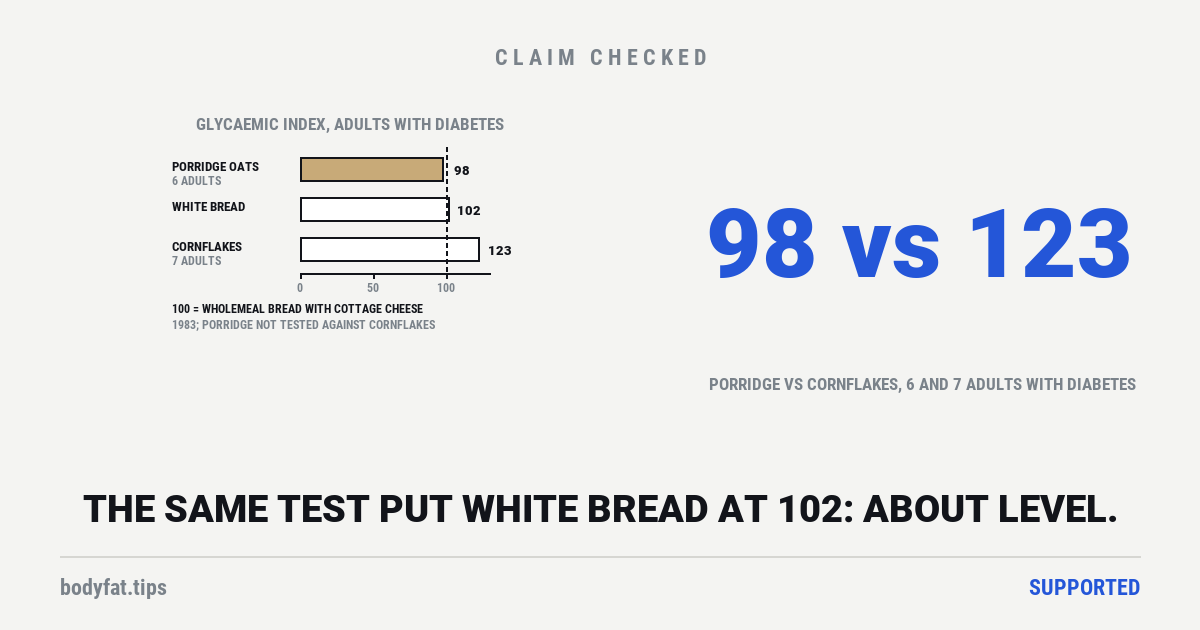
Compared with refined cereals, mostly less, though the direct tests in people with diabetes are old and few. Put oats against another starchy food with the same amount of carbohydrate and the result turns over. In a 1994 study, porridge made from oat bran gave a smaller rise in blood sugar than porridge made from refined wheat, in people with type 2 diabetes as well as without [6]. A 2021 pooling, a meta-analysis that combines trials to get one estimate, gathered 103 meal tests in which oat beta-glucan, the soluble fibre that makes porridge thick, came in oat bran or a concentrate added to a carbohydrate meal. On average it cut the rise in blood sugar by 23%, against comparisons such as glucose drinks, white bread and muffins, and whether people had diabetes did not significantly change the result; 11 of the tests were in people with type 2 diabetes [7]. An unrestricted grant from PepsiCo, which owns Quaker Oats, paid for part of that work [7]. That pooling left whole oats, oat flakes and oat flour out on purpose, because their starch blurs the fibre’s effect, so it speaks for the oat’s fibre rather than for a bowl of porridge [7]. In a 1983 test of 15 foods in adults with diabetes, most of them on insulin, each food was eaten by five to seven of them and scored against a standard breakfast of wholemeal bread with cottage cheese, set at 100. That score is a glycaemic index: how much a food raises blood sugar over the next two to three hours, against a standard food. In that test plain porridge oats scored 98, white bread 102 and cornflakes 123, and wholemeal bread on its own 102 [8]. Cornflakes were significantly above the standard; porridge was not significantly different from it, and the paper did not test porridge and cornflakes against each other [8]. A 1987 test in people with type 2 diabetes, each serving as their own comparison, gave them oatmeal, cornflakes and seven other starchy foods; its summary lists oatmeal and bread, and not cornflakes, among the foods that raised blood sugar significantly less than the same 50 g of carbohydrate taken as pure glucose [9]. We read that one as its summary only.
So is oatmeal a spike? Next to eggs, yes. Next to cornflakes with the same carbohydrate, less of one; next to white bread, about level in that 1983 test [8]. The glucose-monitor company that calls oatmeal “one of the worst foods for blood sugar” gives an average rise of 34 mg/dL from its customers’ food logs, with no comparison food beside it and no count of the logs [1]. A number with nothing beside it cannot tell you whether the breakfast you would eat instead does better.
Does oatmeal lower A1C?
A1C, also written HbA1c, is a blood test that reads your average blood sugar over roughly the past three months, and it is the number diabetes treatment is judged by. Here the evidence is thinner than the confident answers suggest, for reasons that only show up when you open the papers.
The newest pooling, from 2022, combined eight comparisons in 407 people with type 2 diabetes, a median of four and a half weeks each [10]. A1C fell 0.47 points, with a range of 0.13 to 0.80, and fasting blood sugar about 14 mg/dL (0.75 mmol/L) [10]. That range is the confidence interval, the range the true average probably sits in, not a range of what will happen to you. The authors graded their own certainty “low” for the A1C result, meaning the true effect could be quite different, and high for fasting blood sugar [10]. The pooling was paid for by an unrestricted grant from the Quaker Oats Center of Excellence [10]. PubMed, the main index of medical research, returns no record of it; we found it through an ordinary web search [11].
Open its table of trials and the biggest is a trial in Inner Mongolia: 219 of the 407 people, 54% by our arithmetic [10] [4]. Everyone in that trial lived in a hotel for 30 days. Three groups ate a supervised low-fat, high-fibre diet, two of them with 1.8 or 3.5 oz (50 or 100 g) of the sponsor’s oats a day in place of other grains; the usual-care group ate as it chose [4]. The pooling compared the oat groups with the usual-care group [10]. The trial’s own report also compared them with the group that got the same diet without oats, which is the comparison that isolates the oats [4].
| Comparison | After 30 days in a hotel | After a year at home |
|---|---|---|
| The supervised diet without oats, against usual care | 0.71 points lower | 0.77 points lower |
| 1.8 oz (50 g) of oats a day plus the diet, against the diet alone | 0.14 points lower, within what chance produces | 0.48 points lower, within what chance produces |
| 3.5 oz (100 g) of oats a day plus the diet, against the diet alone | 0.10 points lower, within what chance produces | 0.64 points lower, with a range of 0.09 to 1.19 |
| Oats plus the diet, against usual care: the comparison the 2022 pooling used [10] | 0.86 points lower (50 g); 0.81 lower (100 g) | 1.25 and 1.41 points lower |
In the first month, the diet did most of the work: it lowered A1C by 0.71 points against usual care [4]. What the oats added on top depends on which of the trial’s two 30-day reports you read. In the 298 overweight people in the table, adding oats to it changed A1C by an amount within what chance produces [4]. In a report on 260 people who also met the criteria for metabolic syndrome, a cluster of a large waist, raised blood pressure, blood fats and blood sugar, A1C fell 0.51 points more on 3.5 oz of oats a day than on the diet alone, a difference the authors report as unlikely to be chance, while 1.8 oz made no significant difference [12]. Each report picked its group out of the same 445 by a starting trait, so at least 113 people are in both (our arithmetic), and neither covers the whole trial [4] [12]. After a year at home, with oats still provided, the group on 3.5 oz a day was 0.64 points lower than the diet-only group, with a range of 0.09 to 1.19 [4]. That is a real result, from one trial, which an oat company paid for and supplied the oats to [4]. The metabolic-syndrome report, published first, was paid for by the same company [12]. The trial was registered after it had begun, and its registry lists A1C at six months as well, a result that is not in the two reports we read [4] [11].
The two earlier poolings rest on thin evidence too. A 2015 pooling reported in its summary that oats cut A1C by 0.42 percentage points [13]. Its own charts label that figure a standardised mean difference, a gap measured in units of how much people vary rather than in A1C points, and the chart’s figures for five of its six trials differ from those trials’ changes in A1C points in the review’s own table; so we read the 0.42 as the standardised figure, on a scale where 0.2 is small and 0.5 moderate (our reading) [13]. More than half of the chart’s weight, 55%, sits on the 30-day report of the Inner Mongolia trial [13] [12]. A 2016 pooling of four trials found A1C 0.21 points lower, with a range of 0.02 to 0.40, and put 58% of its weight on a three-week Greek trial of 41 people eating bread with added oat fibre [14]. Three weeks is short for a test that reads three months.
Four trials we read that oat companies did not pay for found less. The 2022 pooling also holds a few smaller ones, from the 1980s to 2009, whose separate results we did not read [10].
| Trial | Who, what, how long | A1C | Paid for by |
|---|---|---|---|
| Scotland, 2013 [15] | 27 adults with type 2 diabetes on diet alone; an oat-rich diet and standard advice, 8 weeks each | No significant difference between the two diets | The Scottish Government |
| France and Sweden, 2010 [16] | 53 adults with type 2 diabetes; soup with 3.5 g of oat beta-glucan a day, or the same soup without; 8 weeks | Not reduced in either group | A European Commission research project and two Swedish funders; a frozen-food company made the soups and employed one author |
| Mexico, 2015 [17] | 29 adults with type 2 diabetes; 1.4 oz (40 g) of oatmeal with milk, or one egg, at breakfast; 5 weeks each | No significant difference | An egg-industry research centre |
| Germany, Norway and Sweden, 2025 [18] | 194 adults at risk of type 2 diabetes, average A1C 5.6%; bread with 6 g of oat beta-glucan a day, or whole-wheat bread; 16 weeks | No significant difference | Research councils in three countries |
Two three-month trials in type 2 diabetes are not in the 2022 pooling, and both appeared in a food-science journal [19] [20]. In Chile, 37 adults took 5 g of oat beta-glucan a day as a supplement, or cellulose as a dummy, for 12 weeks; the summary reports that A1C fell in the beta-glucan group, without a comparison between the groups [19]. In China, 98 older adults ate 1.4 oz (40 g) a day of an oat meal product, or kept to their usual diet, for three months; the oat group’s cholesterol fell more, and by the authors’ summary its blood-sugar measures did not change significantly differently from the usual-diet group’s [20]. We read both as summaries only, and neither paper’s funding statement: the research indexes list two Chilean universities as funders of the first, and the second’s first author is also an author of the Inner Mongolia trial’s year-long report [19] [20] [4].
None of these trials found A1C significantly worse on oats, and the egg comparison is the closest any of them comes to what the low-carb camp proposes. The fair summary: a small fall in short, mostly small trials, carried largely by one company-funded trial whose oats came with a diet, and whose own oats-against-diet results were mixed at 30 days and favourable at a year on the higher dose, beside independent trials that could not tell oats from the comparison.
Is instant oatmeal good for diabetics?
It is the form that keeps the least of the oat’s advantage. A 2021 pooling of meal tests compared oats with refined grains of the same carbohydrate: whole oat kernels and thick flakes gave a smaller rise in blood sugar, while thin, quick and instant flakes made no significant difference [21]. We read it as its summary only; the research indexes list PepsiCo as its funder, and four of its eight authors work at that company’s oat research centre [21].
The most direct test we found in people with type 2 diabetes is a New Zealand trial. For two weeks, 28 adults ate traditional oats, brown rice and coarse whole-grain bread; for two weeks, instant oats, brown-rice pasta and finely milled whole-grain bread, matched for nutrients, wearing glucose monitors throughout [22]. The rise after breakfast was 9% smaller on the less-processed foods, with a range of 3% to 15%, and the day’s swings were smaller too, though the hours spent in the target range did not differ significantly [22]. The oats were only part of each bundle, so this is the evidence for processing in general, with oats in it. Older glycaemic-index tests in people with diabetes, gathered in a 2015 review, cannot show whether the gap holds for oats alone, because none of them used thick-flake or steel-cut oats: oats the review counts as quick-cooking (the 1987 test above) scored 75, porridge of unstated flake size 69 (the 1983 test’s 98, recalculated by the review on this scale), and instant porridge 65 and 71, on a scale where glucose is 100 [23]. Across that review’s tests, most of them in people without diabetes, quick-cooking oats averaged 71 and instant 75, not significantly different from each other [23]. The review’s two authors include an employee of the oat brand’s owner [23].
Oatmeal is also what the makers of diabetes shakes test their products against. In two trials of 22 and 24 people with type 2 diabetes, blood sugar rose less after a diabetes shake than after oatmeal [24] [25]; in the second, the oatmeal was plain instant oats made with water [25]. One was paid for by a shake maker; in the other, three of the four authors were or had been employees of the other shake’s maker [24] [25]. Our oatmeal and weight page has the pooled glycaemic-index table by oat form, a score of how much a food raises blood sugar against a standard food, from tests mostly in people without diabetes; instant scored worst there too.
Steel-cut oats for diabetics, and overnight oats
Steel-cut oats are the whole grain chopped into pieces rather than rolled flat, and they are the form most often recommended. In a test of 30 healthy adults, they gave a smaller peak rise in blood sugar than instant oats, about 35 against 44 mg/dL (1.93 and 2.47 mmol/L); large rolled flakes came between, at about 39 (2.19), and the trial’s table does not show steel-cut and large flakes as significantly different [26]. PepsiCo paid for that test and helped design it, and two of its six authors work at the company’s oat research centre [26]. We found no test of steel-cut oats in people with diabetes [11]. The glycaemic-index range for steel-cut that Google’s AI answer repeats, 42 to 52, matches the range on a low-carb diabetes clinic’s page that the answer cites, which gives no source beside it [1].
Overnight oats are rolled oats soaked cold instead of cooked. We found no test of overnight oats in people with diabetes [11]. The closest test we read is a 1989 one in which nine people with type 2 diabetes ate rolled oats raw, cooked into porridge, or raw with raisins, matched for carbohydrate, and the three gave similar rises in blood sugar [27]. An oat company’s two tests of oats soaked overnight in skim milk, in 80 adults without diabetes, finished in 2017; their registry records post no results, but a 2019 journal paper reports them [11] [28]: over the next two hours, the rise in blood sugar was 33% smaller than after cooked cream of rice, a refined rice cereal, and 24% smaller when both had sugar, nuts and seeds stirred in [28]. The company paid for the tests, helped design them and supplied the cereals, and two of the eight authors work at its oat research centre [28].
Can a diabetic eat oatmeal every day?
The trials gave it every day, and none of the trials of oats as food on this page found A1C or fasting blood sugar significantly worse for it. The Inner Mongolia groups ate 1.8 or 3.5 oz of oats daily for a year [4], and the Scottish oat diet ran eight weeks [15]. What the trials do not settle is the cost in carbohydrate. The 3.5 oz (100 g) daily serving in that trial carried about 64 g of it [4], and the right amount for one person is a question for whoever helps manage their diabetes, especially if they take insulin.
How to prepare oats for diabetic patients
The trials served oats plainly. The Inner Mongolia oats were boiled into porridge in place of the usual staple [12]; the Mexican breakfast was 1.4 oz (40 g) of oatmeal with 16 fl oz (472 mL) of lactose-free milk [17]; the Canadian one was oats in a parfait with fruit and yogurt [5]. The common advice to add protein or fat to the bowl to soften the rise was not what these trials tested, and we do not rate it here. One small 1991 test comes near it: in eight children and teenagers with type 1 diabetes, adding protein to a bowl of oatmeal delayed the peak in blood sugar, and the height of the peaks did not differ significantly [29]. What the evidence does support is the choice of oat: thicker and less processed rather than instant [21] [22]. The American standards also advise keeping foods with added sugar to a minimum [30]. If you take coffee with it, coffee and blood sugar has its own verdict, as do peanuts.
Why do some doctors say not to eat oatmeal?
Because carbohydrate is what raises blood sugar, and the American Diabetes Association’s 2019 consensus report on nutrition says that reducing overall carbohydrate intake “has demonstrated the most evidence for improving glycemia” [31]. Its 2026 standards ask clinicians to “consider reducing carbohydrate intake for some adults with diabetes to improve glycemia” [30]. A low-carb diabetes clinic’s page puts it in oat terms: portion size and frequency matter [1]. Fibre pulls the other way. A 2025 pooling of ten trials in 499 people with diabetes, which changed fibre and carbohydrate together, found that diets higher in both lowered A1C about half a point more than diets lower in both, with a range of 0.02 to 0.99; its authors conclude that fibre matters more than the amount of carbohydrate [32]. The lower-carbohydrate diets in those trials were moderate, 34 to 47% of calories, not very low-carb ones [32]. Those were whole diets, not oat trials. Our page on reversing insulin resistance weighs the low-carb trials themselves, and cites the same pooling.
The breakfast trials back the narrow version. Beside the Canadian omelette result [5], a 12-week trial of 121 people with type 2 diabetes found that a low-carbohydrate breakfast, against a low-fat one, improved most glucose-monitor measures and lowered A1C by 0.2 points more, a difference just the wrong side of the line researchers use for “probably not chance” [33]. We read that trial as its summary only; its registry record says each group was given eight breakfast recipes and does not list them, so we cannot say whether oatmeal was among the low-fat ones; the research indexes list egg-industry groups among its funders [33].
What the low-carb argument does not show is that oatmeal is worse than the breakfasts most people would eat instead. If the choice is oats or eggs, eggs win on the glucose monitor [5]. If it is oats or cornflakes, oats come out lower [8] [21]; against white bread, the 1983 test in people with diabetes came out about level [8]. Each camp is right about its own comparison.
What the diabetes guidelines say about oats
The American standards do not name oats. They ask for eating patterns built partly on whole grains, with at least half of grains “whole, intact”, and for “minimally processed, nutrient-dense, high-fiber sources of carbohydrate” [30]. Diabetes Canada’s nutrition guideline does name them: it says the evidence of benefit is greatest for gel-forming fibres and names beta-glucan from oats and barley first among them, and says higher intake of whole grains remains advisable, “especially from oats and barley”, while more research is needed; its fibre recommendation carries a middling grade, C, on a scale from A to D [34]. The European diabetes association’s 2023 recommendations list oats among whole grains and warn that processing and milling appear to lower whole grains’ capacity to reduce blood sugar [35]. Psyllium is another gel-forming fibre with its own verdict, and the EU food-safety agency’s rulings on oats and blood sugar after meals are on our oatmeal and weight page.
Who these studies were done on
Mostly adults in their fifties and sixties with type 2 diabetes, most of them overweight and on medication: in the newest pooling the median age was 59, and 88% of those whose treatment was reported took diabetes medicines, insulin or both [10]. Its trials ran in China, Scotland, France, Sweden, Greece, Mexico and the United States [10]. The pooled meal tests were mostly in people without diabetes: three in four of the 2021 pooling’s comparisons [7].
Type 1 diabetes has two small trials that we found of oats eaten as food for a week or more, both in teenagers. In the larger, 60 Egyptian teenagers added oat flakes, 4.8 oz (135 g) a day, for three months, in an open-label crossover, meaning everyone knew what they were eating and each spent time on both diets [36]. A1C fell from 7.89% to 6.50% on the oats and to 7.62% on the ordinary diet, and the gains faded once the oats stopped [36]. That drop is far larger than anything in the type 2 trials, and it comes from one hospital and an unblinded, unfunded trial. The other gave 30 teenagers oat flakes for a week at a time and found lower blood sugar on glucose monitors at the higher dose [37]. In adults with type 1 diabetes, a two-week trial of oat beta-glucan tablets before meals against dummy tablets found the highest readings worse on the tablets [38]. For anyone on insulin, adding that much carbohydrate is a change to plan with the diabetes team.
People with prediabetes have the bread trial above: 16 weeks, no significant difference [18]. Its authors suggest their volunteers were too healthy for an effect to show; the average A1C at the start was 5.6% [18]. Gestational diabetes is not covered here.
Does eating oats prevent diabetes?
It is a different question, and Google’s AI answer cites the study usually quoted for it: a 2021 pooling of cohort studies, which found those eating the most oats 22% less likely to develop type 2 diabetes than those eating the least [39]. That figure comes from four cohorts in two reports, about 250,000 people by our sum of its table: three American cohorts of nurses and other health professionals, and one Danish cohort; the 471,157 people often quoted for it are the review’s total across all three outcomes it studied [39]. A cohort study follows people’s habits over time and cannot show that the oats did it. The top group’s threshold was more than 5.7 g a day, about a fifth of an ounce, and oat eaters against non-eaters, in three reports (an Australian cohort, the Danish one and an earlier report on the American nurses), showed a smaller difference, 14%, with a range that included none [39]. A supplement company paid for it and employed three of its authors [39]. We do not rate it here.
If a bowl of oats still raises blood sugar, where did the A1C drops come from?
This section is the desk’s own reasoning, and it is labelled as such. The meal tests say oats beat refined grains and lose to eggs. The poolings say A1C fell. Here are three ways those fit together, with the evidence for each.
Answer one: the diet that came with the oats. In the trial that carries the most weight, the supervised diet without oats lowered A1C by 0.71 points against usual care in 30 days [4]. What adding oats did on top was within what chance produces in one of the trial’s two 30-day reports [4] and 0.51 points on the higher dose in the other [12], less in both than the diet itself did (our reading of the two reports, the second through the 2015 pooling’s table) [13]. A pooling that compares oats-plus-diet with no diet counts the diet as the oats [10]. The numbers are measured. That this explains most of the pooled drop is our inference.
Answer two: what the oats replaced. Oats eaten in place of a refined staple give a smaller rise after each meal [6] [7], and in the Inner Mongolia trial they replaced the usual grain [4]. A smaller rise three times a day could add up to a lower A1C over months, and the year-long result points that way [4], as does one of the two 30-day reports [12]. That is a surmise with one company-funded trial on its side.
Answer three: who was tested. The trial reports with the biggest falls enrolled people whose A1C was high to begin with, 9.9% on average in the 30-day Inner Mongolia report [13] and about 8% in the year-long one [4]. The Scottish and Mexican trials started at 6.8% and found no significant difference [13], and the bread trial in people at risk started at 5.6% [18]. A handful of trials is not a test of that pattern, so this one is a hunch, though the bread trial’s authors offer the same explanation [18].
Put together, here is what we think is true, stated plainly so you can disagree with it: oatmeal is a better carbohydrate for people with diabetes, not a free one, and its reputation for lowering A1C has been borrowed from the diets it was tested inside.
What we could not find, and would like to: a trial lasting a year or more, not paid for by an oat company, in people with type 2 diabetes, that swapped a refined-grain breakfast for a bowl of minimally processed oatmeal with the same carbohydrate, left the rest of the diet alone, and measured A1C with glucose monitors running [11]. If you know of one, the corrections line on this site is open.
Where “oatmeal is good for diabetics” came from
Oats have been a diabetes food for more than a century, and they began as something stranger than breakfast. A 1907 abstract in an American medical journal describes a physician’s “oatmeal cure”: 250 g (8.8 oz) of oatmeal cooked with 300 g (10.6 oz) of butter and water into a soup, with a protein powder added, fed every two or three hours [40]. The same abstract reports one doctor’s attempt to check it. In a severe case, sugar in the urine “markedly increased” on the oats, and the patient died in a coma a few days later, which the account puts down to bicarbonate of soda not being given in the usual amounts rather than to the diet. In a moderate case the sugar nearly vanished and came back with ordinary food, but a second course of oatmeal increased it. Several other patients vomited on the diet or refused it, and the checking doctor concluded that the cure’s good results came from the oats’ carbohydrate being little absorbed, or not at all [40]. A 2020 commentary traces the idea to a German diabetes physician more than a hundred years ago, and says short oatmeal treatments are still used in several German hospitals, some doctors now leaving out the butter [41].
The modern case was made by the poolings. The 2015 review concluded that oats “could therefore be recommended to patients” [13], and a drug-price and telehealth site’s page, “Is Oatmeal Good for Diabetes? Yes, Here’s Why”, first published in November 2024 and updated in February 2026, cites it among its references and lists “Lowering hemoglobin A1C” among oatmeal’s effects [1]. That page is among those Google’s AI answer cites when it says “Yes, oats can be good for people with diabetes, provided you choose the right type” [1]. The answer also cites an oat seller’s page, “5 Ways Oats Make Diabetes Control Easier”, which cites no study [1].
The counter-claim has its own sellers. A glucose-monitor company’s blog calls oatmeal “one of the worst foods for blood sugar”, and a low-carb diabetes clinic’s page, the answer’s most-cited source, warns that oatmeal is carbohydrate-rich [1]. Beside them in the results sit forum threads from people with diabetes, one titled “Oatmeal is not the diabetes super food I was told it was” [1].
None of this is aimed at anyone who has eaten oatmeal for their diabetes, or given it up. Both pieces of advice are partly true, and each was sold without its comparison: the oat sellers left out the eggs, and the glucose-monitor sellers left out the white bread. We could not trace who first said the modern version in so many words; the earliest version we read is the 1907 cure.
Who paid for the oat-and-diabetes research
Who pays matters, so here it is by role. An oat company paid for the Inner Mongolia trial and supplied its oats [4] [12]. The research centre of Quaker Oats paid for the 2022 pooling [10], and PepsiCo, Quaker’s owner, funded the 2021 meal-test pooling in part, the steel-cut test and the overnight-oats tests, employs two authors of each test and four of the oat-form pooling’s eight, and is listed as that pooling’s funder [7] [21] [26] [28]. An egg-industry body paid for the oatmeal-against-egg trial [17] and is listed among the funders of the low-carb breakfast trial [33]. Shake makers paid for or ran the shake-against-oatmeal tests [24] [25]. The three A1C trials we read that were paid for from outside the food industry, by the Scottish Government, a European Commission project and three national research councils, found no difference in A1C that could be told from chance [15] [16] [18], though in the soup trial a frozen-food company made the soups and employed one author, and a Swedish food company supplied the oat beta-glucan [16]. The 1983 porridge test was paid for by the Canadian diabetes association and a national research council [8], and the processing trial, paid for by a New Zealand research foundation, found a modest difference after meals [22].
What this is rated, and what the rating covers
Supported — for the claim that oatmeal is good for people with diabetes, read as it is usually meant: less processed oatmeal as a carbohydrate food, compared with the refined breakfast cereals it replaces.
It is rated Supported because meal tests, mostly in people without diabetes, find that oats with more of the grain left whole raise blood sugar less than refined grains with the same carbohydrate [21] [26]; oat bran and oat fibre do the same in people with type 2 diabetes [6] [7]; in people with diabetes, a 1983 test scored plain porridge 98 and cornflakes 123, without testing the two against each other, and porridge level with white bread [8], and a 1987 test found oatmeal, and not cornflakes, significantly below pure glucose [9]; a two-week trial in type 2 diabetes found less-processed oats and grains doing better than instant and finely milled ones on glucose monitors [22]; no trial of oats as food on this page found A1C or fasting blood sugar significantly worse on oats; and the American, Canadian and European diabetes guidelines all point toward whole, minimally processed grains, the last two naming oats [30] [34] [35]. It is not Established because the trials are short and small, much of the evidence was paid for by oat companies, the direct tests of ordinary oatmeal in people with diabetes are old and few, and the two we found that set it against a refined cereal, in 1983 and 1987, used porridge of unstated or quick-cooking flake size, not the thicker, less processed oats the rest of the evidence favours; the advantage depends on what the oats replace (against white bread there was no clear one); and instant oats lose most of it. So for less processed oatmeal in people with diabetes, the rating carries meal tests in people without diabetes across to people with it, which puts it at the low end of Supported. The 1983 paper gives the strongest reason for doing that: its 15 foods ranked in much the same order in people with diabetes as in people without, a correlation of 0.76, where 1 would be a perfect match [8]. Instant oatmeal, rated alone on the same comparison, would be Unsupported, of the tested kind: in the oat-form pooling, thin, quick and instant flakes made no significant difference against refined grains [21], and in the steel-cut test, in healthy adults, instant oats were not significantly different from cream of rice [26].
The narrower claims, rated alone, in words. That oats lower A1C in people with type 2 diabetes: Preliminary. The three poolings on this page found a fall, but the largest single source of their people is one oat-company trial whose own comparisons against the same diet without oats were mixed at 30 days (within what chance produces in one report, 0.51 points lower on the higher dose in the other) and significant at a year on the higher dose; the four trials we read that oat companies did not pay for found no significant difference; of two three-month trials outside the poolings, read as summaries, one reports a fall within its oat-fibre group and the other no significant difference from the usual diet; and the newest pooling grades its own A1C result low certainty [4] [12] [10] [19] [20]. That instant oatmeal raises blood sugar more than less-processed oats, steel-cut included, in people with diabetes: Preliminary. Meal tests mostly in people without diabetes point that way, as does one two-week trial in type 2 diabetes against traditional flakes; the older glycaemic-index tests in people with diabetes set instant oats beside quick-cooking oats and porridge of unstated flake size only, so they cannot show the gap either way; and we found no test of steel-cut oats in people with diabetes [21] [26] [22] [23]. One older test, in healthy volunteers, points the other way on grinding: in 1988, whole oat groats, rolled oats and finely ground oatmeal gave similar insulin responses, and all three oat meals gave smaller rises in blood sugar and insulin than wheat or maize meals; its authors conclude that particle size changed how wheat and maize behaved but not oats [42]. It did not test precooked instant flakes.
That a bowl of oatmeal raises blood sugar more than a low-carbohydrate breakfast: Supported, by a glucose-monitor trial against an omelette and two shake makers’ tests against oatmeal [5] [24] [25]; a 12-week trial found a low-carbohydrate breakfast better than a low-fat one whose recipes we could not read, so it backs the low-carb side without testing oatmeal [33]. That oatmeal is bad for people with diabetes, in the sense of worsening their blood-sugar control: Unsupported, of the tested kind. It was tested, and it did not hold up: in the trials of oats as food on this page, which ran from three weeks to a year, none found A1C or fasting blood sugar significantly worse on oats than on the comparison diet.
What is not rated here: preventing diabetes, which rests on cohort studies; cholesterol, which our oatmeal and weight page rates as established in its own right; gestational diabetes; the advice to add protein or fat; and the frame in the section above, which is this desk’s reasoning from the evidence rather than a result the evidence delivered. It is marked as ours so that you can weigh it as ours.
This is journalism, not medical advice. What you eat for breakfast, and any change to your diabetes medicines, belongs with the clinician or dietitian who knows your numbers. How we read a study, and what each tier means, is set out here.