Foods That Lower Cholesterol Do Lower It, Mostly by Single Digits. The Diet Said to Match a Statin Fell Short of a Low Dose, With the Food Delivered.

“Foods that lower Cholesterol.” That is the whole title of a 57-second video posted on 18 January 2023 by a physicians’ explainer channel, run by two orthopaedic surgeons who bring on specialists. It had 2,051,965 views when we read its numbers on 10 October 2026, and its description says only “Foods to lower your cholesterol” [1]. Nine months later the same channel’s “How To Lower Your Cholesterol”, now at 1,968,915 views, named names: “heart-healthy foods like oats, nuts, olive oil, and fish rich in omega-3” [1].
And in December 2025 it asked a bigger question, in a title: “A Diet That Lowers Cholesterol As Much As A Statin? Portfolio Diet” [1]. A statin is the standard cholesterol tablet. The description promises to explain “how effective the Portfolio Diet is compared to statins”, and links the trial that question comes from [1].
Plenty of people are asking. In the United States, “foods that lower cholesterol” is searched about 27,100 times a month, “how to lower ldl cholesterol naturally” about 18,100 times, “portfolio diet” about 12,100 times and “foods that lower ldl” about 4,400 times a month (from a paid keyword database, pulled 10 October 2026) [2].
These foods do lower LDL cholesterol, a little each. LDL is the cholesterol carried in the particles that build up in artery walls, the kind people call bad. Soluble fibre from oats, barley and psyllium, plant sterols, nuts, soy protein, and unsaturated fat in place of saturated fat have each lowered it in dozens of trials, mostly by a few percent apiece and plant sterols by up to about 12% [3] [4] [5] [6].
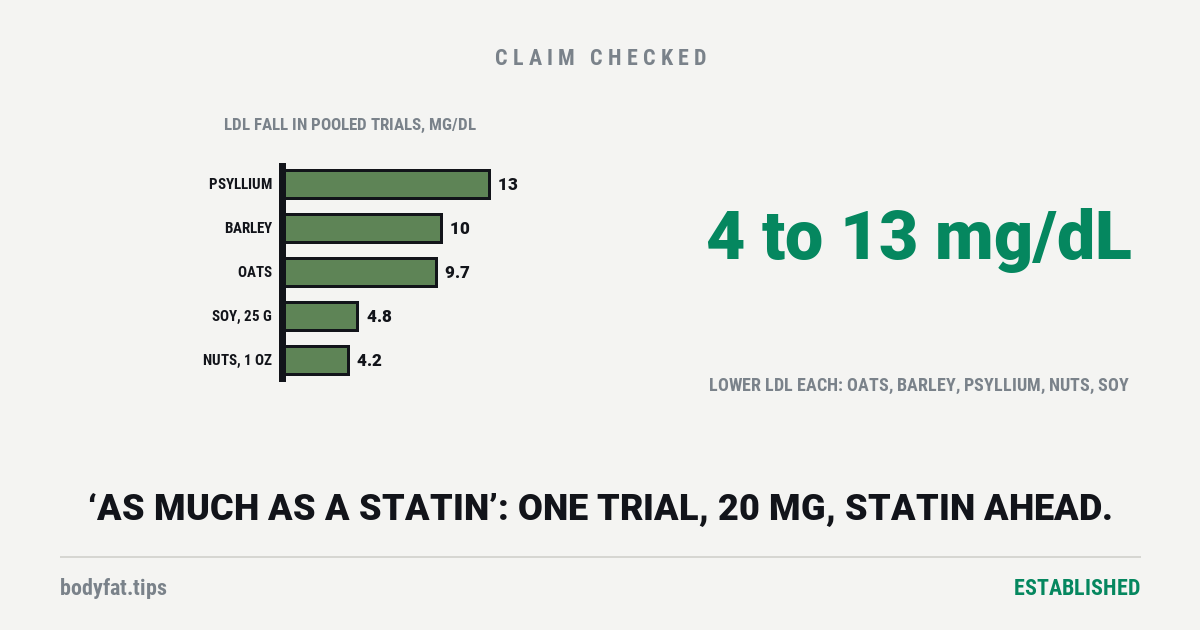
“As much as a statin” rests on one month, 46 people, delivered food and a statin dose from the weakest class. In that trial’s first month, reported in 2003, the combined diet lowered LDL 28.6% and 20 mg of lovastatin 30.9%, a gap too small for the trial to call [7]. The same volunteers then tried the other two treatments, a month each, with the food again provided apart from fresh fruit and vegetables; after four weeks on each, in the 34 who finished all three, the statin did significantly better, 33.3% against 29.6% [8]. And 20 mg of lovastatin sits in the weakest class of statin doses in the US guideline [9].
At home, on advice, the same diet did about half as much. Over six months LDL fell about 13% on it, against 3% on a standard low-fat diet [10]. That is still a real fall. It is not a statin’s.
Which foods lower LDL cholesterol, and by how much?
First, the unit. LDL is measured in milligrams per decilitre of blood in the US (mg/dL) and in millimoles per litre (mmol/L) in most of the world; one mmol/L is about 39 mg/dL. The volunteers in the Portfolio trials below started at about 170 mg/dL (4.4 mmol/L) [11]. Here is what each food did, pooled across the trials that tested it.
| Food | Amount in the trials | LDL change | Evidence |
|---|---|---|---|
| Oats (beta-glucan, their soluble fibre) | 3 g or more of beta-glucan a day | About 9.7 mg/dL lower (0.25 mmol/L) | 28 trials; rated on our oatmeal verdict |
| Barley (beta-glucan) | A median of 6.5 g of beta-glucan a day, in one pooling | About 10 mg/dL lower (0.25 to 0.27 mmol/L) [12] [13] | Two poolings, 11 and 14 trials |
| Psyllium husk | The doses set out on its page | About 13 mg/dL lower (0.33 mmol/L) | 28 trials; rated on our psyllium verdict |
| Plant sterols and stanols (added to spreads, yogurts, drinks) | About 2 g a day; about 3.3 g a day | About 8% lower; about 12% lower [3] | 124 studies |
| Tree nuts | Per ounce (28 g) a day; the trials’ median was about 2 oz (56 g) | About 4.2 mg/dL lower per ounce (0.11 mmol/L) [4] | 38 randomised trials, 61 in all |
| Soy protein | A median of 25 g of soy protein a day | About 4.8 mg/dL lower (0.12 mmol/L), about 3% [5] | 41 trials |
| Polyunsaturated fat in place of saturated fat | Per 1% of calories moved | About 2.1 mg/dL lower (0.055 mmol/L) [6] | 84 feeding studies |
Soluble fibre. The kind that dissolves and turns gluey in water: oats, barley, psyllium. Oats and psyllium have their own verdicts on this site, both rated Established for cholesterol: about 9.7 mg/dL off LDL for 3 g a day of oat beta-glucan, the gluey fibre in oats, and about 13 mg/dL for psyllium, each across 28 trials. See the oatmeal verdict and the psyllium verdict. Barley carries the same fibre. Two poolings, one partly from a Canadian government cereal research centre and one from the Toronto group behind the Portfolio diet, found LDL about 10 mg/dL lower (0.25 to 0.27 mmol/L), across 11 trials and 14 [12] [13].
Plant sterols and stanols. These are cholesterol look-alikes from plants, added to spreads, yogurts and drinks; they cut how much cholesterol the gut absorbs [7]. Across 124 studies, about 2 g a day lowered LDL by about 8% and about 3.3 g by about 12% [3]. On an LDL of 160 mg/dL, 8% is about 13 mg/dL, by our arithmetic. Two of that analysis’s three authors worked for a company that sells sterol-enriched foods, and say so [3]; one of them was also an author of the Toronto trial that set the Portfolio diet against a statin, employed then by the same company’s research institute [7]. Not every health body tells people to use them. Britain’s NICE guideline tells clinicians not to advise plant sterols or stanols to prevent cardiovascular disease, heart attacks and strokes among it, for anyone being treated to prevent it, or for people with kidney disease or diabetes [14]. Germany’s Federal Institute for Risk Assessment, a 2021 review reports, does not recommend sterol-enriched foods, and the same review cites genetic evidence suggesting that plant sterols in the blood may themselves help build artery plaque [15]. Whether lowering LDL this way prevents heart attacks is taken up below.
Nuts. Across 61 trials, each ounce (28 g) of tree nuts a day lowered LDL by about 4.8 mg/dL; counting only the 38 randomised trials, where a coin decides who eats the nuts, it was 4.2 mg/dL (0.11 mmol/L) [4]. The effect grew with the amount, more so at 60 g (about 2 oz) a day or more, and did not differ clearly between walnuts, almonds, pistachios and the rest [4]. Three of its authors had been paid, through a research organisation, for a review funded by a tree-nut industry council [4].
Soy protein. The smallest effect on the list, and the one whose US health claim the regulator has proposed revoking. In 2017 the US Food and Drug Administration proposed revoking the heart-health claim soy foods have carried since 1999, saying the evidence no longer showed the scientific agreement the claim needs [16]. The Toronto group behind the Portfolio diet pooled the 46 trials the agency had weighed, 41 of which reported LDL: about 25 g of soy protein a day lowered LDL by 4.76 mg/dL (0.12 mmol/L), about 3% [5]. We found no final decision in the Federal Register’s records; in 2024 the agency was still renewing the paperwork rules for the claim [16] [17].
Swapping the fat. Here the food matters less than what it replaces. An analysis published by the World Health Organization, of 84 feeding studies, found that moving 1% of calories from saturated fat to polyunsaturated fat, the kind in sunflower and corn oil, lowered LDL by about 2.1 mg/dL (0.055 mmol/L); to monounsaturated fat, the main fat in olive and canola oil, by about 1.6 mg/dL; to carbohydrate, by about 1.3 mg/dL [6]. Moving 5% of calories, about 11 g of fat on a 2,000-calorie day, from saturated to polyunsaturated fat would be about 11 mg/dL, by our arithmetic. Whether that swap means fewer heart attacks has been tested in trials, and our saturated-fat verdict sets them out; olive oil against the other oils has its own verdict.
So what does 4 mg/dL buy you? On its own, not much. Eggs push LDL up by about as much in the other direction, which is the subject of our egg verdict. For scale, statin trials measure their benefit per 39 mg/dL (1 mmol/L) of LDL lowered [18]. Which is why a Toronto group, by 2002, was testing the obvious idea: eat them all at once [11].
Portfolio diet food list: what the trial actually served
The Portfolio diet is that idea, named like an investment portfolio: spread the bets. It was built by a clinical nutrition group at a Toronto hospital and the University of Toronto [7]. In the 2003 trial the daily targets were set per 1,000 calories: 1.0 g of plant sterols, in an enriched margarine; 21.4 g of soy protein, as soy milk and soy meat substitutes; 9.8 g of soluble fibre, from oats, barley and psyllium, with okra and eggplant; and 14 g of almonds [7]. On a 2,000-calorie day that doubles, by our arithmetic, to 2 g of sterols, about 43 g of soy protein, about 20 g of soluble fibre and 1 oz (28 g) of almonds.
The diet was vegetarian, low in saturated fat, and in that trial it came to the door: “All foods were provided except for fresh fruits and vegetables”, by courier and at weekly clinic visits [7]. Of the participants who commented afterwards, 40% found it acceptable with little change, and 27% said there was too much food [7].
Does the Portfolio diet work as well as a statin?
With the food delivered, for a month, nearly; at home, about half as well. Here is the trial everything rests on [7]. In late 2002, 46 adults with high LDL, recruited from the hospital’s clinic and through newspaper advertisements, were assigned by chance to one of three diets for a month: a very-low-saturated-fat diet with a dummy capsule; the same diet with 20 mg of lovastatin a day; or the Portfolio diet [7]. The paper says every participant was “reluctant to take statins” [7]. Twenty-one of the 46 had been started on a statin at some point and had stopped it at least two weeks before the trial began [7].
After four weeks LDL had fallen 8.0% on the low-fat diet, 30.9% with the statin and 28.6% on the Portfolio diet [7]. In the paper’s own figures that is about 14 mg/dL (0.37 mmol/L), 55 mg/dL (1.43 mmol/L) and 53 mg/dL (1.36 mmol/L) [7]. The statin and the diet were “not significantly different”: the gap between them was smaller than the trial, with 14 and 16 people in those two groups, could tell apart from chance [7]. That is not the same as showing they were equal. A companion paper the same year, which the channel’s video also links, fed 25 people the diet or a low-fat diet for a month: LDL fell 35.0% against 12.1%, with no statin in the comparison [1] [19].
That month was only the trial’s first phase. The volunteers went on to the other two treatments, a month each with a break of two to six weeks between, again with all their food provided apart from fresh fruit and vegetables, so that each person could be compared with themselves; 34 of the 46 finished all three, and the complete trial was published two years later [8]. The authors chose that design because it “allowed relatively small differences to be detected” [8]; the first month on its own had the statistical power to detect a difference of 8% between treatments [7]. After four weeks on each, the statin lowered LDL 33.3% and the Portfolio diet 29.6%, and this time the statin’s lead was statistically significant [8]. The authors pointed out that 9 of the 34 got their lowest LDL on the diet, and that 27 on the statin and 24 on the diet got below the usual target for people without heart disease, a gap the trial could not call [8]. Both are true. So is the result.
| Study | What people got | What happened to LDL |
|---|---|---|
| Toronto, 2003; 46 adults, the trial’s first month [7] | All food delivered: a low-fat diet; the same diet plus 20 mg of lovastatin; or the Portfolio diet | Down 8.0% on the diet, 30.9% with the statin, 28.6% on the Portfolio diet; statin and Portfolio not significantly different [7] |
| The same trial, completed (2005); 34 adults, 1 month on each [8] | Each person had all three in turn, in random order, all food again provided apart from fresh fruit and vegetables | Down 8.5%, 33.3% with the statin and 29.6% on the Portfolio diet; the statin did significantly better [8] |
| Toronto, 2006; 66 adults, 1 year, no comparison group [20] | Advice, buying their own food | Down 12.8% on average at one year; 21 of the 66 by more than 20% [20] |
| Four Canadian cities, 2011; 351 adults, 6 months [10] | Advice only: the Portfolio diet at two or seven clinic visits, or a standard low-fat diet | Down 13.8% and 13.1% on the Portfolio diet, 3.0% on the low-fat diet [10] |
| Birmingham, UK, 2021; a pilot; 60 adults with HIV, 6 months of support, measured again at 12 [21] | Advice: a Mediterranean-style Portfolio diet, or advice to cut saturated fat | About 15 mg/dL lower than the comparison at 6 months (0.4 mmol/L); at 12 months, six months after the support ended, about 2 mg/dL, with a range from 13 lower to 9 higher; in the authors’ word, not sustained [21] |
Now the statin. Lovastatin is what the 2003 paper calls the first-generation statin, and 20 mg was its starting dose [7]. The 2018 US cholesterol guideline sorts statin doses by how much they lower LDL: under 30% is low intensity, and that is where 20 mg of lovastatin sits; 30 to 49% is moderate; 50% or more is high intensity, which means 40 to 80 mg of atorvastatin or 20 to 40 mg of rosuvastatin [9]. The 2003 paper put its own result the same careful way: the foods lowered LDL “similarly to the initial therapeutic dose of a first-generation statin” [7]. We found one trial that set the diet against a statin, this one, reported after its first month and again when complete, and it used 20 mg of lovastatin [7] [8] [17].
Then the diet left the clinic. The same paper said its true worth could only be judged in people who “assemble the diets for themselves” [7]. Two Toronto studies did that. In a year-long study with no comparison group, 66 people buying their own food, apart from a sterol margarine the study supplied because it could not be bought in Canada, averaged a 12.8% fall in LDL; 21 of them, about a third, managed more than 20% [20]. In a trial at four Canadian centres, 351 people were given advice, not food, for six months [10]. Starting from an average LDL of 171 mg/dL, it fell 13.8% (26 mg/dL, about 0.67 mmol/L) with seven clinic visits, 13.1% (24 mg/dL) with two, and 3.0% (8 mg/dL) on standard low-fat advice [10]. Between 18% and 26% of each group had dropped out by six months [10].
A 2018 analysis pooled seven Portfolio comparisons, 439 people in all, and found LDL 17% lower than on a low-fat diet alone: 28 mg/dL (0.73 mmol/L), with a range from 22 to 34 mg/dL, the range the true average probably sits in [11]. It graded that as high certainty, on GRADE, a scale researchers use to grade how sure they can be of a pooled result [11]. Two things sit underneath it. The biggest study in it is the six-month advice trial: 345 of its 439 people [11]. And it splits cleanly in two. When the food was supplied, LDL came out 34 mg/dL (0.87 mmol/L), about 21%, lower; on advice alone, 19 mg/dL (0.50 mmol/L), about 11% [11]. The trials’ results varied more than chance would explain, with an I-squared of 67%: the share of the spread between the trials’ results that is more than chance would produce. That split accounted for all of it [11].
All seven comparisons came from the Toronto group, every trial was funded by a mix of public agencies and industry, and the statin trial is in it only through its first month, with the statin group left out [11]. The authors raise the single-group point themselves and decided it did not lower their grade [11]. The one independent trial we found that used the full set of foods and has published results, a pilot in England, gave 60 adults with HIV and high LDL six months of support to eat a Mediterranean-style Portfolio diet, or advice on cutting saturated fat [21]. At six months LDL was about 15 mg/dL (0.4 mmol/L) lower on the Portfolio diet. At twelve months the gap was about 2 mg/dL (0.05 mmol/L), with a range from 13 lower to 9 higher, by our conversion: in the authors’ word, “not sustained” [21]. That twelve-month reading came six months after the support had ended, so it measures what was left once the help stopped, not the diet in people being helped to eat it [21]. A Mexican trial of a partial set of the foods, dried nopal cactus, soy protein, chia seeds, inulin and oats, with no sterols or nuts, gave 62 adults with mildly high LDL the foods or a placebo on top of a low-saturated-fat diet for two and a half months: LDL fell about 18% with the foods and about 5% with the placebo, the second figure read off the paper’s chart [22].
If the diet came close to a statin in 2003, why did it do half as much in 2011?
This section is the desk’s own reasoning, and it is labelled as such. Measured against the low-fat diet in the same trial, the Portfolio diet took LDL down about 21 percentage points further in 2003 and about 11 in 2011, by our arithmetic from the two papers [7] [10]. Same foods, same research group. Three answers, each rated.
Answer one: the kitchen. In 2003 almost all the food arrived at the door, much of it ready to heat; in 2011 people got advice and a dietitian. The pooled analysis split exactly on that line, 21% with food supplied and 11% on advice [11], and in both the six-month and the one-year studies, the people who ate more of the diet lost more LDL [20] [10]. In the year-long study, only 2 of the 26 people who ate less than 55% of it got past a 20% fall [20]. This is measured: the split and the link with how much was eaten are in the papers. That the kitchen is most of the difference is our reading of them.
Answer two: the yardstick. Even in 2003 the diet was matched against the bottom of the statin range [9]. When the 2018 US guideline recommends a statin to prevent a first heart attack, it asks for a fall in LDL of 30% or more, and 50% or more for people at higher risk or who already have heart disease [9]. The diet, with the food supplied, delivered 21% beyond the low-fat diet in the pooled trials [11]. This is arithmetic from a guideline table, not a trial: we found no trial that put the diet against a stronger statin dose [17].
Answer three: who signed up. The 2003 volunteers came from a nutrition clinic and newspaper advertisements and were, every one of them, reluctant to take a statin [7]. Twenty-one of them had been on a statin before and stopped it [7], and 29 of the 66 in the year-long study had already been through the statin trial [20]. People that motivated are probably the ceiling. Most people trying this from a food list would land below them, as the one-year study’s spread suggests: about a third got past 20% and the average was 12.8% [20]. This is a surmise; the papers we read do not say how typical their volunteers were.
Put the three together and here is what we think is true, stated plainly so you can disagree with it: the Portfolio diet works about as well as it is eaten, which at best is a low-intensity statin dose and at home is about half of that. Half of a real effect is still a real effect, and nothing on this page says the foods do not work. What it says is that “as much as a statin” describes one month in a Toronto clinic, not a kitchen.
What we could not find, and would like to: the results of a trial of the Portfolio diet that counts heart attacks and strokes rather than blood tests, which has begun and is described below [23]; a trial against a moderate or high statin dose; and an independent trial that supported people on the diet for a year or more, which the English pilot did not [21]. A Toronto trial of the diet with and without exercise, measuring neck arteries by MRI, finished in June 2023 with no results posted and none published that we found on its arteries; a 14-person pilot of a diet app, run among its volunteers, was published in 2025 and reports how closely people kept to the diet [24]; our plaque verdict lists it [17]. If you know of the others, the corrections line on this site is open.
Does lowering LDL with food prevent heart attacks?
That is the question the number is for, and it has two parts. Does lower LDL mean fewer heart attacks? In statin trials, yes: across 26 trials and about 170,000 people, every 39 mg/dL (1 mmol/L) of LDL lowered came with about 22% fewer major heart and stroke events [18]. A 2016 analysis of 49 trials found about the same, 25% fewer per 39 mg/dL, for a group of non-statin treatments that, like statins, mainly work by making the liver clear more LDL: diet, bile-acid binders, intestinal bypass surgery and the drug ezetimibe, counted together [25]. We read that one as its summary, which does not give diet trials a figure of their own.
Does LDL lowered by these foods do the same? That has not been tested directly yet. We found no randomised trial of the Portfolio diet that has reported heart attacks, strokes or deaths [17]. One is counting them: a Toronto trial registered as an assessment of the Portfolio diet in primary care, planned for about 1,100 adults who already take a statin and have heart or artery disease, or type 2 diabetes and another risk factor. They are assigned by chance to a digital programme (an app, 16 live online sessions and some of the key foods supplied) on top of their usual care, or to usual care alone, and major heart and stroke events at seven years are one of its two main measures. It began recruiting in August 2025, and its main data collection is estimated to finish in June 2034 [23]. It tests the diet on top of a statin, not in place of one. For plant sterols, a 2023 review calls them the most widely used cholesterol-lowering approach sold without a prescription, “despite the lack of randomized trials” of their effect on heart disease [26], and Germany’s cardiology society has asked for one [15]. The exception is the fat swap, which has been tested on events; that is on our saturated-fat verdict. Trials of a Mediterranean diet with nuts are on our olive oil verdict.
What exists for the Portfolio diet is observation. In three US cohorts of nurses and health professionals, 210,240 people followed for up to 30 years, those whose diets most resembled it had about a 14% lower risk of heart disease and stroke than those whose diets least did [27]. In 123,330 older American women the risk of cardiovascular disease was 11% lower, and the link with stroke on its own was too weak to call either way [28]. A 2026 pooling of four cohorts found the same direction [29]. Studies like these watch what people eat and wait; they cannot rule out that people who eat this way differ in other ways that matter. Their authors include the Toronto group behind the diet [27] [28] [29].
If LDL lowered by food behaved like LDL lowered by a statin, the pooled Portfolio fall of 28 mg/dL would mean about 17% fewer major events, and the 19 mg/dL seen on advice about 12%, by our arithmetic from the statin trials’ figure [18] [11]. That rests on an assumption no trial has tested, and on the diet being kept up for years, which no trial has measured either.
Which drink can reduce cholesterol?
The drinks with trial evidence are carriers for the foods above: soy milk counts toward soy protein, and plant sterols are sold in drinks and yogurts [5] [3]. In the sterol analysis, sterols in drinks lowered LDL less than sterols in solid foods, 6.5% against 9.2% on average, in the studies giving about 2 to 2.5 g a day; the authors found that difference after the fact, so it is a lead rather than a rule [3].
What flushes cholesterol out of your body?
Flush is the wrong picture. In the 2003 paper’s account these foods work on the traffic in your gut and liver, not on your arteries: soluble fibre carries away bile acids, which the liver then remakes from cholesterol; plant sterols block cholesterol from being absorbed; and soy protein may slow the liver’s own production [7]. Different routes are the reason the authors thought stacking them would add up [7]. Whether any diet can shrink plaque already in the arteries is the question of our plaque verdict.
What foods are worst for high cholesterol?
Read the fat-swap numbers backwards: moving calories toward saturated fat, the fat in butter, cheese and fatty meat, pushes LDL up [6]. Eggs raise it a little, by about 5 to 8 mg/dL in feeding studies; our egg verdict asks whether that matters. Garlic, which turns up on many of these lists, has its own verdict, rated Preliminary for cholesterol.
How fast can you lower cholesterol: in 7 days, in 30?
The trials measured at two and four weeks, and in the 2003 trial LDL at week two was already close to week four [7]. So a month is long enough to see what a diet does to a blood test. It is not long enough to know what it does to an artery. The harder part is keeping it up: between a fifth and a quarter of the six-month trial’s volunteers had dropped out by the end [10].
Who these studies were done on
Mostly middle-aged adults whose LDL was already high, about 170 mg/dL (4.4 mmol/L) in the Portfolio trials, without diabetes or heart disease [11] [10]. The Portfolio trials were Canadian, and four of the five reports pooled had all their food supplied [11]. The single-food trials were short, weeks to a few months [4] [5] [13]. People whose LDL is normal may see less: the oat analysis on our oatmeal page found the effect largest in people who started high. The 2003 trial took no one then on a cholesterol drug, but 21 of its 46 volunteers had been on a statin before and had stopped it [7].
Where “as much as a statin” came from
It started with the researchers’ own sentence. The 2003 paper said the foods appeared to lower LDL “similarly to the initial therapeutic dose of a first-generation statin”, and said in the next line that people would have to be tested assembling the diet themselves [7].
The day before the paper came out, a food and supplement industry trade site ran it under the headline “Healthy diet equals cholesterol-lowering drugs”, quoting the study’s leader that the effect “was equal to that of the starting dose of statins” [30]. It also said the diet lowered a marker of inflammation, C-reactive protein, more than the statin did [30]. The paper’s figures go the other way, 28.2% on the diet against 33.3% on the statin, and call the gap not significant [7]. The story named brands of sterol margarine, a psyllium laxative and soy patties among the foods [30].
Twenty-three years later the comparison is the diet’s calling card. Ask Google about the Portfolio diet and its AI answer says the foods cut LDL by nearly 30%, “an effect comparable to low-dose statin medication”, and cites a video titled “The Portfolio Diet: 4-Food Stack That Matched a Statin for LDL Reduction” [2]. Another result on the page says the diet can lower cholesterol “similar to a first generation statin” [2]. The AI answer kept the word low-dose; it does not mention the completed trial’s result or the fall from 29% to 13% [2]. Seventh on the page, the UK site of a plant-stanol spread brand explains the diet, listing “plant stanols, nuts and soy protein” first among its foods [2].
None of this is aimed at anyone trying to eat their way to a lower number. The foods work, and the paper that started this stated its comparison with care. What went missing from the headlines we read was the word initial, and the delivery van.
What this is rated, and what the rating covers
Established — for the claim that eating soluble fibre from oats, barley or psyllium, plant sterols, nuts or soy protein, or swapping saturated fat for unsaturated, lowers LDL cholesterol, each by a modest amount: about 4 to 13 mg/dL for oats, barley, psyllium, an ounce of nuts or 25 g of soy protein a day, and about 12% for plant sterols at around 3 g a day, the top of the range the pooled trials could average.
It is rated Established because each part has been pooled across dozens of trials pointing the same way, by research groups that differ from food to food, and for barley by two separate groups [12] [13] [3] [4] [5] [6]. The limits are size and time. Each food does a little, soy least, and most trials ran weeks, not years. Much of the work was paid for, staffed or supplied by the companies and trade bodies that sell the foods, which the funding row sets out; the effects held across groups with different backers, but that is the row to read.
Rated alone, in words. That the Portfolio diet lowers LDL “as much as a statin”: Unsupported, of the tested kind, as a general statement. One Toronto trial tested it, a month per treatment with the food delivered, against 20 mg of lovastatin, a dose from the lowest class of statin doses. After its first month, with 46 people in three separate groups, it could not separate the diet from the statin; that phase had the power to detect a difference of 8%, and the gap was about 2 percentage points. Completed, with 34 people trying all three treatments in turn, it found the statin better, 33.3% against 29.6% [7] [8]. Nearly as much as the lowest statin dose, with the food delivered, is what that supports. At home, on advice, the diet did about half as much [10].
That the foods do more in combination, and that the Portfolio diet, eaten as a whole, lowers LDL by about a sixth: Supported. Seven comparisons agree, but all come from one research group. The one independent trial with published results that we found using the full set of foods, a pilot, agreed after six months of support; six months after the support ended, its authors called the effect not sustained, though the range of plausible answers still allowed a gap nearly as large. A Mexican trial of a partial set agreed over two and a half months [11] [21] [22].
That lowering LDL with these foods means fewer heart attacks: Preliminary. LDL lowered by statins and by other means has been followed by fewer events in trials, and people who eat this way have fewer in cohorts [18] [25] [27]; no trial of these foods has reported them, apart from the fat swap rated on its own page, and one trial of the Portfolio diet that counts them, in people already taking a statin, began recruiting in 2025 [23].
What is not rated here: fish and omega-3 fats, which the 2023 video names beside oats and nuts and which the AI answer for this search files under triglycerides, a different blood fat [2]; the same video’s claims about exercise, alcohol and weight loss [1]; and the frame above, which is this desk’s reasoning from the evidence rather than a result the evidence delivered. It is marked as ours so that you can weigh it as ours.
This is journalism, not medical advice. Whether you need a statin depends on your whole risk, not on LDL alone, and that decision belongs with a clinician who knows your numbers. Food is not a substitute for a medicine you have been prescribed; do not stop one to try this. Statins have side effects worth knowing, and one of them has its own verdict. How we read a study, and what each tier means, is set out here.
- Is Fruit Sugar Bad for You? Told to Eat More Fruit or Less, People With Type 2 Diabetes Showed No Clear Difference in Blood Sugar.
supported - Dark Chocolate Benefits: Cocoa Shaved About 1.8 mmHg Off Blood Pressure in Short Trials. The 21,442-Person Heart Trial Used Capsules, and Missed Its Main Goal.
preliminary - Lycopene Benefits: Cook Tomatoes With Oil and More Gets Into Your Blood. In Seven Trials, Tomatoes Didn’t Clearly Move the Scale.
supported