Whey vs Plant Protein: Strength Came Out the Same. The Lean-Mass Edge Was Under a Pound, in People Under 50.

Somebody put animal protein and plant protein against each other, in randomised trials, and measured what happened to muscle. Sixteen trials went into the pool, out of 3,081 papers screened. [1] One thing to know before the numbers: in those trials “plant protein” mostly meant soy, in 14 of the 18 reviewed, and “animal protein” mostly meant dairy. One trial tested pea and one rice. And in two, the plant group got more protein than the whey group, to match whey’s leucine, the amino acid most tied to switching on muscle building. [1]
Strength: no difference. Absolute lean mass: no clear difference. Animal protein came out about half a pound ahead (0.22 kg), on a range that still includes no difference at all. [1] Those are the two outcomes anybody buying a tub actually cares about.
Then it gets more interesting, and this is where both sides of the marketing start quoting selectively.
What the head-to-head actually found
| Outcome | Result |
| Muscle strength | No difference |
| Absolute lean mass | No clear difference: +0.49 lb (0.22 kg) · range −0.04 to 1.01 lb |
| Percent lean mass | Favours animal protein: +0.50% · range 0.05 to 0.95 |
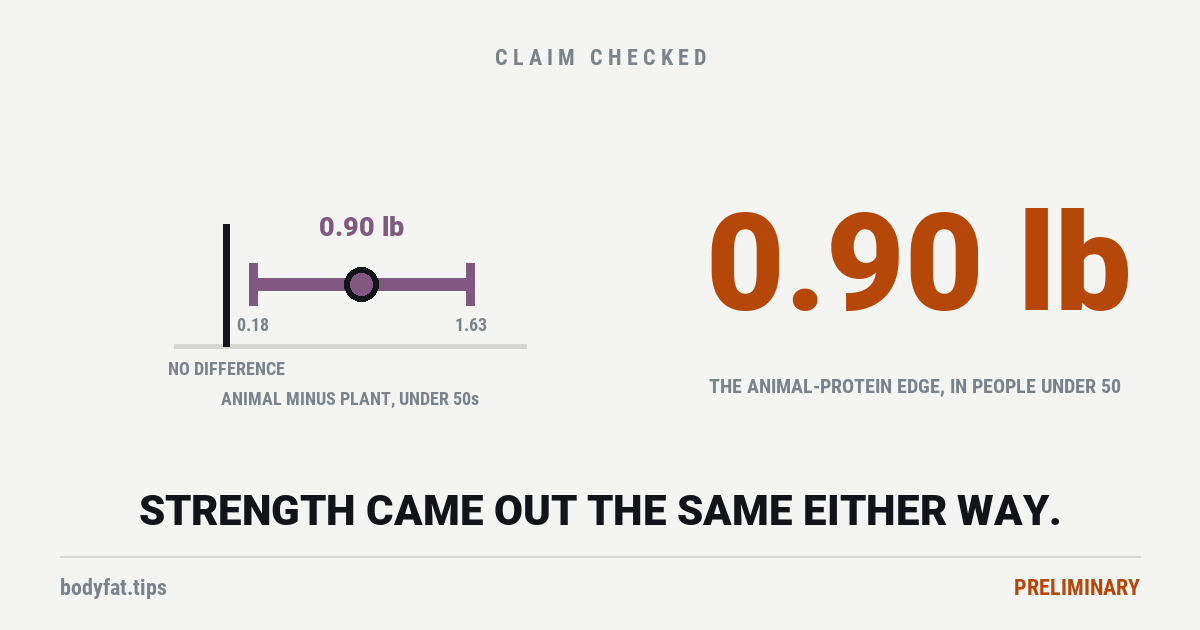
| Absolute lean mass, under 50s | +0.90 lb (0.41 kg) · range 0.18 to 1.63 lb |
| Percent lean mass, under 50s | +0.50% · range 0.00 to 1.01 |
| Did resistance training change it? | No |
Percent lean mass did favour animal protein, with all ages pooled: 0.50%, on a range of 0.05 to 0.95. Percent lean mass is lean tissue as a share of body weight, so it also rises when fat falls and no muscle is added, and the review’s authors say that may be part of what they saw. In adults under 50 there was a measurable edge in absolute terms too: 0.90 lb (0.41 kg), from seven trials and about 370 people, by our count. [1]
Look inside those seven and the edge thins. Two found more lean mass with animal protein in their own analyses, and both had dairy industry funding. The other five found no difference. The one the review weighted most, a third of the figure, was among the five: the review entered it with unusually tight figures for how much people’s results varied, which that trial’s own authors label as model predictions, and that is what made it count so heavily. Leave it out and, by our arithmetic rather than the review’s, the range dips just below zero. [1]
Under a pound. Over the course of a trial. That is the biggest number the head-to-head pooling produced, and it is worth seeing at full size before anybody sells you a conclusion with it.
And one of those numbers is closer to nothing than it looks
The percent-lean-mass edge in under-50s was 0.50%, with a range of 0.00 to 1.01. [1]
That range is a confidence interval — the span the true answer probably sits inside. When it includes zero, “no effect at all” is still on the table. This one does not merely come close to zero. Its lower edge is zero.
So the honest way to say it is: animal protein probably has a small edge on that measure in younger adults, and no edge whatsoever is still inside the range the data allows. This is what our ratings mean.
A 2026 analysis ranks whey top — and grades the plant comparisons weakly
A 2026 network analysis pooled 36 randomised trials and 1,552 people, comparing whey, casein, milk, soy, pea, rice and blends against placebo alongside resistance training. [2]
Whey came first for lean body mass, at 2.7 lb (1.24 kg) more than placebo, with milk and casein just behind, and the authors grade whey’s lead over placebo as moderate certainty. Treat 2.7 lb as this analysis’s own estimate: its table of included trials gets some of them wrong when checked against their own records, listing a nine-month trial of untrained men and women as nine weeks in trained men, and a 327-person trial of middle-aged adults as 34 young adults. [2] The authors also estimate that whey’s benefit levels off at around 30–35 g a day, or 35–40 g for people over 65, and call that estimate exploratory: it rests on ten data points, in an analysis whose trials were mostly of men only, and it does not account for how much protein people already ate. [2]
Now the sentence the ranking gets quoted without. The reviewers write that plant proteins showed smaller effect estimates than dairy ones, “but the evidence certainty was low to very low and the credible intervals were wide, limiting firm conclusions”. [2]
That is the authors grading their own plant-protein comparison as weak. A first place over the plant proteins, built on comparisons graded low to very low, is a league table with most of its matches unplayed.
A bigger pooling found the same small edge, and showed where it sits
A 2025 review pooled 30 head-to-head trials and 1,538 people for muscle mass, with the plant and animal supplements matched to within 5 g of protein. Many of its trials are ones the 2021 review also pooled, so this is a bigger look at overlapping evidence rather than a fresh test. Animal protein came out slightly ahead, by an effect size of 0.20. An effect size puts different measurements on one scale: 0.2 is small, 0.8 is large. The edge showed up in adults under 60 and not in those 60 and older. Strength showed no difference, in 14 trials. [3]
Then it split the plant proteins, which is the part worth having before you pick a tub. Soy against milk protein, 17 trials: no difference. The gap sat with rice, chia, oat and potato protein, pooled from just five trials, which came out behind by an effect size of 0.58, a moderate one, and with whole plant-based diets, in seven. Pea protein was not in that pool: the review’s two pea-against-whey trials went into its write-up, not its numbers. [3]
Two more poolings sit on either side of it. A 2026 review of trials that lasted six months or more, 18 trials and 1,893 people, mostly soy and most of them in women around the menopause, found no difference in lean mass or strength. [4] A 2024 pooling that set plant protein against other kinds, such as whey, beef and milk, found plant protein slightly behind on strength, by an effect size of 0.13, a small one. [5]
The condition that makes all of this readable
Here is the detail that changes how you should read every number above. In those head-to-head trials, total protein intake was generally above the recommended amount — at the start and at the end. [1]
So what was compared was two adequate protein intakes from different sources. That is precisely the situation where the source should matter least, because the thing that drives muscle is getting enough protein in total — and that part is settled for people who lift, at about two-thirds of a pound of extra lean mass in a 2018 review, with no clear gain shown in people who neither train nor diet.
What these trials do not tell you is whether source matters when total protein is low. Every trial in the 2021 and 2025 reviews that reported intake was above the recommended amount, and nobody ran that comparison here. [1] [3]
The nearest tests we found are in other people, or change more than the source, and they point different ways. In adults with kidney disease on prescribed low-protein diets, a 12-month trial of 85 people found the soy-based diet kept more lean mass than the one built on animal protein, by an electrical estimate rather than a scan [6], while a 1998 crossover trial, in which nine people finished six months on each diet, found no difference [7]. In about 1,600 malnourished young children, swapping part of a food supplement’s soy protein for milk protein added no significant fat-free tissue [8]. And in a 2026 trial, healthy adults aged 65 and over who switched to a vegan diet of their own choosing went from about 1.0 to about 0.7 g of protein per kilogram of body weight a day, under the recommended 0.8, and lost 2.5 lb (1.15 kg) of lean mass from their arms and legs in 12 weeks; lifting weights roughly halved the loss [9]. They ate less protein as well as different protein, and the trial cannot separate the two; its authors put the loss down mainly to the protein that went missing. Our verdict on that trial is here.
So which tub
On the evidence: if you are hitting your protein target, the source is a much smaller lever than the marketing on either tub implies. Strength came out the same. Absolute lean mass came out close to the same. The measurable edge for animal protein was small: under a pound of lean mass in the under-50s, on a range that stays clear of zero but leans on one heavily weighted trial, and half a percentage point of lean mass with all ages pooled, on a measure that also rises when fat falls. Against soy, the bigger 2025 pooling found no difference. The rating on this page, Preliminary, is for one claim, the gold-standard one: that whey builds more muscle than plant protein. Real trials have tested it, and they show at most a small lean-mass edge, no difference when soy and milk protein were pooled against each other, and no strength edge in the 2021 and 2025 reviews.
Two practical notes for the shelf:
— Whey’s 30–35 g a day is a rough guide, not a ceiling. [2] The analysis’s authors call it exploratory, and put it at 35–40 g for people over 65.
— “Plant protein” is not one thing. Soy has been tested against milk protein in 17 trials and matched it; rice, chia, oat and potato protein, five trials between them, came out behind; pea rests on a handful of trials against whey that the 2025 review did not pool. [3] The 2026 analysis grades pea, rice and blends very low. [2] “Very low certainty” is a statement about that thin evidence, not about the food.
Neither industry comes out of this well. Dairy marketing sells a gold standard: one 2026 whey buying guide that earns retailer commissions calls a hydrolysed whey “the gold standard for muscle gain” because it reaches the blood faster. The 2021 and 2025 reviews found no strength edge for animal protein and, at most, a small lean-mass edge, with soy and milk protein no different when pooled. Plant marketing sells “just as good”, and the press helps: an August 2026 news item turned a pooling of mostly soy trials into a headline that began “Plant Protein Matches Animal Protein for Muscle”. For soy the trials agree; for the other plant proteins they are few, and the pooled ones came out behind. If you bought either on the strength of a claim like that, the claim was ahead of the research — that is a fault of the label, not of you.
Elsewhere: protein while dieting, whether it actually keeps you full, one of the two supplements that survived a screen of 250, and what training does after 60. The whole shelf is ranked here.
Corrected on 30 September 2026. This page said the protein evidence showed two-thirds of a pound of extra lean mass “across 49 trials, and nothing at all without the training”. Our protein verdict was corrected today after an independent editorial review. The figure pools 26 comparisons inside a 2018 review of 49 trials, all of them in people who lift. And in people who neither lift nor diet, the pooled trials show no clear gain, with ranges too wide to rule one out, which is not the same as nothing. The sentence now says that. Nothing else on this page has changed, and its rating is unchanged.
This page was corrected on 9 October 2026 after an independent editorial review. Its funding row said funding was “not stated in the sources read”. Both reviews state theirs, and of the seven trials behind the under-50 figure, five had dairy or beef industry money and a sixth was paid for by a consultancy that employs two of its authors; the only two that found an edge for animal protein in their own analyses were dairy-funded. The search description called 0.90 lb “the one real edge”, but the percent-lean-mass edge held with all ages pooled. The page said the under-a-pound edge sat on an interval that touches zero; that interval, 0.08 to 0.74 kg, does not. “No difference” in absolute lean mass was a non-significant 0.49 lb in animal protein’s favour. And the panel said the finding had not been replicated, when a 2025 pooling of 30 trials had found the same small edge, and found soy and milk protein the same.
Also changed: the page now says what “plant protein” meant in the trials (mostly soy), what the seven under-50 trials found on their own, and that the 2026 network analysis calls its 30–35 g whey plateau exploratory and has errors in its table of trials. “Not disproved — untested” was too broad: trials in kidney disease, in malnourished children and in older adults switching to a vegan diet come near the low-protein question, and the page now names them. The provenance chain now starts with the dairy-funded lab studies of 2007 to 2009, names a real 2026 instance of the gold-standard claim in place of a sentence about dairy brands that we could not trace, and states the one claim the rating covers. The follow-up row now gives the trials’ lengths, and the creatine link now says two supplements survived, not one. The provenance chain’s search figure now says where it came from and when we pulled it. The rating is unchanged.