Greens Powder Benefits: The Vitamins Get In. The Gut Benefit Missed Twice.

Start with the part that is real, because most pages about this go straight to the sneering and it is not warranted.
Take concentrated fruit and vegetable powder every day, by the scoop or in capsules, and the vitamins in it turn up in your blood. Not metaphorically — measured. Across 22 reports on commercially available concentrates, blood levels of beta-carotene, vitamin C, vitamin E and folate rose significantly overall, and falls in markers of oxidative damage to protein, fat and DNA were reported too. [1]
None of the studies reported a serious side effect. [1] So this is not a scam and we are not going to pretend it is.
Here is the problem. Everything in that paragraph is a biomarker — something measured in a blood sample. None of it is an outcome. Your beta-carotene going up is a fact about your blood. Whether it makes you healthier is a completely separate question, and it is the one you are actually buying the tub to answer.
Then there is the small matter of what that review was reviewing
That review of 22 reports is from 2011, and it examined fruit and vegetable concentrates. [1]
A modern greens powder is that, plus probiotics, plus adaptogens, plus added vitamins and minerals, plus mushroom extracts, plus digestive enzymes. The review covers an ancestor of the thing on your counter, not the thing itself. Borrowing its conclusions for a 2026 product would be lending evidence to something it never tested — which is the whole trick this site exists to catch.
The authors’ own ask, fifteen years ago, was for larger randomised trials. [1] So what arrived for the multi-ingredient powders on the shelf now?
The biggest brand’s own trials
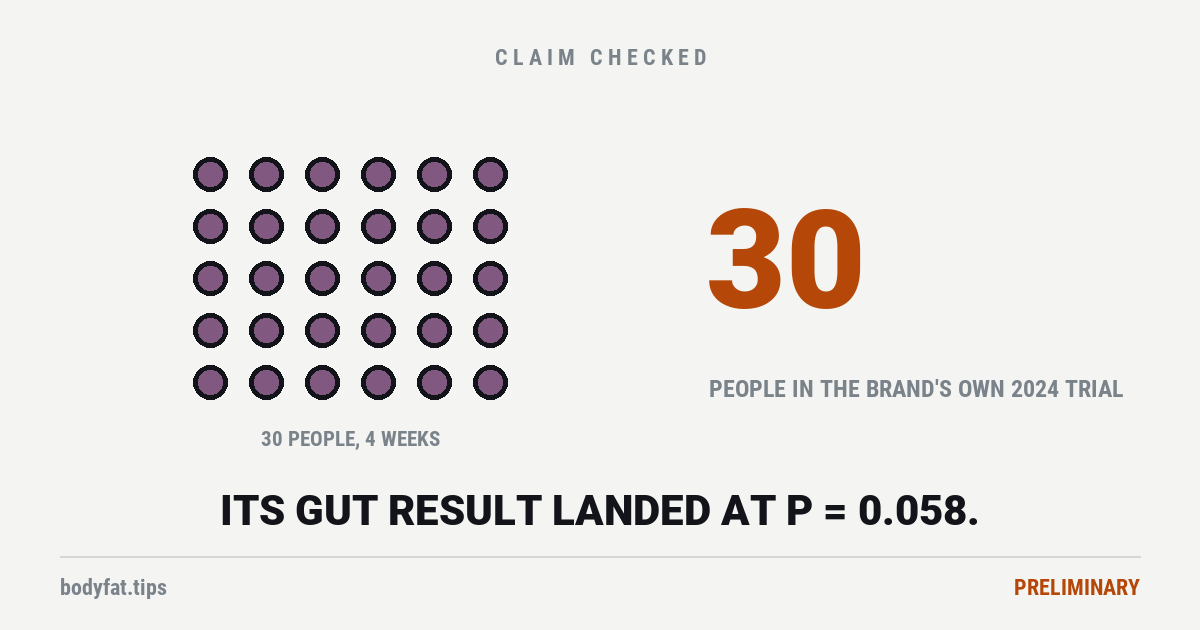
The category’s biggest brand has published three randomised, placebo-controlled trials of its powder as full papers, every one of them paid for, wholly or in part, by the brand: 30 people for four weeks in 2024; 20 people who each took the powder for two weeks and a dummy powder for two, in March 2026; and 16 people given a single serving of each, in July 2026 [2] [3] [4]. Its longest trial, 120 people randomised for 12 weeks, has so far appeared only as conference abstracts [5] [6]. The 2024 trial is the oldest, and the brand now files it under its “Original Formula”, apart from the four trials it counts for the powder it sells today [13]. Here it is, whole:
| People | 30 healthy adults aged 18 to 50 (15 men, 15 women); people with a known digestive disease were excluded |
| Length | 4 weeks |
| Design | Randomised, double-blind, against a dummy powder of maltodextrin, a starch |
| Funding | Funded in part by the maker, which is also its registered sponsor; two of the nine authors worked for it |
| Safety | No adverse changes in blood work |
| Microbiome | Within the greens group, two of the product’s probiotic species and two other kinds of bacteria rose and one fell; against placebo, no difference in the gut community as a whole |
| Digestive quality of life | Improved, at p = 0.058 |
Thirty people. Four weeks. [2] The two trials the brand has published since are smaller and shorter [3] [4].
It is randomised, double-blind and placebo-controlled, which is the right design. It was not registered in advance. The brand, as sponsor, submitted it to the trial registry on 5 December 2023, two months after the last participant finished, and in February 2024 moved its digestive measures, quality of life among them, from primary outcomes (the results a trial is built to test) to “exploratory” ones [7]. The registration also lists blood levels of zinc, vitamin C, folate and magnesium as an outcome; the paper reports none of them [2]. That did not stop the brand, answering a rival supplement seller’s public criticism in January 2026, from saying the trial “showed improved nutrient status and digestive quality of life” [11]. It is also very small and very short, and it was funded in part by the brand, by the paper’s own account, not our characterisation. Two of its nine authors worked for the brand: one helped conceive the study, and the other shared the analysis and the first draft. [2] We keep a running count of who funds the research behind health claims, and industry money is not automatically disqualifying — but it is always worth knowing.
What it found, and the sentence you should read twice
In healthy adults, it looked safe. Four weeks of it did not move anything worrying in routine blood work [2], and an abstract from the brand’s 12-week trial reports the same in 105 people [6]. Genuinely useful to know, and the 2024 trial’s authors present it as their main conclusion. Reports to the FDA are a weaker kind of evidence, because anyone can file one and a report proves nothing on its own, but they are not all quiet: a 2026 analysis of the agency’s adverse-event reports on supplements found a preliminary signal of raised liver enzymes (a blood sign of strain on the liver) for the product, emerging between 2023 and 2025, which its author treats as a flag for investigation, not a confirmed risk [12].
It changed the microbiome — the community of bacteria living in your gut — at least within the greens group. Over the four weeks, four kinds of bacteria rose there and one fell. Two of the four were probiotic species, and here is how the researchers themselves describe those two: they “likely stem from the probiotics species that exist in the product”. [2]
Read that again. The two headline bacteria were the bacteria they put in the tub. That is not a health effect. It is a delivery receipt. It tells you the probiotics survived the trip, which is worth confirming and is not what the marketing is about. And set beside the placebo group at the end, the gut community as a whole did not differ (p = 0.119, well short of the line researchers use for “probably not chance”); the placebo group’s bacteria shifted more, six kinds up and five down [2].
And the digestive benefit missed. Digestive quality of life improved in the greens group and got worse in the placebo group — but the comparison came out at p = 0.058. [2] That is just the wrong side of the line researchers use for “probably not chance”. The worsening may be the placebo’s own doing: it was maltodextrin, which the authors themselves say “is not entirely inert” and has “questionable validity as a placebo control”. The authors handle the result honestly, writing that there may have been a greater improvement, and their abstract concludes only that the product is safe with a potential benefit. The brand’s 2026 crossover asked the same question with the same questionnaire in 20 trained adults and found no difference (p = 0.777, nowhere near the line) [3].
The paper is careful with its words. The category’s advertising is not.
So what is a greens powder actually for?
On the evidence as it stands, the defensible version is narrow and unglamorous: if you eat very few vegetables, a concentrate raises the blood levels of some of the nutrients you are missing. That is what the 2011 review found and it is what its authors suggested it was for — a complement for people struggling to hit their intake. [1] The biggest brand’s own trials say the same of its powder: one serving raised blood levels of 9 of the 10 vitamins, minerals and plant compounds measured over the next eight hours, and in an abstract from its 12-week trial, in 105 adults who ate fewer fruits and vegetables than recommended, vitamin C rose by a third and folate by a quarter against placebo while zinc did not move [4] [5]. Its claim that the powder is “clinically shown to fill common nutrient gaps” leans partly on arithmetic, though: in its 2026 crossover the gaps were worked out by adding the powder’s nutrient content to what people reported eating [3] [13].
What has not been shown is that it does anything for energy, immunity, bloating, skin, focus, or any of the things the category is sold on. Some of it has been measured, a little, and some of the measuring has not been reported.
Energy first. A 2004 trial of another brand’s greens powder in 105 women scored energy higher than placebo on a secondary measure but missed on its main one, vitality (p = 0.055, just the wrong side of the line), lost two in five of its volunteers before the end, and set out to count colds and flu without reporting a difference in its abstract [9]. A 120-person trial of a third powder, built to measure energy and well-being at a Canadian university with a supplement company among its registered collaborators, finished in 2012; we have found no published result [7]. A 2026 trial of a fourth, open-label (everyone knew what they were taking) and paid for by its maker, found body composition, metabolic markers and quality-of-life scores unchanged after 30 days in 19 older adults with obesity [10].
Then the biggest brand. Its digestive result in healthy people came out at p = 0.058 and then p = 0.777 [2] [3]. Its 12-week trial registered fatigue, well-being and digestive-symptom scores, and its research page says the trial set out to assess “markers related to overall well-being”; we have found no report of how any of those came out [7] [13]. Its trial in adults with occasional digestive trouble, the people a bloating claim is aimed at, finished in February 2025 and has surfaced only as conference abstracts whose titles report gut bacteria, stool chemistry and “nutrient gaps”, not symptoms [7] [8] [13]. For energy, “mental performance” and skin, one of its regional research pages offers a 2023 “single-arm study” of how participants felt, with no comparison group, cited as “Data on file, 2023” [13]. On immunity, the 2011 review called the concentrates’ results on immune markers “promising” [1].
Small, short, mostly paid for by the people selling it, and mixed or missing where it should be clearest: that is why this page is rated Preliminary. It is not rated Unsupported, which on our scale means the evidence does not back the claim: it was tested and did not hold up, or nobody has tested it and nothing that was tested supports it. Here a little has been tested, a secondary energy score and the immune markers a 2011 review called promising lean the claim’s way, and several registered tests have not been reported. Here is what earns each rating.
Worth saying too: a greens powder is not a vegetable. Vegetables bring fiber, volume and the business of chewing, and fiber from food is the thing with the actual track record. The best-rated item on our gut-health ranking is psyllium husk, a fiber, and it is the only one there rated Established.
Where this sits on the shelf
Greens powders land in the same place as several things we have already checked: real trials exist, they are small, and they measure something adjacent to what is being sold.
Colostrum was set against another protein powder in all eight controlled body-fat trials a 2026 review found, and came out ahead in none of them. Sea moss had less than that. The pattern repeats because the economics repeat: a category can be enormous and still have almost no independent evidence behind it, because evidence is a cost and marketing is an investment.
The honest summary: in short trials of healthy adults it looked safe, the vitamins get in, and the biggest brand’s own small trials, all paid for at least in part by the brand, have not shown the benefits on the tub: its digestive result missed twice, and the energy and well-being scores its longest trial registered are still unreported. If you like drinking it and it is not straining your budget, nothing here says stop. Just do not mistake a delivery receipt for a health benefit, and do not let a tub stand in for the vegetables.
One line was corrected on 30 September 2026. This page said colostrum “had one trial in thirteen move body fat”. In that trial body fat fell by the same 0.4 points in the group taking whey, and nine of the thirteen studies in the review measured body fat, not all thirteen. Our colostrum page made the same mistake and was corrected the same day. Nothing else on this page changes.
This page was corrected on 9 October 2026 after an independent editorial review. It said the biggest greens-powder brand had one published randomised trial, 30 people for four weeks. By the time this page went up the brand had three in full papers, all paid for at least in part by the brand, and a 12-week trial reported only in conference abstracts, and other brands’ powders have small trials of their own; the page now describes them. It called the 2024 trial pre-registered: it was registered two months after it ended, and its digestive measures were later moved from primary to “exploratory” outcomes. It said the bacteria that rose were the ones in the product: two of the four that rose were, and against placebo the gut community did not differ. And it said energy, immunity and the rest were unmeasured: a 2004 trial of another powder measured energy, and several registered results have not been reported.
Also corrected: both funding rows, which missed a travel grant from a capsule-concentrate maker to the 2011 review’s first author and the brand’s employees among the 2024 trial’s authors; “22 trials”, which the review counts as 22 reports; the safety line, now scoped to healthy adults in short trials, with a 2026 analysis of FDA adverse-event reports added; the unnamed placebo; three phrases we could not source; and the provenance chain, which now quotes the brand’s own pages. The provenance chain’s search and advertising figures now say where they came from and when we pulled them. The rating is unchanged: the evidence on the benefits sold is small, short and mixed, which is what Preliminary means, and the page no longer gives “unmeasured” as the reason.