Grip Strength Predicts Death Better Than Blood Pressure. Squeezing Won’t Help.

How hard you can squeeze predicts whether you are going to die better than your blood pressure does.
That is not a headline we are dressing up. It is what the paper says, in those words, after measuring 139,691 people in 17 countries. [1]
| Outcome | Risk |
| Dying of anything | +16% |
| Dying of heart disease | +17% |
| Stroke | +9% |
| Heart attack | +7% |
| Diabetes | no association |
| Falls and fractures | no association |
The finding
The PURE study handed a dynamometer — a spring-loaded gauge you squeeze — to nearly 140,000 adults across seventeen countries rich and poor, then followed them. [1]
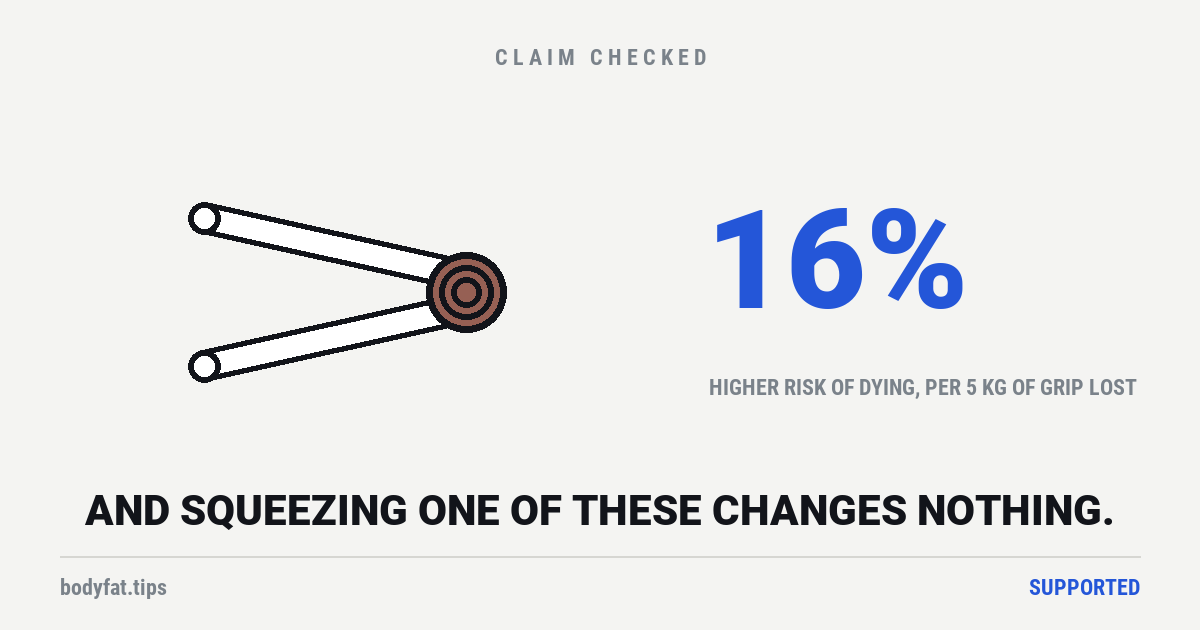
For every 5 kg of grip you were missing — that is about eleven pounds of squeeze, a difference you would not particularly notice in daily life — the risk of dying in the follow-up period was 16% higher. Heart death, 17% higher. Stroke, 9%.
And the line everyone quotes, correctly: “Grip strength was a stronger predictor of all-cause and cardiovascular mortality than systolic blood pressure.” [1]
The effect held across rich and poor countries alike, which is unusual and makes it harder to explain away as an artefact of one health system.
Now the part that gets skipped
Every few months this study resurfaces, and underneath it somebody is selling a hand gripper.
Here is the sentence from the same paper, from the interpretation section, that never travels with the headline:
“Further research is needed to identify determinants of muscular strength and to test whether improvement in strength reduces mortality and cardiovascular disease.” [1]
The researchers are saying, plainly, that nobody knows whether making your grip stronger changes anything at all.
Because grip strength is almost certainly not doing anything. It is a cheap readout of something much larger — total muscle, nerve function, nutrition, whether you have an illness nobody has found yet. Squeezing a spring will move the readout. There is no evidence it moves the thing being read.
It is a thermometer, not a thermostat.
Four years is not very long
Here is the objection that should worry you most, and it is barely mentioned anywhere.
The median follow-up was four years. [1]
Serious illness weakens your grip long before it kills you. Over a four-year window, some unknown share of “weak grip predicts death” is simply undiagnosed disease showing up in the hand first. That is not a flaw in the study; it is a limit on what a four-year study can tell you, and it means the arrow may point backwards from the direction people assume.
The result nobody quotes
In high-income countries, the study found something awkward: stronger grip went with more cancer, not less. [1] The association did not appear in middle- and low-income countries.
We have no explanation for that and neither did they. We are reporting it because it is in the paper, and because a page that prints five tidy rows and quietly drops the sixth is doing the thing we spend most of our time here catching other people doing.
So what actually has evidence behind it
If grip is the readout, the sensible question is what moves the underlying thing. And there the answer is better.
A meta-analysis of 16 cohort studies looked at muscle-strengthening activity — actual resistance training, not hand squeezing — and found it associated with a 10 to 17% lower risk of dying, of cardiovascular disease, of cancer and of diabetes. [2]
Then the interesting bit. The curve was J-shaped: benefit climbed steeply, peaked, and then flattened out or bent slightly back. And it peaked at roughly 30 to 60 minutes a week. [2]
Not a day. A week.
Beyond about an hour a week, the authors say the effect on mortality, heart disease and cancer is “unclear”. [2] More is not obviously better, and might not be better at all.
This is cohort data, not trials, so it carries the same caution as everything else on this page — people who lift weights differ from people who do not in a hundred ways. But it is sixteen studies pointing the same direction at a dose most people would consider almost embarrassingly small.
The verdict
Grip strength predicts death, and it does so better than blood pressure. That is Supported — 139,691 people across seventeen countries, consistent across income levels.
Training your grip is not the same as changing your risk, and the researchers who produced the finding list that as an open question rather than a conclusion.
If the number moved you to do something, the thing with actual evidence attached is half an hour of strength work a week. Your hands will get stronger as a side effect — which is rather the point.
And if you are worried about your own reading, that is a conversation with a clinician. We read the research; we are not your doctor.
Related: does lifting weights burn fat · creatine benefits · how many steps a day · does metabolism slow with age · all the habits we have checked