Do Testosterone Boosters Work? The Top 16 Had Never Been Tested as Sold

A systematic review published in 2024 went looking at two decades of data on 27 different testosterone boosters across 52 studies. Its finding, in six words: “most fail to increase total testosterone.” [1]
But the more damning number is not about whether they work. It is about whether anyone has checked.
Not one of the top sellers had been tested as sold
In 2021, researchers took the top 16 testosterone supplements and top 16 erectile dysfunction supplements sold on Amazon, Walmart, Vitamin Shoppe and A1 Supplements. They pulled out all 37 ingredients and went looking for randomised controlled trials. They found 105 of them. [2]
And then they wrote this: “No whole supplement products have published RCT evidence.” [2]
Read that carefully, because it is the whole page. Some of the ingredients have been studied. Not one of the products has. The thing you would actually swallow — that specific combination, at those doses, in that proportion — has no published trial against a placebo.
So has any testosterone booster been tested as sold? A few finished products have, and the record is thin. A zinc-magnesium formula sold as ZMA raised testosterone in its first trial, in 27 college football players; the company behind the formula paid for that trial, and the paper discloses that one of its authors held an equity interest in the company. [8] Two later trials of ZMA products, in 42 and 14 men, found no change in testosterone. [9][10] And the one finished product among the 2024 review’s exceptions, a supplement called Novedex XT, rests on a single trial of 16 men. [1][11]
It gets thinner. Of the 37 ingredients, only 19% earned the top grade for evidence, meaning net positive results in two or more randomised trials. 68% landed in the bottom two grades — contradicting, negative, or simply absent evidence. And about a third of the ingredients in testosterone supplements had no published randomised trial evidence at all. [2]
The evidence that does exist is mostly not in humans
In a study published in 2019, a different team took the top five results for “testosterone booster” in Amazon’s default search — average rating 4.56 stars, with anywhere from 6 to 11,158 reviews each — and reviewed the literature behind their ten commonest ingredients. [3]
They found 191 studies. Of those, 19% involved human subjects. Fifty-three per cent were animal models, 15% were done in a dish, and 12% were case reports or review articles.
So what did the human studies find? Among those 37 studies: 30% saw testosterone rise, 3% saw it fall, 46% found no effect, and 22% were indeterminate. [3]
Roughly one human study in three found the thing the entire category is named after.
So where do the five-star reviews come from?
This is the part of that study that deserves to be much better known.
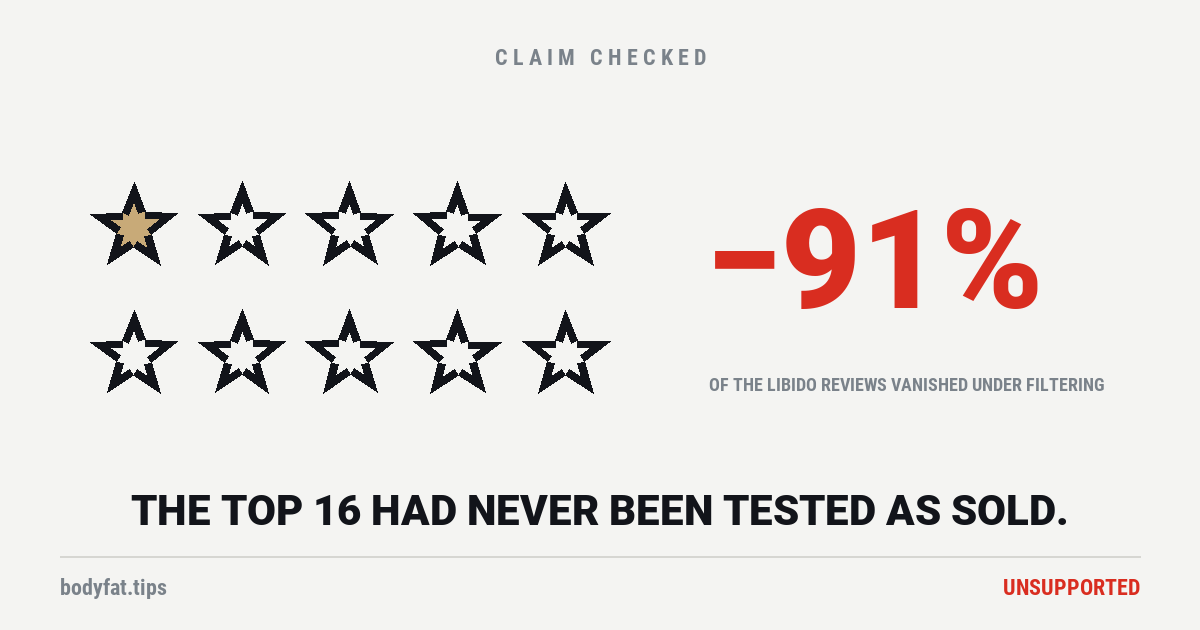
The researchers took the 65 reviews on the first two review pages of those five products and scored them against the themes of a standard clinical questionnaire for low testosterone in ageing men — libido, energy, strength, erections, sleep, work performance, sports ability, happiness. Then they ran all 13,806 reviews of the five products through ReviewMeta, a tool that flags untrustworthy Amazon reviews. It flagged two-thirds of them. The team scored the 43 reviews it rated most trustworthy, and compared the two sets. [3]
| Reported better strength or endurance | −93% |
| Reported increased libido | −91% |
| Reported better sports ability | −89% |
| Reported better sleep | −67% |
| Reported better erections | −60% |
| Reported more energy | −59% |
| Reported better work performance | eliminated |
Reports of increased libido fell by 91%. Reports of better strength, by 93%. Every single report of improved work performance disappeared. [3] The trusted set was a third smaller than the first, so every count would have fallen by about a third with no filtering at all. The biggest falls are far beyond that. On the first two pages, 17% of reviews reported a better sex drive; among the trusted ones, about 2% did. By our arithmetic from the paper’s chart, that is 11 reviews, then one.
That is not a statement about whether the supplements work. It is a statement about what you are reading when you read the reviews — and the reviews, not the evidence, are what sells a 4.56-star product.
Ingredient by ingredient
Tribulus terrestris is among the commonest ingredients in these products. [2] In a placebo-controlled trial of 21 young men, two groups of seven took 20 or 10 mg per kilogram of bodyweight daily for four weeks, with hormones sampled repeatedly out to 24 days. Testosterone came out at 454 and 471 ng/dL (15.75 and 16.32 nmol/L, the paper’s units) in the supplemented groups versus 512 (17.74) in placebo — no significant difference, and if anything numerically lower. Androstenedione and luteinising hormone did not move either. The paper’s title says it: Tribulus “does not influence the androgen production in young men.” [4] Those were healthy young men whose levels were already normal. The 2021 review’s own tables are kinder to Tribulus, listing six studies it read as positive for low testosterone and five, this one among them, as equivocal; [2] but the 2024 review, which looked for a rise against placebo in men with low testosterone among others, still counted it among the failures. [1]
D-aspartic acid got a proper test in 2017: 22 resistance-trained men, 6 grams a day, twelve weeks, randomised, double-blind, placebo-controlled, on a supervised training programme. “No change in basal TT or FT were observed” — that is, in resting total or free testosterone. Both groups gained strength and muscle equally. The authors’ verdict: “DAA supplementation is ineffective at changing testosterone levels, or positively affecting training outcomes.” [5] It did lower oestradiol by 16%, which nobody was asking for. Earlier research had reported rises in untrained men, the authors note, but not in men who already trained; [5] the 2024 review counted D-aspartic acid among the failures. [1]
Zinc is the interesting one, and the two best sources disagree. A 2023 systematic review concluded that zinc deficiency lowers testosterone and zinc supplementation raises it — but 30 of its 38 papers were animal studies, only eight were clinical, and it noted the effect “may vary depending on basal zinc and testosterone levels.” [6] The 2024 review of human trials put zinc among the things that fail. [1]
The reading that fits both: if you are genuinely zinc deficient, correcting that appears to help. If you are not, there is no good human evidence that more does anything. Which is the same shape as most micronutrient stories, and not what the label implies.
Fenugreek has a meta-analysis reporting a significant effect on total testosterone. [7] It pooled four trials. Four. That is worth knowing about and it is not worth much yet.
A bigger review, published in August 2026, after this page first went up, bears that out. It pooled six trials, 385 men in all, and found a small rise: 0.25 on the standardised scale reviews use to compare studies, where 0.2 counts as small, 0.5 as medium and 0.8 as large, and the range of plausible answers runs from almost nothing to just under medium. It rated the certainty of that evidence very low, the bottom of four grades. Every one of the eight trials that gave it testosterone data had industry funding, by its own table. And its authors’ conclusion is blunt: current evidence “does not support clinical or commercial testosterone-boosting claims.” [12]
Vitamin D did nothing in the men it was tested in, and this has been measured carefully — a randomised trial using mass spectrometry found no effect in healthy men whose levels were normal, and a meta-analysis of eight trials agreed. Whether it helps men whose testosterone is genuinely low is still open. We covered it properly in part four.
What did show something
We are not going to leave you with the impression that nothing on earth moves testosterone, because that would be its own kind of dishonesty.
The 2024 review named its exceptions, and the wording matters. Beta-hydroxy beta-methylbutyrate and betaine “can be considered effective for male athletes”. Eurycoma longifolia and two trademarked preparations — a pomegranate-rind and cocoa-seed blend, and a purified shilajit extract — are “possibly effective” for men with late-onset hypogonadism. Eurycoma longifolia and Withania somnifera are “possibly effective” for healthy men. [1] And one product sold as a finished supplement made the list: Novedex XT (the review spells it Novadex XT), a non-hormonal aromatase inhibitor, meaning it is meant to stop the body turning testosterone into oestrogen, is “possibly effective for male athletes”. [1] That rating rests on a single eight-week trial in 16 young men whose testosterone was normal to begin with. [11]
Note what those sentences are doing. Two ingredients were called effective, for male athletes: beta-hydroxy beta-methylbutyrate (HMB), on a single study, and betaine, on two. Everything else was only possibly effective, in a named population: three studies apiece for Eurycoma and ashwagandha, and one each for the two trademarked preparations and for Novedex XT. [1]
Withania somnifera is ashwagandha, and we have a whole verdict on it. A 2026 meta-analysis of 23 ashwagandha trials found eight that measured testosterone. In the six that included men, it rose by 57 ng/dL on average compared with placebo [13] — a real, measurable change, in a page we rated Preliminary rather than Supported, for reasons that page sets out at length. Five of those six trials were paid for or supplied by extract companies; the funding row at the top names them. For scale, the weight-loss evidence puts the rise in men with obesity who lose weight by diet at about 72 ng/dL, from 19 studies and 735 men. That is not a like-for-like comparison: the 57 is a gap against a dummy pill, the 72 a rise from where the men started, so the two cannot be ranked against each other.
Who checks what is in the bottle?
In the United States, nobody has to check it before it goes on sale. The FDA says it “does not have the authority to approve dietary supplements before they are marketed”, and a company generally does not have to give it the evidence that its product is safe, before or after it starts selling. [14] That is how a booster reaches the shelf with no trial behind it.
When the FDA does test what is in the bottle, it sometimes finds a prescription drug. In December 2023 it told consumers not to buy or use T XTRA Strength Test Booster, which was being sold for sexual enhancement and energy on websites including Amazon, after its laboratory found tadalafil, the active ingredient in the erection drug Cialis. Tadalafil may interact with the nitrates in some prescription heart drugs, such as nitroglycerin, and lower blood pressure to dangerous levels. [15] The agency says its list of tainted sexual-enhancement products “covers only a small fraction of the contaminated products on the market”, and that such products “often have multiple positive reviews”. [16]
The verdict
Testosterone boosters, as a category, are Unsupported. The systematic review that asked the question directly found that most fail. Roughly half of the human studies on the commonest ingredients found no effect. And none of the top 16 testosterone supplements in the 2021 review, or the 16 erection supplements beside them, had been tested as sold. Where a finished product has been, the record is thin: ZMA’s one positive trial, paid for by the company behind it, did not replicate, and Novedex XT rests on one small trial.
A handful of individual ingredients have shown something in a handful of trials, mostly in specific populations. The 2024 review called two of them effective for male athletes, HMB on a single study and betaine on two; for everything else it reached for the word possibly. None of that supports the claim on the bottle, which is not “this ingredient possibly does something in men with late-onset hypogonadism”.
If your number is genuinely low and you have symptoms, the conversation is with a doctor. If you are carrying extra weight, the intervention with the best evidence is losing some of it. The diet version needs nothing from a shop, and it rests on far more evidence than ashwagandha, the best-performing supplement this site has checked. And if you are about to buy something because it has four and a half stars, it is worth remembering what happened to those stars when somebody checked them.
Part 5 of a series on testosterone. Earlier: whether to get tested, what normal means, free versus total, and what actually raises it.
Related: how to increase testosterone naturally · ashwagandha benefits · free vs total testosterone · is creatine safe
An independent editorial review on 18 September 2026 found that this page claimed more than its sources support. Our title said no testosterone booster had ever been tested, and our verdict said no product sold as one had ever been tested as sold. The 2021 review behind that showed it for the top 16 testosterone supplements and 16 erection supplements it examined, not for every product. Our own lead source rates one finished product, Novedex XT, “possibly effective” on a single trial of 16 men, and we had left it off the list of exceptions we quoted. A zinc-magnesium formula, ZMA, has three trials of the product: the first, paid for by the company behind it, found a rise, and the two later ones found none. The title, a heading and the verdict now say what the sources support.
Also corrected. Our table of Amazon reviews labelled an 89% fall as mood; it was sports ability, and no review reported better mood before or after filtering. The table compares the 65 reviews on the first two review pages with the 43 a filtering tool rated trustworthy, not the same reviews scored twice, and the five products had from 6 to 11,158 reviews each, not thousands. The ashwagandha rise of 57 ng/dL comes from six trials in men, not 23, and we called it roughly what weight loss delivers. The two figures measure different things, a gap against a dummy pill and a rise from where the men started, so they cannot be ranked; and the diet figure rests on 19 studies and 735 men, not the 44 and 1,774 we gave, which include surgery. Our vitamin D line now says whom the trials tested. The funding row said the sources did not state their funding; they do, and the trials behind the positive findings were mostly paid for, or supplied with product, by companies with a stake in the result. The 2024 review called HMB and betaine effective, not just possibly effective, and one of the three reviews we said agreed is a zinc review that found a benefit. We also fixed smaller slips: the review’s quoted finding is six words, not seven, and the Tribulus doses were paired with the wrong results. We have added a 2026 fenugreek review published after this page, and what the FDA says about who checks supplements before sale. The rating is unchanged: Unsupported.