Does Creatine Cause Hair Loss? Nobody Checked The Hair Until 2025

Somebody measured a hormone in twenty rugby players in 2009.
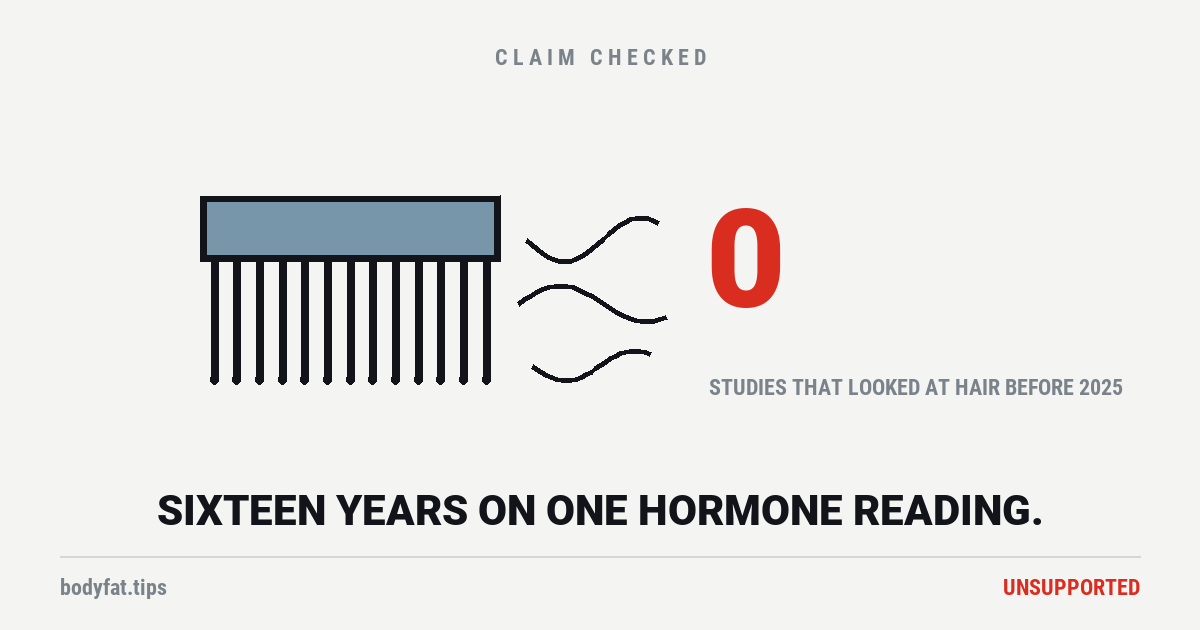
Nobody measured anyone’s hair until 2025.
That gap — sixteen years between the study everyone cites and the study that actually tested the claim — is the entire story, and it is worth walking through slowly, because you can watch a myth get built out of one real result and one missing step.
What the 2009 study actually did
At a rugby institute in South Africa, twenty college-aged players took either creatine or a placebo, double-blind, swapping over after a six-week gap [1].
The dose was a standard loading phase, the quick way to top up muscles with creatine: 25 grams a day for a week — five times the usual daily amount — then 5 g a day for a fortnight.
Their testosterone did not budge. But a related hormone called DHT did. Dihydrotestosterone, if you want the full name; it is what your body converts some testosterone into, and it is a good deal more potent at the receptor it lands on.
DHT went up 56% after the loading week, and was still 40% above where it started two weeks later [1].
Here is the thing about that study, and it is not a criticism of the researchers, who did what they set out to do: they never looked at anybody’s hair. Not with a camera, not with a comb, not with a questionnaire. It was a hormone study. Hair does not appear in it.
Why a hormone reading became a hair scare
The leap is easy to make, and once you see it laid out you will recognise it, because it is the same leap the internet makes every time.
DHT is genuinely central to male pattern baldness. It binds to androgen receptors in hair follicles that happen to be susceptible, and those follicles shrink. That is not folklore — it is why finasteride, the prescription baldness drug, works by blocking the enzyme that makes DHT in the first place.
So you have two true statements. Creatine raised DHT in this study. DHT drives male pattern baldness. Weld them together and you get “creatine causes hair loss,” which sounds like a deduction and is actually a guess.
The 2009 paper even handed the internet its pull quote. Its formal statement of clinical relevance says the mechanisms are “incompletely understood, particularly in relation to dihydrotestosterone, and therefore the long-term clinical safety cannot be guaranteed” [1]. Which is scientists being careful. It reads online as scientists being worried.
Now look at the actual numbers, not the percentage
This is the part that gets left out of every version of this story, and it is the part that should change your mind.
A 56% increase sounds enormous. So what were the numbers?
On creatine, the players’ average started at 0.98 and peaked at 1.53. The normal range for a healthy adult man is 0.8 to 3.5 [2].
So the frightening percentage describes a move from the very bottom of normal to somewhere in the lower-middle of normal. Every group average, on creatine and on placebo, at every time point, sat inside that normal range [2].
And notice something else. These were the same twenty players, taking creatine and placebo in turn, and they started their creatine weeks lower than their placebo weeks, which began at 1.26 [2]. When your starting number is small, a 56% rise is arithmetically cheap. Percentages are wonderful for making a small absolute change look like an event.
None of this means the 2009 result was wrong. It means the result was always smaller than the headline it produced.
Sixteen years later, somebody finally checked the hair
In 2025 a group ran the study that should have been run in 2010 [2].
Forty-five resistance-trained men aged 18 to 40 signed up. Six withdrew before it started, and the other thirty-nine were randomly assigned to 5 grams of creatine a day or 5 grams of maltodextrin, a starch powder, that looked identical, for twelve weeks. Thirty-eight finished, and thirty-seven had their hair assessed at the end [2]. The people assessing the results did not know who was in which group until the analysis was done.
They measured testosterone and DHT, as the 2009 study had, plus free testosterone, the part not bound to proteins in the blood. And then they did the thing nobody had done: they examined the hair. Dermatologists photographed the crown of each man’s scalp under magnification and ran a trichogram on the images — counting the hairs in a small patch and sorting them into growing and resting, thick and fine — and measured hair density, follicular units (the small clusters hairs grow in) and total hair thickness from the same pictures. Run with the Iran Skin Research Center supervising.
The result: nothing. No difference between the groups in DHT, in the DHT-to-testosterone ratio, or in any measure of hair [2].
One detail from that trial is a small masterclass in why control groups exist. Over the twelve weeks, total testosterone rose in both groups and free testosterone fell in both groups [2]. Had they run the creatine arm alone, they would have had a headline about creatine and testosterone. With a placebo group, it turned out to be something else entirely — the seasons, the training, who knows — happening to everybody.
Where this verdict could still be wrong
We are rating this Unsupported, so we should be straight about what the 2025 trial does not settle. The authors list these themselves, which we note approvingly.
It did not use a loading phase. The 2009 study gave 25 g a day for a week; the 2025 study gave 5 g a day throughout. The authors name that as one of the differences that could explain why they saw no DHT rise [2]. If you are one of the people who loads, that specific protocol has not been tested against hair.
Twelve weeks is short. Male pattern baldness takes years. The authors say plainly that “a longer term and higher dose creatine study may alter androgens and hair” [2].
They did not record family history. Which matters, because the same paper notes that men whose fathers lost hair are twice as likely to lose it themselves [2]. Thirty-eight men, none screened for genetic susceptibility, is not a test of what happens to the men actually at risk.
And it is one trial. Men only. Blood androgens rather than androgens measured in the hair itself.
So why Unsupported rather than “we cannot tell yet”? Because the claim never had support to lose. In sixteen years, no study has observed hair loss from creatine — not one. When we searched PubMed on 18 September 2026, nobody had repeated the 2009 loading week and measured DHT again. The one later trial that measured DHT at all, the 2025 one at 5 g a day with no loading, found no rise, and its authors say their results contradict the 2009 finding [2].
What about the follicle itself? No study has shown a creatine supplement doing anything to one; in the 2025 authors’ words, “no mechanistic studies have directly linked creatine supplementation to hair follicle physiology” [2]. Follicle cells do carry the machinery for using creatine: a 2002 study found creatine kinase, the enzyme cells use to turn stored creatine into quick energy, and the transporter that carries creatine into cells, in several kinds of hair-follicle cell in mice [3]. The machinery being there is not evidence that a supplement makes hair fall out. And the first study to look at hair directly found nothing. An unsupported claim with a plausible mechanism is still an unsupported claim.
The disclosure you are entitled to
We report funding on every page, and here it matters more than usual.
The 2025 trial was published in the journal of the International Society of Sports Nutrition. One of its authors is the ISSN’s CEO and co-founder — an organisation that, in its own words, “may be sponsored by companies that manufacture, market, and sell dietary supplements” — and is a scientific advisor to brands including Creapure, Bear Balanced and Create [2], three companies that his declaration to another paper describes as ones that “manufacture, market, and sell creatine-containing supplements” [4]. Another author also advises Bear Balanced, and has received creatine donations from Creapure for research. A third owns a consultancy that sells services to supplement manufacturers, and his laboratory has received research funding or in-kind gifts (products rather than money) from nutrition and sports nutrition companies [2].
The paper says no specific funding or institutional support was received for the study [2]. Its trial registration says otherwise: it names the Iran Center for Dermatology and Hair Research, a public-sector research centre in Tehran, as the study’s sponsor and its only funder [2]. The creatine itself was a BPI Sports product, and the authors thank BPI Sports’ official representative for its support, without saying what that support was [2].
The paper also sits in a special supplement of the ISSN’s journal, Creatine for Health and Performance. Another paper in the same supplement [5] says its publication fee — the charge an open-access journal makes to publish a paper — would be paid by Alzchem Group, a creatine manufacturer [4], “as part of a special issue for the Creatine for Health 2025 conference”, and its copy in PubMed Central, the US National Library of Medicine’s archive, labels the supplement “sponsored and supported by Alzchem Group” [5]. The hair paper says nothing about who paid its own fee [2].
Every author interest above is declared in the paper. The registration’s funder and the supplement’s sponsor are not. You should know all of it before you decide how much weight to put on a favourable result about a supplement.
Our own read: the conflict is real and the finding still stands, because of how it was done rather than who did it. Randomised, placebo-controlled, assessors blinded, with objective imaging rather than self-report, in collaboration with a dermatology research centre. That is a design that could have produced an inconvenient answer. It did not.
If you want to hold it to a lower weight than an independent replication, that is a reasonable position and the numbers above are all there for you to do it with.
What to actually do
If you are taking creatine and you are worried about your hairline, the honest answer is that nobody has ever caught creatine doing this, and the one group that went looking with a camera came back empty-handed.
If your hair is thinning and you take creatine, the overwhelmingly likely explanation is the one that explains most thinning hair in most men, and it arrived with your genes rather than your supplement tub. That is a conversation for a doctor, not a website — there are actual treatments. Know where the evidence stops, though. The one hair trial was registered to take only men without early signs of male pattern baldness [2], so creatine has never been tested in men whose hair is already going. Whether to pause it while you sort that out is a fair question to put to the doctor.
And if a product is being sold to you specifically as the “hair-safe” alternative, notice what it is charging you for: a fear built out of one hormone reading in twenty rugby players, taken during a loading week — a way of taking creatine nobody has yet tested against hair — whose average never left the normal range.
We rate creatine Supported for safety — consistent evidence, with known limits — and have looked separately at whether it does anything for fat loss. This page changes neither.
An independent editorial review on 18 September 2026 found that this page promised a complete disclosure it had not given, and printed the wrong size for the 2025 hair trial. We said the trial’s interests were “reported in full”. We had left out that its trial registration names a public-sector research centre as sponsor and only funder, though the paper says no funding was received; that the creatine was a BPI Sports product and the authors thank BPI Sports’ official representative for support; that another paper in the same journal supplement says Alzchem, a creatine manufacturer, paid its publication fee as part of a special issue, and PubMed Central’s copy of it labels the supplement as sponsored by Alzchem; that a second author also advises Bear Balanced, which makes creatine products; and that a third author’s lab has had funding or gifts from nutrition companies. We said 45 men were randomised, as the paper’s summary does; its own flowchart shows six withdrew before the start, so 39 were randomised, 38 finished and 37 had their hair assessed.
Smaller statements went further than their sources. We said every 2009 DHT reading stayed inside the normal range; the published figures are group averages, and it is the averages that did. We wrote about the 2009 study as if it had two groups; it was the same twenty players on creatine and on placebo in turn. We said the 2009 finding had never been confirmed or refuted; the 2025 trial measured DHT without a loading week, found no rise, and its authors call that a contradiction. We said no study had linked creatine to hair follicles; a 2002 study found the machinery for using creatine in mouse follicle cells, which is not evidence of hair loss. We called the 2009 dose one you almost certainly are not using, when a loading week is standard and has never been tested against hair; we described the 2025 trichogram as pulling hairs, when it worked from photographs; we implied the 2009 study measured free testosterone; and we said we rate creatine Established for safety, a verdict we moved to Supported on 16 September. We now also say that the hair trial was registered to take only men without early signs of baldness. The rating of this page is unchanged: Unsupported.