Is Aspartame Bad For You? Two WHO Reports, One Headline

No — and the reason everyone thinks otherwise is one of the cleanest misreadings in modern health coverage.
On 14 July 2023, two bodies inside the World Health Organization published their assessments of aspartame on the same day.
One of them made headlines in every country on earth. The other one contained the number you actually needed.
What the first one said
The International Agency for Research on Cancer classified aspartame as possibly carcinogenic to humans, Group 2B, on the basis of “limited evidence for cancer in humans (specifically, for hepatocellular carcinoma, which is a type of liver cancer)” [1].
That is real and we are not going to wave it away. IARC also found limited evidence in animals and limited evidence on the mechanism. Three limiteds, and a genuine reason to keep looking.
But look at what Group 2B actually is. In the release’s own words, it is “the third highest level out of 4 levels” [1]. Third of four. The rung used when the evidence is suggestive and nothing more.
And here is the sentence that should have been the headline
From the same document:
“IARC classifications reflect the strength of scientific evidence as to whether an agent can cause cancer in humans, but they do not reflect the risk of developing cancer at a given exposure level.” [1]
This is the distinction the entire story turns on, so it is worth being plain about it.
Hazard asks: could this thing cause cancer under any circumstances at all? Risk asks: will it, at the amount a person actually consumes?
Sunlight is a hazard. So is alcohol. So is the wooden dust in a joinery workshop. Whether any of them is a risk to you depends entirely on dose, and IARC does not answer that question. It is not the agency’s job. It says so in the release.
The other report answered the question people were actually asking
The Joint FAO/WHO Expert Committee on Food Additives — JECFA — does risk. It reviewed the same evidence and reaffirmed the acceptable daily intake of 0–40 mg per kilogram of body weight, concluding there was “no sufficient reason to change” it [1].
Not lowered. Reaffirmed.
And then the release does the arithmetic for you, which almost no coverage reproduced:
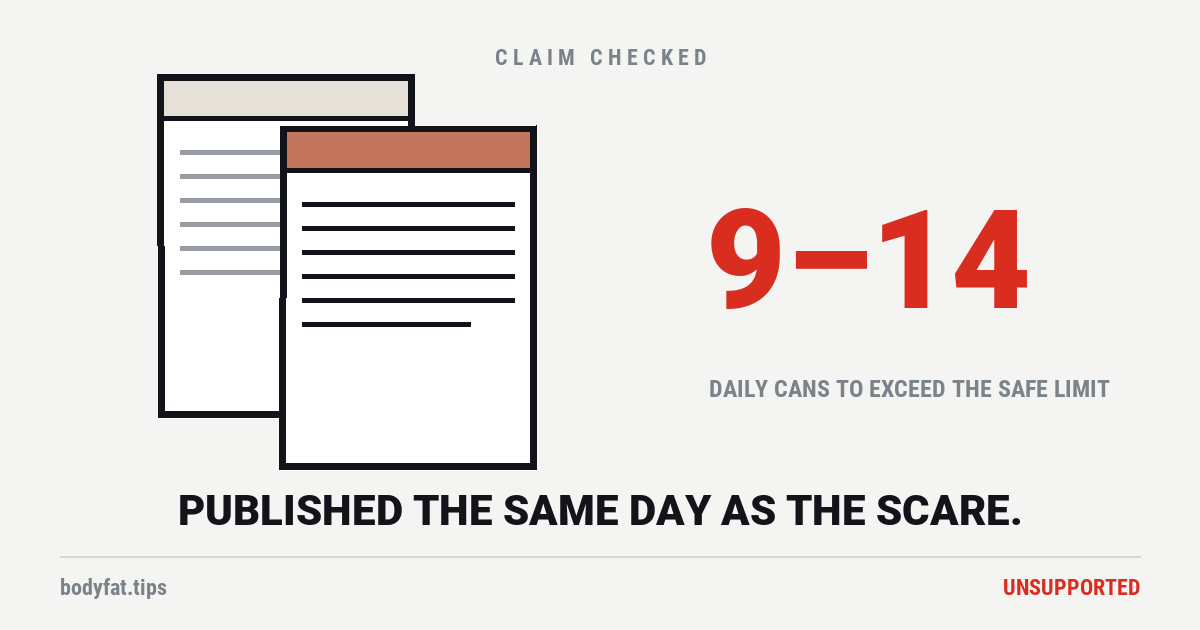
“with a can of diet soft drink containing 200 or 300 mg of aspartame, an adult weighing 70kg would need to consume more than 9–14 cans per day to exceed the acceptable daily intake, assuming no other intake from other food sources.” [1]
Nine to fourteen cans. Every day. And that is the level at which you merely exceed a conservative safety threshold — not a level at which anything has been shown to happen to you.
Two WHO officials, on the record, in the same release
On the cancer evidence, Dr Moez Sanaa of WHO: JECFA “concluded that the evidence of an association between aspartame consumption and cancer in humans is not convincing” [1].
And Dr Francesco Branca, WHO’s Director of Nutrition and Food Safety: “while safety is not a major concern at the doses which are commonly used, potential effects have been described that need to be investigated by more and better studies” [1].
That is the World Health Organization saying, in the document that produced the cancer headlines, that safety is not a major concern at normal intakes. It was in paragraph three.
Why this keeps happening
Because a hazard classification is a headline and a risk assessment is not. “Possibly carcinogenic” is two words and it frightens people. “You would need fourteen cans a day” is reassuring, and reassuring does not travel.
We have now documented this same error three times in three different costumes, and it is worth seeing them together:
— a cell study read as a human result (sucralose)
— a confidence interval read as a personal prediction (fibre, where we made the mistake ourselves and corrected it)
— a hazard read as a risk (this page)
Different fields, same shape: a careful technical statement loses its qualifier on the way to you.
What to actually do
If you drink a couple of diet drinks a day, this evaluation gives you no reason to stop. The margin between what you consume and the reaffirmed safety limit is roughly an order of magnitude [1].
If you want to be cautious anyway, that is a defensible position — IARC found a limited signal for liver cancer and asked for better research, and nobody is claiming the file is closed. Just be cautious for the actual reason rather than the headline one.
And the transferable habit, which is worth more than anything specific to aspartame: when something is called possibly carcinogenic, ask what the exposure was. The classification tells you a question is worth asking. It does not tell you the answer.
For the wider sweetener picture, see our verdict on artificial sweeteners and the one on diet soda.