Does Food Combining Work? One Real Trial in Ninety Years Says No

The rule is that you should never eat protein and starch in the same meal. No steak with potatoes. No eggs with toast. No cheese sandwich. Do it wrong, the theory says, and the food sits in your stomach and rots.
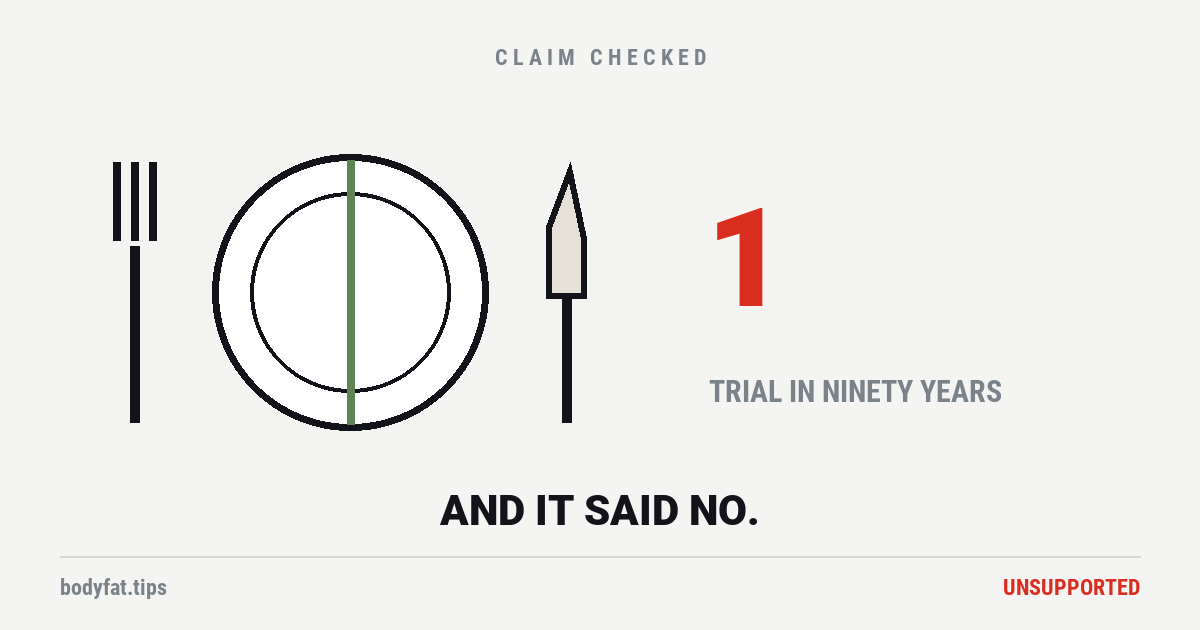
Here is the number that should end the conversation: in the ninety-odd years this idea has been sold, it has been put through a real trial — a control group, calories matched, every meal served in hospital rather than reported — once. Fifty-four people, for six weeks, in the year 2000 [1]. Two much smaller studies since, a dozen people each, pointed the same way; they are below.
We’ll get to what that trial found. But the more interesting question is how a rule about what you may put on a plate survived seven decades without anyone checking.
It began with one man who felt better
In 1905 a New York surgeon named William Howard Hay collapsed running for a train. He was diagnosed with kidney disease and an enlarged heart, and he was frightened enough to overhaul his life. He changed how he ate, and he also quit coffee and quit tobacco. Over about three months he went from 225 pounds to 175, and he felt transformed.
Something clearly worked. But look at what changed at once: his diet, his caffeine, his smoking, and his weight. There is no way to know which of those did the work — and Hay did not try to find out. He concluded it was the food pairing, and he spent the rest of his life saying so.
That is the entire original evidence base. One man, no control, four variables moving together.
His reasoning, in his own words
Hay laid the theory out in 1929. He believed starch digestion needed alkaline conditions and protein digestion needed acid, and that the stomach could not do both at once. His phrase was that no stomach could be both, “just as no room could be at once both light and dark” [5].
If digestion stalled, he wrote, the starch would ferment and the meat would putrefy. That is where “rotting in your stomach” comes from — it is a 1929 prediction, not an observation.
It is a tidy argument. It is also wrong in a way that is now easy to check.
Why the mechanism fails
Three things sink it, and none of them are controversial.
Your pancreas does not take orders. The enzymes that digest starch, protein and fat are made in the same cells, stored together, and released together into the small intestine [2]. There is no switch that sends one and holds back the others based on what you ate.
The conflict Hay described happens in two different organs. Protein digestion starts in the stomach, in acid. Starch digestion in the stomach is only what the saliva enzyme manages while the meal is still buffering the acid — the stomach makes no starch enzyme of its own [2]. The real work on starch happens further down, in the small intestine, where the environment is close to neutral [3]. Adding protein cannot interrupt a job the stomach was never doing.
And the rule cannot actually be followed. Wheat flour is about 10 grams of protein and 76 grams of carbohydrate per hundred grams. Rice is roughly 7 and 80. A potato is 2 and 17 [4]. Every food on the approved “starch” list is also a protein source. If mixing the two caused rot, a slice of plain bread would do it.
The one time anyone tested it properly
In 2000, researchers in Geneva took 54 people with obesity into hospital — so intake was controlled rather than reported — and put them on 1,100 calories a day for six weeks. Half ate separated meals, half ate normal mixed ones. Calories and macronutrients were closely matched, which is exactly the right way to test whether the separation does anything by itself.
The separated group lost 6.2 kg. The mixed group lost 7.5 kg. No significant difference — and the numbers, if anything, ran the other way. Body fat, waist measurements, cholesterol, blood sugar and insulin all improved about equally in both [1].
That trial has never been repeated at that standard. Two smaller studies have looked since, and both landed in the same place. In 2001 a group at the University of Rostock in Germany put twelve healthy adults on a ten-day Hay diet matched to their usual food for calories and protein, and reported no reduction in body fat, lean mass or weight: about 159 lb before and 157 lb after (72.2 vs 71.4 kg) [11]. The Hay diet did raise measured fat oxidation — how much fat the body was burning for fuel — over those ten days. That is the one result a proponent could cite, and it came with no change in body fat to show for it. Then in 2020 researchers in Jakarta ran a randomised crossover in twelve overweight adults aged 18 to 21, ten of them women: three weeks of food combining and three weeks of a plain 1,200-to-1,500-calorie diet, in random order, and no significant difference in weight change between the two [12]. And for the other half of the claim — that separating foods eases bloating or digestion — there are no trials at all. Not negative ones. None. It has simply never been studied, while being promoted continuously since 1929.
But people do lose weight on it
They do, and it is worth being straight about why, because dismissing their experience would be both rude and inaccurate.
A rule that forbids common combinations removes a lot of food from your day. No sandwiches. No pasta with meat. No burger. You are not reorganising your enzymes; you are eating less, because you have made most normal meals against the rules.
The diet works. The explanation for why it works is the part that isn’t true. And that distinction matters, because you can get the same result without memorising a compatibility chart.
The twist: order genuinely matters
Here is the part that makes this more than a simple debunk.
There is real, repeated evidence that the sequence of a meal changes your blood sugar response. Eat the protein and vegetables first and the carbohydrate last, and the glucose spike afterwards drops sharply — in one crossover study of 11 adults with type 2 diabetes, the post-meal glucose level was about 29% lower at 30 minutes, 37% lower at an hour and 17% lower at two hours, and the total rise above the starting level, added up across those two hours, was 73% lower [8]. The same group then repeated it in 15 people with prediabetes, where the peak rise in glucose came down by more than 40% [9]. Whether the order does anything over months is another matter: the one longer test, sixteen weeks of carbohydrate-last coaching for 45 adults with prediabetes on top of standard diet counselling, saw the food-order group lose about 3.6 lb and the counselling-only group about 2.6 lb, with no difference between the groups in weight, HbA1c (the three-month blood-sugar average) or glucose tolerance [10].
These are small studies, all in people with type 2 diabetes or prediabetes, and they measure blood sugar rather than fat loss; whether the order does anything for someone whose blood sugar is already normal is not something this series tested. But notice what they require: protein and carbohydrate in the same meal, minutes apart.
So the genuine finding is the opposite of the folk rule. Keep them on the same plate. Just eat them in a sensible order.
Where the idea went after Hay
The rules were formalised into a system in 1951 and reprinted for decades. In 1981 the Beverly Hills Diet added the claim that fruit enzymes could undo the fattening effect of other foods; it drew a formal medical rebuttal documenting real harms, including severe diarrhoea and dangerously low potassium [6].
Then in 1985 Fit for Life took it mainstream — reportedly 1.8 million copies in print within a year [7], built on the claim that wrongly combined food rots inside you. Its authors’ nutrition qualifications came from an unaccredited correspondence school.
Today it arrives as a 21-day protocol on your phone. The rules are Hay’s, unchanged. The mechanism is Hay’s, unchanged. What has never arrived, in ninety-seven years, is the evidence.
Three descriptions of the evidence were corrected on 15 September 2026 after an independent editorial review. The page said the food-combining diet had been tested in a clinical trial once and never repeated. The 2000 Geneva trial is the only randomised in-hospital test, but a ten-day metabolic study in Rostock (2001) and a three-week randomised crossover in Jakarta (2020), twelve people each, also tested it and found no advantage; the page now reports both, including the higher fat oxidation the Rostock study measured. The food-order study was described as cutting the glucose rise “by around a third to a half at every measured point”; the paper reports 28.6%, 36.7% and 16.8% lower glucose at 30, 60 and 120 minutes, and the page now gives those figures and says the study was in 11 adults with type 2 diabetes. A 2023 sixteen-week pilot was cited as repeating that finding; it did not measure it, and found no difference between groups in weight, HbA1c or glucose tolerance, which the page now says.
Also changed: the sentence that starch digestion “does not happen in the stomach at all” contradicted the page’s own source, which says the saliva enzyme keeps working there while the meal buffers the acid; the evidence panel’s funding field said the trial’s full text was paywalled, when its acknowledgements are open and name no funder; the Fit for Life sales figure now carries its source’s “reportedly”; and the headline now says “one real trial”. The rating is unchanged: Unsupported.
- The No-Sugar Diet: Cutting Sugar Lost 1.8 lb in the Trials Pooled for the WHO. Swapping It for the Same Calories Changed Nothing. The Sugar Was Never the Point.
supported - A Vegan Diet Cost Older Adults 2.5 lb of Muscle in 12 Weeks. The Protein They Stopped Eating Is Most of the Story.
preliminary - How Many Calories to Lose a Pound? 3,500 Is a Rule About One Week, and Everyone Uses It as a Rule About a Year
unsupported