Methylene Blue: No Energy Boost Shown. On an Antidepressant? Read This.

Methylene blue is not a supplement. It is a drug, and it is approved by the Food and Drug Administration to treat exactly one thing.
Methemoglobinemia — a poisoning in which the blood loses its ability to carry oxygen. [1] It is an emergency, it happens in hospitals, and methylene blue is the antidote.
It is now sold in dropper bottles to people who want more energy.
Know what that warning is built on. The published cases followed methylene blue injected or infused in hospital, most often during parathyroid surgery or to treat shock, in patients taking an antidepressant. [5] [6] Whether the same happens when it is swallowed, the FDA said in 2011, is “not known”. [5] Not known is not the same as safe: in September 2025 Australia’s regulator told consumers not to use it by mouth unless a health professional advises or prescribes it. [9]
The symptoms the label lists: agitation, hallucinations or sudden confusion; a racing heart, swings in blood pressure, sweating, flushing or fever; tremor, rigid or jerking muscles, poor coordination; seizures; nausea, vomiting or diarrhoea. It tells doctors to advise patients to “seek immediate medical attention” if these follow a dose. [4]
We are not telling you to stop any medicine your doctor prescribed. We are telling you that this is a conversation to have with them before anything else.
The hospital evidence is real, and it is worth stating properly
We are not going to pretend this is snake oil, because it isn’t.
Beyond the poisoning indication, methylene blue is used in vasoplegic shock, in a specific chemotherapy complication, and as a surgical stain. [1] And there is genuinely interesting recent work on preventing the confusion and memory problems that follow major surgery in older patients — a problem affecting somewhere between 15% and 40% of them. [3]
In one trial at a Shanghai hospital, 248 patients aged 60 to 80 were given either a single dose into a vein during their operation or the same volume of salt water. Delirium followed in 7% of those given methylene blue, against 24% of those given salt water: 9 patients of 124, against 30 of 124. [12] That is a large effect on a serious problem.
Now notice everything that sentence contains
Intravenous. Single dose. Weight-calculated. Given during surgery, by an anaesthetist, to elderly patients under monitoring, in a hospital.
None of those words describe a dropper bottle and a glass of water.
This is the move the whole category runs on, and it is worth naming because you will see it again: a real drug with real uses is not the same thing as a supplement, and the evidence for the first does not transfer to the second.
And the hospital evidence is itself young. Two later trials, each at a single hospital in China, found smaller gaps: 8.3% against 20.4% after hip and knee replacements in 217 patients, and 11.5% against 23.6% after pancreatic surgery in 314, where a second dose was given. [13] [14] A 2026 analysis pooled all three, 779 patients, and put the odds of delirium with methylene blue at about a third of the odds without it. The figure is an odds ratio of 0.35: an odds ratio of 1 would mean no difference, and the range the true average effect probably sits in runs from 0.23 to 0.53. [15] We re-did the sum from the three trials’ own counts (36 cases among 390 patients given the drug, 89 among 389 who were not) and got the same answer.
Now the limits. None of the three kept everyone in the dark about who got the drug, which turns urine blue: the first was open-label, and the other two were single-blind, meaning only some of the people involved did not know. [3] [13] [14] [15] Two of the three come from one research group. All three kept out patients taking SSRI or SNRI antidepressants and patients with G6PD deficiency, which tells you how the people running them regard the two risks this page sets out. [12] [13] [14] And when the joint-replacement trial phoned its patients a month later, a test of thinking and memory showed no difference between the groups. [13] The pooled analysis says further large trials are required. [15] The review this page first cited, a narrative one, asks for large trials at more than one hospital before methylene blue’s role is considered established. [3]
For the thing actually being sold — drops in water, taken daily, for energy, by healthy people — we did not find a trial, in searches of PubMed, OpenAlex and the US trial registry on 30 September and 1 October 2026. None that gave the drops, and none that set out to measure energy.
So has anyone tested it in healthy people?
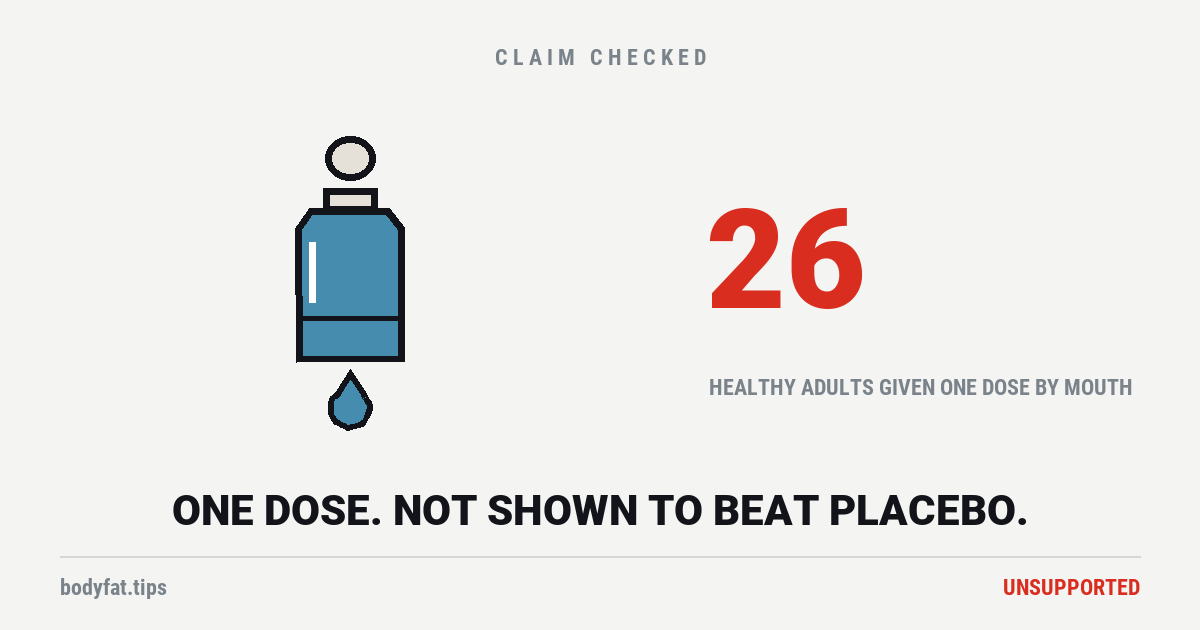
Yes, a little, and not the way it is sold. One trial is the one that sellers’ pages and the videos we sampled point to. In 2016 a University of Texas team gave 26 healthy adults either one 280 mg capsule of methylene blue or a capsule of blue food colouring, then scanned their brains and tested them an hour later. [16] That is one dose, given once, and it is many times the serving printed on the two drops labels we read. [29]
What did it find? The paper’s summary says methylene blue was “associated with a 7% increase in correct responses” on a memory test. Its results section is more careful. The people given methylene blue got about 7% more answers right than they had an hour earlier, and the people given the dye did not change. But when the two groups were tested against each other, the difference fell the wrong side of the line researchers use for “probably not chance” (the paper gives P = .09; the line is .05). [16] Reaction time on the attention test, the first thing the trial was registered to measure, did not change. [16] [17] Mood a week later was no different. [16] Only six of the 26 were over 30. The press release from the journal’s publisher was headed “Methylene Blue Shows Promise for Improving Short-Term Memory”; it gave the 7 percent and did not mention that, tested against placebo, the difference was not statistically significant. [31]
The same team then ran the trial that could have settled it: 282 mg a day for twelve weeks, against a dyed placebo, in healthy older adults and in people with mild memory problems. [18] Its main measurements were complete by April 2022. Its results went onto the US trial registry in September 2024 as tables of averages, with no statistical test, and we found no published paper. Of the 43 healthy older adults who started, 25 finished. The registry records no serious harm in any group. It does record this, among the healthy volunteers: an urgent or frequent need to urinate in 12 of 22 on methylene blue against 2 of 21 on placebo, and bladder irritation in 7 against none. It posts no statistical test of those counts either. [18]
And the mitochondria? Two small British studies, from one research group, measured the thing the slogan is about: how much oxygen the brain uses. Both gave methylene blue into a vein, not by mouth. In eight healthy women the brain’s oxygen use fell, by 8% at the lower dose and 12% at the higher, and its blood flow fell by 8%. The authors had predicted a rise, and said so. [19] In the second study, of 15 people with bipolar disorder and 15 healthy volunteers, oxygen use and blood flow fell again across the group as a whole. [20] Both studies also asked people to rate their energy before and after the infusion. Neither found that methylene blue raised it. In the eight women, energy ratings fell measurably after the placebo and after the higher dose, but not after the lower one, which the authors took as some support for their idea; in the second study the ratings did not differ between methylene blue and placebo. [19] [20]
One thing all five of those reports share: each kept out people taking serotonin-raising medicines, people with G6PD deficiency and anyone pregnant. The Texas trials went further and took nobody on any psychiatric medicine. [16] [17] [18] [19] [20] That includes the trials that gave it by mouth.
In patients the record is longer, and mixed at best: an exploratory trial of methylene blue itself in 321 people with Alzheimer’s disease reported a benefit at the middle of its three doses, and of the three large trials of a related compound that its developer ran next, the first (891 patients) found no benefit, the second (800) swapped its main comparison before unblinding for one that was not randomised, and the third (598) could not separate its groups on its main measures at one year; small trials in bipolar disorder, claustrophobia and post-traumatic stress gave mixed results. [32] [21] [22] [23] [24] [25] [26] None of those people is the healthy buyer this page is about.
The interaction, in the reference’s own words
This is the part of the page that matters most, so here it is verbatim.
“Serotonin syndrome has been reported following administration of methylene blue, particularly when used concomitantly with medications that increase serotonergic activity, including selective serotonin reuptake inhibitors, serotonin-norepinephrine reuptake inhibitors, and monoamine oxidase inhibitors; certain opioids; and dextromethorphan. The risk is increased with concurrent use, and fatal cases have been described.” [1]
And the instruction that follows it: “Concomitant use of methylene blue with serotonergic agents and opioids should be avoided.” [1]
SSRIs and SNRIs are among the most widely prescribed medicines in the world. Dextromethorphan is in cough syrup. So this is not a warning about two rare drugs. The question for a reader on one of those medicines is narrower: where did the cases happen, and does the warning reach a dropper bottle?
Where the cases happened
In hospital. A 2018 review of the medical literature counted 50 published cases. In every one the methylene blue had been injected or infused, not swallowed; most were around surgery on the parathyroid glands or treatment for shock; and every patient was taking a serotonin-raising antidepressant. One of the 50 died. [6] A 2014 report, which calls itself the first of a fatal outcome, describes a patient on the antidepressant venlafaxine who had been under a general anaesthetic. [7] The cases in the FDA’s own files, it said in 2011, mostly followed doses of 1 to 8 mg/kg into a vein during parathyroid surgery. [5] Britain’s medicines regulator had counted 33 reports by April 2009: 32 followed methylene blue used as a dye in parathyroid or thyroid surgery and one followed its use for low blood pressure during heart surgery. Its advice is about the drug given into a vein and does not mention taking it by mouth. [33] We searched for case reports published since. The ones whose summaries we could read were hospital cases too: heart and lung surgery, shock, cancer care.
By mouth the record is almost empty, and empty is not the same as clean. The same 2018 review reported what it called the first case after a swallowed product: a prescription urinary tablet that contains methylene blue, started in a patient already on several serotonin-raising drugs. [6] The FDA’s public file of adverse-event reports adds one: a report received in May 2026 of a 65-year-old man on the antidepressant citalopram, hospitalised with serotonin syndrome and delirium, with methylene blue recorded both as taken by mouth and as put on the skin. Reports in that file are unverified, and this one gives no dose. Of the 16 reports of serotonin syndrome it flags as deaths, none records the drug being swallowed. [27] In the other direction, a 2021 review of 17 studies, in which 1,902 patients were given methylene blue by mouth, counted three serious adverse events blamed on it. The paper is behind a paywall and we could read only its summary, which does not say what the three were or whether anyone in those studies was on an antidepressant. [28]
And by mouth? Three regulators, three answers
The FDA, October 2011: “it is not known whether there is a risk of serotonin syndrome in patients taking serotonergic psychiatric medications who are given methylene blue by other routes (e.g., orally or by local tissue injection) or at intravenous doses lower than 1 mg/kg.” [5] It wrote that before it had approved any methylene blue product. The label it has approved since, in 2016, is for the injection. [4]
The European Union, in the label for methylene blue tablets that are swallowed over one evening, with the bowel preparation before a colonoscopy: “It is not known if there is a risk of serotonin syndrome when methylthioninium chloride is administered orally in preparation for colonoscopy.” (Methylthioninium chloride is methylene blue’s other name.) The same label adds that peak blood levels were lower after the tablets than after an injection, “suggesting a lower risk”. [8]
Australia, 25 September 2025, in an advisory about exactly this product: oral methylene blue, imported and promoted for “cognitive enhancement, mood improvement, and anti-ageing effects”. It does not say “not known”. It lists serotonin syndrome, harm in pregnancy and red-cell damage in G6PD deficiency as risks of these products, and tells consumers: “Do not use oral methylene blue products unless advised or prescribed by a healthcare professional.” [9]
Why take seriously a risk that has not been measured by mouth? Here is our reasoning, and it is reasoning, not a measurement. The mechanism belongs to the drug, not to the needle. In the laboratory, methylene blue is a potent blocker of MAO-A, the enzyme that clears serotonin, which is the action the MAOI antidepressants are named for; the team that showed it drew its conclusion about infusions, which is where the cases were. [10] And a swallowed dose does reach the blood: about 72% of it, in a study of 16 healthy volunteers given a single 500 mg dose. [11] What the FDA and the EU label both call not known is whether, and at what amount, that adds up to harm by mouth. That gap is the honest answer. It is a reason to ask before you take it, not a reason to relax.
And a second contraindication most buyers have never heard of
Methylene blue is contraindicated in people with G6PD deficiency — an inherited enzyme difference — because of the risk of haemolysis, the destruction of red blood cells. [1]
The awkward part is that plenty of people who have it do not know they have it. Would a wellness video tell you? Of the 25 video descriptions we read, one named it. Would the bottle? Neither of the two drops labels we read in the government’s drug-label database mentions it. [29]
Two more lines, for two specific readers
If you are pregnant, or trying to be: the FDA’s label says methylene blue “may cause fetal harm when administered to a pregnant woman”. Injected into the fluid around the baby in mid-pregnancy it has been linked to babies born with a blocked bowel and to deaths in the womb, and fed to pregnant rats and rabbits, at doses at least 16 times the hospital dose, it harmed their young. [4] The reference this page opened with says the same, in the very section that lists G6PD. [1] Europe’s colonoscopy tablet is barred in pregnancy outright, [8] and Australia’s advisory says methylene blue “should not be used during pregnancy”. [9]
If you are breastfeeding: the NIH’s lactation database has an entry. It notes that current labelling says “breastfeeding should be discontinued during and for up to 8 days after administration”. [2]
And then: “No information is available on the safety of oral methylene blue during breastfeeding.” [2] Oral being the exact route the dropper bottle uses.
The verdict
Unsupported, for the claim that methylene blue boosts your mitochondria for energy and focus. Take the claim a piece at a time. Energy: we found no trial that set out to measure it in healthy people, and the two small studies that asked volunteers to rate theirs, both after a dose into a vein, did not find a rise. Focus: the published trial that tested memory and attention in healthy adults, with one large dose, found no change in reaction time and a memory score it could not tell apart from placebo; the twelve-week trial that followed has posted no analysis. That half is the closest call: two real trials exist, both at many times the serving on the drops labels we read, and neither has shown a benefit over placebo. Mitochondria: in the two studies that measured the brain’s oxygen use in people, it went down. And we found no trial of any kind that tested the drops as they are sold. What exists is a real drug, with one approved indication, several legitimate hospital uses, and promising early surgical research that is delivered by injection under supervision.
What is documented is the harm, and it is worth being exact about how well. A serotonin interaction that the FDA’s label calls “serious or fatal”: documented in 50 published cases after injection or infusion, plausible by mouth for the reason given above, and not measured by mouth. A contraindication in G6PD deficiency, an inherited condition a person can carry without knowing. A warning that it may harm an unborn baby. And a drug that stays in you long enough that the labelling talks in days.
So are the people selling it lying? About the chemistry, no: in a dish, and in some animal experiments, methylene blue really can carry electrons inside a mitochondrion, and you can watch someone explain it very persuasively. The trial they cite says the same, and cites laboratory and animal work for it. [16] What the explanation skips is that when the brain’s oxygen use was measured in people, it fell. [19] [20]
About the warnings, sellers are not one thing, and it would be unfair to write as if they were. Some say it plainly. One brand’s safety page tells customers “Do NOT combine with any serotonergic medication”, and says of its own product category that “No published randomized trial has tested chronic daily oral methylene blue in healthy adults for cognitive or mitochondrial endpoints.” [30] Others do not. Two sellers’ labels for 1% drops, filed with the FDA as over-the-counter drug labels in 2025 and 2026, give the product’s purpose as “Memory consolidation” and “Mental fatigue resistance”. Each tells the buyer to “Consult a health care professional before using the product orally or on the skin”; neither mentions antidepressants, G6PD deficiency or pregnancy. [29] Australia’s regulator said much the same of the imported products it looked at: most “do not include clear instructions or warnings”. [9] In the United States the FDA has written to a seller at least once: in June 2020 it and the Federal Trade Commission warned a New York wellness centre that the methylene blue products on its website were “unapproved new drugs”, sold with claims about COVID-19. That letter is about one seller’s COVID-19 claims; it says nothing about energy. [34]
And the evidence a seller shows you deserves a second look even when the warnings are in place. The brand with the careful safety page also publishes a table of “12 methylene blue clinical trials” that it says are registered on ClinicalTrials.gov. We looked up all twelve registry numbers. Two match. Four belong to studies with no methylene blue in them at all, one of them about ear infections in children and one about breast milk for newborns. The number it gives for the 2016 memory trial belongs to a nine-patient Alzheimer’s study. [30]
This is journalism, not medical advice. If you are taking methylene blue or thinking about it, and especially if you take an antidepressant, an opioid or cough medicine, that is a conversation for a doctor or a pharmacist — who can check your actual medication list, which we cannot.
Related: NAD+ supplements · sea moss benefits · colostrum benefits · does zinc help with colds · every claim we’ve checked
This page was corrected on 1 October 2026 after an independent editorial review, and the corrections are large. We wrote that we had looked for trials of methylene blue in healthy people and found none. There were some: a 2016 trial of one 280 mg dose in 26 adults, which two of the video descriptions in our own sample cite, one by its main paper and one by its second; a twelve-week trial whose results sit unanalysed on the trial registry; and two studies of a dose into a vein in which the brain’s oxygen use fell. The page now reports each and says what it did and did not test. We also printed the serotonin warning, fatal cases included, without saying where those cases happened. The published ones followed methylene blue injected or infused in hospital; by mouth, the FDA said in 2011 that the risk is “not known”, and the page now gives that, the EU label and Australia’s 2025 advisory in their own words. And we left out pregnancy, which our own first source lists in the section we cited.
Smaller errors, all ours. The delirium figure we gave as the result of “randomised trials”, 24% to 7%, was one trial at one hospital; two later trials and a pooled analysis now stand beside it, with their limits. Our count of 13 videos with a “commerce link or discount code” took in three descriptions that had neither; ten had one, nothing for sale was labelled as methylene blue, and the description we quoted as the pitch also listed the antidepressant and G6PD warnings. The sentences saying that a wellness video would not tell you, and that sellers leave the warnings out, were not supported; they have been replaced with what sellers’ own labels and pages say. The funding row said “not stated in the sources read”; the sources do state it, and the row now reports each. The chain tracing the claim named a review published after every video in our sample; it now starts from the 2016 trial. A search figure in it, 301,000 a month, was a twelve-month average for the bare term “methylene blue”, which is also the name of the hospital drug; it says nothing about demand for the drops, and it has come out. The headline no longer reads as if deaths had followed the drops. The rating is unchanged.