Ask Google whether blood pressure is higher in the morning and its AI answer opens with one word: “Yes, blood pressure is normally higher in the morning.” The page at the top of its list of sources, a large US medical centre’s, says something different: pressure “continues to rise during the day, peaking in midday” [1]. Plenty of people want to know which: “is blood pressure higher in the mornings” is searched about 5,400 times a month in the United States (from a paid keyword database, pulled 20 October 2026) [1].
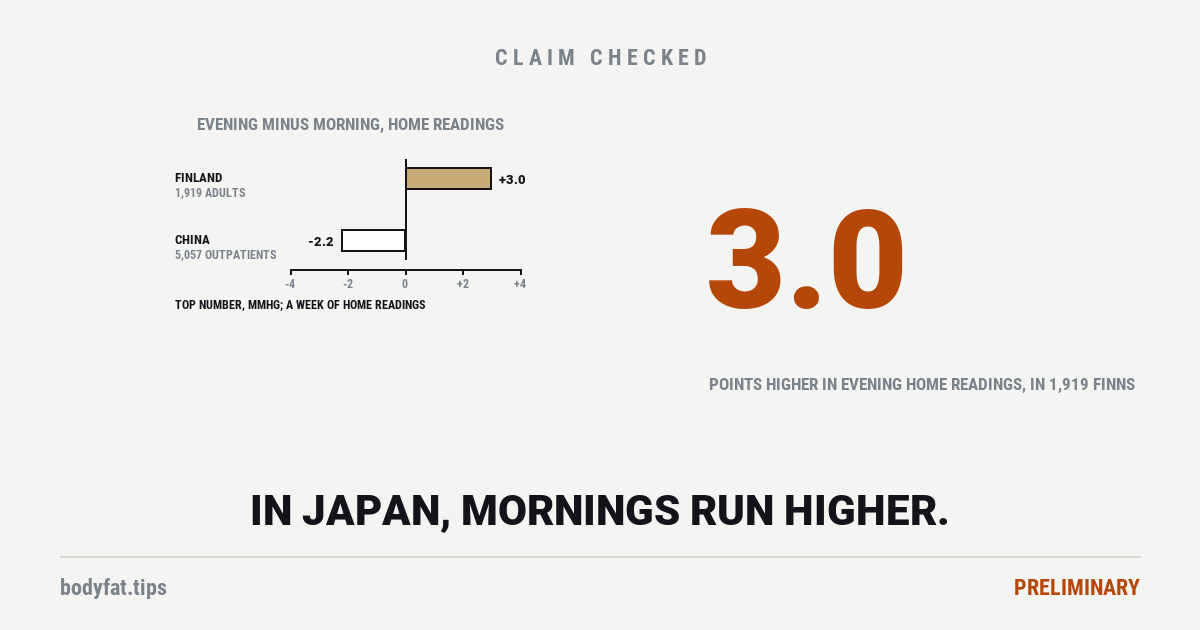
Higher than while you slept: yes, for most people, and the climb starts before you wake [2]. Higher than the evening: not reliably. In a week of home readings by 1,919 Finnish adults, taken between 6 and 9 each morning and each evening, the evening ran 3.0 points higher than the morning [3]; in Japan, mornings run higher [4][5]. And whether a steep morning climb predicts strokes depends on which study you read.
Before anything else. This is journalism, not medical advice. A reading above 180/120, which the 2025 US guideline calls severe, needs prompt attention from a clinician [6]; that or any high reading with chest pain, shortness of breath, weakness, numbness, a change in vision or confusion needs care at once, not a second reading tomorrow morning; our headaches page sets out where the emergency line sits. And if you take blood-pressure medicine, do not change the time you take it without your clinician.
One unit before the numbers. Blood pressure is measured in mmHg, millimetres of mercury, and we call each one a point. The top number, systolic, is the pressure as the heart beats, and it is the one most of the studies below report.
What time of day is your BP usually the highest?
The classic answer comes from 1978. A team recorded 25 people’s pressure beat by beat for a day and a night, through a fine tube in an artery, while they went about their lives. Pressure was “highest mid-morning” and then fell through the rest of the day; it was lowest at 3 a.m., and began to rise again before they woke [2].
Later recordings found a second high. In 31 healthy young men measured every 10 minutes, with their sleep recorded as well, the day had two peaks, around 10 a.m. and around 8 p.m., with a small dip about 3 p.m. and the lowest point about 3 a.m.; the rise had begun before they woke [7]. The medical centre’s page puts the peak at midday [1].
What every recording agrees on is the night. In an international database of 7,320 people, aged 10 to 99, who wore a 24-hour monitor, a cuff worn through a day and a night that inflates by itself at set times, night-time readings on top averaged 16.7 points below daytime ones [8]. So the morning reads higher than the night because you have woken up. Whether it reads higher than the afternoon or the evening is a different question, with a less tidy answer.
Strip the day away and the body clock points the other way. A Boston laboratory kept 28 healthy adults awake or asleep on schedules that spread meals, posture and activity evenly around the clock, so that only the internal clock was left to move their pressure. It did move it, by 3 to 6 points on top, and the peak fell at the clock time corresponding to about 9 p.m. [9]. The authors’ conclusion: the body’s own rhythm is “unlikely to underlie the well-documented morning peak in adverse cardiovascular events” [9].
Why is my blood pressure higher in the evening than in the morning?
Because in some countries that is the usual pattern. In Finland’s national health survey, 1,919 adults aged 41 to 74 measured themselves at home for a week, twice each morning between 6 and 9, before breakfast, and twice each evening between 6 and 9 [3].
Morning against evening, in a week of home readings
Evening 2.2 points lower on top than morning, on average
Points are mmHg; “on top” is the systolic number. The bold rows are where the evening ran higher. Japan’s 2019 guideline says Japanese evening readings, taken at bedtime and often after a bath or a drink, usually run a few points lower, and that reports from Europe find no difference or a higher evening.
Across all 1,919, the top number averaged 128.1 in the morning and 131.1 in the evening, 3.0 points higher; the bottom number was 80.2 at both times [3]. The evening ran higher in people with normal pressure, by 3.8 points, and in the 541 with untreated high blood pressure, also by 3.8. In the 589 on blood-pressure medicine the gap shrank to 0.9, which the authors put down to timing: they measured in the morning before the day’s pills and in the evening nearer the pills’ strongest effect [3]. What pushed the morning up relative to the evening, in their analysis: being a man, heavy drinking, heart disease, sleep apnoea and taking blood-pressure medicine [3].
Japan is the other way round. In the town of Ohasama, 1,207 adults’ morning readings were significantly higher than their evening ones [5]. Japan’s 2019 guideline explains part of it: Japanese evening readings are taken at bedtime, often after a hot bath, a drink or an evening pill, all of which lower pressure, so they usually run a few points below the morning; and it adds that reports from Europe find “no difference” or a higher evening [4]. In 5,057 Chinese outpatients, the evening averaged 2.2 points below the morning [10].
So an evening reading above your morning one is common, and in Finland it was the average. What it means for your health is the next question.
Is high blood pressure in the morning dangerous?
High blood pressure is dangerous at any hour, and a high morning reading counts. The question is whether the morning reading tells you more than the evening one. In Ohasama, 1,766 adults followed for about 11 years, morning and evening home readings predicted strokes “equally”; people whose mornings alone ran high, 135/85 or more with normal evenings, had 2.66 times the stroke risk of people normal at both times [11]. In Finland, 2,081 adults followed for 6.8 years, morning and evening readings were “equally predictive” of heart and stroke events [12]. In 4,310 Japanese patients at higher risk, most on medicine and followed for about 4 years, the morning reading predicted strokes better than the evening one; that study was paid for in part by a maker of home blood-pressure monitors, whose monitors it used [13]. A later analysis of the same patients, followed for about 6 years, found heart and stroke events 1.40 times as often in those whose mornings ran 20 points or more above their evenings as in those whose mornings ran up to 20 points higher, a significant difference in its main analysis, which allowed for the average of each person’s morning and evening readings. Allowing for the two readings separately instead, the authors call the difference “marginally significant”, short of the line researchers use for ‘probably not chance’, and it was significant in women but not in men [14]. In those whose evenings ran higher, events came 1.11 times as often, not a significant difference [14].
The morning does have a reputation, and the reputation is earned. In 2,999 heart-attack patients, attacks began most often between 6 a.m. and noon; in 703 whose start could be timed by a blood test, three times as many began at the 9 a.m. peak as at the 11 p.m. low. The pattern was not seen in people already taking beta-blockers, heart drugs that blunt the body’s adrenaline response [15]. Strokes followed suit: across 31 studies and 11,816 strokes, 49% more began between 6 a.m. and noon than if strokes were spread evenly through the day [16]. Spread evenly, a quarter would fall in those six hours; 49% more than a quarter is about 37% (our arithmetic). In a 16,602-person drug trial that timed events prospectively, more began between 6 a.m. and noon than in any other six hours [17].
Whether the morning rise in blood pressure is the cause is another matter. The body clock’s own pressure peak is in the evening [9], and a 2019 American Heart Association statement calls it “unclear” how the morning surge should be defined and whether it is linked to more harm [18]. That is where the surge studies come in.
Does a big morning surge predict strokes?
The morning surge is the size of the climb: the average of the first two hours after waking, minus the lowest readings of the night (the sleep-trough surge) or minus the two hours before waking (the pre-waking surge). It needs a 24-hour monitor to measure. The study its lead author later described as the first to tie it to strokes followed 519 older Japanese patients with high blood pressure: in the top tenth, a climb of 55 points or more, 19% had a stroke, against 7.3% of the rest, and the gap held after matching for age and average pressure [19][20]. The authors asked for a large trial of treating the surge [19].
Then other teams looked, and the results went every which way.
The morning climb, and what happened to people later
1,726 people with hard-to-treat high blood pressure, 8.3 years
No measure of the climb predicted any outcome once other risks were allowed for
Bold rows found more events with bigger climbs. Figures are hazard ratios: how often events happened in one group against another over the same time, so 1.32 is 32% more often and 1 is no difference. The eight-population study compares its top tenth with the average of everyone in it, and the 2003 Japanese figure is a relative risk from matched groups, read the same way. The eight populations include 1,396 people from Ohasama, so that row and the Ohasama row share people. The studies measured the climb in different ways, and the review of them counted seven. The table is a selection of the cohorts we read, not every one published.
Two numbers in that table need their range. The Japanese study’s 2.7 had a confidence interval, the range the true average probably sits in, of 1.1 to 6.8: a real link in those patients, of very uncertain size, built on 44 strokes [19]. The eight-population study, the largest in the table, found its link with deaths and with heart events but not with strokes, the outcome the surge was famous for, though among its Asian participants, four in five of them from Ohasama (our arithmetic), the top tenth had more strokes from bleeding, 2.28 times the risk of the other Asian participants [21]. And in the Italian study the people at risk were those whose pressure climbed least [23]; a small climb often means the night stayed high, which carries its own risk [23][4].
We found two poolings of these studies, both published in 2015 [28]. A pooling, or meta-analysis, combines studies to get one estimate. The first, of 17 studies and 33,154 patients, found seven different definitions of the surge. With the surge defined by a fixed cut-off, it found no clear link with heart and stroke events or with strokes, from two studies in each case, nor with deaths. Measured on a sliding scale, each 10 points of pre-waking surge went with about 11% more strokes, a hazard ratio of 1.11 with a range of 1.03 to 1.20, from three studies [29]. Before quoting a pooled number we look for the biggest study inside it: here it is 11,291 Irish patients that the reviewers had only as a conference abstract, and, in their words, “the 2 largest, highest quality studies” could not be included in that analysis [29]. The second pooling, of seven studies, found the sleep-trough surge linked with deaths; seven-tenths of the weight in that result is the eight-population study above, so it largely repeats it [30][21].
The numbers have grown in the retelling. A 2023 study of 1,339 Argentine patients found a bigger surge linked with every outcome it measured, including a hazard ratio of 2.70 for cardiovascular death, death from heart and blood-vessel disease, built on 21 deaths, and 2.32 for strokes, built on 22 [31]. A consumer health website turned those ratios into “270% greater risk of cardiovascular death” and four more percentages [1]. A hazard ratio of 2.70 is 170% greater, not 270% (our arithmetic).
Where the guideline writers land: the American Heart Association statement calls the link “unclear” [18]. Japan’s 2019 guideline says “a mild morning surge is a physiological phenomenon, but an excessive morning surge becomes a risk factor”, and adds, in the next breath, that one study found the risk higher where the surge disappears [4]. Its 2025 replacement still ties a climb beyond the normal range to more heart and stroke events, and on timing pills to the body’s daily rhythm to treat it says: “We cannot conclude that chronotherapy is useful in these cases if there is no verification of its event-suppressing effect” [32].
How much does the daily pattern differ between people?
A lot. In the 7,320-person database, 3.2% had night-time readings as high as or higher than daytime ones, on both numbers. The odds of a small night-time fall rose with age, 2.8 times between 30 and 60 and 5.7 times between 60 and 80, and were 2.4 times higher in the Asian participants, nearly all Japanese [8]. Doctors call a night-time fall of less than 10% non-dipping. In a Spanish registry of 42,947 patients with high blood pressure, 41% of the untreated and 53% of the treated were non-dippers [33]. In 53,350 people aged 3 to 101 monitored through Italian community pharmacies, the gap between day and night narrowed with age and the morning climb grew [34]. And the climb itself differs by group: none of 761 Black adults in Mississippi reached the 55-point cut-off of the Japanese study [26][19].
What is normal blood pressure when waking up?
The same as at any other time you measure at home. None of the six guideline documents we read gives a separate normal range for the morning [18][4][32][6][35][36]. The American Heart Association lines up home readings with clinic ones: an average of 120/80 at home matches 120/80 in the clinic, and 130/80 matches the US threshold for high blood pressure, 130/80 [18]; the 2025 US guideline keeps the same table [6]. Japan’s 2019 guideline called a morning home average of 135/85 or more, with normal clinic readings, morning hypertension[4]. Its 2025 replacement applies the same 135/85 to the morning average or the evening average, either one, and, like the 2019 one, asks for the averages of a week, five days at least, not any single reading [32][4].
Why shouldn’t you measure your blood pressure right after you wake up?
The guidelines do not quite say that. Japan’s 2019 guideline asks for the morning reading “within 1 h after waking up … after urination … before dosing … before breakfast”, after sitting still for a minute or two. It mentions a stricter rule, a reading immediately on waking, and keeps the hour because a schedule that is too strict makes people stop measuring [4]. Its 2025 replacement keeps the same morning schedule, and the evening reading at bedtime [32]. The American Heart Association asks for an empty bladder and five minutes’ seated rest, two readings a minute apart in the morning before blood-pressure medicine and two in the evening before bed [18]. The European society’s schedule is morning and evening, before medicine and before meals [35], and England’s guideline asks for readings “twice daily, ideally in the morning and evening”, for at least four days, discarding the first [36]. The reason for measuring before the morning pills is that it catches the medicine at its weakest, which Japan’s 2019 guideline calls the trough of the drug’s effect [4]. The step-by-step checklist, and what each mistake does to the number, is on our home-measurement page.
What time of day should you not take your blood pressure?
No guideline we read names a forbidden hour. What they ask for is the same times every day, averaged over days [18][4]. Japan’s 2019 guideline warns about one evening habit: a bedtime reading taken after a bath, a drink or a pill will run low [4]. If your clinic readings run higher than your home ones, our white-coat hypertension page explains why that happens.
Should you take your pills at night to cover the morning?
This was tried with a drug built for the job. A form of the blood-pressure drug verapamil, taken at bedtime, was designed to reach its highest level in the blood at about the time of the early-morning rise in pressure, pulse and heart and stroke events, and in 1996 to 1998 a trial gave it, or older standard drugs, to 16,602 people with high blood pressure [17]. Events were 364 on the new drug and 365 on the old ones. Of the people whose event could be timed, 99 of 277 on the new drug and 88 of 274 on the old ones had it between 6 a.m. and noon, a hazard ratio of 1.15, not significant; the authors’ reading was that the data “do not support the concept of chronotherapeutics”, the timing of drugs to the body’s daily rhythm. The trial was “stopped 2 years early by the sponsor for commercial reasons” [17].
Then came trials of the time of day itself, with whatever pills people already took. In the UK, 21,104 adults on blood-pressure medicine were assigned at random to take all of it in the morning, between 6 and 10, or in the evening, between 8 and midnight, and followed for a median of 5.2 years. Vascular deaths and hospital stays for heart attack or stroke came to 3.7% of the morning group and 3.4% of the evening group, a hazard ratio of 0.95 with a range of 0.83 to 1.10, so no clear difference [37]. In Canada, 3,357 adults followed for a median of 4.6 years had 2.4 deaths or hospital visits for stroke, heart failure or acute coronary syndrome, a heart attack or its near miss, per 100 person-years of follow-up taking their pills in the morning and 2.3 at bedtime, a hazard ratio of 0.96 [38]. A second Canadian trial, of 776 frail care-home residents with a median age of 88, followed for a median of 415 days, counted 29.4 deaths or hospital visits for the same conditions per 100 person-years with bedtime pills and 31.5 with the usual timing, mostly morning: a hazard ratio of 0.88 with a range of 0.71 to 1.11, so no clear difference, and most of the events were deaths [39]. A Spanish trial of 19,084, from the laboratory behind the bedtime aspirin trials on our aspirin page, reported 45% fewer events with bedtime dosing [40]. In April 2020 the journal that published it told readers that the trial’s content and conduct were under investigation and recommended reading its results with caution; in November 2020 it reported that the investigation, by its editors, outside experts and the European Society of Cardiology’s journals ethics committee, had found “no grounds for an ethical or factual concern” [40].
So the three trials of the time of day above that other teams ran found no clear benefit from moving pills to the evening [28], and the UK trial’s authors write that patients can take their medicine “at a convenient time” [37]. Japan’s 2025 guideline says the effect of bedtime dosing on preventing heart and stroke events “is limited, and no clear conclusions have been reached”, while accepting pills timed to a high morning or night-time pressure after a talk with the patient [32], and the 2025 US guideline notes that in a large trial people kept to morning pills more reliably than to evening ones [6]. Either way, it is a decision to make with your clinician, not on your own. The non-drug ways of bringing the pressure itself down are rated on our page on lowering blood pressure naturally.
Who these studies were done on
The daily-pattern recordings were mostly of European and Japanese adults, a few hundred to a few thousand at a time, plus registries of patients with high blood pressure in Spain and Italy [8][33][34]. The morning-against-evening home readings come from a Finnish population sample aged 41 to 74, a Japanese town and Chinese outpatients [3][5][10]. The surge studies in the table were of adults in Japan, China, Europe, Israel and the Americas: four drew on the general population, three on patients with high blood pressure and one on patients sent for 24-hour monitoring; the Mississippi study of Black Americans found smaller climbs and no significant link [19][21][22][23][24][25][26][27]. The dosing-time trials were of adults already on blood-pressure medicine, in the UK, Canada and Spain, average age in the sixties, apart from the Canadian care-home trial, median 88 [37][38][39].
So read yourself against them. If you are measuring at home and your evenings run a few points above your mornings, you look like the average Finn in that survey. If your mornings run far above your evenings, and especially if you take your pills in the morning, that is a pattern worth showing your clinician, because it can mean the medicine has worn off by dawn [4], and in the Japanese study above a gap of 20 points or more went with more heart and stroke events [14]. And if you have been told your pressure does not fall at night, the studies above are about you as much as the ones about surges.
If heart attacks peak in the morning, why doesn’t a bigger morning climb reliably predict them?
This section is the desk’s own reasoning, and it is labelled as such. The events cluster in the morning; the size of the morning climb predicts them in some studies, in others predicts nothing, and in two goes with fewer deaths or events. Here are three ways to fit that together, each rated.
Answer one: the surge is partly the night, read upside down. A big climb needs a low night to climb from. In the Italian study the size of the night-time fall and the size of the morning climb moved together, a correlation of 0.56, on a scale where 1 is lockstep and 0 is no relation [23], and a small climb often means a night that stayed high, which the same studies tie to risk [23][4]. So one number can carry two opposite risks. The correlation is measured; reading it as one pattern seen from two sides is ours.
Answer two: it is the waking, not the clock. In the young men whose sleep was recorded, lying down and sleeping accounted for 65% to 75% of the night-time fall [7]; with behaviour held constant, the body clock’s own peak came in the evening [9]; and the morning excess of heart attacks was not seen in people on drugs that blunt the adrenaline response [15]. Japan’s 2019 guideline notes that for shift workers “the period within 1 h after waking is not always the morning” [4]. The pieces are measured, in small studies; that getting up, rather than the hour, explains the morning peak in events is a surmise.
Answer three: the level is what counts. In Mississippi the climb did not predict events, while how high the morning readings ran did [26]; in Finland and Ohasama, morning and evening home readings predicted equally [12][11]; and in the trials above that other teams ran, neither a drug timed to peak in the morning nor pills moved to the night changed events significantly [17][37][38][39], while the Spanish trial above reported 45% fewer, a result those trials did not repeat [40]. Each result is measured; joining them into one explanation is our reasoning.
Put the three together and here is what we think is true, stated plainly so you can disagree with it: your blood pressure gets up when you do; what predicts trouble is how high it runs, day and night, not how steeply it climbs at dawn.
What we could not find, and would like to: a trial that chose people for a large morning climb, lowered the climb rather than the day’s average, and counted strokes. The 2003 Japanese study asked for one, and its lead author again in 2010 [19][20]; the trials we found that timed pills to the morning or the night chose people by their blood pressure, not by their climb [28]. If you know of such a trial, the corrections line on this site is open.
Where “highest in the morning” came from
The research is real. The 1978 recordings found pressure “highest mid-morning” [2], and in 1985 the heart-attack study found attacks clustering between 6 a.m. and noon [15]. The two ideas were joined in the early 2000s as the morning surge [19], and a 2010 review in a heart-association journal framed it the way Google’s answer still does: “Normal morning BP surge is a physiological phenomenon, but an exaggerated morning BP surge is a cardiovascular risk” [20]. That review is one of the pages the AI answer cites [1].
By 2007 it was in front of the public, with a sponsor. A US pharmacy trade magazine’s article of 1 April 2007, “Early to Rise? Your Blood Pressure May Be Too!”, carried the line “This article is brought to you by” a maker of home blood-pressure monitors. It told readers that “even in patients with well-controlled blood pressure, 50% still have high morning blood pressure”, and that the maker’s model was the only home monitor “cleared by the FDA to help determine a patient’s risk of morning hypertension” [1]. The AI answer still cites it. We could not trace who first put it as “highest in the morning”.
Today the claim sits on clinic and company pages. A Texas practice’s article asks “Why is my blood pressure highest in the morning?”; a medical group’s says pressure “can increase the most in the morning time”; the consumer website puts the peak “at around 10:00 a.m.” and adds the 270%; and a seller of a cuffless wristband, in the same results, pairs the 6 a.m. to noon peak in heart attacks with an offer to wear its band for round-the-clock monitoring [1]. Meanwhile the medical centre’s page the AI answer leans on says midday, and quotes a reader whose pressure was “always lower in the morning than in the afternoon” [1].
None of this is aimed at anyone checking their pressure at breakfast. Measuring at home is a good habit, and the morning is a sensible time to do it. It is the certainty about the hour, and the percentages bolted onto it, that we could not let stand.
What this is rated, and what the rating covers
Preliminary — for the claim that blood pressure is highest in the morning, as it circulates.
It is rated Preliminary because the evidence for it conflicts. In its favour: the 1978 recordings, of 25 people, found the day’s highest pressure mid-morning, and in Japan and China morning home readings run above evening ones [2][5][10]. Against it: in young men the day had a second peak at 8 p.m., the body clock alone peaks in the evening, and in 1,919 Finns evening home readings ran higher [7][9][3]. The recordings on this page that timed the day’s highest pressure are small: 25 people in 1978 and 31 young men in 1991; the laboratory study that timed the body clock’s own peak had 28 [2][7][9]. The large 24-hour databases here, of 7,320, 42,947 and 53,350 people, report how far pressure falls at night, and the largest how the morning climb grows with age; they set the night against the day, not one hour of the day against another [8][33][34]. The home readings are large, but they compare two fixed times of day, and which comes out higher depends on the country and on when the evening reading is taken [4]. It is not Unsupported because some of what was tested backs it: the 1978 recording’s mid-morning peak, and morning home readings above evening ones in Japan and China.
Each part, rated alone, in words. That blood pressure rises on waking, and before it, from a low during sleep: Established; every recording here shows it, and in 7,320 people night-time readings averaged 16.7 points below daytime ones, though in a small share the night is as high as the day [2][7][8].
That the morning is the most dangerous time, in the sense that heart attacks and strokes begin most often between 6 a.m. and noon: Supported, by the heart-attack study, the pooling of 31 stroke studies and a large trial that timed events [15][16][17]. That the morning rise in blood pressure is the cause is not shown: the body clock’s pressure peak is in the evening, and a drug timed to the morning did not cut morning events [9][17].
That a big morning surge predicts strokes: Preliminary. For it: the 2003 Japanese study and the 2023 Argentine one found more strokes with bigger climbs, from 44 and 22 strokes; two analyses drawing largely on the same Ohasama residents found more strokes from bleeding; a study of 1,191 treated older Italians found more strokes from a clot among those whose pressure fell normally at night, though not in the group as a whole; and a pooling found 11% more strokes per 10 points, on a sliding scale, from three studies, two of them the Japanese ones above. Against it: the eight-population study, the largest in the table above, found no significant link with strokes overall, and others found none, or fewer events with bigger climbs [19][31][22][21][41][29][23][24].
That an evening reading above your morning one is a warning sign: Unsupported, of the tested kind. In the most direct test, the Japanese study of 4,258 people at higher risk, the 939 whose evenings ran above their mornings had heart and stroke events 1.11 times as often as those whose mornings ran up to 20 points higher, a range of 0.82 to 1.50 and not significant; those whose mornings ran 20 points or more higher had them 1.40 times as often [14]. In Ohasama, people whose evening readings alone were high had more strokes than people normal at both times, but not significantly [11]. In the Chinese registry, the gap that went with more strokes ran the other way: the quarter whose evenings fell furthest below their mornings, a drop its authors call “mild to moderate” [10]. And in a Finnish population sample, evenings above mornings were the average pattern [3].
What is not rated here: whether to take your pills in the morning or the evening, which belongs with your clinician; morning headaches, which have their own verdict; and the frame above, which is this desk’s reasoning from the evidence rather than a result the evidence delivered. It is marked as ours so that you can weigh it as ours.
This is journalism, not medical advice. If your home readings worry you, take the week’s numbers to a clinician who knows your history. How we read a study, and what each tier means, is set out here.
Sources
[1] Search data from a paid keyword database: the monthly US search volume for “is blood pressure higher in the mornings”, pulled 20 October 2026, and Google’s results, People Also Ask questions, related searches and AI answer for the same phrase, pulled 21 October 2026. Pages the AI answer cites, read on 22 October 2026: a large US academic medical centre’s patient page by its staff (22 May 2024; the live page refused our request and we read the Internet Archive’s copy of 30 September 2026), a consumer health website’s article (26 February 2026, updated 2 August 2026), a US pharmacy trade magazine’s article of 1 April 2007, a Texas primary-care practice’s article (6 July 2026), a Medicare-focused medical group’s article (31 August 2022, updated 8 July 2026), a clinical-trial site company’s blog (24 August 2026) and a Vietnamese hospital group’s question-and-answer page (2024); one more cited clinic page returned no article, and the video and social-media post it cites were not read. From the ordinary results, read the same day: a seller of a cuffless blood-pressure wristband’s article. Kept with this page’s records.
[2] Millar-Craig MW, Bishop CN, Raftery EB. Circadian variation of blood-pressure. Lancet 1978;1(8068):795–797. 20 patients with high blood pressure and 5 without, recorded through a fine tube in an artery. Read as its published abstract; its funding statement was not read. doi:10.1016/s0140-6736(78)92998-7
[3] Johansson JK, Niiranen TJ, Puukka PJ, Jula AM. Factors affecting the difference between morning and evening home blood pressure: the Finn-Home study. Blood Pressure 2011;20(1):27–36. 1,919 adults from a representative sample of Finns aged 41 to 74. Read in full in the Internet Archive’s copy of the journal’s page (March 2022), with its two tables. The authors declare no conflicts of interest; we found no funding statement in it. The authors were at Finland’s national public health institute. doi:10.3109/08037051.2010.518675
[4] Umemura S, Arima H, Arima S, Asayama K, Dohi Y, Hirooka Y, et al. The Japanese Society of Hypertension guidelines for the management of hypertension (JSH 2019). Hypertension Research 2019;42(9):1235–1481. Its sections on home measurement and on morning hypertension read in full on the journal’s page. doi:10.1038/s41440-019-0284-9
[5] Imai Y, Nishiyama A, Sekino M, Aihara A, Kikuya M, Ohkubo T, et al. Characteristics of blood pressure measured at home in the morning and in the evening: the Ohasama study. Journal of Hypertension 1999;17(7):889–898. 1,207 adults, 881 untreated and 326 treated. Read as its published abstract; its funding statement was not read. doi:10.1097/00004872-199917070-00004
[6] Jones DW, Ferdinand KC, Taler SJ, Johnson HM, Shimbo D, Abdalla M, et al. 2025 AHA/ACC/AANP/AAPA/ABC/ACCP/ACPM/AGS/AMA/ASPC/NMA/PCNA/SGIM guideline for the prevention, detection, evaluation and management of high blood pressure in adults. Hypertension 2025;82(10):e212–e316. Published 14 August 2025. Its sections on home and 24-hour monitoring, on severe high blood pressure and on sticking to treatment read in the Internet Archive’s copy of the journal’s page (November 2025); its drawing of the home-measurement routine and its appendix of the writers’ relationships with industry were not read. It says that one writing-committee member who disclosed relationships with two drug companies was removed before the guideline was approved. doi:10.1161/HYP.0000000000000249
[7] Degaute JP, van de Borne P, Linkowski P, Van Cauter E. Quantitative analysis of the 24-hour blood pressure and heart rate patterns in young men. Hypertension 1991;18(2):199–210. 31 healthy young men, readings every 10 minutes for 24 hours, with sleep recorded. Read as its published abstract; its funding statement was not read. doi:10.1161/01.hyp.18.2.199
[8] Staessen JA, Bieniaszewski L, O’Brien E, Gosse P, Hayashi H, Imai Y, Kawasaki T, Otsuka K, Palatini P, Thijs L, Fagard R. Nocturnal blood pressure fall on ambulatory monitoring in a large international database. Hypertension 1997;29(1 Pt 1):30–39. 4,765 people with normal blood pressure and 2,555 with high, aged 10 to 99. Read as its abstract, with its tables and acknowledgements read in the Internet Archive’s copy of the journal’s page (March 2024); we found no funding statement beyond a Belgian government fellowship held by one author. doi:10.1161/01.hyp.29.1.30
[9] Shea SA, Hilton MF, Hu K, Scheer FAJL. Existence of an endogenous circadian blood pressure rhythm in humans that peaks in the evening. Circulation Research 2011;108(8):980–984. 28 healthy adults with normal blood pressure, 16 of them men, in three laboratory protocols. Read in full on PubMed Central. Funded by US National Institutes of Health grants; the authors declare no disclosures. doi:10.1161/CIRCRESAHA.110.233668
[10] Zhu JB, Xia JH, Wang WYY, Kang YY, Wang XY, Cheng YB, et al. Morning-to-evening change in home blood pressure as a predictor of fatal and nonfatal cardiovascular events. Journal of Hypertension 2025;43(12):2048–2056. 5,057 outpatients in a Chinese national registry, followed for about 4.9 years. Read as its published abstract; its funding statement was not read. doi:10.1097/HJH.0000000000004163
[11] Asayama K, Ohkubo T, Kikuya M, Obara T, Metoki H, Inoue R, et al. Prediction of stroke by home “morning” versus “evening” blood pressure values: the Ohasama study. Hypertension 2006;48(4):737–743. 1,766 adults aged 40 or more, about 11 years. Read as its abstract, with its results and funding statement read in the Internet Archive’s copy of the journal’s page (January 2025): Japanese government grants and Japanese foundations, which had no direct role; the authors declare no disclosures. doi:10.1161/01.HYP.0000240332.01877.11
[12] Niiranen TJ, Johansson JK, Reunanen A, Jula AM. Optimal schedule for home blood pressure measurement based on prognostic data: the Finn-Home study. Hypertension 2011;57(6):1081–1086. 2,081 adults aged 45 to 74, 6.8 years, 162 heart and stroke events. Read as its abstract, with its funding statement read in the Internet Archive’s copy of the journal’s page (January 2025), which lists Finnish public bodies; the authors declare no disclosures. doi:10.1161/HYPERTENSIONAHA.110.162123
[13] Hoshide S, Yano Y, Haimoto H, Yamagiwa K, Uchiba K, Nagasaka S, et al. Morning and evening home blood pressure and risks of incident stroke and coronary artery disease in the Japanese general practice population: the Japan Morning Surge-Home Blood Pressure study. Hypertension 2016;68(1):54–61. 4,310 people with heart disease or its risk factors, 79% on blood-pressure medicine, about 4 years. Read as its abstract, with its methods, results and statements read in the Internet Archive’s copy of the journal’s page (June 2025). Supported in part by a grant from a maker of home blood-pressure monitors, whose monitors it used, with Japanese government and community-foundation grants; the funders had no role, the paper says. One author declares research grants from that maker and other companies, drug companies among them, and another honoraria from the maker. doi:10.1161/HYPERTENSIONAHA.116.07201
[14] Narita K, Hoshide S, Kario K. Difference between morning and evening home blood pressure and cardiovascular events: the J-HOP Study (Japan Morning Surge-Home Blood Pressure). Hypertension Research 2021;44(12):1597–1605. 4,258 of the patients in the Japanese home-reading study above, mean follow-up 6.2 years, 269 heart and stroke events. Its abstract, methods, results, second table and statements read on the journal’s page. Supported in part by a grant from a maker of home blood-pressure monitors, whose monitors it used, with Japanese government and community-foundation grants; the funders had no role, the paper says. One author declares research funding from that maker and two other device companies, one of them another maker of blood-pressure monitors, and honoraria from the maker; the other authors report no conflicts. doi:10.1038/s41440-021-00686-2
[15] Muller JE, Stone PH, Turi ZG, Rutherford JD, Czeisler CA, Parker C, et al. Circadian variation in the frequency of onset of acute myocardial infarction. New England Journal of Medicine 1985;313(21):1315–1322. 2,999 patients admitted with a heart attack. Read as its published abstract; its funding statement was not read; PubMed’s record lists US National Heart, Lung, and Blood Institute contracts. doi:10.1056/NEJM198511213132103
[16] Elliott WJ. Circadian variation in the timing of stroke onset: a meta-analysis. Stroke 1998;29(5):992–996. 31 publications, 11,816 strokes. Read in full in the Internet Archive’s copy of the journal’s page (October 2022); we found no funding statement in it. doi:10.1161/01.str.29.5.992
[17] Black HR, Elliott WJ, Grandits G, et al. Principal results of the Controlled Onset Verapamil Investigation of Cardiovascular End Points (CONVINCE) trial. JAMA 2003;289(16):2073–2082. 16,602 people at 661 centres in 15 countries. Read in full in the Internet Archive’s copy of the journal’s page (October 2026), which lacks the article-information section, so its funding statement was not read. The paper names the drug’s maker, calls the trial’s backer “the sponsor”, and lists one author in clinical research at a drug company’s laboratories. doi:10.1001/jama.289.16.2073
[18] Muntner P, Shimbo D, Carey RM, Charleston JB, Gaillard T, Misra S, et al. Measurement of blood pressure in humans: a scientific statement from the American Heart Association. Hypertension 2019;73(5):e35–e66. Read in full on PubMed Central. Most of its writing group declare no relationships or public grants only; one declares a drug company and two medical-device companies. doi:10.1161/HYP.0000000000000087
[19] Kario K, Pickering TG, Umeda Y, Hoshide S, Hoshide Y, Morinari M, et al. Morning surge in blood pressure as a predictor of silent and clinical cerebrovascular disease in elderly hypertensives: a prospective study. Circulation 2003;107(10):1401–1406. 519 patients, average age 72, 44 strokes. Read in full in the Internet Archive’s copy of the journal’s page (June 2025). Supported by a Japanese community-development foundation in Tochigi and a US National Heart, Lung, and Blood Institute grant. doi:10.1161/01.cir.0000056521.67546.aa
[20] Kario K. Morning surge in blood pressure and cardiovascular risk: evidence and perspectives. Hypertension 2010;56(5):765–773. A review, published online 11 October 2010. Read in full in the Internet Archive’s copy of the journal’s page (November 2025). The author declares no disclosures. doi:10.1161/HYPERTENSIONAHA.110.157149
[21] Li Y, Thijs L, Hansen TW, Kikuya M, Boggia J, Richart T, et al. Prognostic value of the morning blood pressure surge in 5645 subjects from 8 populations. Hypertension 2010;55(4):1040–1048. 785 deaths and 611 heart and stroke events. Its eight populations include 1,396 people from Ohasama, Japan, and its hazard ratios compare each tenth with the average risk of everyone in the study. Read as its abstract, with its methods, results and funding statement read in the Internet Archive’s copy of the journal’s page (May 2025). Supported by European Union, national and university research grants, Japanese and Chinese government grants and Japanese and Danish foundations; the authors declare no disclosures. doi:10.1161/HYPERTENSIONAHA.109.137273
[22] Metoki H, Ohkubo T, Kikuya M, Asayama K, Obara T, Hashimoto J, et al. Prognostic significance for stroke of a morning pressor surge and a nocturnal blood pressure decline: the Ohasama study. Hypertension 2006;47(2):149–154. 1,430 adults aged 40 or more in Ohasama, the town that also supplied 1,396 of the eight-population study’s people. Read as its abstract, with its funding statement read in the Internet Archive’s copy of the journal’s page (September 2022): Japanese government grants and Japanese foundations; we found no disclosure statement in the copy. doi:10.1161/01.HYP.0000198541.12640.0f
[23] Verdecchia P, Angeli F, Mazzotta G, Garofoli M, Ramundo E, Gentile G, et al. Day-night dip and early-morning surge in blood pressure in hypertension: prognostic implications. Hypertension 2012;60(1):34–42. 268 major heart and stroke events. Read in full in the Internet Archive’s copy of the journal’s page (December 2025). Funded in part by an Umbrian heart and hypertension charity; the authors declare no disclosures. doi:10.1161/HYPERTENSIONAHA.112.191858
[24] Israel S, Israel A, Ben-Dov IZ, Bursztyn M. The morning blood pressure surge and all-cause mortality in patients referred for ambulatory blood pressure monitoring. American Journal of Hypertension 2011;24(7):796–801. Read as its published abstract; its funding statement was not read; PubMed’s record lists a US National Institutes of Health grant. doi:10.1038/ajh.2011.58
[25] Bombelli M, Fodri D, Toso E, Macchiarulo M, Cairo M, Facchetti R, et al. Relationship among morning blood pressure surge, 24-hour blood pressure variability, and cardiovascular outcomes in a white population. Hypertension 2014;64(5):943–950. Read as its published abstract; in the Internet Archive’s copy of the journal’s page (March 2023) we found no funding statement, and the authors declare no disclosures. doi:10.1161/HYPERTENSIONAHA.114.03675
[26] Booth JN, Jaeger BC, Huang L, Abdalla M, Sims M, Butler M, Muntner P, Shimbo D. Morning blood pressure surge and cardiovascular disease events and all-cause mortality in Blacks: the Jackson Heart Study. Hypertension 2020;75(3):835–843. 74 heart and stroke events. Read in full on PubMed Central. The Jackson Heart Study is funded by US National Heart, Lung, and Blood Institute and National Institute on Minority Health and Health Disparities contracts; authors held American Heart Association and National Institutes of Health grants; one author reports an institutional grant from a drug company, unrelated to the topic. doi:10.1161/HYPERTENSIONAHA.119.14233
[27] Cardoso CRL, Salles GF. Associations of the nocturnal blood pressure fall and morning surge with cardiovascular events and mortality in individuals with resistant hypertension. Journal of Hypertension 2021;39(6):1177–1187. Read as its published abstract; its funding statement was not read. doi:10.1097/HJH.0000000000002775
[28] The desk’s searches, 22 October 2026, behind the absence sentences on this page. Poolings of the morning-surge cohorts: PubMed by title and abstract in two wordings (19 and 21 records, every title read), the wider class of reviews of blood-pressure patterns and variability since 2015 (165 records, every title read; a 2020 review of variability measures could not pool, and a 2015 review could pool only the night-time fall), the newest general review’s table of 17 studies ([29]), two 2024 and 2026 reviews limited to kidney disease, and one web search, first page read. Trials that chose people for a large morning climb and counted strokes or heart events: PubMed by title and abstract in two wordings (43 and 22 records, every title read; the trials found measured the climb as a blood-pressure outcome, not events), the wider class of trials of dosing time ([17], [37], [38], [39], [40] and the 2025 and 2026 poolings of them), ClinicalTrials.gov for “morning surge”, “morning blood pressure surge”, “morning hypertension” and “early morning blood pressure” (49 records, every one read; none selected people by their climb and counted events), and one web search, first page read. The count of outcome trials of the time of day: a 2026 pooling lists five, two from the Spanish laboratory and three run by other teams, and another 2026 pooling counts five with the same 46,477 people; a third 2026 pooling, of eight studies and 64,235 people, lists the same five, the morning-timed drug trial above, a third trial from the Spanish laboratory and a 1998 Italian trial of two different drugs, one taken at bedtime and one in the morning (its table of studies read on the journal’s page); a fourth counts six trials, and its reference list names four of the five and a 2025 trial of night-time blood pressure (its own list of the six was not read). Run again by the desk on 22 October 2026, before publication: PubMed for trials of the morning surge or morning hypertension with strokes, events or deaths (31 records, every title read) and for poolings of the surge’s prognosis in two wordings (13 and 11 records); ClinicalTrials.gov for the morning surge (33 records); and one web search for each; the two sentences held. The record is kept with this page.
[29] Sheppard JP, Hodgkinson J, Riley R, Martin U, Bayliss S, McManus RJ. Prognostic significance of the morning blood pressure surge in clinical practice: a systematic review. American Journal of Hypertension 2015;28(1):30–41. 17 studies, 33,154 patients, searched to October 2013. Read in full on PubMed Central. Independent research supported by the UK National Institute for Health Research; no conflicts of interest declared. doi:10.1093/ajh/hpu104
[30] Xie JC, Yan H, Zhao YX, Liu XY. Prognostic value of morning blood pressure surge in clinical events: a meta-analysis of longitudinal studies. Journal of Stroke and Cerebrovascular Diseases 2015;24(2):362–369. 7 studies, 14,133 people. Read as its published abstract, with its chart of pooled results from the publisher’s image server; its funding statement was not read. doi:10.1016/j.jstrokecerebrovasdis.2014.09.001
[31] Renna NF, Ramirez JM, Murua M, Bernasconi PA, Repetto JM, Verdugo RA, et al. Morning blood pressure surge as a predictor of cardiovascular events in patients with hypertension. Blood Pressure Monitoring 2023;28(3):149–157. 1,339 Argentine patients, median 32 months. Read as its published abstract; its funding statement was not read. doi:10.1097/MBP.0000000000000641
[32] Ohya Y, Arakawa K, Arata N, Arima S, Arima H, Asayama K, et al. The Japanese Society of Hypertension guidelines for the management of elevated blood pressure and hypertension 2025 (JSH2025). Hypertension Research 2026;49(1):9–235. Published 1 January 2026, the edition after the 2019 one. Its sections and tables on home measurement, on the morning surge and on the timing of pills read on the journal’s page; its conflict statements were not read. doi:10.1038/s41440-025-02462-y
[33] de la Sierra A, Redon J, Banegas JR, Segura J, Parati G, Gorostidi M, et al. Prevalence and factors associated with circadian blood pressure patterns in hypertensive patients. Hypertension 2009;53(3):466–472. 42,947 patients, 8,384 untreated and 34,563 treated. Read as its published abstract, with its funding statement read in the Internet Archive’s copy of the journal’s page (November 2024): the study’s main funding came from a Spanish drug company, through an unrestricted educational grant; the authors declare no disclosures. doi:10.1161/HYPERTENSIONAHA.108.124008
[34] Omboni S, Ballatore T, Rizzi F, Tomassini F, Campolo L, Panzeri E. Age-related patterns of ambulatory blood pressure in a large cohort of individuals referred to Italian community pharmacies: results from the TEMPLAR project. Journal of Hypertension 2023;41(2):336–343. 53,350 people aged 3 to 101 at 866 pharmacies. Read as its published abstract; its funding statement was not read. All six authors give the Italian Institute of Telemedicine, Varese, as their affiliation; a 2024 paper from the same project (Hypertension Research 2024;47(2):435–444) describes the institute as a non-profit organisation that promotes and mainly sponsors the project, and the lead author as a scientific consultant to the company that provides its telemedicine service. doi:10.1097/HJH.0000000000003337
[35] Stergiou GS, Palatini P, Parati G, O’Brien E, Januszewicz A, Lurbe E, et al. 2021 European Society of Hypertension practice guidelines for office and out-of-office blood pressure measurement. Journal of Hypertension 2021;39(7):1293–1302. Its home-measurement schedule and conflict statement read on the publisher’s page. Four of its nine authors declare validation studies for, and advice to, makers of blood-pressure devices. doi:10.1097/HJH.0000000000002843
[36] National Institute for Health and Care Excellence. Hypertension in adults: diagnosis and management (NG136). Published 28 August 2019, last updated 26 February 2026; recommendation 1.2.7, on home measurement, read on the institute’s site on 22 October 2026. No DOI.
[37] Mackenzie IS, Rogers A, Poulter NR, Williams B, Brown MJ, et al. Cardiovascular outcomes in adults with hypertension with evening versus morning dosing of usual antihypertensives in the UK (TIME study): a prospective, randomised, open-label, blinded-endpoint clinical trial. Lancet 2022;400(10361):1417–1425. 21,104 adults. Read in full on PubMed Central. Funded by the British Heart Foundation, which the authors say had no role in the study; several authors declare income from drug and device companies outside the work. doi:10.1016/S0140-6736(22)01786-X
[38] Garrison SR, Bakal JA, Kolber MR, Korownyk CS, Green LA, Kirkwood JEM, et al. Antihypertensive medication timing and cardiovascular events and death: the BedMed randomized clinical trial. JAMA 2025;333(23):2061–2072. 3,357 adults. Read in full on PubMed Central. Funded by the Canadian Institutes of Health Research and Alberta Innovates, which had no role in the study. Among the authors’ disclosures: one was formerly chief executive of a digital health company, one reports grants from a drug company and a device company to his university, and one has worked on research teams funded in part by two drug companies. doi:10.1001/jama.2025.4390
[39] Garrison SR, Youngson ERE, Perry DA, Campbell FN, Korownyk CS, Green LA, et al. Bedtime vs morning antihypertensive medications in frail older adults: the BedMed-Frail randomized clinical trial. JAMA Network Open 2025;8(5):e2513812. 776 residents of 13 Canadian continuing-care facilities, median age 88. Its abstract, methods summary and statements read on PubMed Central. Funded by the Canadian Institutes of Health Research and Alberta Innovates, which had no role in the study; one author reports grants from a public research funder and a device company to his university. doi:10.1001/jamanetworkopen.2025.13812
[40] Hermida RC, Crespo JJ, Domínguez-Sardiña M, Otero A, Moyá A, Ríos MT, et al. Bedtime hypertension treatment improves cardiovascular risk reduction: the Hygia Chronotherapy Trial. European Heart Journal 2020;41(48):4565–4576. 19,084 adults. Read as its published abstract, with its funding statement read in the Internet Archive’s copy of the journal’s page (November 2025): unrestricted grants from Spain’s science ministry, the Spanish government’s Carlos III health institute, the Galician regional government, the European Regional Development Fund and the University of Vigo, which, the paper says, had no role in the study; no conflicts of interest are declared. PubMed’s record files two notices from the journal as expressions of concern, and we read both in the Internet Archive’s copies of the journal’s pages. The first, of 21 April 2020 (European Heart Journal 2020;41(16):1600), says the trial’s content and conduct were under investigation and recommends reading its major results and conclusions with caution until further notice. The second, an Editor’s Note published online on 22 November 2020 (2020;41(48):4564), says the investigation, by the journal’s editors, external experts and the European Society of Cardiology’s journals ethics committee, found “no grounds for an ethical or factual concern”. doi:10.1093/eurheartj/ehz754
[41] Pierdomenico SD, Pierdomenico AM, Cuccurullo F. Morning blood pressure surge, dipping, and risk of ischemic stroke in elderly patients treated for hypertension. American Journal of Hypertension 2014;27(4):564–570. 1,191 treated patients aged 60 to 90, about 9 years, 139 strokes from a clot. Read as its published abstract; its funding statement was not read. doi:10.1093/ajh/hpt170