“Yes, THC (tetrahydrocannabinol) can temporarily raise blood pressure immediately after use,” runs Google’s answer to the question at the top of this page [1]. A Canadian government page says the opposite, that cannabis “can lower your blood pressure” [2], and CBD is sold as if it did. Plenty of people want to know which: “can weed raise blood pressure” is searched about 6,600 times a month in the United States, and “does thc affect blood pressure” and “will pot lower blood pressure” about 5,400 times each (from a paid keyword database, pulled 20 October 2026) [1].
In the hours after THC, the heart speeds up; that much is settled. Blood pressure is not so tidy: in controlled studies it rose a little in some, fell in others, and fell hardest when people stood up. In population studies of thousands, one of them following people for 35 years, cannabis users’ rates of high blood pressure were not significantly higher. CBD lowered blood pressure by a few points in small, short trials.
A few terms before the numbers. Blood pressure is two numbers: systolic, the top one, the pressure while your heart is pushing, and diastolic, the bottom one, between beats. Both are measured in mmHg, millimetres of mercury, the scale blood pressure has always been measured on; there is no American version of it. THC is the compound in cannabis that makes you high. CBD, cannabidiol, is the one that does not.
This page reports what the studies measured. It neither encourages nor discourages legal use, and it is journalism, not medical advice: if you have high blood pressure or heart disease, or take blood-pressure medicines, talk to your clinician about cannabis.
Does weed increase heart rate?
Yes, and it is the most consistent finding in the studies on this page. A 2018 pooling of six studies in people who did not normally use cannabis found THC raised heart rate by about 8 beats a minute on average, and by more at higher doses [3]. Before printing a pooled figure we look for the biggest study inside it: here, a 1976 study of 36 healthy people, 24 of them given THC by mouth and 12 a comparison: in the pooling’s chart, heart rate rose by 14.5 beats a minute on average on THC and fell by 3.1 in the comparison group [3]. Single studies found more: about 32 beats a minute after THC into a vein in 10 healthy men [4], and 19 to 27 after smoked or vaped THC in 17 adults [5]. The prescription label for dronabinol, THC made as a medicine, lists palpitations and a fast heartbeat among the side effects seen in more than 1% of patients in its trials [6].
Does THC affect blood pressure?
Less than the warnings suggest, and not in one direction. The cleanest tests compare THC with a dummy, a placebo, without people knowing which they got. Five of the seven below did that; the other two compared people with themselves before the dose. Here is what they measured in the hours after.
THC, then a blood-pressure cuff: what lab studies measured in the hours after
Heart rate up about 32 beats a minute; blood pressure, in the authors’ word, “unchanged”
16 glaucoma patients, 8 of them with high blood pressure, seated, 1979 [7]
Inhaled THC, 2.8%, and a dummy
Heart rate up 20 to 62; systolic down 12 to 52 points for 3 to 4 hours, more in those with high blood pressure
29 volunteers, lying and then standing, against a dummy, 2003 [8]
THC into a vein, and a joint
Dizziness on standing, severe in 28%, who had the biggest drops in blood pressure
63 men who smoke cannabis, in six groups, seated, 2006 [9]
A dummy pill or one of five doses of a drug that blocks a receptor THC acts on, then a joint of 2.64% THC or a dummy joint
In the group given the dummy pill, of a size the summary does not give, “no consistent effect on BP”, in the authors’ summary; about a fifth of that group had dizziness or light-headedness from low blood pressure
Up right after smoking, then down over the session; never more than 8 points either way from the start
10 people with dementia, against a dummy, 2015 [11]
THC by mouth, 0.75 mg and then 1.5 mg
Systolic 7 points lower on the smaller dose, 5 points higher on the larger
17 adults who seldom use cannabis, against dummies, 2018 [5]
10 or 25 mg of THC, smoked or vaped
Heart rate up 19 to 27 where it differed from the dummy; systolic’s largest average move after each THC dose was a fall, of 4 to 10 points, significant after 10 mg smoked from a pipe
Small studies, 10 to 63 people each; five were against a dummy, and the other two compared people with themselves before the dose. The bold rows are the two that found blood pressure higher at some point: one had no dummy joint to compare with, and the other found it lower on the smaller dose. “Systolic” is the top number. A significant result is one bigger than chance would easily explain.
The two that found a rise are worth reading closely. In 13 daily users smoking on a research ward, blood pressure went up right after smoking and drifted down through the session, never by more than 8 points from where it started; there was no dummy joint to compare with [10]. In 10 people with dementia, average age 77, systolic pressure was 7 points lower than on the dummy at the smaller dose and 5 points higher at the larger [11]. Both directions, in one small trial.
The others went the other way or nowhere. A 2006 trial gave 63 men who smoke cannabis a dummy pill or one of five doses of a drug that blocks a receptor THC acts on, and then a joint of 2.64% THC. In the men given the dummy pill, a group whose size the summary does not give, the joint had “no consistent effect on BP” while they sat, in the authors’ summary, and about a fifth of them had dizziness or light-headedness from low blood pressure [9]. In 17 adults who seldom used cannabis, the largest average change in systolic pressure after each THC dose was a fall, of 4 to 10 points; after the dummy it was a rise of about 8, and the difference was significant, bigger than chance would easily explain, after 10 mg smoked from a pipe [5]. In 16 glaucoma patients who inhaled 2.8% THC, systolic pressure fell by 12 to 52 points for three to four hours, more in the 8 who had high blood pressure [7]. And the 2018 heart-rate pooling, whose text says it had no human blood-pressure data to pool, notes blood pressure in its own table for three of its six studies: “no changes”, “no effect” and, in 18 men, “decreased BP” [3].
So where does “raises blood pressure” come from? Partly from the older summaries. A 1975 paper described single doses as producing “tachycardia and unchanged or increased blood pressure”, tachycardia being a fast heart rate [12], and a 2002 review summed THC up as able to “slightly increase supine blood pressure”, lying down, while “on occasion” producing “marked orthostatic hypotension” [13]. Orthostatic hypotension is a drop in blood pressure on standing up, the light-headed moment when the room tilts. One of the two reviews the CDC cites for its line on blood pressure called the rise “mild” [14][15].
Why do some people get dizzy when they stand up after using it?
Because the fall on standing is the best-documented blood-pressure effect of THC. In 29 volunteers given THC into a vein or a joint, against a dummy, standing up after it brought dizziness, severe in 28%, and those people had the biggest drops in blood pressure [8]. A 2021 pooling of randomised trials of cannabinoid medicines, 47 trials and 2,800 patients between the drug and comparison arms, most of them lasting days or weeks, found people on the drugs about three times as likely to have low blood pressure and about three times as likely to have a drop on standing [16].
Two cautions on that pooling. Its summary and its chart print slightly different figures, 3.55 and 3.14 for low blood pressure and 3.16 and 3.47 for the drop on standing, and we read only its summary, charts and back pages, so we cannot say why. And before printing a pooled figure we look for the biggest study inside it: in each of those two charts, the trial carrying the most weight did not find a significant difference on its own, and in one it leaned the other way [16]. That one, the biggest row in the low-blood-pressure chart, compared a synthetic cannabinoid with chlorpromazine, another anti-sickness drug, not with a dummy [17], so the comparison arms in this pooling are not all dummies. The chart we could read shows no result for high blood pressure.
The dronabinol label sums the lab work up: its effects on blood pressure “are inconsistent, but subjects have experienced orthostatic hypotension and/or syncope upon abrupt standing”, syncope being a faint. It warns of “occasional hypotension, possible hypertension, syncope, or tachycardia”, and lists low blood pressure, not high, among the side effects seen in its trials [6]. Health Canada warns older adults that the drop raises the risk of falls [2].
Does smoking weed raise blood pressure permanently?
This is where the big numbers are. Population studies compare people who use cannabis with people who don’t. They show an association, which cannot by itself prove that one thing causes another: users differ from non-users in many ways, tobacco above all, and each study handled that differently.
Cannabis and blood pressure over months and years, and what each study did about tobacco
Monthly use for over a year: pressure not significantly higher, and high blood pressure not significantly more common, once other differences were allowed for
More years of use did not go with a significantly higher rate of new high blood pressure
Allowed for; no significant difference between smokers and non-smokers
Population studies show an association, which cannot by itself prove cause. The bold rows found blood pressure higher in recent or heavy users. Once other differences were allowed for, not one of the nine that looked at high blood pressure as a diagnosis found it significantly more common in users. Five of the rows are analyses of one US survey in overlapping years, so they are not five separate tests.
The largest in the table, 91,161 UK Biobank volunteers not on blood-pressure medicines, found people who had used cannabis more than 100 times with systolic pressure about 1 point lower than never-users in men and about 2 lower in women, after allowing for tobacco [25].
The longest in the table followed 4,328 young Black and White Americans from the mid-1980s for 35 years, and 2,478 of them developed high blood pressure [27]. It counted use in cannabis-years, 365 days of use each. Each extra cannabis-year came with a hazard ratio of 0.99, the rate of new high blood pressure compared with one fewer, where 1 means no difference; the confidence interval, the range the true value probably sits in, ran from 0.97 to 1.00 [27]. Each five days of use in the past month came out at 1.03, with a p-value of 0.06, just the wrong side of the line researchers use for “probably not chance”; and an extra analysis the authors ran afterwards found “a modest increase in hypertension risk” at the very highest lifetime use, where the people were few and the uncertainty large [27]. Most participants used little: by year 35 the median was under one cannabis-year, 0.2 in the paper’s summary and 0.6 in its text [27].
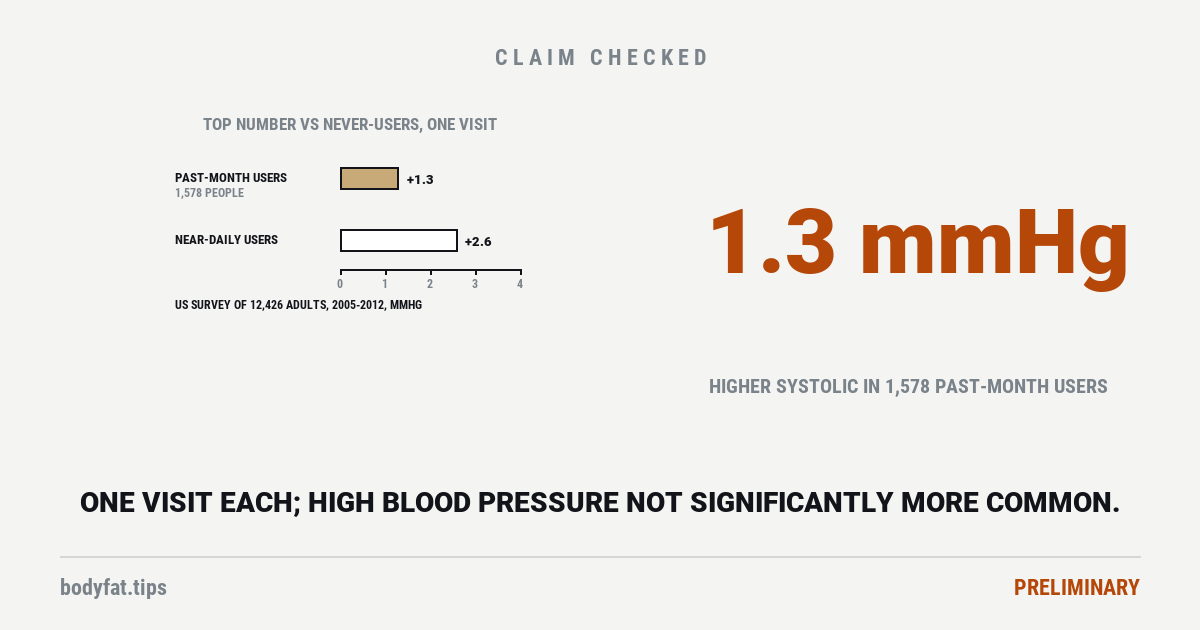
The rises at population scale are small, and they sit with recent or heavy use. In 12,426 US adults, people who had used cannabis in the past month had systolic pressure about 1.3 points higher than never-users, and those who used on 21 or more of the last 30 days about 2.6 higher; diastolic pressure showed no association, and their odds of high blood pressure were not significantly higher [18]. In another analysis of the same survey, heavy users had 1.8 times the odds of “elevated” blood pressure, the band just below high [19]. The first took blood pressure at a single visit [18], a point we come back to below.
Three more things the table does not show. An earlier look at the 35-year study, at 15 years, found systolic pressure climbing across groups of heavier use, from 112.7 to 116.5, until drinking was allowed for: the heavier cannabis users drank more alcohol [28]. And a 2018 review of the evidence to late 2017 found one study on high blood pressure and graded the evidence insufficient [29]. Last, a 2024 analysis of a US drug-use survey asked a different question: among 19,270 people who all had high blood pressure, those who had first used cannabis before 18 developed it at a younger age than those who had never used it, with a hazard ratio of 1.85 (1.75 to 1.95); its summary does not say what else it allowed for [30].
Three of the studies in the table share a lead author who sits, paid by the 2025 paper’s own statement, on the board of directors of a company that makes hemp-derived CBD products [20][26][27]. The studies were paid for with US public research money and point the same way as studies by other teams [25][23]; we report the tie because the papers do.
Is one joint a day considered heavy use?
There is no single line, and the studies on this page draw it in different places. In UK Biobank, more than 100 uses in a lifetime counted as heavy [25]. In the 2016 US analysis, the top group used on 21 to 30 of the last 30 days [18]. The 35-year study counted 365 days of use as one cannabis-year [27]. A joint a day is near-daily use by the second measure and, kept up for a year, one cannabis-year by the third. Near-daily users’ systolic pressure was about 2.6 points higher in the US analysis [18], and each cannabis-year did not go with a significantly higher rate of new high blood pressure in the long study [27].
Does quitting weed lower blood pressure?
The seven studies on this page that measured it are small and point different ways. There may be more: three of the four ward studies below give their readings with and without cannabis only in their results, not in their summaries, so a search of summaries can pass over a study like them; and five older ward studies from the laboratory that ran three of them could be read only as summaries [31].
Thirteen daily users living on a research ward, all of them tobacco smokers too, alternated days of smoking cannabis with three-day stretches without it. Their systolic pressure, taken lying down, averaged 129.6 while using and 139.8 while abstaining, and on smoking days the readings after smoking were lower than those before [32]. Three more ward studies, all from one New York laboratory, tested possible medicines for heavy cannabis use against a dummy capsule, and on the dummy compared the same people on days with and without cannabis. In the first, 11 daily users, 8 of them men and all of them tobacco smokers, came in for three eight-day stays. On the dummy, the day’s highest seated systolic reading averaged 115.6 when they were given cannabis and 119.7 over three days when only dummy cannabis, with no THC, was on offer, and the diastolic 69.3 and 73.7; both rises were significant, and the authors call them small. Going without cannabis did not significantly change how much tobacco they smoked [33]. The second, of 15 daily users, 13 of them men, tested guanfacine, a blood-pressure medicine, as a treatment for withdrawal, against a dummy capsule, over two nine-day stays. On the dummy, their blood pressure was significantly higher on the four days without cannabis than on the two days they smoked it, a rise the authors call small but significant; 12 of the 15 also smoked tobacco, and smoked more of it on the days without cannabis [34]. The third, of 15 daily users, 11 of them men, tested lorcaserin, a weight-loss drug since withdrawn from sale, over two 13-day stays. On the dummy, their blood pressure each morning averaged a systolic of 128 and a diastolic of 80 on the two days they were given cannabis, and 129 and 79 on the three days without it; the paper reports no test of that difference, and its summary does not mention blood pressure. Seven of the 15 smoked tobacco, about 8 cigarettes a day on both kinds of day [35]. In 39 people treated in hospital for cannabis dependence, all of them tobacco users, stopping was “not followed by significant changes” in blood pressure [36]. In a trial of nicotine patches for cannabis withdrawal, the 56 people on a dummy patch who stayed off cannabis for 15 days, with lab tests to confirm it, went from an average systolic of about 113 to about 115; those figures are from the trial’s registry record, not the paper’s summary [37]. And in 100 men admitted to a Saudi hospital for cannabis addiction, systolic pressure averaged about 136 on admission and about 123 after treatment, which included medicines for withdrawal, among them lofexidine, which has low blood pressure among its side effects [38][34]; the paper gives no length of treatment that we could find.
Of the seven, only the four ward studies compared stopping with carrying on in the same people, three or four days at a time: three found pressure higher while stopped, and the fourth printed morning readings about the same without testing the difference. None of the seven set people who quit against similar people who kept using, so none can say what stopping does over months. None of them can tell you how your own pressure would move if you quit, or whether it would.
Will pot lower blood pressure?
For an hour or two, and especially when you stand up, it can. Whether it lowers it usefully for someone with high blood pressure is much less clear.
One study in Israel followed 26 people aged 60 and over with high blood pressure who were starting medical cannabis. They wore 24-hour monitors, cuffs that take readings through a day and a night, before and after three months. Their average systolic fell by 5.0 points and diastolic by 4.5, lowest about three hours after a dose [39]. There was no comparison group; 38 were recruited, 36 started and 26 finished, and five stopped because of side effects that included dizziness; the authors’ starting hypothesis had been that cannabis would not have a significant effect on blood pressure [39].
Older work points the same way at higher doses. In 1975, hospitalised volunteers given THC by mouth for days had slower hearts and lower blood pressure, with drops on standing that eased as they got used to it [12]. The dronabinol label describes 12 men given 210 mg a day for 16 days: a fall in blood pressure lying down, worse on standing, and tolerance within 12 days [6]. And the UK Biobank’s heavy users had slightly lower pressure, an association [25].
None of it is a trial of cannabis as a blood-pressure treatment, and we found no such trial [31].
Can CBD gummies raise your blood pressure?
In the trials on this page, CBD did not raise it. In most of them it lowered it a little.
The newest review of randomised trials of CBD by mouth on blood pressure, searched to September 2024, found four, with 120 people between them, and all four reported lower systolic pressure on CBD at some point [40]. In 9 young men, a single 600 mg dose left resting systolic pressure about 6 points lower than on a dummy, with a confidence interval from 1 to 12 points lower [41]. In 26 men, 13 on CBD and 13 on a dummy, 600 mg a day for a week lowered average pressure slightly on the first day, but by the seventh the effect at rest had gone, and readings over 24 hours, taken in 17 of the 26, did not differ significantly [42].
Two trials in people with raised blood pressure, by one Croatian group with one sponsor, measured pressure around the clock. Over a single day of 450 mg in 16 adults with untreated raised blood pressure, from the band just below high to the higher of high blood pressure’s two stages, 24-hour systolic pressure was about 5 points lower than on a dummy [43]. In the biggest CBD trial on this page, 70 adults with high blood pressure, treated or untreated, were randomised to five weeks of CBD and five of a dummy in turn. After two and a half weeks of CBD, their 24-hour systolic pressure was 4.76 points below where it had been at the start of the CBD weeks, with a confidence interval from 1.72 to 7.80, and it did not fall significantly further when the dose went up; over the dummy weeks it did not change significantly [44]. Those are changes within each stretch, each measured from its own start: the paper prints no figure for how far the CBD weeks and the dummy weeks differed, although its methods say the change within the CBD weeks was tested where the two had differed significantly, a result whose size and test it does not print [44]. Both trials tested one company’s CBD formulation, and that company sponsored both [43][44].
Those trials used 225 to 600 mg a day. A 12-week trial of a CBD product at 100 mg a day in 56 healthy adults, 28 on CBD and 28 on a dummy, paid for by the company behind the product, found no significant difference in blood pressure between CBD and the dummy [45]. The label of the prescription CBD medicine does not mention blood pressure at all [6].
Does Indica raise blood pressure?
We found no study that compared products sold as indica and sativa on blood pressure [31]. The studies on this page varied the dose of THC, not the name on the jar.
Should I smoke weed if I have high blood pressure?
That is a decision for you and your clinician, and this page does not make it. Here is what the studies add. In the 1979 glaucoma study, the falls in blood pressure were bigger and longer in the patients who had high blood pressure [7]. The dronabinol label says patients with heart conditions “may be at higher risk” of its blood-pressure effects [6]. And a reading taken an hour after a joint has the joint in it, the way a reading after coffee has the coffee in it; our page on measuring blood pressure at home covers the rest of what moves a reading.
On edibles and blood-pressure medicines, no study on this page was designed to test the combination. The dronabinol label warns of “additive cardiac effects (e.g., hypotension, hypertension, syncope, tachycardia)” with other drugs that act on the heart and blood vessels [6]. What does lower blood pressure, by how much, is on our page on lowering blood pressure naturally.
How bad is smoking weed for your heart?
That is a bigger question than blood pressure, and this page does not rate it. A 2025 pooling of 24 observational studies, 17 of them single snapshots in time, found cannabis use associated with more heart attacks and similar heart emergencies, more strokes and more deaths from heart disease [46]. We read its summary only and have not checked how each of its studies handled tobacco. The CDC adds a different caution: most studies linking cannabis to heart attacks and strokes are of people who smoked it, and the effects of THC are hard to separate from those of the other chemicals in the smoke [15].
Who these studies were done on
The lab studies were small groups, mostly of young, healthy adults in the US and Britain, and mostly men [4][9][5][41][42]; the exceptions were 16 glaucoma patients, 10 people with dementia and 26 older adults starting medical cannabis [7][11][39]. The population studies were of US adults [18][20][21], US women after a first pregnancy [24], UK Biobank volunteers [25], older Americans of several ethnic groups [26] and Black and White Americans followed from young adulthood [27]. The CBD trials in raised and high blood pressure were in Croatian adults [43][44].
So read yourself against them. If you use now and then and your blood pressure is normal, the population studies were about people like you, and their rates of high blood pressure were not significantly higher. If you use daily, the closest evidence is a survey difference of 2.6 points systolic and four ward studies of daily users who stopped for a few days: in three, pressure rose; in the fourth, morning readings were about the same, and the difference was not tested. If you are older or have high blood pressure, the studies that included you mostly found falls, sometimes large, with dizziness, and one small trial in older people found a rise on its larger dose; that is a conversation for a clinician.
If THC makes the heart race, why doesn’t blood pressure follow?
This section is the desk’s own reasoning, and it is labelled as such. In the hours after THC, every study on this page that reported heart rate found it rising, except at the larger dose in the small dementia trial and in volunteers already taking THC by mouth for days, who had grown almost completely tolerant to the faster heart a joint brings [12]; blood pressure, in the same hours, went up, down or nowhere, and over years the big studies did not find users’ rates of high blood pressure significantly higher. Here are three ways to fit that together, each rated.
Answer one: the vessels widen as the heart speeds up. The 2002 review describes THC raising the heart’s output while the resistance of the blood vessels falls [13], and the drop on standing fits that, if widened vessels cannot tighten fast enough when gravity pulls blood to the legs [8]. The parts are measured, in small studies. That they roughly cancel in a seated reading, and explain the drop on standing, is our inference.
Answer two: tolerance. In hospitalised volunteers given THC for days, the racing heart gave way to a slower one and blood pressure fell [12]; in the 12 men on the dronabinol label, tolerance to the heart and blood-pressure effects came within 12 days [6]; and in daily users, THC by mouth blunted the heart-rate rise from a joint [10]. That is measured, in small groups, mostly decades ago.
Answer three: the reading lands at a random moment. A population study takes blood pressure once, at a visit [18]. For a regular user that moment might fall an hour after use, when the pressure can be lower [39], or on a day without it, when in three of four ward studies it was higher [32][33][34][35]. A single reading averages across all of that, which is also why one clinic reading can mislead in general, as our white-coat hypertension page describes. That is a surmise; no study we read tested it.
Put the three together and here is what we think is true, stated plainly so you can disagree with it: weed pushes blood pressure around for hours, up a little for some, down for others and down hardest when you stand, and nothing we read shows it leaving the pressure higher for good.
What we could not find, and would like to: a randomised trial that gave THC or cannabis, or a dummy, to people with high blood pressure for weeks or months, and measured their pressure through day and night [31]. The closest are a month-long trial of a THC-and-CBD mouth spray against a dummy in 34 people after a stroke, 31 of them on blood-pressure drugs, which compared pressure only within the spray month and reports that it did not change [31], a three-month study with no comparison group [39], a five-week trial of CBD rather than THC [44], and stopping studies of 3 to 15 days [32][33][34][35][37]. One registered trial, at a US clinic and not yet recruiting when we read its record, plans to give 50 occasional users aged 21 to 40 a single 10 mg dose of THC on one occasion and a dummy pill on another, in random order, and to measure their blood pressure; that is a test of one dose, not a treatment trial [31]. If you know of a trial of the kind we were looking for, the corrections line on this site is open.
Where “weed raises your blood pressure” came from
The research is old and points both ways. The 1975 study of hospitalised volunteers set the fast heart and “unchanged or increased blood pressure seen after single doses” against what days of THC did: a slower heart and lower pressure [12]. The 2002 reviews kept both halves: a slight or mild rise lying down, and drops on standing [13][14].
The frightening number came in 2017. A European cardiology society’s press release, “Marijuana associated with three-fold risk of death from hypertension”, reported a study of 1,213 US survey participants in which anyone who had ever tried cannabis counted as a user, and the years since first trying it counted as years of use [47][48]. In 2019 the journal retracted the paper: “A methodological error has led to immortality bias”, says the notice, because people who died before the 2005 survey could never have answered it [48]. Immortality bias is counting years in which no one in the study could have died, because they had to survive them to be in it. The 2018 review had already called that study’s measure of use “flawed” [29].
Then it settled into the official line and the search results. The CDC’s page says cannabis “can raise blood pressure immediately after use”, citing two reviews, one of them the 2002 review that called the rise mild [15][14]. Google’s AI answer, pulled on 20 October 2026, says THC “commonly causes an increase in heart rate and a temporary spike in blood pressure”, citing a medical-card referral site and the CDC; it also says THC “can sometimes trigger a sudden drop” on standing, and that a large study found “no strong direct link” with long-term high blood pressure [1]. We could not trace who first said that weed raises blood pressure.
And it sells, in both directions. The referral site, whose article says THC “can cause inflamed blood pressure”, advises readers to “consult with a marijuana doctor” and offers appointments for a medical card [1]. On the other side, CBD oils and gummies are sold on blood-pressure claims: on 30 August 2024 the FDA warned one seller whose blog said a study “concluded that a dose of CBD was helpful to reducing blood pressure” [49].
None of this is aimed at anyone who uses cannabis and wonders what it does to their blood pressure. That is a fair question. It is the retracted three-fold figure, and the selling on both sides, that we would rather see stop.
What this is rated, and what the rating covers
Preliminary — for the claim that weed raises blood pressure, as it circulates, with the evidence leaning against it.
It is rated Preliminary because the evidence for it is small and conflicting. In its favour: older papers describe a slight rise lying down after single doses [12][13]; daily users’ pressure rose right after smoking in a study with no dummy joint [10]; a dementia trial found a rise on its larger dose [11]; and in US surveys recent and heavy users’ pressure was slightly higher [18][19]. Against it: in most of the lab studies blood pressure fell or showed no consistent change [4][7][9][5]; trials of cannabinoid medicines found low blood pressure, not high [16]; and the large population studies found users’ rates of high blood pressure not significantly higher, once other differences were allowed for, or their pressure lower [27][25][26][23][24][21]. It is not Unsupported because the small rises are real findings, if few and slight.
Each part, rated alone, in words. That cannabis use leads to high blood pressure, the diagnosis, over the years: Unsupported, of the tested kind: it was tested, in population studies of thousands, one of them following people for 35 years, and did not hold up, though one study’s extra analysis hinted at a rise at the very highest use [27][20][26][23][18][24][21]. The 2024 analysis that found an earlier onset in people who first used cannabis before 18 does not move this rating, in our reasoning: it counted only people who already had high blood pressure, so it cannot say whether users get it more often, which is the question this rating answers [30].
That THC makes the heart beat faster in the hours after a dose: Established[3][4][5][6]. That is a short-term effect: given daily for days, THC slowed the heart [12][6], and in the small dementia trial the larger dose did not raise it significantly [11]. That it can drop blood pressure when you stand, enough to make some people dizzy: Supported, on a controlled lab study, two studies of THC given for days and a pooling of medicine trials, which agree, all of them small or short [8][12][6][16].
The opposite version, that weed lowers blood pressure in a way that would help someone with high blood pressure: Preliminary, on one 26-person study with no comparison group, a 1979 study of 16 glaucoma patients and an association in UK Biobank [39][7][25].
That quitting lowers it: Preliminary, leaning against: three small ward studies found pressure higher while abstaining than while using, and a fourth printed morning readings about the same without testing the difference; one study found no significant change, one a rise of about 2 points over 15 days, and the one fall came with withdrawal medicines and no comparison group [32][33][34][35][36][37][38].
That CBD lowers blood pressure: Preliminary, on four small trials with 120 people in a 2026 review, the longest five weeks, two of them sponsored by the maker of the product tested, the bigger of those two reporting its fall from the start of its CBD weeks, with no figure for the difference from its dummy weeks; the seven-day trial’s effect at rest faded, and a 12-week trial at a lower dose found no significant difference [40][41][42][43][44][45]. That CBD raises it: Unsupported, of the tested kind: none of the five trials on this page found a rise [40][45].
What is not rated here: heart attacks and strokes; cannabis taken with blood-pressure medicines; indica against sativa, which we found untested; and the frame above, which is this desk’s reasoning from the evidence rather than a result the evidence delivered. It is marked as ours so that you can weigh it as ours.
This is journalism, not medical advice. If you have high blood pressure or heart disease, or take blood-pressure medicines, talk to your clinician about cannabis. How we read a study, and what each tier means, is set out here.
Sources
[1] Search data from a paid keyword database: monthly US search volumes for “can weed raise blood pressure”, “does thc affect blood pressure” and “will pot lower blood pressure”, pulled 20 October 2026, and Google’s results, People Also Ask questions, related searches and AI answer for “can weed raise blood pressure”, pulled the same day. Four of the web pages the AI answer cites, read on 21 October 2026: a medical-card referral site’s article (21 March 2023), an addiction-treatment centre’s guide (published 15 July 2025, updated 11 September 2026) and two US hospital systems’ pages. Kept with this page’s records.
[2] Health Canada. Health effects of cannabis on adults over 55. Government of Canada, page dated 1 April 2026. Read in full on 21 October 2026.
[3] Sultan SR, Millar SA, O’Sullivan SE, England TJ. A systematic review and meta-analysis of the in vivo haemodynamic effects of Δ9-tetrahydrocannabinol. Pharmaceuticals 2018;11(1):13. 31 studies, most of them in animals; six in people, pooled for heart rate. Its text says no human study examined blood pressure; its own table notes blood pressure in three of the six. Read in full on PubMed Central. No conflict of interest declared; we found no funding statement in it. doi:10.3390/ph11010013
[4] Kanakis C Jr, Pouget JM, Rosen KM. The effects of delta-9-tetrahydrocannabinol (cannabis) on cardiac performance with and without beta blockade. Circulation 1976;53(4):703–707. 10 healthy men, and 9 more given a beta blocker first. Read as its published abstract; its funding statement was not read. doi:10.1161/01.cir.53.4.703
[5] Spindle TR, Cone EJ, Schlienz NJ, Mitchell JM, Bigelow GE, Flegel R, Hayes E, Vandrey R. Acute effects of smoked and vaporized cannabis in healthy adults who infrequently use cannabis: a crossover trial. JAMA Network Open 2018;1(7):e184841. 17 adults, 9 men and 8 women; the cannabis was smoked from a small pipe or vaped. Read in full on PubMed Central. Funded by the US Substance Abuse and Mental Health Services Administration, which, by the paper’s statement, helped design the study and approved the manuscript; one author reports fees from cannabis and drug companies outside the work. doi:10.1001/jamanetworkopen.2018.4841
[6] US prescribing information, read in full on DailyMed (US National Library of Medicine) on 21 October 2026: MARINOL (dronabinol) capsules, revised January 2023; SYNDROS (dronabinol) oral solution, revised October 2020, with the same blood-pressure warnings; and EPIDIOLEX (cannabidiol) oral solution, revised July 2025, whose label text contains no mention of blood pressure, hypotension or hypertension.
[7] Crawford WJ, Merritt JC. Effects of tetrahydrocannabinol on arterial and intraocular hypertension. International Journal of Clinical Pharmacology and Biopharmacy 1979;17(5):191–196. 16 glaucoma patients, 8 with high blood pressure. Read as its published abstract; its funding statement was not read. No DOI; PubMed 468444.
[8] Mathew RJ, Wilson WH, Davis R. Postural syncope after marijuana: a transcranial Doppler study of the hemodynamics. Pharmacology, Biochemistry and Behavior 2003;75(2):309–318. 29 volunteers, randomised, placebo-controlled. Read as its published abstract; its funding statement was not read (the Internet Archive’s copy of the journal’s page carries none). doi:10.1016/s0091-3057(03)00086-8
[9] Gorelick DA, Heishman SJ, Preston KL, Nelson RA, Moolchan ET, Huestis MA. The cannabinoid CB1 receptor antagonist rimonabant attenuates the hypotensive effect of smoked marijuana in male smokers. American Heart Journal 2006;151(3):754.e1–754.e5. 63 men in six parallel groups, given a dummy pill or one of five doses of the drug before smoking. Read as its published abstract, with its funding line in the Internet Archive’s copy of the journal’s page: the US National Institute on Drug Abuse’s own research programme and the maker of rimonabant, the drug the trial tested, which took part in designing it. The summary does not give the number of men in each group. doi:10.1016/j.ahj.2005.11.006
[10] Vandrey R, Stitzer ML, Mintzer MZ, Huestis MA, Murray JA, Lee D. The dose effects of short-term dronabinol (oral THC) maintenance in daily cannabis users. Drug and Alcohol Dependence 2013;128(1–2):64–70. 13 daily users who completed it. Read in full on PubMed Central. Funded by the US National Institute on Drug Abuse; no conflicts. doi:10.1016/j.drugalcdep.2012.08.001
[11] Ahmed AI, van den Elsen GA, Colbers A, Kramers C, Burger DM, van der Marck MA, Olde Rikkert MG. Safety, pharmacodynamics, and pharmacokinetics of multiple oral doses of delta-9-tetrahydrocannabinol in older persons with dementia. Psychopharmacology 2015;232(14):2587–2595. 10 people, average age 77, crossover; systolic -7.2 (-11.4 to -3.0) on 0.75 mg and +5.1 (1.0 to 9.2) on 1.5 mg against the dummy. Read in full on PubMed Central. Funded by a European Union regional-development grant awarded to a consortium of the company developing the THC tablet tested and a Dutch university medical centre; by the paper’s statement the company had no role in the design, analysis or writing; no conflicts. doi:10.1007/s00213-015-3889-y
[12] Benowitz NL, Jones RT. Cardiovascular effects of prolonged delta-9-tetrahydrocannabinol ingestion. Clinical Pharmacology and Therapeutics 1975;18(3):287–297. Hospitalised volunteers; the summary does not give their number or dose. Read as its published abstract; its funding statement was not read. doi:10.1002/cpt1975183287
[13] Jones RT. Cardiovascular system effects of marijuana. Journal of Clinical Pharmacology 2002;42(S1):58S–63S. A review. Read as its published abstract; its funding statement was not read. doi:10.1002/j.1552-4604.2002.tb06004.x
[14] Sidney S. Cardiovascular consequences of marijuana use. Journal of Clinical Pharmacology 2002;42(S1):64S–70S. A review; the first reference on the CDC’s page. Read as its published abstract; its funding statement was not read. doi:10.1002/j.1552-4604.2002.tb06005.x
[15] US Centers for Disease Control and Prevention. Cannabis and heart health. Page dated 15 February 2024. Read in full on 21 October 2026.
[16] Watanabe AH, Navaravong L, Sirilak T, Prasitwarachot R, Nathisuwan S, Page RL 2nd, Chaiyakunapruk N. A systematic review and meta-analysis of randomized controlled trials of cardiovascular toxicity of medical cannabinoids. Journal of the American Pharmacists Association 2021;61(5):e1–e13. 47 trials, 2,800 patients between the drug and comparison arms, 34 trials pooled. Read as its published abstract, with its two figures from the publisher’s image server and its funding and disclosure lines in the Internet Archive’s copy of the journal’s page; the body was not available to us. Self-funded; no relevant conflicts. doi:10.1016/j.japh.2021.03.013
[17] Hutcheon AW, Palmer JB, Soukop M, Cunningham D, McArdle C, Welsh J, Stuart F, Sangster G, Kaye S, Charlton D, et al. A randomised multicentre single blind comparison of a cannabinoid anti-emetic (levonantradol) with chlorpromazine in patients receiving their first cytotoxic chemotherapy. European Journal of Cancer and Clinical Oncology 1983;19(8):1087–1090. 108 patients. The only 1983 trial by this first author with a cannabinoid in PubMed, which we take to be the pooling’s “Hutcheon (1983)”. Read as its published abstract; its funding statement was not read. doi:10.1016/0277-5379(83)90032-9
[18] Alshaarawy O, Elbaz HA. Cannabis use and blood pressure levels: United States National Health and Nutrition Examination Survey, 2005–2012. Journal of Hypertension 2016;34(8):1507–1512. 12,426 adults. Read in full on PubMed Central (the authors’ manuscript); its table gives the past-month difference as 1.3 (0.4 to 2.3), its text as 1.4 (0.3 to 2.3), and we use the table. Funded by the US National Center for Complementary and Integrative Health; no conflicts. doi:10.1097/HJH.0000000000000990
[19] Vidot DC, Powers M, Gonzalez R, Jayaweera DT, Roy S, Dong C, Messiah SE. Blood pressure and marijuana use: results from a decade of NHANES data. American Journal of Health Behavior 2019;43(5):887–897. 10,709 adults. Read as its published abstract, which does not say how it defined heavy use; its funding statement was not read. doi:10.5993/AJHB.43.5.2
[20] Corroon J, Grant I, Bradley R, Allison MA. Trends in cannabis use, blood pressure, and hypertension in middle-aged adults: findings from NHANES, 2009–2018. American Journal of Hypertension 2023;36(12):651–659. 9,783 adults. Read in full on PubMed Central. Funded by a US National Heart, Lung, and Blood Institute training grant; the lead author sits on the board of directors of a company that makes hemp-derived CBD products. doi:10.1093/ajh/hpad068
[21] Alhassan HA, Akunor H, Howard A, Donohue J, Kainat A, Onyeaka HK, Aiyer A. Comparison of atherosclerotic cardiovascular risk factors and cardiometabolic profiles between current and never users of marijuana. Circulation: Cardiovascular Quality and Outcomes 2023;16(11):e009609. 13,965 US adults aged 18 to 59 without heart disease, 3,362 of them past-month users. Read in full in the Internet Archive’s copy of the journal’s page (July 2025). Its summary gives high blood pressure as 19.3% against 18.8%; its text and table give 18.2% in past-month users against 18.8% in never-users, an odds ratio of 0.84 (0.62 to 1.12). Supported by an endowed fund of a university department of medicine; no disclosures. doi:10.1161/CIRCOUTCOMES.122.009609
[22] Shah RM, Patel S, Shah S, Doshi S, Li A, Diamond JA. Sustained cannabis use does not predispose clinical hypertension: findings from a national survey. Journal of Clinical Hypertension 2023;25(1):47–52. 4,565 adults; allowed for age, race and sex only. Read in full on PubMed Central. No funding; no conflicts. doi:10.1111/jch.14623
[23] Haleem A, Hwang YJ, Elton-Marshall T, Rehm J, Imtiaz S. The longitudinal relationship between cannabis use and hypertension. Drug and Alcohol Review 2021;40(6):914–919. 26,844 adults. Read as its published abstract; its funding statement was not read. doi:10.1111/dar.13266
[24] Dahl CM, Chahine R, Wiener LE, Silver RM, McMillin GA, Catov JM, et al. Cannabis exposure after pregnancy and development of hypertension in the nuMoM2b Heart Health Study. O&G Open 2026;3(2):e164. 4,079 women seen 2 to 7 years after a first pregnancy, 406 of them with a cannabis breakdown product in their urine; adjusted odds ratio for new high blood pressure 1.05 (0.63 to 1.76). Read in full on PubMed Central. Funded by US National Institutes of Health grants, with support from two women’s heart-research programmes at a US medical centre; one author discloses fees from a clinical reference publisher and work as a site investigator on two vaccine trials, one of them a drug company’s; the others report none. doi:10.1097/og9.0000000000000164
[25] Vallée A. Association between cannabis use and blood pressure levels according to comorbidities and socioeconomic status. Scientific Reports 2023;13:2069. 91,161 UK Biobank volunteers. Read in full on PubMed Central. No competing interests; we found no funding statement in it. doi:10.1038/s41598-022-22841-6
[26] Corroon J, Bradley R, Allison MA, Grant I. Blood pressure and hypertension in older adults with a history of regular cannabis use: findings from the Multi-Ethnic Study of Atherosclerosis. Frontiers in Cardiovascular Medicine 2024;11:1432923. 3,255 adults. Read in full on PubMed Central. Funded by US National Heart, Lung, and Blood Institute contracts and National Institutes of Health grants, with support from the same San Diego cannabis research centre; the lead author sits on the board of directors of a company that makes hemp-derived CBD products. doi:10.3389/fcvm.2024.1432923
[27] Corroon J, Bradley R, Grant I, Bancks MP, Jakob J, Auer R, Reis JP, Allen N, Yeh KH, Allison MA. Lifetime cannabis use and incident hypertension: the Coronary Artery Risk Development in Young Adults (CARDIA) study. Hypertension 2025;82(10):1641–1652. 4,328 adults at the start, 2,810 at year 35. Read in full on PubMed Central. Funded by US National Institutes of Health grants and a state-funded cannabis research centre at the University of California, San Diego; the lead author is “a compensated member of the Board of Directors” of a company that makes hemp-derived CBD products. doi:10.1161/HYPERTENSIONAHA.125.25005
[28] Rodondi N, Pletcher MJ, Liu K, Hulley SB, Sidney S; CARDIA Study. Marijuana use, diet, body mass index, and cardiovascular risk factors (from the CARDIA study). American Journal of Cardiology 2006;98(4):478–484. 3,617 adults followed 15 years. Read as its published abstract; its funding statement was not read. doi:10.1016/j.amjcard.2006.03.024
[29] Ravi D, Ghasemiesfe M, Korenstein D, Cascino T, Keyhani S. Associations between marijuana use and cardiovascular risk factors and outcomes: a systematic review. Annals of Internal Medicine 2018;168(3):187–194. Read in full on PubMed Central. Funded by a US National Heart, Lung, and Blood Institute grant. doi:10.7326/M17-1548
[30] Wang K, Shafique S, Wang N, Walter SM, Xie X, Piamjariyakul U, Winstanley EL. Early-onset alcohol, tobacco, and illicit drug use with age at onset of hypertension: a survival analysis. Social Psychiatry and Psychiatric Epidemiology 2024;59(7):1129–1141. 19,270 people from a US drug-use survey, 2015–2019, all of whom had high blood pressure and gave the age it began. Read as its published abstract, which does not list what the analysis allowed for, with its funding and conflict statements on the publisher’s page: no funding; no conflicts. doi:10.1007/s00127-023-02596-9
[31] The desk’s searches, 21 October 2026, behind the absence sentences on this page. Stopping cannabis and blood pressure: PubMed by title and abstract in two wordings (47 and 15 records, every title read); ClinicalTrials.gov (cannabis use disorder, withdrawal or dependence with a blood-pressure outcome, 20 records; cannabis cessation with a blood-pressure outcome, 5 records), which surfaced the registry results in [37]; one ordinary web search, first page read. Strains: PubMed in two wordings (94 and 11 records, every title read), ClinicalTrials.gov (strain, indica, sativa or chemovar with a blood-pressure outcome, 128 records, none of them about cannabis strains), one web search, first page read. THC or cannabis as a blood-pressure treatment: PubMed in two wordings (10 and 3 records), ClinicalTrials.gov (hypertension with cannabis, marijuana, THC or dronabinol, 3 records), the newest review of randomised trials on blood pressure, of CBD only, and its table of four trials ([40]), and one web search, first page read; run again on 21 October 2026 (PubMed by title and abstract, 14 records, every title read; ClinicalTrials.gov, cannabis, marijuana, THC or dronabinol with hypertension or blood pressure, 5 records), which found no treatment trial and one registered trial of a single dose: ClinicalTrials.gov NCT07231965, registered by the Mayo Clinic on 13 November 2025 and not yet recruiting when its record was read on 21 October 2026, which plans one 10 mg dose of dronabinol and, on another occasion, a dummy pill, in random order, in 50 occasional cannabis users aged 21 to 40, with blood pressure and heart rate as its main outcomes. Ward studies of stopping, run again the same day after an independent review found one the first search had passed over, and again after a second review found another: PubMed by title and abstract in four wordings (12, 25, 33 and 122 records, every title read), with the full text on PubMed Central of the 20 of the 33 that have one searched for blood pressure. Among what they returned, four ward studies compare days with and without cannabis in the same people and print blood pressure, all four on this page; three of them give it only in their results. Five older ward studies from the New York laboratory behind three of the four, from 1999 to 2004, were read as their abstracts only, none of which mentions blood pressure: none is on PubMed Central, Semantic Scholar lists no open copy, and the Internet Archive’s copies of three of their journal pages hold only the summary and references. We found no systematic review of stopping cannabis and blood pressure (PubMed, 51 records, every title read). Run again by the desk on 21 October 2026, before publication: PubMed for cannabis, THC or cannabinoid trials with hypertension or blood pressure in the title (12 records, every title read), for strains with blood pressure, heart rate or cardiovascular outcomes (46 records, titles read; one 2025 protocol tests cannabis against THC oils, not strains), and for reviews of stopping (11 records); the claims held. The first search also returned a 2022 randomised crossover of a THC-and-CBD mouth spray against a dummy in 34 people after a stroke (Frontiers in Cardiovascular Medicine 2022;9:990188, read on PubMed Central): investigator-initiated, with the drug and the dummy supplied free by the spray’s maker and the insurance, measuring devices and part of the costs from its European marketer; it compares blood pressure only within the spray month. doi:10.3389/fcvm.2022.990188 The record is kept with this page.
[32] Vandrey R, Umbricht A, Strain EC. Increased blood pressure after abrupt cessation of daily cannabis use. Journal of Addiction Medicine 2011;5(1):16–20. 13 daily users, 11 of them men. Read in full on PubMed Central. Funded by US National Institutes of Health grants. doi:10.1097/ADM.0b013e3181d2b309
[33] Haney M, Cooper ZD, Bedi G, Vosburg SK, Comer SD, Foltin RW. Nabilone decreases marijuana withdrawal and a laboratory measure of marijuana relapse. Neuropsychopharmacology 2013;38(8):1557–1565. 11 daily users who completed it, 8 of them men and all of them tobacco smokers, in three eight-day stays on a research ward, one on a dummy capsule and two on different doses of the drug. Read in full on PubMed Central (its article page); its blood-pressure readings are in its results and table, not its summary. Funded by the US National Institute on Drug Abuse, which supplied the cannabis; authors report partial salary support from drug companies for other studies, payment from a drug company for a meta-analysis, and consulting for companies, drug companies among them; two report no conflicts. doi:10.1038/npp.2013.54
[34] Haney M, Cooper ZD, Bedi G, Herrmann E, Comer SD, Reed SC, Foltin RW, Levin FR. Guanfacine decreases symptoms of cannabis withdrawal in daily cannabis smokers. Addiction Biology 2019;24(4):707–716. 15 daily users who completed it, 13 of them men and 12 of them tobacco smokers, in two nine-day stays on a research ward, one on the drug and one on a dummy capsule. Read in full on PubMed Central (the authors’ manuscript), with its blood-pressure chart. Funded by the US National Institute on Drug Abuse, which supplied the cannabis; two authors report partial salary support, for a separate study of CBD and pain, from a drug company that made a prescription THC medicine; the other authors report no conflicts. doi:10.1111/adb.12621
[35] Arout CA, Cooper ZD, Reed SC, Foltin RW, Comer SD, Levin FR, Haney M. 5HT-2C agonist lorcaserin decreases cannabis self-administration in daily cannabis smokers. Addiction Biology 2021;26(4):e12993. 15 daily users who completed it, 11 of them men and 7 of them tobacco smokers, in two 13-day stays on a research ward, one on the drug and one on a dummy capsule; registered as NCT03253926. Read in full on PubMed Central (the authors’ manuscript); its blood-pressure readings are in its results, not its summary, and it reports no test of the difference between days with and without cannabis. Funded by the US National Institute on Drug Abuse, which supplied the cannabis, with a university research fellowship acknowledged; two authors report partial salary support, for a separate study of CBD and pain, from a drug company that made a prescription THC medicine, and one of them consulting for one company and sitting on another’s scientific advisory board; a third reports grant support from a drug company among other funders, consulting for a professional sports league, and unpaid advisory-board seats at three drug companies; the other authors report no conflicts. doi:10.1111/adb.12993
[36] Bonnet U. Abrupt quitting of long-term heavy recreational cannabis use is not followed by significant changes in blood pressure and heart rate. Pharmacopsychiatry 2016;49(1):23–25. 39 inpatients. Read as its published abstract; its funding statement was not read. doi:10.1055/s-0035-1565242
[37] Gilbert DG, Rabinovich NE, McDaniel JT. Nicotine patch for cannabis withdrawal symptom relief: a randomized controlled trial. Psychopharmacology 2020;237(5):1507–1519. 127 people randomised to a nicotine or a dummy patch. Read as its published abstract; the blood pressures come from the results posted on its registry record, NCT01400243, read on 21 October 2026, which name a US university as sponsor and the US National Institute on Drug Abuse as collaborator; the paper’s own funding statement was not read. doi:10.1007/s00213-020-05476-1
[38] Siwar MAAL, Mansour SHE, Aldubayan MA, Alhowail AH, Almogbel YS, Emara AM. Health status outcome among cannabis addicts after treatment of addiction. PLoS ONE 2023;18(11):e0290730. 100 men in treatment and 20 healthy men. Read in full on PubMed Central. Publication paid for by the authors’ university research deanship; no competing interests. doi:10.1371/journal.pone.0290730
[39] Abuhasira R, Haviv YS, Leiba M, Leiba A, Ryvo L, Novack V. Cannabis is associated with blood pressure reduction in older adults: a 24-hours ambulatory blood pressure monitoring study. European Journal of Internal Medicine 2021;86:79–85. 38 recruited, 36 started, 26 completed. Read as its published abstract and its flow chart (from the publisher’s image server), with its design, results summary and funding and conflict lines in the Internet Archive’s copy of the journal’s page. Funded by a UK charity; no competing interests. doi:10.1016/j.ejim.2021.01.005
[40] Roberts A, Fountzopoulos S, Desai T. The effects of oral cannabidiol supplementation on blood pressure in adults: a systematic review of randomised controlled trials. Journal of Cannabis Research 2026;8:96. Four trials, 120 people; searched to September 2024. Read in full on PubMed Central. No funding; no competing interests. doi:10.1186/s42238-026-00463-3
[41] Jadoon KA, Tan GD, O’Sullivan SE. A single dose of cannabidiol reduces blood pressure in healthy volunteers in a randomized crossover study. JCI Insight 2017;2(12):e93760. 9 men. Read in full on PubMed Central. The CBD and the dummy capsules were supplied by a company that makes cannabis medicines, which, by the paper’s statement, did not fund the study. doi:10.1172/jci.insight.93760
[42] Sultan SR, O’Sullivan SE, England TJ. The effects of acute and sustained cannabidiol dosing for seven days on the haemodynamics in healthy men: a randomised controlled trial. British Journal of Clinical Pharmacology 2020;86(6):1125–1138. 26 men, 13 on CBD and 13 on a dummy. Read in full on PubMed Central. The CBD and the dummy were provided free by a CBD company; the first author’s doctoral fees were paid by his university; no other funds; no competing interests. doi:10.1111/bcp.14225
[43] Dragun T, Brown CV, Tulppo MP, Obad A, Dujić Ž. The influence of oral cannabidiol on 24-h ambulatory blood pressure and arterial stiffness in untreated hypertension: a double-blind, placebo-controlled, cross-over pilot study. Advances in Therapy 2023;40(8):3495–3511. 16 adults. Read as its published abstract and the 2026 review’s table of its results; funded, by Crossref’s and Europe PMC’s records, by the company that makes the CBD formulation tested; its funding statement was not read. doi:10.1007/s12325-023-02560-8
[44] Dujic G, Kumric M, Vrdoljak J, Dujic Z, Bozic J. Chronic effects of oral cannabidiol delivery on 24-h ambulatory blood pressure in patients with hypertension (HYPER-H21-4): a randomized, placebo-controlled, and crossover study. Cannabis and Cannabinoid Research 2024;9(4):979–989. 70 randomised, 69 analysed; registered as NCT05346562. Its 24-hour figures are changes from the start of each period; it prints no figure for the difference between the CBD and the dummy periods, though its methods say the change within the CBD period was tested where that difference was significant. Read in full in the copy posted by its sponsor, the company that makes the CBD formulation tested, which the paper names as sponsor. doi:10.1089/can.2022.0320
[45] Mastrofini GF, McFadden BA, Chandler AJ, Lints BS, Cintineo HP, Rhoades ND, Vincenty CS, Stray-Gundersen SO, Lane AD, Arent SM. The effects of a brand-specific, hemp-derived cannabidiol product on physiological, biochemical, and psychometric outcomes in healthy adults: a double-blind, randomized clinical trial. Journal of the International Society of Sports Nutrition 2024;21(1):2370430. 56 randomised, 28 to each group; 54 finished. Read in full on PubMed Central. Paid for by the company behind the CBD product tested; one author held a US National Institutes of Health training grant; no conflicts reported. doi:10.1080/15502783.2024.2370430
[46] Storck W, Elbaz M, Vindis C, Déguilhem A, Lapeyre-Mestre M, Jouanjus E. Cardiovascular risk associated with the use of cannabis and cannabinoids: a systematic review and meta-analysis. Heart 2025;111(22):1047–1056. 24 studies. Read as its published abstract; its funding statement was not read; no competing interests declared. doi:10.1136/heartjnl-2024-325429
[47] European Society of Cardiology. Marijuana associated with three-fold risk of death from hypertension. Press release, Sophia Antipolis, 9 August 2017. Read in full in the Internet Archive’s copy of 26 September 2017; the society’s own page no longer loads.
[48] Yankey BA, Rothenberg R, Strasser S, Ramsey-White K, Okosun IS. Effect of marijuana use on cardiovascular and cerebrovascular mortality: a study using the National Health and Nutrition Examination Survey linked mortality file. European Journal of Preventive Cardiology 2017;24(17):1833–1840. RETRACTED: retraction notice, European Journal of Preventive Cardiology 2019;26(7):783, read in full on the publisher’s page on 21 October 2026. The paper was read as its published abstract; its funding statement was not read. doi:10.1177/2047487317723212; notice doi:10.1177/2047487319840608
[49] US Food and Drug Administration. Warning letter MARCS-CMS 673646 to a seller of CBD oils and gummies, 30 August 2024. Read in full on 21 October 2026.