Does Aspirin Lower Blood Pressure? Not in the Largest Trials. At Bedtime, the Evidence Splits.

“Will aspirin lower blood pressure” is searched about 12,100 times a month in the United States (from a paid keyword database, pulled 20 October 2026) [1]. A hospital system’s health page that Google’s answer cites puts the belief bluntly: could a few aspirin lower your blood pressure? “A lot of folks seem to think so” [1].
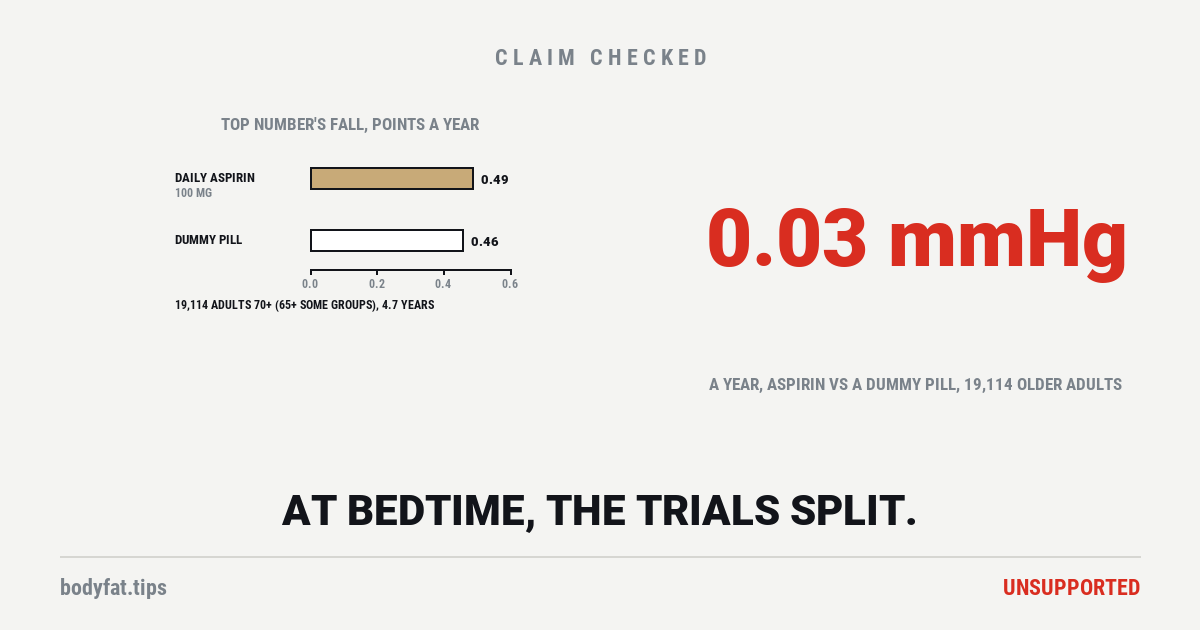
Not as far as the largest trials can tell. In 19,114 older adults given a daily low-dose aspirin or a dummy pill for a median of 4.7 years, systolic pressure fell by 0.49 points a year in one group and 0.46 in the other [2]. In 18,790 people with high blood pressure, the readings reached on aspirin and on the dummy pill were, in the researchers’ word, “superimposable” [3]. The version most people have heard, a low-dose aspirin at bedtime, reached the public from one laboratory’s trials. Four independent trials that compared bedtime with morning found no significant fall, and a 2020 pooling built mostly from Chinese trials found one, so on bedtime the evidence splits.
Before anything else. This is journalism, not medical advice. If you have high blood pressure, do not start aspirin, stop it, change the time you take it, or take it to bring a reading down, without your clinician. Aspirin thins the blood: in that 18,790-person trial, 129 people on aspirin had a major bleed that did not kill them, against 70 on the dummy pill [4]. The American Heart Association advises against aspirin during a stroke, because some strokes are bleeds that aspirin “could make … worse” [5]. And a reading of 180/120 or higher, taken twice a minute apart, with chest pain, shortness of breath, back pain, numbness, weakness, a change in vision or difficulty speaking is an emergency: “Do not wait to see whether your blood pressure comes down on its own. Call 911” [6]. Sudden confusion is a stroke warning sign too; our headache page sets out the rule in full.
Two words first. Systolic is the top number, the pressure while the heart pushes; diastolic the bottom one, between beats. Both are in mmHg, millimetres of mercury, the scale blood pressure has always been measured on, and a “point” is one mmHg.
Does aspirin lower blood pressure?
The best test is a big trial that hands out aspirin or an identical dummy pill at random and keeps measuring. The biggest we found that reports blood pressure is ASPREE, and its authors describe the largest before it as HOT [2].
ASPREE gave 100 mg of aspirin or a dummy pill to 19,114 Australians and Americans aged 70 and over (65 and over for US minorities), three in four of them with high blood pressure [2]. Both groups’ pressure drifted down over the years, from about 139/77 to about 135/72, as their own doctors treated them. The gap between the groups was 0.03 points a year of systolic pressure, with a confidence interval, the range the true average probably sits in, from 0.13 lower to 0.07 higher: a range that includes no difference at all [2]. Over 4.7 years that is about a seventh of a point (our arithmetic). It held whether or not people were already on blood-pressure pills [2].
HOT, from 1998, enrolled 18,790 people aged 50 to 80 with high blood pressure, 9,399 given 75 mg of aspirin and 9,391 a dummy pill for nearly four years, alongside their blood-pressure treatment [4]. The pressures reached in the two groups were “superimposable, with clinically irrelevant differences”, on similar amounts of blood-pressure medicine [3]. By a 2024 pooling’s figures from the trial, the aspirin group’s systolic pressure fell 0.7 points less than the dummy-pill group’s, with a range from 0.33 to 1.07: a gap of under a point, in aspirin’s disfavour [7]. The trial’s principal sponsor was the drug company that made its aspirin, a later paper from the trial says [3].
Most smaller trials we read agree. In 142 Italians on blood-pressure pills, three months of aspirin left clinic readings not significantly different from a comparison group given none [8], and in 17 people on two common blood-pressure drugs, two weeks each of 81 mg and 325 mg made no significant difference against a dummy pill [9]. In 10 Italians with untreated mild high blood pressure, a month of 100 mg against a month of a dummy pill, in a double-blind crossover, “did not affect blood pressure”; the summary does not say what time of day it was taken [10]. One small trial pointed the other way: in 21 people on blood-pressure pills and cholesterol drugs, 24-hour systolic pressure fell 5.7 points over 12 weeks of aspirin, rose 6.2 over 12 weeks of a dummy pill they were not told about, and fell 4.9 on aspirin again; it compared the same people over time rather than with a group on dummy pills. Its 20 comparison patients, matched but not on cholesterol drugs, who by the summary’s wording took the first 12 weeks of aspirin too, showed no such fall [11]. A 2024 pooling, or meta-analysis, which combines trials into one estimate, took five trials of people with high blood pressure, 20,312 people in all, and found systolic pressure 0.78 points lower on aspirin, with a range from 2.41 lower to 0.84 higher, which includes no difference [7].
Before quoting a pooled number we look for the biggest study inside it. Here it is HOT, nearly all of the pooling’s people; the pooling lists it at 19,567, where HOT’s own report gives 18,790 [7] [4]. The pooling’s search ended in September 2023, before the ASPREE analysis was published [7]. HOT is also the only one of its five trials with a dummy pill; the other four compared aspirin with no treatment, and two of them are the Spanish laboratory’s bedtime trials described below [7]. HOT holds 96% of the pooling’s people (our arithmetic), but the pooling used a random-effects model, which, when trials disagree, gives small trials more say than their size alone would: in its chart HOT carries about two-fifths of the weight behind the systolic figure (39.84%), and the four small trials without dummy pills carry the rest [7]. On its own, HOT came out 0.7 points in aspirin’s disfavour; the pooled figure points the other way, 0.78 lower. So the pooling is not a third result beside the two big trials, and its figure leans on the small trials more than on HOT (our reading of its chart). The next-heaviest row, at about a quarter of the weight (25.93%), is also the only one of the five that found a significant fall on its own: a Polish trial described below, entered as its morning and evening aspirin groups together against 61 patients without heart disease who took no aspirin and were not randomised [7] [12]. Whether the time of day matters is the next question.
Does taking aspirin at night lower blood pressure?
This is where the belief has a real source. In 1997 a chronobiology laboratory at a Spanish university, which studies how the body’s 24-hour rhythms change the effect of drugs, reported a double-blind trial in 18 people with untreated mild high blood pressure, split among three dosing times, each of whom took a week of dummy pills and a week of 100 mg aspirin. In the group dosed at bedtime, 24-hour blood pressure fell by about 4.5 points with aspirin; the summary reports significant falls only for the bedtime and afternoon groups, and does not give the size of each group [13]. Over the next 13 years the laboratory published larger trials, each measuring pressure every 20 to 30 minutes for 48 hours, and each found the same pattern.
| Trial | Who, and how it was compared | Systolic pressure, 24-hour average |
|---|---|---|
| Spanish laboratory, 2003 [14] | 100 people with untreated mild high blood pressure, about half allotted to advice only and a quarter each to morning or bedtime aspirin, for 3 months; no dummy pill | Bedtime: 6.2 points lower. Morning: no significant change |
| Spanish laboratory, 2005 [15] | 328 people, same design | Bedtime: 6.8 lower. Morning: 2.6 higher |
| Spanish laboratory, 2005 [16] | 257 people, morning against bedtime only | Bedtime: 7.2 lower. Morning: 1.5 higher |
| Spanish laboratory, 2009 [17] | 244 people with blood pressure just below the high range | Bedtime: about 6 lower. Morning: not lowered |
| Poland, 2021 [12] | 114 people with heart disease and treated high blood pressure, already on aspirin, moved to morning or evening for 3 months; no dummy pills | Evening: 134.4 to 128.9. Morning: 134.6 to 132.8 |
| Leiden, 2009 [18] | 16 people with untreated mild high blood pressure; both times for 2 weeks each, with dummy pills so nobody knew which | 133.8 at bedtime against 133.4 in the morning; no 24-hour difference |
| France, 2012 [19] | 75 people on blood-pressure pills; both times for a month each | 128.3 against 128.3 |
| Leiden, 2015 [20] | 263 people taking aspirin for heart disease; both times for 3 months each | 0.1 point lower at bedtime, with a range from 1.0 lower to 0.9 higher |
| Basque Country, 2019 [21] | 225 people on blood-pressure pills and aspirin; both times for 2 months each, with dummy pills | 123.2 at bedtime against 122.4 in the daytime; no significant difference |
The laboratory’s three-month trials share a design. The volunteers had mild high blood pressure that was not being treated, were in their mid-forties and were mostly women, and the comparison was aspirin at another time of day, or advice on diet and exercise alone, with no dummy pill: open-label, so people knew which treatment they had, with what the laboratory calls a blinded end point, which in that design means the readings are assessed without knowing who took what [14] [15] [16] [25]. In the 2003 trial, about a quarter of the 100 were allotted to bedtime aspirin, and pressure fell in 85% of the bedtime group [14]. In both 2005 papers, the morning group’s pressure went up a little, by 2.6 and 1.5 points [15] [16]. Both 2005 trials were supported in part, they say, by the Spanish arm of an aspirin maker, alongside the regional government, under one grant number for both, and the university [15] [16]. In 2004 two primary-care doctors in Spain wrote to the journal about the 2003 trial. They had “serious concerns”, among them that “many records were taken out and omitted from the analysis, and information on 4 patients was missing”, and that the trial made “no mention of the feasible placebo effect”. The laboratory replied that with 24-hour monitoring the need for a placebo group is “still under debate” and that “short-term trials on antihypertensive efficacy may be designed without a placebo arm”; that it had excluded 4 people and “did not exclude any other ABPM profile from analysis”, meaning no other 24-hour recording; that 3 of the 4 had been assigned to advice and 1 to morning aspirin, none to bedtime; and that larger trials had repeated the result [25].
Then other teams tested it. A Polish trial agreed: in 114 people with heart disease and treated high blood pressure, moved to evening aspirin, the 24-hour systolic average fell from 134.4 to 128.9, against 134.6 to 132.8 for those kept on morning aspirin; they were randomised, but with no dummy pills, so people knew which time they had [12]. A Chinese trial of 150 people on a blood-pressure drug reported a fall too [23], and more Chinese trials are counted in a 2020 pooling below.
Four others did not. They used a crossover: each person took aspirin at bedtime for one stretch and in the morning for another, so each was compared with themself. In Leiden, 16 people with untreated mild high blood pressure, chosen by the same rules as the Spanish volunteers, took aspirin at one time and a dummy pill at the other so that nobody knew which was which; over 24 hours the averages were 133.8 at bedtime and 133.4 in the morning [18]. Daytime systolic pressure did come out 1.3 points lower with the bedtime dose, with a range from 0.1 to 2.5, and night-time systolic pressure came out 2.4 points higher with it, though that trial lasted two weeks a stretch and was built to measure hormones, not pressure [18]. In France, 75 people on blood-pressure pills averaged 128.3 either way [19]. The biggest, again in Leiden, gave 263 people who took aspirin for heart disease three months at each time: 0.1 points lower at bedtime, with a range from 1.0 lower to 0.9 higher, and no fall even among those taking no blood-pressure drugs [20]. In the Basque Country, 225 people on blood-pressure pills and aspirin took it at each time for two months with dummy pills, and the difference was not significant [21]. A pilot in 2026 gave seven healthy young adults 81 mg or a dummy pill at bedtime and found aspirin “did not decrease” blood pressure [26].
The poolings split the same way. A 2020 pooling searched Chinese databases as well as English ones [24] and, by a later review’s count, combined 17 trials, 13 of them Chinese [27]. It found that aspirin taken “before bed reduced systolic and diastolic blood pressure compared with taking it in the morning”, while reporting “a large heterogeneity across the studies”, meaning the trials’ results differed from each other by more than chance would produce, and that “the quality of some studies was not high enough” [24]. We read its summary and its reference list, not its full text or its trials. The list cites the Spanish laboratory’s trials, three of the four crossover trials above, and Chinese-language reports on untreated, mild and borderline high blood pressure and on older people with high blood pressure; which of them it pooled for blood pressure, we could not see. A 2024 pooling of six trials, whose search ended in August 2020, found bedtime aspirin 3.65 points lower than morning aspirin [27]. Four of its six trials are the Spanish laboratory’s, 1,145 of its 1,470 people, or 78% (our arithmetic from its table); its biggest is the laboratory’s 328-person trial; and none of the four crossover trials above is in it, though they fit its stated rules, and its text does not say why [27]. A 2025 pooling of 11 trials divided them: in untreated or borderline high blood pressure, 8.20 points lower at bedtime; in people already treated or with heart disease, 0.08, which is no significant difference [28]. A 2026 review of 17 aspirin studies called the effects on 24-hour pressure “mixed” [29]. We read the last two as summaries only.
We looked for published notices about the laboratory’s aspirin trials. PubMed’s records link none of its twelve aspirin papers to an expression of concern, a correction or a retraction, and a search for such notices found none [30]. What the registry does show is the laboratory’s own blinded test. In 2007 it registered a crossover trial with dummy pills, in people with high-normal or mild high blood pressure, with an aspirin maker as a collaborator. It was stopped after 23 people: “Not enough recruitment during the proposed period”, the registry says, and no results were posted [31]. A Korean double-blind crossover trial of 191 people with well-controlled blood pressure, with a dummy-pill group as well, was sponsored by a drug company that sells a 100 mg aspirin. By the registry’s dates its main measurements were finished in January 2007 and it closed in August 2008; it has posted no results, and we found no paper from it [32] [30]. A search engine’s AI summary we read on 21 October 2026 described results for it; the registry holds none, and the page that summary cited first is a copy of the registry record, with none either [30].
Does aspirin lower your blood pressure quickly?
No test we found says so. The nearest thing is an old hospital test for a rare kind of high blood pressure, caused by a narrowed artery to one kidney. Doctors injected aspirin into a vein, about 10 mg per kilogram, roughly 700 mg for a 154 lb (70 kg) adult (our arithmetic), and watched for 30 minutes. In 21 people with the kidney-artery kind, pressure fell; in 40 people with ordinary high blood pressure, it “did not change” [33]. In an earlier version of the test, ordinary high blood pressure went up [34]. We found no trial that gave aspirin tablets to bring a high reading down [30].
How to quickly bring down blood pressure?
Not with anything from the medicine cabinet on your own. The American Heart Association’s rule for a reading of 180/120 or higher is to wait at least a minute and take it again. If it is still that high and you have any of the symptoms above, call 911. If you have none of them, contact your clinician as soon as possible, who may adjust your medicines [6]. Below that, a high reading is worth taking properly before anything else: a cuff the wrong size or a bad position can move it by several points, and a reading taken at a clinic can run higher than the same pressure at home. What brings blood pressure down over weeks, and by how much, is on our page on lowering it without pills.
Can I take aspirin when my BP is high?
That is a question for your clinician, and the label says so. The US Drug Facts label on over-the-counter aspirin says: “Ask a doctor before use if … you have high blood pressure, heart disease, liver cirrhosis, or kidney disease”, and the same for anyone taking a water pill [35]. On the trials above it will not bring the reading down, and it adds a bleeding risk [4].
Whether to take a daily aspirin to prevent a heart attack is a separate decision. The heart association says it can be considered for people aged 40 to 70 who are not at increased risk of bleeding, that for people over 70 taking it to prevent a first heart attack or stroke “could do more harm than good”, and that you “should not start aspirin therapy on your own” [5]. In the HOT trial, in people whose blood pressure was being treated, aspirin cut major cardiovascular events by 15% and heart attacks by 36%, at the cost of nearly twice as many non-fatal major bleeds [4].
Is aspirin or acetaminophen better for high blood pressure?
Neither treats it, and the question is really about painkillers. In the large trials above, low-dose aspirin left blood pressure within about a point of the dummy pill’s [2] [3] [7]. Acetaminophen was tested in 2022: 110 people with high blood pressure took 1 g four times a day, 4 g in all, or a dummy pill for two weeks each, and on acetaminophen their daytime systolic pressure was 4.7 points higher, with a range from 2.9 to 6.6 [36].
The other anti-inflammatory painkillers, such as ibuprofen and naproxen, are the ones with a warning. A 1994 pooling of trials found they raised average blood pressure by 5.0 points, with a range from 1.2 to 8.7, and that aspirin had “the least hypertensive effect” [37]. US prescribing information for these drugs says they “can lead to new onset of hypertension or worsening of pre-existing hypertension” [38], and over-the-counter ibuprofen carries the same “ask a doctor” line about high blood pressure as aspirin [35]. If you have high blood pressure and need a painkiller, a pharmacist or your clinician can say which suits you.
Does aspirin increase blood pressure?
At low doses, ASPREE found no significant rise in new high blood pressure, and both big trials a gap of under a point in the pressure reached. In ASPREE, among people who started with normal pressure and no blood-pressure pills, those on aspirin began blood-pressure treatment at about the same rate as those on the dummy pill: a hazard ratio of 1.10, meaning 10% more often, with a range from 0.97 to 1.26 that includes no difference [2]. In HOT the gap was the 0.7 points above, in aspirin’s disfavour [7]. Neither trial’s report that we read says what time of day people took aspirin, though the 2024 pooling lists HOT’s dose as taken on waking without saying where that comes from; so whether morning aspirin raises pressure, as in the Spanish laboratory’s trials, is not settled by them [15] [2] [3] [7].
At painkiller doses the evidence is thin, and it pulls two ways. In short trials pooled in 1993, aspirin at 1.5 g a day or more, four groups of patients, lowered average pressure by 1.76 points, less than the 2.59 seen on dummy pills, and the authors called its effect “negligible” [39]. In 16,031 American men followed for four years, those who took aspirin six or seven days a week were diagnosed with high blood pressure 26% more often than those who took none, a range from 14% to 40%, with “similar results” when the study counted pills a week instead [40]. In 51,630 American nurses aged 44 to 69, followed for eight years, those who took aspirin on 22 or more days a month had an odds ratio of 1.21 for a diagnosis of high blood pressure: their odds of one were 21% higher than those of women who took none, with a range from 13% to 30% higher [41]. In 9,986 Spanish university graduates, average age 36, taking aspirin on two or more days a week went with a hazard ratio of 1.45, a diagnosis 45% more often, with a range from 1.02 to 2.04 [42]. Two others found no significant link: in 80,020 younger American nurses, aspirin went with more high blood pressure once age was allowed for, but not significantly once the other painkillers and other risk factors were too [43], and in 8,229 male doctors, those who reported taking 2,500 aspirin pills or more in all had a hazard ratio of 1.16, with a range from 0.92 to 1.48 that includes no difference [44]. These are the cohorts our searches found [30], and they do not tell us whether the pills were painkiller strength: the 51,630-nurse study says it did not record dose [41], and the others’ summaries do not give it. A study that did record the average daily dose, in 5,123 nurses drawn from the same two studies of nurses, found aspirin dose “not significantly associated” with high blood pressure [45]. All of these are associations from following people, which cannot by themselves show that the aspirin did it: people choose how often they take aspirin, and whatever leads someone to take it often may go with high blood pressure too. The 51,630-nurse study’s authors add that it is unknown whether frequent users were diagnosed more often because they saw doctors more, a possibility they tried to limit [41].
Can you take aspirin and blood pressure medication together?
At low doses, the trials found aspirin did not get in the way. In HOT, by its researchers’ account, it did not interfere with blood-pressure treatment, including combinations with the drugs called ACE inhibitors [3], and in the two smaller trials it made no significant difference to people on their usual pills [8] [9]. At 300 mg a day it was different: in 52 people on an ACE inhibitor, enalapril, 300 mg of aspirin cut the drug’s effect by more than a fifth in half or more of them, while 100 mg did not [46]. The prescription painkillers’ labels warn that people on ACE inhibitors and some water pills “may have impaired response” to them [38]. Your pharmacist can check your own combination. Some drugs raise blood pressure themselves; testosterone is one we have checked.
Does aspirin lower blood pressure in pregnancy?
Here aspirin does something real, and on the largest trials it is not lowering blood pressure. Pre-eclampsia is a disorder of pregnancy defined by new high blood pressure with protein in the urine or other signs of organ strain. Pooled trials of 36,716 women found that blood-thinning drugs, mostly low-dose aspirin, cut it by 18% [47], and the US Preventive Services Task Force recommends 81 mg a day after 12 weeks for women at high risk [48].
But the same pooling found that those drugs made “little or no difference” to gestational hypertension, high blood pressure that starts in pregnancy without those other signs: 27,834 women in 25 trials, a risk ratio of 0.95, which would mean 5% fewer cases, with a range from 0.90 to 1.01 that includes no difference [47]. And the biggest recent trial, ASPRE, which gave 1,776 high-risk women 150 mg every night or a dummy pill [49], measured their blood pressure about 6,000 times in all. The two groups’ curves “did not differ significantly”; the authors call them “largely overlapping” [50]. The Spanish laboratory’s pregnancy trials, with dummy pills, reported falls with bedtime dosing: in one, of 341 women split six ways by pill and time of day, those taking aspirin at bedtime had a 24-hour systolic average 9.7 points below those taking a dummy pill at bedtime, at delivery [51]. The task force’s own list of research needs includes aspirin’s effect on all the high-blood-pressure disorders of pregnancy [48]. If you are pregnant, aspirin belongs with whoever is looking after the pregnancy.
Who these studies were done on
The two big trials were of older people: Australians and Americans aged 70 and over, mostly white [2], and 50- to 80-year-olds with clearly high blood pressure in 26 countries [4]. The bedtime trials that found a fall were mostly in Spanish volunteers in their forties with untreated mild high blood pressure, two-thirds of them women [14] [16]; those that did not were mostly in older people on blood-pressure pills or long-term aspirin, in the Netherlands, France and Spain [20] [19] [21]. Who was in the Chinese trials of the 2020 pooling we know only from the titles in its reference list [24].
So read yourself against them. If you are over 70, the largest trial was about people like you, and aspirin made no significant difference to their pressure. If you take blood-pressure pills or a daily aspirin for your heart, the independent bedtime trials we read were about people like you: three of the five found no significant difference, and the two that found a fall, in Poland and China, did not use dummy pills, as far as their reports say. If you are in your forties with untreated mild high blood pressure, the trials that found a bedtime fall were about people like you, and in English-language journals they come almost all from one laboratory; the one independent blinded test of bedtime against morning that we read in that group was 16 people, average age 58, for two weeks, and the Chinese-language reports on untreated and borderline high blood pressure that the 2020 pooling cites we have not read. Whichever group you are in, none of this makes aspirin a blood-pressure treatment, and its bleeding risk is why taking it at all is your clinician’s call.
If aspirin doesn’t lower blood pressure, why did one laboratory keep finding that it did at bedtime?
This section is the desk’s own reasoning, and it is labelled as such. The big trials find gaps of under a point; one laboratory found a fall of six or seven points, time after time. Here are three ways to fit that together, each rated.
Answer one: different people. The laboratory’s volunteers were not on blood-pressure pills [14] [16] and, as the Leiden team points out, had not used aspirin before [20]; the independent crossover trials mostly enrolled people on pills, or who had taken aspirin for years, a median of six in the largest [20]. That difference is measured. That it explains the results is a surmise: the largest of those trials found no fall even in its people on no blood-pressure drugs [20], and the one independent blinded test of the timing that we read in people like the laboratory’s was too small and too short to settle it [18]; the Chinese-language reports that the 2020 pooling cites, some on untreated or borderline high blood pressure, we have not read [24].
Answer two: the comparison. In its three-month trials outside pregnancy, the laboratory compared bedtime aspirin with morning aspirin or advice, with no dummy pill, and in two of them the morning group’s pressure rose [15] [16]. So part of the gap between bedtime and morning in those trials is the morning group going up, by 1.5 to 2.6 points, more than the large dummy-pill trials found, though their reports do not say what time people took aspirin [2] [3] [7]. The designs and the rises are measured; what they add up to is a surmise, and the laboratory’s trials that did use dummy pills cut against it: its one-week trial in 1997 and its pregnancy trials reported bedtime falls [13] [51].
Answer three: the counting. The 2024 pooling that found a bedtime fall drew 78% of its people from the laboratory’s four papers and left out the four crossover trials that found no significant difference [27]; the 2025 pooling that kept the treated trials found the fall only in the untreated ones [28]; and the 2020 pooling that found one drew 13 of its 17 trials from China, by a later review’s count, with results its own authors found more varied than chance would produce [24] [27]. That is arithmetic and reading, not a measurement of aspirin.
Put the three together and here is what we think is true, stated plainly so you can disagree with it: taken the usual way, aspirin does not lower blood pressure by any amount the large trials could detect; taken at bedtime, it lowered blood pressure in one laboratory’s trials, in two others we read and in a 2020 pooling built mostly from Chinese trials, and not in the four independent crossover trials or the largest pregnancy trial.
What we could not find, and would like to: a trial run outside the original laboratory, with dummy pills, in people with untreated mild high blood pressure who are new to aspirin, lasting three months and measuring pressure around the clock, as the laboratory’s own trials did [30]. The laboratory’s attempt stopped at 23 people [31], and the Korean trial’s results are not public [32]. We know the Chinese trials behind the 2020 pooling only by the titles in its reference list, so we cannot say whether one of them is that trial [24]. If you know of one, the corrections line on this site is open.
Where “aspirin lowers blood pressure” came from
The research is real and specific. After the one-week trial in 1997 [13], the laboratory took its three-month trial to the American Society of Hypertension’s annual meeting in May 2002. The society’s press release was headed “For maximum blood pressure reduction, take aspirin at bedtime, researchers say”, and reported falls of 7.0 and 4.8 points in 109 people [52]; the laboratory’s paper the next year, of a trial with the same design, gave 100 people and 6.2 and 4.1 [14].
Six days after the release, a health-news wire opened its story: “A daily baby aspirin pill, often recommended to lower the risks of heart disease, can also reduce high blood pressure — but only if it’s taken at bedtime” [52]. In 2008 the same wire covered the laboratory’s trial in people with borderline pressure: “A daily aspirin can control prehypertension, but only if it is taken at bedtime” [52]. A pharmacists’ newsletter item from that year, still online, is headed “Taking aspirin at bedtime LOWERS blood pressure.” [1].
It is still in the search results. A health system’s blog that Google ranks for this question carries the subheading “Low-dose aspirin can help with high blood pressure – but there are better treatments”, and a medical group’s page, updated in July 2025, says that taken at bedtime “aspirin may lower blood pressure in pregnant women at risk for preeclampsia and with mild high blood pressure” [1]. Google’s own AI answer now says the opposite: “No, aspirin does not meaningfully lower blood pressure” [1]. We could not trace who first told the public that aspirin lowers blood pressure; the earliest public version we found is the 2002 release.
The product in this story is aspirin itself, sold over the counter. Its own US label tells people with high blood pressure to ask a doctor before using it [35].
None of this is aimed at anyone who has taken an aspirin at night hoping it would help. The idea came from published trials and was reported plainly as good news. It is the step from one laboratory’s results to “aspirin lowers blood pressure” that the wider evidence does not support.
What this is rated, and what the rating covers
Unsupported — for the claim that aspirin lowers blood pressure, as it circulates.
It is Unsupported, of the tested kind: it was tested, and did not hold up. Against a dummy pill, in the two largest trials, 19,114 older adults and 18,790 people with high blood pressure, aspirin did not lower blood pressure: in the first the gap was 0.03 points a year and not significant, and in the second the pressures were, in the researchers’ words, “superimposable, with clinically irrelevant differences”, and 0.7 points apart in aspirin’s disfavour by a later pooling’s figures [2] [3] [7]. A 2024 pooling of five trials found no significant difference either; it includes the second of those trials, and its figure leans on four small trials without dummy pills [7]. Taken at bedtime it has a case in its favour, rated separately below.
Each narrower claim, rated alone, in words. That a low-dose aspirin at bedtime lowers blood pressure: Preliminary, with the evidence divided. In its favour: the laboratory’s trials, with falls of six or seven points in its three-month trials, which had no dummy pills, and falls in its trials with dummy pills, a one-week trial of 18 people and its pregnancy trials [15] [16] [13] [51]; two other trials we read, without dummy pills [12] [23]; and a 2020 pooling built mostly from Chinese trials, some of them not of high enough quality by its authors’ account, which we have not read [24]. Against it: four independent crossover trials, two of them with dummy pills, found no significant fall [18] [19] [20] [21]; and in the largest pregnancy trial, with aspirin every night, blood pressure did not differ significantly from the dummy-pill group’s [50]. The trials with dummy pills run outside the laboratory lean against it; the trials without them, and the 2020 pooling whose trials we have not read, lean for it.
That aspirin brings a high reading down quickly: Unsupported, of the untested kind: we found no test of tablets for this, and the nearest test, aspirin injected into a vein at many times a low-dose tablet, did not bring ordinary high blood pressure down within half an hour, and in an earlier version of the test it went up [33] [34] [30].
That aspirin lowers blood pressure in pregnancy: Unsupported, of the tested kind: across 25 trials it made no significant difference to gestational hypertension, and the largest recent trial found no significant difference in blood pressure [47] [50]. The Spanish laboratory’s bedtime trials in pregnancy are the exception, and the largest trial, which also gave aspirin at night, did not repeat them [51] [50]. That it prevents pre-eclampsia in women at high risk is a different claim, which this page does not rate [48].
That aspirin at painkiller doses raises blood pressure: Preliminary, with the evidence conflicting. For it: of the five cohorts above that counted how often people took aspirin, or how many pills, three found more high blood pressure among the most frequent users, 51,630 nurses among them [40] [41] [42], and two found no significant link [43] [44]. Against it, the studies that looked at dose: short trials at 1.5 g a day or more found its effect negligible, and in 5,123 nurses aspirin dose was not significantly associated with high blood pressure [39] [45]. The cohorts counted days or pills: the 51,630-nurse study did not record dose, and the others’ summaries do not give it, so they cannot say whether painkiller doses are the ones at work; and they are observations, which cannot show that the aspirin did it. The 300 mg trial found aspirin blunting a blood-pressure drug, not raising pressure on its own [46].
What is not rated here: whether you should take a daily aspirin to prevent a heart attack or stroke; aspirin to prevent pre-eclampsia; the other anti-inflammatory painkillers and acetaminophen, whose evidence is summarised above; and the frame above, which is this desk’s reasoning from the evidence rather than a result the evidence delivered. It is marked as ours so that you can weigh it as ours.
This is journalism, not medical advice. Talk to your clinician before you start, stop or retime aspirin, and treat a very high reading with symptoms as the emergency it is. How we read a study, and what each tier means, is set out here.
- Does Smoking Raise Blood Pressure? Each Cigarette Does, Briefly. Lasting High Blood Pressure Is Unsettled
preliminary - Can High Blood Pressure Cause Headaches? At 180/120, Treat It as an Emergency. Below That, It Is a Poor Guide to Your Reading
preliminary - Vibration Plate Benefits: The Three Biggest Randomised Bone Trials We Found With Results, 1,086 People, Showed No Clear Gain. Stronger Legs Are Another Matter.
preliminary