Tart Cherry Juice: The 84-Minute Sleep Result Came From Eight People. The Better Evidence Is for Something Else.

The sleepy girl mocktail is tart cherry juice, magnesium and something fizzy. Fifteen YouTube videos about it have collected over 1.8 million views, and it has quietly become the default answer to “what should I drink before bed”.
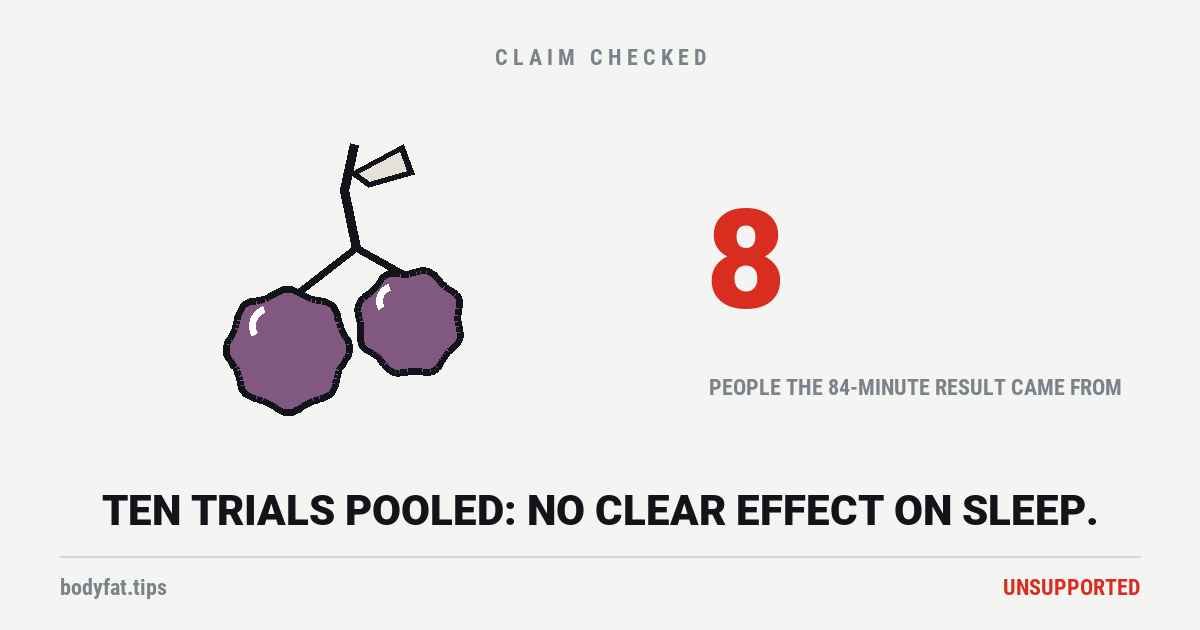
The number that powers it is 84 minutes — the extra sleep measured in a study, on a proper sleep lab machine rather than a questionnaire.
That study finished with eight people.
What the sleep evidence actually is
In people with insomnia there are two published trials, and both are small pilots: 23 people between them. They are not the whole file. At least eight more placebo-controlled trials have given tart cherry on its own and measured sleep, in healthy and active adults, athletes, middle-aged adults and adults with overweight and sleep complaints. [5]
The first randomised 11 people aged 50 or over, then excluded three of them because they turned out to have sleep apnea rather than insomnia. The remaining eight completers slept 84 minutes longer on cherry juice than on placebo, measured by polysomnography over one night in the lab on each drink. The same recordings found no change in how long they took to fall asleep or how long they lay awake in the night. Their sleep efficiency improved on one questionnaire; on the other questionnaires, nothing. [1]
The second was a crossover trial in 15 older adults with chronic insomnia. Against placebo it found reductions on two measures — its main one, a questionnaire score of how severe the insomnia was, and minutes spent awake after falling asleep — and no improvement in how quickly people fell asleep, how long they slept in total, or their sleep efficiency. The questionnaire result clears the usual line researchers use for “probably not chance” (p = 0.025), but not the stricter one of 0.023 that the authors offer for readers who want to allow for testing several outcomes at once. The authors describe their own effect sizes as “moderate and in some cases negligible”. [2]
Both pilots gave two 8 fl oz (240 mL) servings a day, one in the morning and one an hour or two before bed, for two weeks. [1] [2] On 30 September 2026, a review pooled all ten placebo-controlled trials, 294 people, and found no effect on sleep quality that could be told apart from chance: an effect size of 0.06, where 0.2 is small, with a range of plausible answers that still includes doing nothing at all. Only the two insomnia pilots, pooled on their own, came out ahead, and the review rates that finding low-certainty and calls it preliminary. The trial with the most weight in the pool, 34 adults with overweight and sleep complaints, found nothing on any measure. [5]
| Claim | Studies | People |
| Helps you sleep why everyone drinks it |
10 trials, 2 in insomnia |
294, 23 with insomnia |
| Helps you recover from training what athletes are sold it for |
5 meta-analyses, up to 19 trials |
hundreds |
Those same authors then wrote the sentence that should travel with every mocktail video. The effects, they say, were “considerably less than those for evidence-based treatments of insomnia: hypnotic agents and cognitive-behavioral therapies for insomnia”. [2] None of the fifteen videos we counted carries it in its title or description, though several of them ask whether the drink works at all, and at least one article about the mocktail does pass the point on.
Cognitive behavioural therapy for insomnia is the first-line treatment, it is not a drug, and by the juice trial’s own authors’ reckoning it works considerably better. If you have real insomnia, that is the thing to ask about.
The three people who were excluded
Worth pausing on, because it is the most practically useful detail in either paper.
Of eleven people who signed up believing they had insomnia, three had sleep apnea and were referred elsewhere. [1] Not insomnia. A different condition, with a different treatment, that no beverage is going to touch.
If you have been fighting your sleep for months and self-treating with drinks and supplements, that ratio is worth knowing about.
Now the other thing it is sold for
Here is the inversion. The better evidence for tart cherry is not about sleep at all.
A meta-analysis pooled 14 studies on recovery from hard training. Muscle strength recovered better with an effect size of 0.78 — on the usual scale, 0.2 is small, 0.5 is moderate and 0.8 is large, so that is at the top of moderate. Power recovered better too, and a subgroup looking specifically at jump height came out at 0.82, which is genuinely large. Soreness improved slightly. [3]
That strength figure leans hard on one trial, of 14 men, paid for by the juice’s maker, whose authors each held 2.5% of the company. Its four entries in the pool, at 3.5 to 5.1, are the four largest by a distance; no other trial’s tops 2.1. The spreads the review entered for it match the standard errors printed in that trial’s figures, which say how precisely an average is known, rather than the standard deviations in its text, which say how much people varied and are several times wider; entered that way, an effect looks several times bigger than it is. The review also entered every trial once for each time point it measured, so the same people are counted up to five times, which makes the result look more certain than it is. Take that one trial out and, by our arithmetic, the strength effect is 0.44: small to moderate, and still a benefit. [3] [6]
A second, larger review in 2026 pooled 19 trials and also found strength — the hardest contraction people could manage, called maximal voluntary contraction — recovered better, at every time point it pooled. But it graded its own certainty on that result “very low” at every one of them, and its result straight after exercise depended on a single trial whose own authors had found no difference in strength between the drinks. [4] [7]
But it disagreed with the first review on soreness, finding no significant pooled effect there, and none for creatine kinase, two inflammatory markers, or range of motion, though a third marker of inflammation, C-reactive protein, did fall. Its strength results also varied from trial to trial far more than chance explains: the share of the spread between them that was more than chance would produce, a statistic called I-squared, ran from 69% to 93% across the time points, where zero means the trials differed no more than luck allows. Its sensitivity analysis found that significance at several time points depended on individual studies. And it graded its own certainty as very low to moderate, calling for cautious interpretation.
So the reviews do not agree on what tart cherry helps. Of the six meta-analyses of tart cherry and recovery we found, drawing largely on the same small trials, three found strength came back faster and two did not, and the oldest did not pool strength; two found soreness eased and four did not. [3] [4] [8] [9] [10] [11] The newest, published in August 2026, is a network meta-analysis, a review that weighs several supplements against placebo and against each other at once: 30 trials of eight fruit and plant supplements, 13 of them of tart cherry. It found tart cherry eased soreness at 24, 48 and 72 hours, and gave no clear advantage for strength. [10] The two most recent graded their own certainty on these results low or very low. What survives is a small, uncertain benefit for recovery. Which part of recovery is still in dispute.
So should you drink it?
If you are an athlete with another hard session in 48 hours, tart cherry is one of the more defensible things in the recovery aisle, on low-certainty evidence: each of those six reviews found something improved, in the oldest only a blood marker of muscle damage, though they split on whether it is strength or soreness, and the trials mostly started the juice four to seven days before the hard session and kept it going for two to four days after. [4] The trials reported few side effects, but this is fruit juice by the cupful: the sleep pilots used 16 fl oz (480 mL) a day, and both shut out people with diabetes, one of them because of the sugar. [1] [2]
If you are drinking it at 10pm hoping to sleep like the videos promise, the honest position is that ten trials, pooled, found no effect for people in general. The two pilots in people with insomnia, 23 people between them, are not enough to tell you what it does, and the researchers who ran the bigger one said outright that proper insomnia treatments work considerably better.
It is also worth knowing what else is in the glass. The mocktail’s other ingredient is magnesium, and we checked that too: magnesium lowers blood pressure a little, and in pooled trials has made no worthwhile difference to older adults’ night cramps, with sleep evidence thinner than the marketing, and the glycinate form has not been shown to absorb better than the cheap one: not overall in a 1994 trial built to compare them, in 12 patients missing part of the bowel, and not in two later single-dose studies in healthy adults run by makers of rival forms.
The verdict
Unsupported — for sleep, as the mocktail sells it. Pooled, ten trials of tart cherry on its own show no effect on sleep for people in general, and in the two insomnia pilots it did no better than placebo at getting people to sleep faster. Rated on its own, a narrower claim would be Preliminary: that it may help older adults with insomnia sleep longer or wake less in the night. Both pilots moved at least one measure, there is a plausible mechanism involving tryptophan, and pooled they come out ahead, at low certainty. But 23 people across two pilots is not a basis for telling you it works.
Unsupported is not the same as disproved. Nobody has yet run the trial that would settle it: the largest so far enrolled 70 people, and the next insomnia trial, 20 older adults who finished in August 2025, has no results on its registry record.
The recovery evidence is better, from six meta-analyses rather than two pilots, though better is not good: they disagree on whether it is strength or soreness that improves, and the two most recent graded their certainty on those results low or very low. Rated on its own, the recovery claim would be Preliminary. It is not what this page is rated on, because sleep is the claim the mocktail is sold on.
Related: melatonin, and the dose nobody needs, what sleep hygiene advice actually achieves, and beta-alanine if the interest is performance rather than sleep.
If you want to know what earns each rating, we wrote down how we read a study, and everything we have checked is in one place.
Our magnesium verdict was corrected on 18 September 2026 after an independent editorial review, and this page’s one-line summary of our magnesium pages went too far in two places. We said magnesium does nothing for cramps; the review behind that found no benefit for the night cramps of older adults, not for every kind of cramp. And we said the glycinate form is not better absorbed than the cheap one; in the only trial that compared them it was not, overall, though the four patients who absorbed the cheap form worst did better on glycinate. The sentence now says both. Nothing about tart cherry juice changed, and the rating is unchanged: Preliminary.
This page was corrected on 7 October 2026 after an independent editorial review, and the largest error was the size of the sleep evidence. We said there were two studies of tart cherry and sleep, 23 people in all. Those two are the trials in people with insomnia; at least eight more placebo-controlled trials have given tart cherry on its own and measured sleep, and a review published on 30 September 2026 pooled all ten, 294 people, and found no effect on sleep quality overall, with only the two insomnia pilots, pooled, coming out ahead, at low certainty. The page now says so. It also adds that the 84-minute study’s own sleep recordings found no change in how fast people fell asleep, and that the other pilot’s main result, its insomnia severity score, did improve against placebo, which we had left out.
We also corrected the funding row, which said funding was not stated in the sources: both sleep pilots state it, and both were backed by the tart cherry business, one supported by the US industry’s marketing body, which supplied the juice, and one funded in its entirety by the maker of the juice it tested. The recovery section said strength recovery survived both reviews and soreness did not; of the six meta-analyses we have now found, three found strength came back faster and two did not, and the oldest did not pool strength; two found soreness eased and four did not; and the strength figure we quoted leans on one trial funded by the juice’s maker. Our gloss of heterogeneity was wrong (it is the share of the spread between the trials’ results that is more than chance would produce, not a sign that they measured different things) and sat beside the wrong result. Smaller changes: the safety line, the search figure’s query and date, the videos’ platform, a sentence that said the authors’ caveat never travels with the videos, and our one-line summary of the magnesium pages, which overstated twice (“does nothing” for night cramps, and “the only trial that compared” the glycinate and cheap forms). The 18 September note above is left as it was written, including its own “the only trial that compared them”. The rating changed from Preliminary to Unsupported, for sleep as the mocktail sells it; rated on its own, the narrower claim about older adults with insomnia would be Preliminary.
Corrected on 9 October 2026. The provenance chain gave a search figure, 33,100 US searches a month for “tart cherry juice benefits”, as “keyword data” without saying whose. It comes from a paid keyword database, pulled on 21 August 2026, and the chain now says so. The rating is unchanged.