Confidence tier Supported

Evidence is consistent, with known limits.

14 mg/dLlower LDL cholesterol on black seed than on a dummy capsule, pooled from 16 comparisons in placebo-controlled trials (2016), a figure an independent overview graded very low in certainty; the range the true average probably sits in runs from about 9 to 19MOSTLYSupported

Black Seed Oil Benefits: Slightly Lower LDL, and Blood Sugar in Diabetes
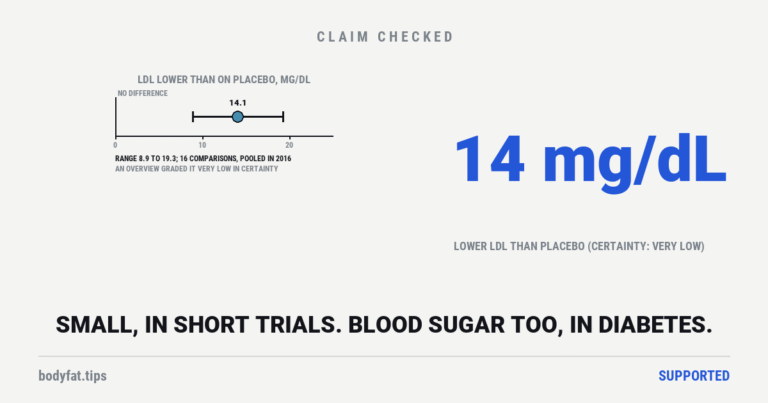
Data graphic: in a 2016 pooling of 16 comparisons in placebo-controlled trials, LDL cholesterol came out 14.1 mg/dL lower on black seed, with a range of 8.9 to 19.3, clear of no difference; an independent overview graded the figure very low in certainty; beside it the figure 14 mg/dL

Black seed (Nigella sativa) lowered LDL cholesterol by about 14 mg/dL against a dummy capsule across 16 comparisons, a figure an independent overview graded very low in certainty, and HbA1c by about 0.4 to 0.7 points in people with diabetes. The trials are small and short, and the largest pooling we found counts two of them twice. For weight, asthma, joints, skin and hair, the evidence is early.
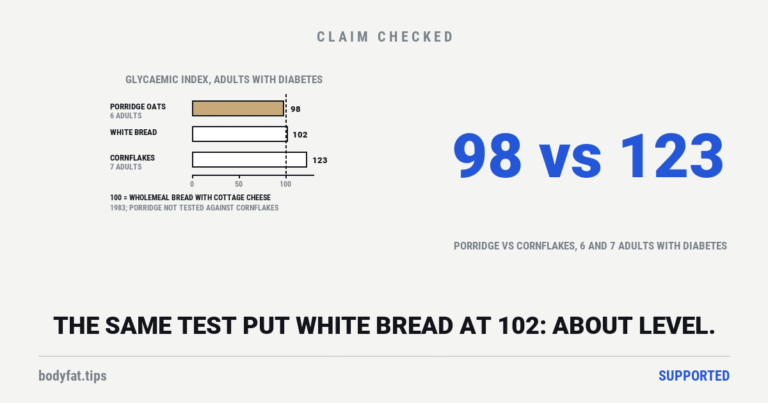
98 vs 123glycaemic index of plain porridge oats and of cornflakes with the same carbohydrate, each scored against a standard of wholemeal bread with cottage cheese at 100, in a 1983 test in which six and seven adults with diabetes ate them; the two were not tested against each other, and white bread scored 102MOSTLYSupported

Is Oatmeal Good for Diabetics? Less Processed Oats Beat Refined Cereal; Instant Doesn’t

Data graphic: glycaemic index in adults with diabetes in a 1983 test, against wholemeal bread with cottage cheese at 100: porridge oats 98, white bread 102, cornflakes 123; the paper did not test porridge against cornflakes directly; beside them the figures 98 vs 123

Mostly yes. Next to refined breakfast cereals with the same carbohydrate, less processed oats raised blood sugar less, mostly in tests of people without diabetes; next to an omelette they raised it more, and instant oats kept little of the edge. The claim that oatmeal lowers A1C rests mostly on one oat-company trial with a whole diet attached.

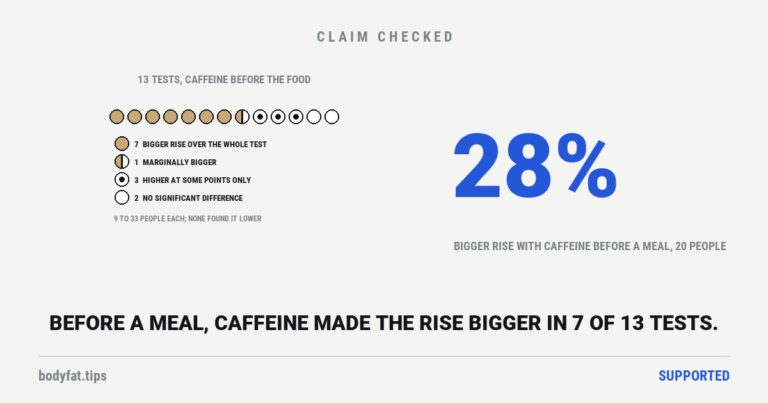
28%bigger blood-sugar rise after a meal when 20 people with type 2 diabetes had 250 mg of caffeine in decaf before it, against the decaf alone; of the 17 one-dose tests we read, 13 gave caffeine or coffee before the food, and 7 of those found a significantly bigger rise over the whole testMOSTLYSupported

Does Coffee Raise Blood Sugar? Before a Meal, Caffeinated Coffee Makes the Rise Bigger

Thirteen markers, one per test of caffeine or caffeinated coffee taken before food: 7 found a significantly bigger blood-sugar rise over the whole test, 1 marginally, 3 at some points only, 2 no significant difference; beside them the figure 28%

Caffeinated coffee, even black, drunk before a carbohydrate meal, makes the blood-sugar rise after it bigger for a few hours: 28% bigger in 20 people with type 2 diabetes. With nothing to eat, black coffee did not significantly raise blood sugar in small tests. Over whole days, 10 people with type 2 diabetes on caffeine capsules averaged 8% higher, while 87 adults, nearly all without diabetes, averaged 95 mg/dL on coffee days and 96 without. Weeks-long trials found no significant rise in fasting blood sugar.

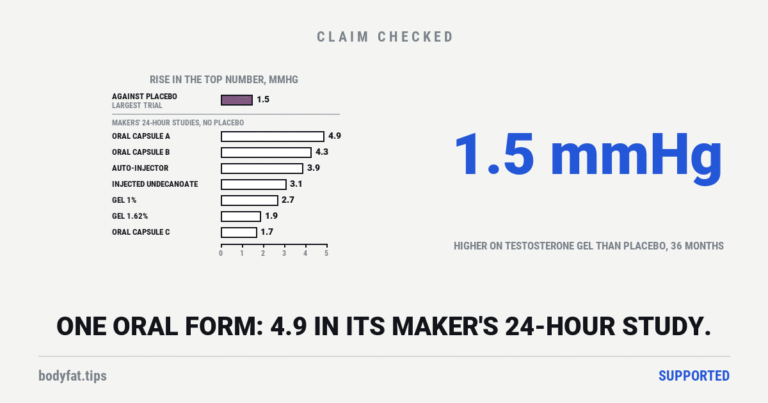
1.5 mmHghigher top-number blood pressure on testosterone gel than on a dummy gel at 36 months in the largest trial (the FDA's figure); up to 4.9 on one oral form in its maker's study without placeboMOSTLYSupported

Does Testosterone Raise Blood Pressure? A Little: About 1.5 Points Against Placebo in the Biggest Trial, and 4.9 on One Oral Form

Bars of the rise in the top number of blood pressure on testosterone: 1.5 mmHg against a dummy gel at 36 months in the largest trial, set apart, and the makers' own 24-hour studies without placebo, from 1.7 to 4.9 by form; beside them the figure 1.5 mmHg

Testosterone therapy raises blood pressure a little. In the largest placebo-controlled trial the top number ended about 1.5 points higher on testosterone gel; the makers' 24-hour studies found rises of 1.7 to 4.9 points, highest on one oral form. The clinic claim that it lowers blood pressure rests on a registry in which men chose their treatment.

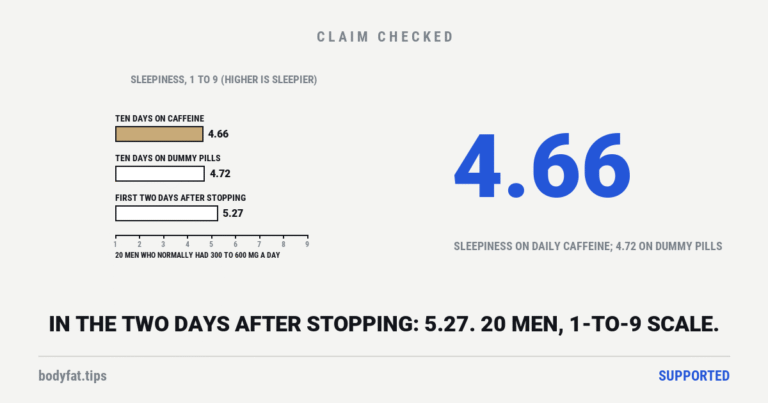
4.66sleepiness (1 to 9) after ten days of 450 mg of caffeine a day, against 4.72 after ten days of dummy pills and 5.27 in the two days after switching to them; 20 men who normally had 300 to 600 mg a dayMOSTLYSupported

Why Does Caffeine Make Me Sleepy? It Doesn’t While It’s Working. Going Without It Does, and the Next Cup Mostly Just Gets You Back to Normal.

Three bars of sleepiness on a 1-to-9 scale in 20 regular caffeine users: 4.66 after ten days of caffeine, 4.72 after ten days of dummy pills and 5.27 in the two days after switching from caffeine to dummy pills; beside them the figure 4.66

Caffeine doesn't make you sleepy while it works. Going without it does, once you're used to it: regular users grew sleepier within a day or two of swapping it for dummy pills, and the next cup mostly just got them back to normal. In the trials we read that followed people for hours after a single dose, the caffeine group did not end up sleepier than the dummy group.

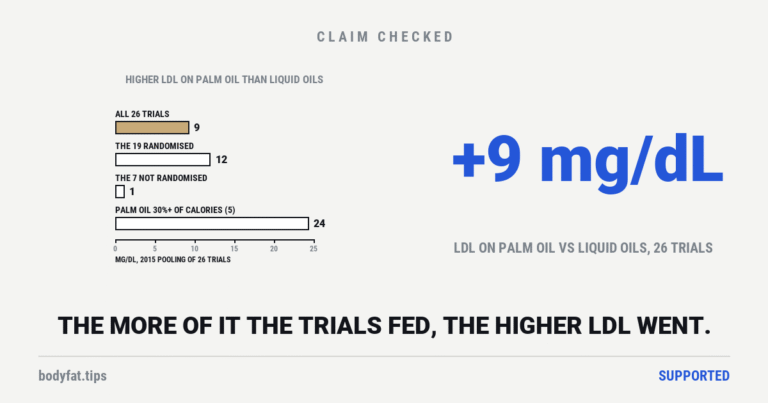
9 mg/dLhigher LDL on palm oil than on liquid vegetable oils, pooled across 26 trials (0.24 mmol/L); about 12 mg/dL in the 19 randomised onesMOSTLYSupported

Is Palm Oil Bad for You? Against Liquid Oils It Raised LDL About 9 mg/dL in 26 Trials. The Cancer Worry Rests on Animal Studies.

Bars of how much higher LDL was on palm oil than on oils low in saturated fat in a 2015 pooling: about 9 mg/dL across 26 trials, 12 in the 19 randomised, 1 in the 7 not randomised and 24 where palm oil was 30% or more of calories; beside them the figure +9 mg/dL

Eaten in place of liquid vegetable oils, palm oil raised LDL cholesterol about 9 mg/dL in a pooling of 26 trials, more in the randomised ones and at higher doses. Against butter it may do better. We found no trial that counted heart attacks, and the cancer worry rests on animal studies of a refining contaminant.

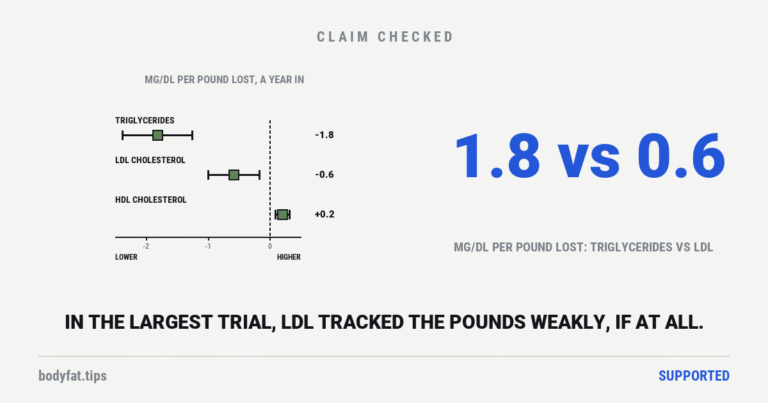
1.8 mg/dLlower triglycerides per pound lost (4.0 per kg) a year into 30 diet-and-exercise trials; LDL fell about 0.6 mg/dL per pound (1.28 per kg)MOSTLYSupported

Does Losing Weight Lower Cholesterol? Mostly the Triglycerides. LDL Fell About 0.6 mg/dL per Pound Lost, and Not on Every Diet.

Chart of what moved for each pound lost a year into 30 diet-and-exercise trials: triglycerides about 1.8 mg/dL lower, LDL about 0.6 lower and HDL about 0.2 higher, each with its range; beside it the figures 1.8 vs 0.6

Losing weight lowers cholesterol, mostly the triglycerides: about 1.8 mg/dL per pound in a year of diet-and-exercise trials. LDL fell about 0.6 mg/dL per pound and rose on a low-carb diet in one trial; in the largest trial it was linked only weakly, if at all, to the pounds lost. HDL was up about 0.2 mg/dL per pound at six months and a year.

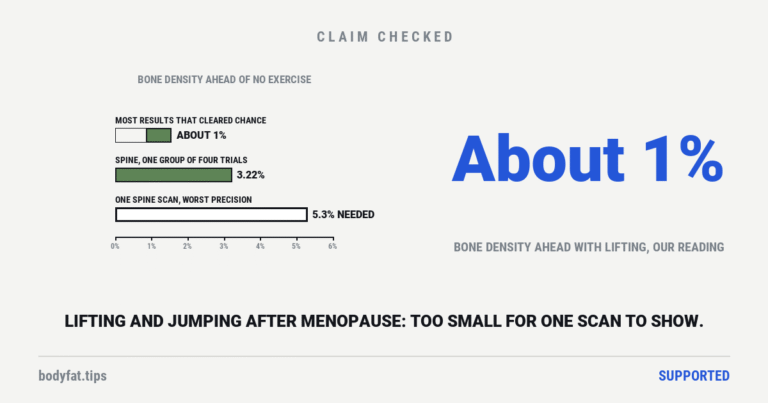
About 1%higher bone density at the spine and hip in most of the Cochrane review's pooled results that cleared chance, for women past menopause who did weight training or impact exercise, against no exercise; our reading, with about 3% at the spine in one group of four trials; part of it bone the comparison groups lostMOSTLYSupported

Exercise for Osteoporosis: Lifting and Jumping Left Women About 1% Ahead on Bone Density, by Our Reading. Fewer Fractures Is Less Certain

Bars: in most of the pooled trial results that cleared chance, women who lifted or jumped ended up about 1 percent ahead on bone density, by our reading, and 3.22 percent at the spine in one group of four trials; one person's spine scan needs about 5.3 percent at the worst precision allowed

Across dozens of trials, women past menopause who lifted weights or did impact exercise ended up ahead on bone density, partly by losing less: about 1% in most of the pooled results that cleared chance, and about 3% at the spine with programmes mixing several kinds of exercise, which came out 1.07% behind at the total hip (our reading). That is well below what one scan can confirm in one person at the worst precision allowed, fewer fractures is less certain, and whether walking alone does less is unsettled.

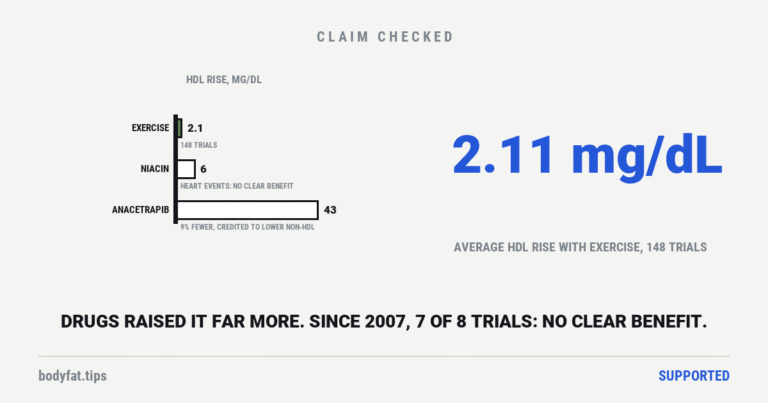
2.11 mg/dLaverage rise in HDL cholesterol with exercise training across 148 randomised trials, most of the exercise groups aerobic; about 3.5% of the starting levelMOSTLYSupported

How to Raise HDL: Exercise Lifts It About 2 mg/dL. Two Pills Approved Partly to Raise It Lost Approval After Heart Trials Found No Clear Benefit.

Three bars of the HDL rise in mg/dL: exercise 2.1 across 148 trials; niacin 6, with no clear heart benefit; anacetrapib 43, with about 9% fewer coronary events credited to lower non-HDL cholesterol; beside it the figure 2.11 mg/dL

Exercise raised HDL cholesterol by about 2 mg/dL across 148 randomised trials, aerobic exercise most reliably, and losing weight, quitting smoking and eating fat in place of carbohydrate raise it too. Drugs raised it far more; in seven of eight large heart trials of drugs aimed at HDL since 2007 that bought no clear benefit, and the eighth's small benefit is credited to the LDL-type cholesterol it lowered. Low HDL is a warning sign. Raising the number is not the same as fixing what it warns about.

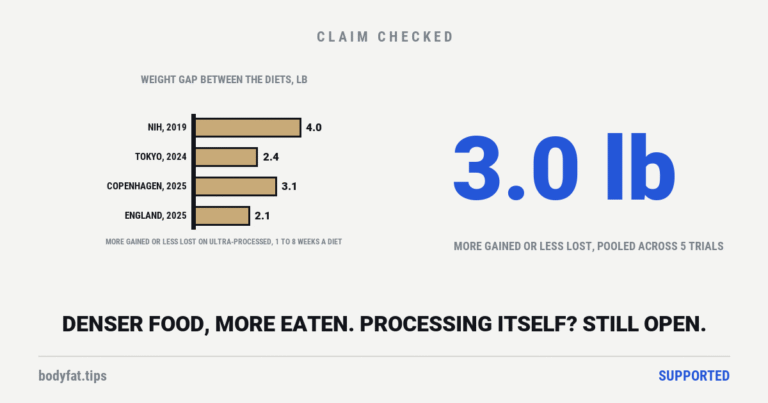
3.0 lbmore weight, or less lost, on ultra-processed than on less-processed diets, pooled by a 2026 review across five small trials (1.37 kg), at low certainty; one week to six months, 9 to 50 people eachMOSTLYSupported

Are Ultra-Processed Foods Bad for You? In Short Feeding Trials, People Gained More or Lost Less. Why Is Still Open.

Horizontal bars of the weight gap between ultra-processed and less-processed diets in four feeding trials, in pounds: NIH 2019 4.0, Tokyo 2024 2.4, Copenhagen 2025 3.1, England 2025 2.1; beside it the figure 3.0 lb, a 2026 review's pooled estimate

In every feeding trial we read that let weight move and reported it, people put on more, or lost less, on ultra-processed diets than on less-processed ones; a 2026 review pooled five small trials at about 3 lb. In three of the five, those diets were also denser in calories, and when an NIH trial took the density and the foods easiest to overeat out, most of the overeating went. The links to disease and death come from cohorts.