BodyFat.Tips Desk

BodyFat.Tips Desk

The BodyFat.Tips Desk is the research and editorial operation behind BodyFat.Tips, a publication of TAK Marketing, LLC, part of the Omnishun information systems. It is a desk, not a person: no headshot, no invented bio, no borrowed credentials. Every verdict here is produced by reading the research itself rather than the press release, rating how strong the evidence actually is on a fixed four-point scale, tracing where the claim came from, and correcting in public when we get something wrong. Nobody pays us to reach a conclusion. This is journalism, not medical advice — take personal health questions to a clinician. How we work, in detail: bodyfat.tips/how-we-read-a-study/
0.1 mg/dLhigher LDL with peanuts than with the comparison diets: the 2022 pooling's 9 trials (3 gave peanut butter) with two rows entered as their trials report them, our arithmetic; range 9 lower to 9 higher. The pooling's own chart gives 2 lower, 11 lower to 6 higherNOUnsupported

Is Peanut Butter Bad for Cholesterol? Not in Nine Trials of Peanuts and Peanut Butter. In Place of Saturated Fat, LDL Fell About 14%; Otherwise It Came Out About Even.
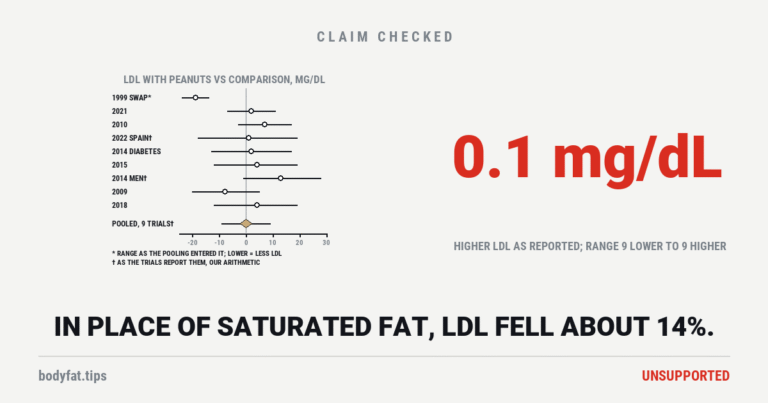
A forest plot of nine randomised trials of peanuts and peanut butter: LDL against the comparison diet from 19 mg/dL lower to 13 higher, most ranges crossing zero, two rows marked as drawn from their trials' own reports rather than the 2022 pooling's chart, pooled about even with a range from 9 lower to 9 higher by our arithmetic; beside it the figure 0.1 mg/dL

Peanuts and peanut butter showed no clear rise in LDL in nine randomised trials pooled in 2022, three of which gave peanut butter. The pooling's chart puts LDL about 2 mg/dL lower than on the comparison diets; with two of its rows entered as their trials report them, it comes out about even, and both ranges include no difference. In place of saturated fat, LDL fell about 14%.
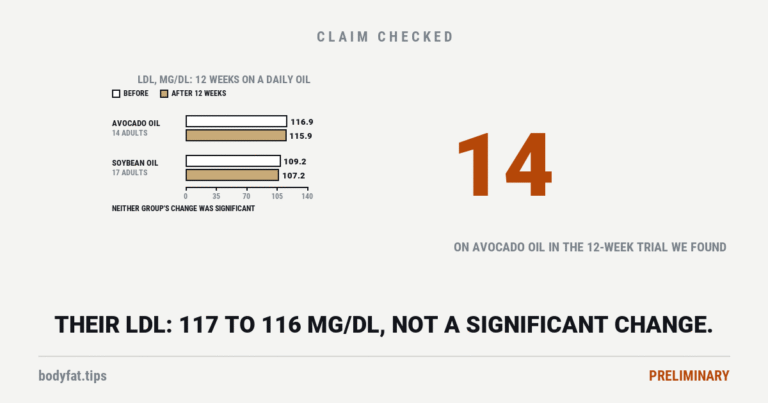
14adults given avocado oil in the one 12-week trial of the oil we found, against 17 on soybean oil; their LDL went from about 117 to 116 mg/dL, not a significant changeMAYBEPreliminary

Is Avocado Oil Good for You? Its Fat Is Close to Olive Oil’s, Its Own Trials Are Small, and Most Bottles Tested in 2020 Were Stale or Mixed

Paired bars of LDL before and after 12 weeks in a Brazilian trial: 14 adults on avocado oil went from 116.9 to 115.9 mg/dL and 17 on soybean oil from 109.2 to 107.2, neither change significant; beside them the figure 14

Avocado oil's fat is close to olive oil's, which predicts lower LDL in place of butter. Its own trials are small: a meal study in 13 adults, and 12 weeks in 31 adults, 14 of them on avocado oil, in which cholesterol did not change significantly. Measured, the refined kind sold for high heat smoked before sunflower oil, and most bottles tested in 2020 were stale or mixed with other oils.

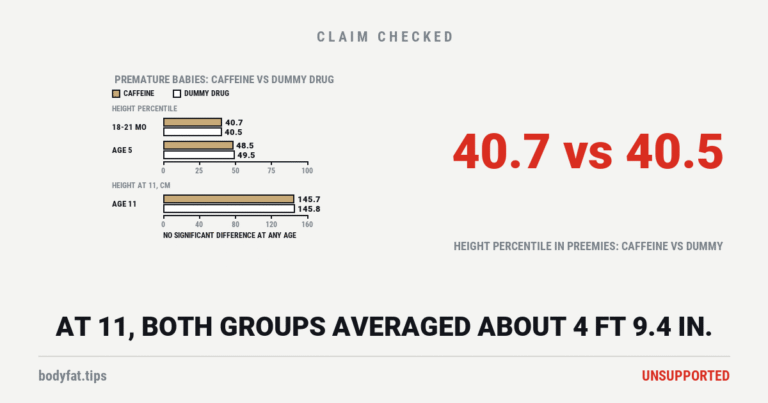
40.7 vs 40.5height percentile at 18 to 21 months in 1,769 very premature babies given caffeine or a dummy drug for weeks; not significantly different (P = 0.88); at 11, both groups averaged about 4 ft 9.4 in (145.7 and 145.8 cm)NOUnsupported

Does Caffeine Stunt Your Growth? The Warning Was Selling a Coffee Substitute in 1900, and the Tests Since Do Not Back It

Paired bars from a randomised trial of caffeine in very premature babies: height percentile 40.7 on caffeine against 40.5 on a dummy drug at 18 to 21 months and 48.5 against 49.5 at age 5, and height at 11 of 145.7 against 145.8 cm, none significantly different; beside them the figure 40.7 vs 40.5

The warning was in a national magazine by 1888 and selling a coffee substitute in 1900. Since then, 81 girls followed to 18 and 1,769 premature babies given caffeine or a dummy drug had heights not significantly different, and those measured at 11 still did. The signals the other way come from the very young and the poorly fed, mostly at far bigger doses per pound.

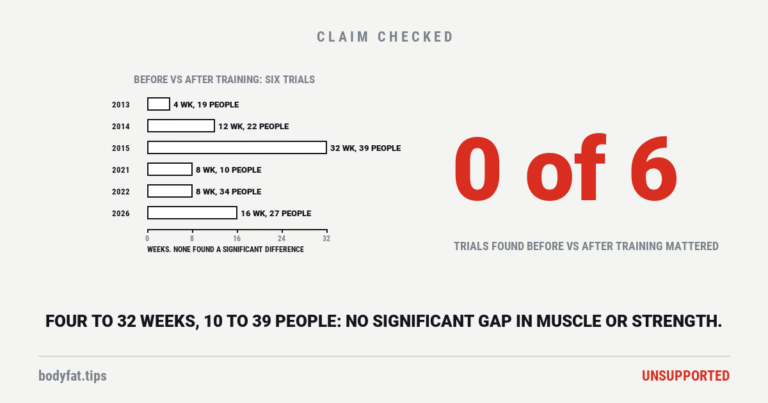
0 of 6randomised trials of creatine taken just before against just after training found a statistically significant difference in muscle or strengthNOUnsupported

When to Take Creatine: Before or After Training, Six Trials Found No Significant Difference in Muscle or Strength

Six bars, one per randomised trial of creatine taken just before against just after training, each as long as the trial ran, from 4 to 32 weeks, with 10 to 39 people finishing; none found a significant difference; beside them the figure 0 of 6

Six randomised trials set creatine taken just before training against creatine taken just after, for four to 32 weeks; none found a statistically significant difference in muscle or strength. Morning against evening was tested once, with no significant difference. Sugar alongside it makes muscle store more creatine; the four trials that tested it directly against creatine alone found no significant difference in performance, and one eight-week trial leans toward sugar without a direct test in the part we could read. Rest days are the open question.

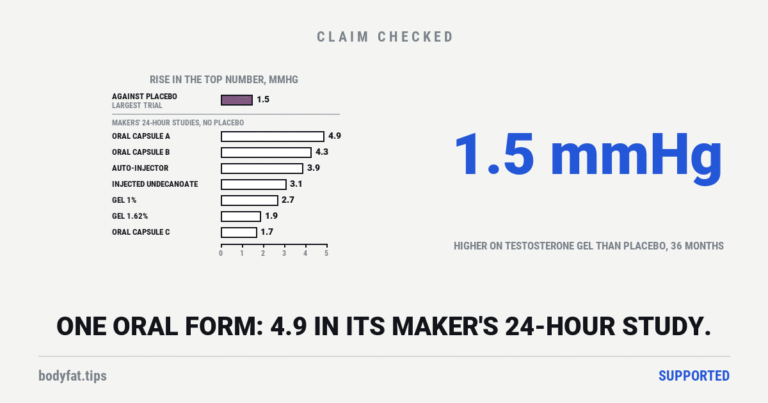
1.5 mmHghigher top-number blood pressure on testosterone gel than on a dummy gel at 36 months in the largest trial (the FDA's figure); up to 4.9 on one oral form in its maker's study without placeboMOSTLYSupported

Does Testosterone Raise Blood Pressure? A Little: About 1.5 Points Against Placebo in the Biggest Trial, and 4.9 on One Oral Form

Bars of the rise in the top number of blood pressure on testosterone: 1.5 mmHg against a dummy gel at 36 months in the largest trial, set apart, and the makers' own 24-hour studies without placebo, from 1.7 to 4.9 by form; beside them the figure 1.5 mmHg

Testosterone therapy raises blood pressure a little. In the largest placebo-controlled trial the top number ended about 1.5 points higher on testosterone gel; the makers' 24-hour studies found rises of 1.7 to 4.9 points, highest on one oral form. The clinic claim that it lowers blood pressure rests on a registry in which men chose their treatment.

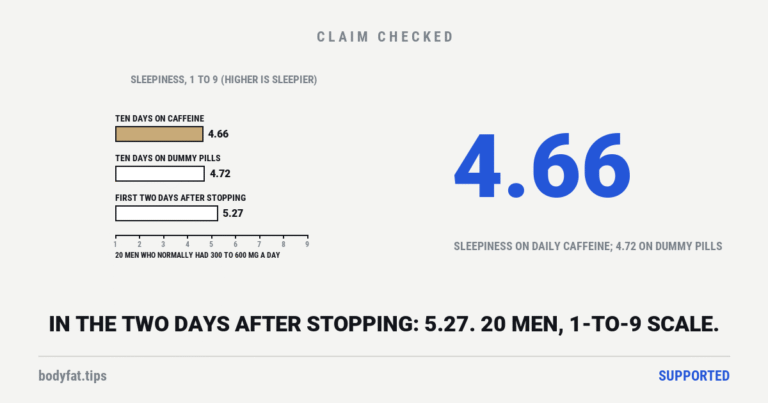
4.66sleepiness (1 to 9) after ten days of 450 mg of caffeine a day, against 4.72 after ten days of dummy pills and 5.27 in the two days after switching to them; 20 men who normally had 300 to 600 mg a dayMOSTLYSupported

Why Does Caffeine Make Me Sleepy? It Doesn’t While It’s Working. Going Without It Does, and the Next Cup Mostly Just Gets You Back to Normal.

Three bars of sleepiness on a 1-to-9 scale in 20 regular caffeine users: 4.66 after ten days of caffeine, 4.72 after ten days of dummy pills and 5.27 in the two days after switching from caffeine to dummy pills; beside them the figure 4.66

Caffeine doesn't make you sleepy while it works. Going without it does, once you're used to it: regular users grew sleepier within a day or two of swapping it for dummy pills, and the next cup mostly just got them back to normal. In the trials we read that followed people for hours after a single dose, the caffeine group did not end up sleepier than the dummy group.

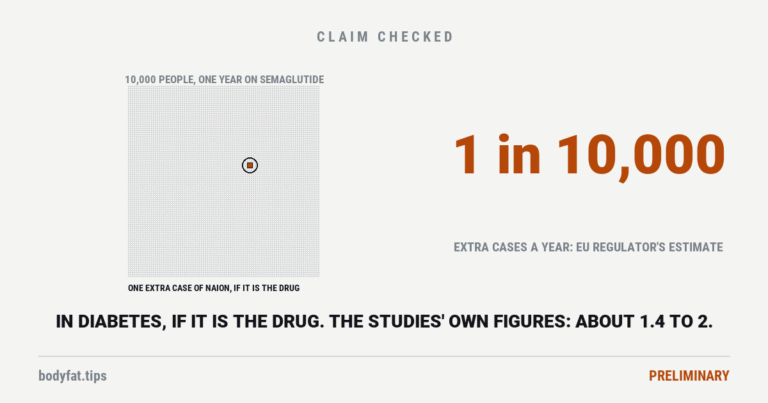
1 in 10,000extra NAION cases per year on semaglutide in type 2 diabetes, the EU regulator's estimate from records studies; the trials are too small to confirm or rule it outMAYBEPreliminary

Does Ozempic Cause Vision Loss? In Diabetes, Europe’s Regulator Says a Rare Optic-Nerve Stroke Shows Up About Twice as Often on It: Roughly 1 Extra Case per 10,000 a Year. The Trials Are Too Small to Tell.

A grid of 10,000 small squares, one person each for a year on semaglutide, with one square circled: about one extra case of the optic-nerve stroke NAION, the European regulator's estimate for people with type 2 diabetes, if the drug is the cause; beside it the figure 1 in 10,000

In people with type 2 diabetes, Denmark's national registry and three studies against other newly started diabetes drugs found a rare optic-nerve stroke called NAION diagnosed about twice as often on semaglutide: roughly one extra case per 10,000 people a year, Europe's regulator estimates. Other records studies, among them the largest against other drugs, found a smaller rise, no clear rise or less. Pooled trials are too small to settle it, and for people without diabetes the studies cannot tell. Sudden vision loss, or sight that worsens quickly, in either eye needs same-day care.

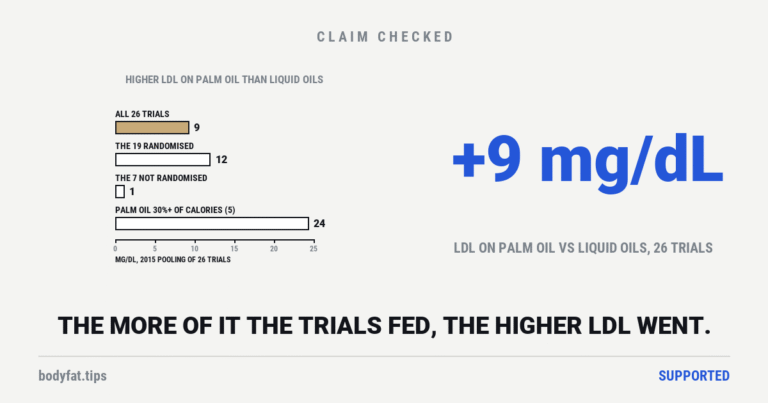
9 mg/dLhigher LDL on palm oil than on liquid vegetable oils, pooled across 26 trials (0.24 mmol/L); about 12 mg/dL in the 19 randomised onesMOSTLYSupported

Is Palm Oil Bad for You? Against Liquid Oils It Raised LDL About 9 mg/dL in 26 Trials. The Cancer Worry Rests on Animal Studies.

Bars of how much higher LDL was on palm oil than on oils low in saturated fat in a 2015 pooling: about 9 mg/dL across 26 trials, 12 in the 19 randomised, 1 in the 7 not randomised and 24 where palm oil was 30% or more of calories; beside them the figure +9 mg/dL

Eaten in place of liquid vegetable oils, palm oil raised LDL cholesterol about 9 mg/dL in a pooling of 26 trials, more in the randomised ones and at higher doses. Against butter it may do better. We found no trial that counted heart attacks, and the cancer worry rests on animal studies of a refining contaminant.

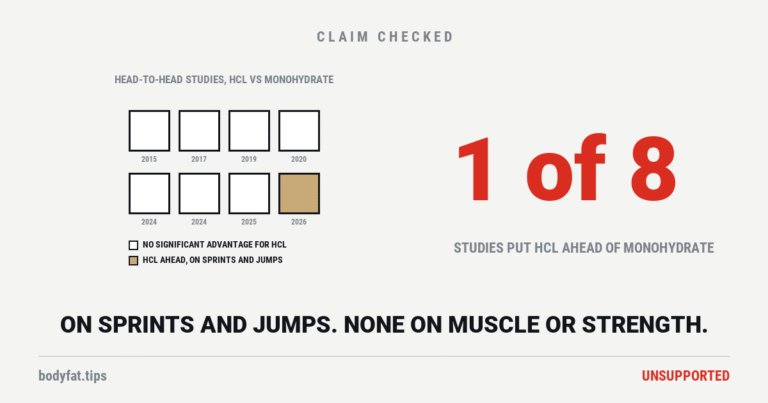
1 of 8studies against monohydrate put HCl ahead, on sprints and jumps; none on muscle or strengthNOUnsupported

Creatine HCl vs Monohydrate: Eight Studies Compared Them, and Only One Put HCl Ahead, on Sprints, Not Muscle

Eight tiles in date order from 2015 to 2026, one per study comparing creatine HCl with monohydrate: seven open, no significant advantage for HCl, and the 2026 tile filled, HCl ahead on sprints and jumps; beside them the figure 1 of 8

Creatine HCl dissolves 38 times better in water. In eight small studies against monohydrate, seven found no significant advantage and one found HCl ahead on sprints and jumps; none found more muscle or strength. The absorption claim rests on a patent's two-hour blood test.

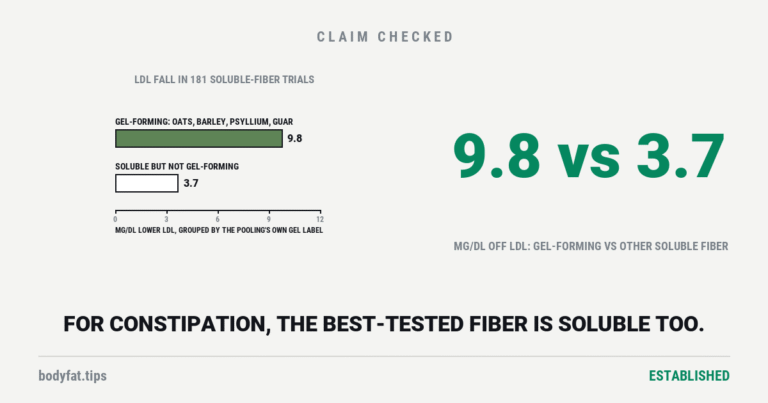
9.8 mg/dLlower LDL in the 141 gel-forming comparisons, of 199, as its authors labelled them, in a 2023 pooling of soluble fiber supplement trials; the 54 comparisons of soluble fibers that do not gel: 3.7YESEstablished

Soluble vs Insoluble Fiber: The Gel-Forming Kind Lowers LDL, About 10 mg/dL in Trials. For Constipation, the Best-Tested Fiber Is Soluble Too.

Two bars of LDL cholesterol lowering in a 2023 pooling of 181 soluble-fiber trials: 9.8 mg/dL for the gel-forming fibers in oats, barley, psyllium and guar, and 3.7 for soluble fibers that do not form a gel; beside them the figure 9.8 vs 3.7

In a 2023 pooling of fiber-supplement trials, the gel-forming soluble kinds lowered LDL cholesterol about 9.8 mg/dL and the soluble kinds that do not gel about 3.7. For constipation the best-tested fiber is psyllium, a soluble one; wheat bran, the classic insoluble fiber, had one small trial in the newest pooling we could read. Most foods carry both kinds.