Menopause Weight Gain: The Scale Doesn’t Speed Up at Menopause. Fat Gain Nearly Doubles, and Muscle Starts to Go

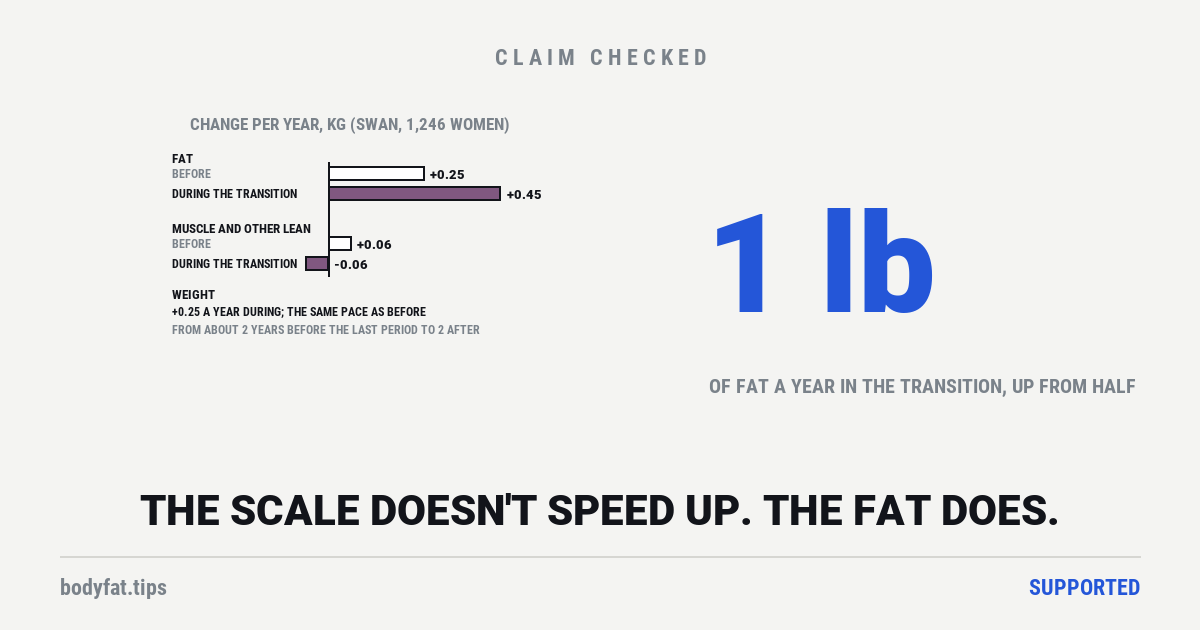
Does menopause cause weight gain? Not on the scale, by itself. In the largest US study that tracked women through menopause with body scans, weight kept rising at the same steady pace it had before [1]. What changed was what the weight was made of. Once the transition started, fat went on nearly twice as fast, about 1 lb (0.45 kg) a year, and muscle started to fall, until about two years after the last period [1].
And the menopause belly? That part is real. A 2019 review that pooled more than 200 studies found waists about 1.8 inches (4.63 cm) bigger after menopause than before, with more fat on the trunk and less on the legs, while the total amount of fat tracked age rather than menopause [2]. An expert review for the International Menopause Society says the same thing in two halves: the weight gain cannot be pinned on menopause, and the extra fat around the middle can [3].
So the claim this page rates, that menopause makes you put on fat around your middle, is Supported. That it makes the scale climb faster has been tested, in two studies that followed women for years, and the scale did not speed up [4] [1].
And 1945? A video watched 1.3 million times in its first five days says menopause weight gain “wasn’t a thing” then [5]. What changed is that everyone got heavier. Between 1960–62 and 1999–2002, the average American woman in her 50s put on 22.7 lb, and the average woman in her 20s put on 28.8 lb [6]. Menopause did not change. The baseline did.
What actually changes during menopause
The study is SWAN, the Study of Women’s Health Across the Nation. It scanned 1,246 women every year with DXA, an X-ray scan that measures fat, muscle and bone separately, and lined each woman’s results up against the date of her last period [1]. That lets you see whether anything changes at the transition, rather than just with age.
Before the transition, the average woman added about half a pound (0.25 kg) of fat a year, and a little lean mass, 0.06 kg, with it. From about two years before her last period to about two years after, fat went on at 0.45 kg a year, about 1 lb, and lean mass went the other way, losing 0.06 kg a year, about 2 oz. Then both levelled off [1].
The scale saw none of that. Weight rose by 0.25 kg (0.55 lb) a year during the transition, and the authors found no change from the pace before it. After the transition it went flat [1]. More fat, less muscle, the same number.
An older study had already found the scale half of this. In 1991, researchers who followed 485 women aged 42 to 50 for three years found they gained 2.25 kg (5 lb) on average. The women who stayed premenopausal gained 2.07 kg (4.6 lb); the women who went through a natural menopause gained 1.35 kg (3.0 lb), a gap too small to rule out chance, and in the other direction from the myth [4].
Where the fat goes
The 2019 review is the big one: 201 studies comparing women before and after menopause, more than a million women between them, plus 11 that followed 2,472 women through it [2]. After menopause, women carried a bigger waist (4.63 cm), more visceral fat, the kind packed around the organs (26.90 cm² more, measured as area on a scan slice), a 5.49-point higher share of fat on the trunk, and a 3.19-point lower share on the legs [2].
Its reading of the total differs from SWAN’s. Comparing mostly different women before and after, it found the extra fat explained by age, with no added effect of menopause; SWAN, timing the same women against their own last period, saw fat gain speed up at the transition [2] [1]. Both found the move to the middle. A smaller 2026 study of 171 women in Romania, matched for body-mass index, found no difference in fat between those before and after menopause, but in the first two years after it the ratio of belly fat to hip fat rose with each year since the last period [7]. That disagreement over the total is the gap between Supported and Established.
Does HRT cause weight gain, or help you lose it?
Neither, on the scale. A Cochrane review pooled 28 randomised trials, 28,559 women, of oestrogen alone or oestrogen with a progestogen against no hormones. The difference in weight gain was 0.03 kg for oestrogen alone and 0.04 kg for the combination, and the range the true answer probably sits in included zero both times [8]. Its own summary: hormone therapy has no effect on body weight and cannot prevent the weight gained at menopause. Its searches ran to July 2005, so it is older than some of the trials below [8].
What it may do is hold on to muscle and stop fat moving up. In a body-scan substudy of the Women’s Health Initiative trial, 835 women with an average age of 63, nearly 14 years past menopause, took oestrogen with a progestin or a dummy pill for three years. The women on hormones lost 0.04 kg of lean tissue; the women on the dummy pill lost 0.44 kg. Their ratio of trunk fat to leg fat fell slightly, while the placebo group’s rose [9]. The International Menopause Society review reads the wider evidence the same way: oestrogen tends to limit the build-up of fat around the middle [3]. In SWAN, hormone use, all of it after the last period and at 404 of 11,213 yearly visits, did not predict any change [1].
How to lose weight during menopause, or not gain it
The best test is a five-year trial that started before the transition. The Women’s Healthy Lifestyle Project assigned 535 premenopausal women aged 44 to 50 to either a programme of eating about 1,300 calories a day with less fat and adding 1,000 to 1,500 calories a week of activity, or to check-ups only. After four and a half years, 55% of the programme group were at or below their starting weight, against 26% of the others. The programme group averaged 0.1 kg (0.2 lb) below where they started; the others averaged 2.4 kg (5.3 lb) above. Waists shrank 2.9 cm (1.1 in) against 0.5 cm (0.2 in) [10]. It worked, and it was a lot of work.
For the muscle, lifting. A 2025 review found only six randomised trials of exercise in women in or just past the transition, all at high risk of bias. In perimenopause, strength training, endurance training and tai chi did not improve lean mass; in the early years after menopause, strength training and walking did [11]. A 2026 trial in Calgary then gave 40 women aged 45 to 60 nine months of heavy lifting twice a week, plus drop landings. Against a waitlist, they gained 0.90 kg (2.0 lb) of lean mass, with a range of 0.08 to 1.72 kg, and bone density at the spine [12]. It was a feasibility trial, built to see whether a full one could run. Our pages on lifting and fat and exercise for bone go further.
For food, the largest look is observational. Among 38,283 nurses followed for 12 years around menopause, the women whose diets scored lowest for raising insulin, low in red and processed meat, sodium and fries, gained about 0.28 kg (0.6 lb) a year less than those scoring highest, by their own reported weights; diets rich in nuts, beans, whole grains and vegetables came with the lowest risk of obesity [13]. That is a pattern seen in people who chose their diets, not a trial.
And it is not your metabolism, at least not yet. Energy burned per day holds steady from 20 to 60, as our page on metabolism and age sets out. If belly fat is the worry, exercise shrank it in trial after trial, often by more than the scale showed: see how to lose visceral fat.
If the scale doesn’t speed up, why does nearly every woman blame menopause?
This section is the desk’s own reasoning, and it is labelled as such. The studies say the number on the scale does not care about menopause. Millions of women say otherwise. Can both be right?
Answer one: the weight was already on its way. In both long studies, weight rose steadily through the 40s, before any change in periods [4] [1]. Menopause arrives at the age the running total gets noticed, and it is the obvious thing to blame. Rating: the steady rise is measured, in two cohorts; that menopause gets the blame because of when it comes is our inference.
Answer two: the same pounds sit differently. More fat and less muscle for the same rise on the scale, and more of the fat at the waist, is exactly what a scale cannot see and a waistband can [1] [2]. Rating: the change in what the body is made of is measured; that this is what women are noticing is a surmise, one we would bet on.
Answer three: the comparison is with a lighter world. The 1945 video sets today’s women beside a generation that was lighter at every age [5] [6]. Women in their 20s gained more between the 1960s and 2002 than women in their 50s did [6]. Rating: the national averages are measured; that they explain the impression is a hunch.
The derived line, stated plainly so you can disagree with it: menopause changes what your weight is made of far more than how much of it there is.
What we could not find, and would like to: a strength-training trial that runs through the whole transition, about four years, with scans, to test whether the muscle SWAN saw going can be kept. The strength trials in or near the transition that we found ran a year at most [14] [12]. If one has been published and we missed it, tell us and we will correct this page.
Who these studies were done on
SWAN: 1,246 American women, 356 of them Black, 153 Chinese, 178 Japanese and 559 White, starting at an average age of 47 [1]. The finding did not hold for everyone. Japanese women’s fat did not rise significantly during the transition, while Black women’s tracked White women’s [1]. The hormone trial was in women long past menopause, average age 63 [9]; the lifestyle trial in healthy women who started it before [10]; the diet study in nurses [13]. If you take creatine for this, our page on creatine for women covers the trials after menopause.
Where “menopause weight gain” came from
The observation is old and real: women gain weight in midlife, and a 1991 study measured about 5 lb in three years [4]. The blame landed on menopause because it arrives at the same age. The research that split the scale from the fat came later, from SWAN in 2019 and the 2019 review [1] [2]. Meanwhile the idea travels as “menopause belly”, and this month as a video asking what changed since 1945, whose description links an Amazon storefront and a calorie guide [5].
“Menopause weight gain” is searched about 5,400 times a month in the United States, and “menopause belly” about 4,400 (from a paid keyword database, pulled 17 November 2026) [15]. Those are the database’s figures for the past year. None of this is aimed at any woman searching. The change is real; it is just not the one on the scale.
What this is rated, and what the rating covers
Supported — for the claim that menopause makes you put on fat, especially around your middle.
Supported rather than Established because the evidence agrees on where the fat goes and disagrees on how much of it menopause adds: a large study that followed the same women saw fat gain speed up at the transition, and a review of more than 200 studies, mostly comparing different women, put the amount down to age [1] [2]. Both found the move to the middle, and so did an expert review [3].
The other parts, rated alone, in words. That menopause makes the scale climb faster: Unsupported, tested in two cohorts that followed women for years [4] [1]. That hormone therapy helps you lose weight: not shown, across 28 trials [8]. That it keeps muscle and stops fat moving to the trunk: Preliminary, one large trial in women long past menopause [9].
This is journalism, not medical advice. Whether hormone therapy suits you is a question for a clinician who knows your history. How we read a study, and what each tier means, is set out here. This page’s derived section is the desk’s reasoning from the evidence rather than a result the evidence delivered.
- Can Inflammation Cause Weight Gain? Genetic Studies Point the Arrow From Fat to Inflammation
unsupported - Is Skinny Fat Dangerous? At a Normal Weight, a Large Waist Went With More Deaths. The Study That Best Fits the ‘Three-Fold’ Claim Found 1.9.
supported - Body Recomposition: In a 114-Trial Review, Lifting Alone Took Off 2.2 lb of Fat and Added 1.8 lb of Lean Mass, No Diet. It’s Not a Protocol. It’s the Default.
established