Rucking: It Burns More Than Walking, but Not 2 to 3 Times More. A Pack a Quarter of Your Weight Added About a Quarter

What is rucking? Walking with weight on your back, usually a backpack with a weight plate in it. That is the whole thing; the name comes from the rucksack [1]. Is rucking good for you? It is walking made harder, so in the ways walking is good for you, yes. Does it burn two to three times the calories of walking, as its best-known seller says? No. Measured on the same walk at the same pace, a pack adds about a quarter to two-fifths, and the heavier the pack, the more it adds [2] [3].
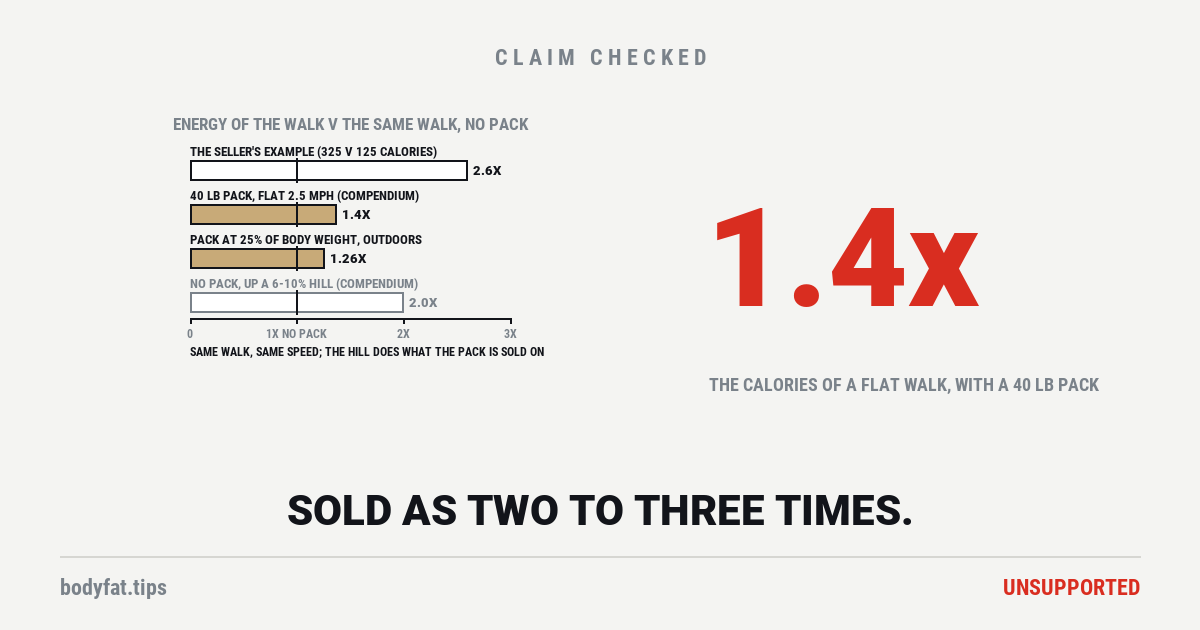
Two numbers make it concrete. Twenty men walked a track at their own pace, once with nothing and once with a pack weighing a quarter of their body weight, about 43 lb (19.4 kg). They walked at the same speed both times, and the pack raised the oxygen they used, the measure of the energy they burned, by about 26% [2]. And in the Compendium of Physical Activities, the reference list of exercise costs the seller itself cites, a flat 2.5 mph walk with a 40-lb pack costs 1.4 times the same walk without one [3].
Getting to two or three times takes a hill, or sand, or speed, and those raise the cost of walking without a pack as well. Whether rucking takes off more fat than ordinary walking has not been tested in a published trial we could find; one small study was recruiting in Australia in 2025 [4] [5].
So the claim rucking is sold on, two to three times the calories of walking, is rated Unsupported. The walk is fine. The multiplier is not.
Where does “two to three times” come from?
From a 2022 page by GORUCK, the bag maker that has run rucking events since 2010 [1]. It says an average person burns about 125 calories on a 30-minute walk and, “according to the Compendium of Physical Activities”, about 325 on the same walk with a rucksack. “That means rucking burns 2-3X as many calories as just walking” [6]. That example works out at 2.6 times.
So we read the Compendium. It scores activities in METs, multiples of the energy you burn sitting still: 1 is resting, 3.5 is an easy walk. Walking on a flat treadmill at 2.5 to 2.9 mph is 3.5. The same flat walk at 2.5 mph carrying 40 lb (18.2 kg) is 4.8 [3]. That is 1.4 times, not 2.6.
The Compendium does hold numbers that big for a pack. They are for hiking and for hills: backpacking, or hiking with a daypack, is 7.8, and climbing a 5 to 20% grade with 20 lb or more on your back is 10.0. Now take the pack off. Climbing a 6 to 10% grade with no load at all is 7.0; with 21 to 40 lb on a 3 to 10% grade, 7.5 [3]. The seller’s page does not say which entries it compared [6]. But the Compendium’s own numbers say the multiplier belongs to the hill. Put a pack on for a hike, set it against a stroll round the block, and you get two to three times. Take the pack off the hiker and most of the gap is still there.
In calories, our arithmetic, for a 180-lb (81.6 kg) person walking 30 minutes at 2.5 mph on the flat, using the standard conversion of one MET to one calorie per kilogram of body weight per hour: about 143 calories without a pack and about 196 with a 40-lb one [3]. About 53 calories more, for carrying 40 lb for half an hour.
How much more does a pack actually burn?
The lab answer is old and consistent. In a 2005 study, ten volunteers walked at speeds from about 1 to 3.8 mph wearing trekking backpacks with hip belts, loaded with anything from nothing to three-quarters of their body weight. The energy cost rose in a straight line with the load, at every speed [7]. A US Army review says the same in a sentence: the cost of walking with a backpack goes up with the weight carried, your own body weight, your speed and the grade, and the terrain matters too [8].
The field study is the one that matches what people actually do: a track outdoors, a pace each walker chose, a frame backpack. With a quarter of their body weight on their backs, the men’s oxygen use went from 15.34 to 19.39 millilitres per kilogram per minute, and the energy it cost them to cover each metre rose by about 24%. Their heart rates went from about 96 to about 112 beats a minute. Their speed did not change [2].
If you want a number for yourself, the US Army publishes one. Its load-carriage model, updated in 2024 for weighted vests and tested against twelve other sets of measurements covering 264 people, comes with a simplified calculator in the paper’s supplement [9]. Our weighted-vest page goes through that study.
Does rucking burn fat?
The extra calories are real, if smaller than the sales page says. Whether they come off as fat is a separate question, and it has not been answered: we found no published trial of people rucking for exercise with their body fat measured [4]. The nearest are trials of weighted vests, which our weighted-vest page reads one by one. When two groups walked at the same effort, set by heart rate, the vest made no difference to fat.
GORUCK’s page has a study for this too. “A Swedish study found that rucking led to three additional pounds of fat loss in a timespan of 3 weeks, compared to subjects who did not wear any extra weight” [6]. The study is real, and the number is close: 3.3 lb (1.51 kg) more fat lost, measured by bioimpedance, an estimate of fat from how a weak electric current passes through the body [10]. But nobody in it rucked. Adults with mild obesity wore a vest for eight hours a day, through their ordinary day, and the comparison group did wear extra weight: a light vest, 1% of their body weight, against the heavy one’s 11% [10]. It was testing an idea about how the body senses its own weight. It was not testing a walk.
The same page says “maximum fat loss occurs in Zone 2”, the steady, conversational effort rucking puts you in [6]. That mixes up the share of your fuel that comes from fat during a workout with the fat you lose from your body. We went through it on our page about running and the fat burning zone.
If a pack adds only a quarter, why does rucking feel like so much more?
This section is the desk’s own reasoning, and it is labelled as such. Anyone who has rucked knows it does not feel like a quarter more than a walk. So what is going on?
Answer one: it feels twice as hard. In the field study, the men rated their effort on a 0 to 10 scale. Without the pack: 2.65. With it: 5.45, more than double. In the same walks, their oxygen use rose by about a quarter [2]. Rating: both halves are measured, in one study of 20 young men. What we infer from it is that effort you feel is a poor gauge of calories you burn, and a pack drives the first much harder than the second.
Answer two: people ruck on hills. The seller’s two-to-three-times example looks like a hike set against a stroll, and the Compendium says the hill does most of that work [3] [6]. If rucking moves people onto trails and slopes, the calories go up, and the pack gets the credit. Rating: a hunch.
Answer three: it is a walk with a purpose. A pack, a plate and a plan turn a walk into a workout, and a workout is something people schedule. Rating: a surmise. If it is true, it is a real benefit, and it has nothing to do with the multiplier.
The derived line, stated plainly so you can disagree with it: a pack raises the effort you feel far more than the calories you burn.
What we could not find, and would like to: a trial that sets rucking against plain walking for the same time each week, for months, with body fat measured by a scan. The Australian study recruiting in 2025 compares weeks of unweighted walking with weeks of weighted walking in the same people, for six weeks [5]; that will say something about strength and fitness, and less about fat. If a trial like the one we describe has been published and we missed it, tell us and we will correct this page.
Is rucking bad for your back?
The injury record comes from soldiers. A US Army review lists the common injuries of prolonged load carriage: foot blisters, stress fractures, back strains, metatarsalgia (pain in the ball of the foot), rucksack palsy (numbness or weakness in the arm when the straps press on nerves at the shoulder), and knee pain. It also says hip belts take pressure off the shoulders, and that a load carried close to the body costs the least energy [8].
Those are soldiers carrying heavy loads for hours or days. Before the 18th century, the same review notes, foot soldiers seldom carried more than 15 kg (33 lb) on the march, and loads have grown since [8]. The studies we read say little about a 20-lb pack on a 40-minute walk.
How much weight should you ruck? The lab study’s authors suggested that, at the walking speed that cost the least energy per metre, about 2.9 mph, a load of up to a quarter of body weight seemed appropriate for long walks [7]. The field study chose a quarter because that is what people carry on a trek of more than a day [2]. Neither is a prescription for a beginner, and on the straight line the lab found, a lighter pack simply adds less.
Where “rucking” came from
The physiology is military. Armies have measured the cost of carrying loads for decades; a 1977 equation for the energy cost of standing and walking with a load is the one the seller’s own page names [11] [6], and the US Army’s current model is the 2024 update above [9]. GORUCK made it a pastime, with events since 2010 and a page calling rucking “just walking with weight on your back” [1]. Its 2022 page supplied the two-to-three-times figure [6]. Today Google’s AI answer for “rucking” cites GORUCK’s site among its eight sources [12].
“Rucking” is searched about 22,200 times a month in the United States, and “what is rucking” about 8,100 (from a paid keyword database, pulled 17 November 2026) [12]. That is the database’s figure for the past year, and the monthly figures have been steady. None of this is aimed at anyone who rucks. Walking with a pack is a fine thing to do, and the people selling the pack owe you the right number.
Who these studies were done on
The field study: 20 young men in Portugal, average age 23, used to walking with poles [2]. The lab study: ten volunteers [7]. The Army’s vest model: 20 physically active adults of military age, 16 of them men [9]. The all-day vest trial: adults with mild obesity [10]. The injury review: soldiers [8]. Women are thin on the ground here. The lab work finds the cost rises with the load in proportion to the walker, which gives no reason to expect a different multiplier for women, but these studies were not built to show it.
For more on walking itself, see whether walking helps you lose weight and Japanese interval walking; for knees, whether running is bad for them.
What this is rated, and what the rating covers
Unsupported — for the claim that rucking burns two to three times as many calories as walking.
Unsupported, of the tested kind. Measured on the same walk at the same pace, a pack a quarter of body weight added about a quarter to the energy cost outdoors, and a 40-lb pack added about two-fifths on a flat treadmill [2] [3]. Two to three times appears in the Compendium only for hiking and climbing, where the hill raises the cost of walking without a pack too [3].
The other parts, rated alone, in words. That a pack makes the same walk cost more energy: Established, measured in the lab and the field [7] [2] [8]. That rucking takes off more fat than walking: not tested in a published trial we could find [4]; the vest trials that come nearest found no difference at the same effort.
This is journalism, not medical advice. If you have a back, joint or heart problem, ask someone who can examine you before you load up. How we read a study, and what each tier means, is set out here. This page’s derived section is the desk’s reasoning from the evidence rather than a result the evidence delivered.