Peptides for Weight Loss: The Ones That Work Are Prescription Drugs. AOD-9604, the ‘Fat-Loss Peptide’ Sold Online, Failed Its Own 536-Person Trial

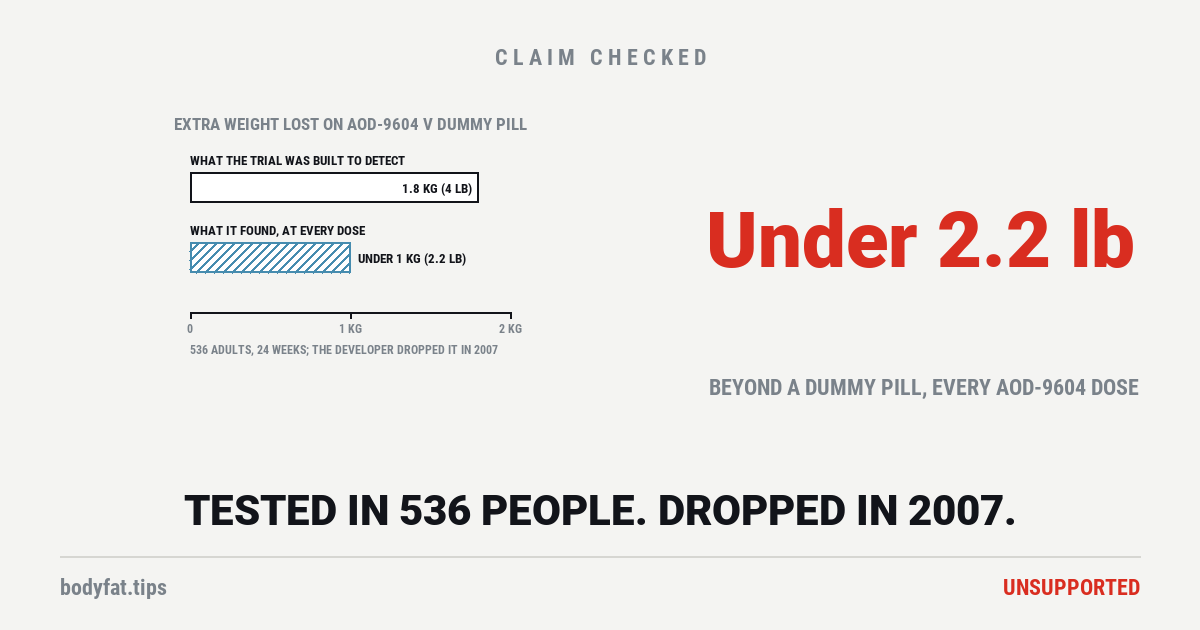
Some peptides cause real weight loss, and they are prescription drugs. Semaglutide (Wegovy) and tirzepatide (Zepbound) are both peptides. In their main trials, people lost about 15% of their body weight on semaglutide and up to 21% on tirzepatide’s top dose, against 2% to 3% on a dummy pill [1] [2]. The peptides sold online for fat loss are another story. AOD-9604, marketed as the fat-loss peptide, was tested in 536 people for 24 weeks, and its own developer announced in 2007 that it beat a dummy pill by less than 1 kg (2.2 lb) at every dose, then dropped it [3]. BPC-157 and MOTS-c, the other names on those lists, have no published human trial of weight loss that we could find [4] [5].
And the vials are a problem of their own. When researchers bought semaglutide from illegal online pharmacies, the three vials that arrived measured 7.7% to 14.37% pure against the 99% on their labels, and every one carried endotoxin, fragments of bacteria that can bring on fever and inflammation when injected [6]. If you feel unwell after injecting anything bought online, see a clinician and say exactly what you injected.
What is a peptide, and why does the word sell?
A peptide is a short chain of amino acids, the building blocks of protein. Semaglutide and tirzepatide are peptides approved by the FDA; BPC-157 is a peptide without regulatory approval for human use [7] [4]. So the word covers drugs tested in thousands of people and powders tested in a few dozen. “Peptide” describes the shape of a molecule. It says nothing about whether the molecule works.
Which peptides actually cause weight loss?
The prescription ones. In STEP 1, 1,961 adults with obesity and no diabetes took weekly semaglutide or a dummy injection for 68 weeks: weight fell 14.9% against 2.4%, which was 15.3 kg (33.7 lb) against 2.6 kg (5.7 lb) [1]. In SURMOUNT-1, 2,539 adults took tirzepatide or a dummy injection for 72 weeks: weight fell 15.0%, 19.5% and 20.9% on the three doses, against 3.1% [2]. Both trials were paid for by the drugs’ makers [1] [2]. How the two compare head to head is on our tirzepatide and semaglutide verdict, and the newest GLP-1 pill has its own verdict.
Then there is retatrutide, now sold online in vials meant for “research” [8]. It is a real drug with real results: in TRIUMPH-1, one of its maker’s large trials, 2,339 adults without diabetes lost 25.0% of their body weight on the top dose over 80 weeks, about 62 lb (28.2 kg), against 3.9% on a dummy injection, counting everyone who started [9]. Those figures come from the maker’s own announcement. And it is not approved: the FDA’s list of approved GLP-1 drugs, published on 9 November 2026, does not include it [10]. So a vial labelled retatrutide is not something a US doctor can prescribe. It is, at best, the trial’s molecule made by someone else, and the label alone cannot tell you which.
Two published cases show what that can mean. A woman in her mid-20s in Zurich spent five days vomiting after four weekly injections of a product reported to contain retatrutide, given by a self-described life coach; she did not think of the injections as medicine, and doctors found them only by asking about injections [11]. In Edinburgh, online-bought retatrutide complicated near-ketoacidosis, a dangerous build-up of blood acids, in a person with type 1 diabetes [12]. Two cases cannot tell you how often this happens. They show what a research label leaves out: the dose, the contents, and anyone to ask.
One more peptide does have trial evidence for fat loss, in one group of people. Tesamorelin, which nudges the body to release growth hormone, cut the fat around the organs by 15.2% over 26 weeks in 412 people with HIV, while it grew 5.0% on a dummy injection [13]. It is FDA-approved for that use [14].
AOD-9604: the fat-loss peptide that was tested
AOD-9604 is a 16-amino-acid fragment from the tail end of human growth hormone, the part thought to carry its fat-burning effect [15]. In obese mice in 2001 it raised fat burning and brought weight down [16]. An Australian drug company took it into human trials as an obesity pill, and paid for all six of them [15].
The first big one, in 2004, gave 300 people with obesity one of five doses or a dummy pill for 12 weeks [15]. The best dose, 1 mg, produced an average weight change of 2.8 kg (6.2 lb) [17]. But on the trial’s main analysis it missed: the p-value was 0.1 [17] [3]. A p-value is how often chance alone would produce a gap at least that big if the drug did nothing. At 0.1, that is one time in ten; researchers usually want one in twenty or less before calling a result probably real.
Here is what the company told the market: “there is a 90 per cent chance that the 1mg dose of AOD9604 induces weight loss” [17]. That is not what a p-value means. It is calculated by assuming the drug does nothing, so it cannot also tell you the chance that the drug works. One minus the p-value is not the probability of anything a buyer cares about.
So the company ran the trial that would settle it. The OPTIONS study enrolled 536 Australian adults with obesity, randomised 502 of them to a dummy pill or one of three daily doses up to 1 mg for 24 weeks, and put everyone on a dietitian-supervised diet and exercise programme that began a month before the pills [3] [18]. It was built to detect a difference of 1.8 kg (4 lb) from the dummy pill [3]. On 21 February 2007 the company told the stock exchange the result: weight loss beyond the dummy pill, at 12 and at 24 weeks, was less than 1 kg (2.2 lb) in every dose group, too low to be significant, and the obesity programme was terminated [3]. Its body-fat scans, waistlines and blood tests: “No relevant findings” [3].
The company pointed to one subgroup it had planned in advance, women who had lost under 2 kg (4.4 lb) in the month of dieting before the drug began, whose results looked like the earlier trial’s, and suggested the diet had overwhelmed the drug [3]. A subgroup inside a trial that missed its main goal is a lead for the next trial, not a finding. We found no later trial of AOD-9604 for weight loss [5].
The result went to a stock exchange, not a journal. The trial’s registry entry, last updated in September 2007, posts no results [18]. In 2013 three authors, all of them tied to the developer, published a summary of the six trials: about 900 people, with AOD-9604’s side effects “indistinguishable from placebo” [15]. It describes both weight-loss trials and reports no weight result from either [15]. So the safety finding is real, for a tablet made to drug standards and swallowed for up to 24 weeks. The weight-loss finding is the one that failed.
Can peptides help you lose body fat? BPC-157, MOTS-c and the rest
BPC-157 is a 15-amino-acid peptide sold mostly for injuries, and now on lists of fat-loss peptides [19]. The newest systematic review of its human evidence, searched to 1 June 2026, found three studies with 30 people in all: 16 with knee pain, 12 with a painful bladder condition, and 2 given it into a vein to check safety [4]. None had a comparison group, and the review rates the certainty very low [4]. None of the three was about weight. Our own PubMed search for BPC-157 with weight, obesity or body fat returned 20 records, every one an animal study or a review [5].
MOTS-c is a small peptide made inside mitochondria, the cell’s power plants. In mice it prevented weight gain on a high-fat diet [20], and it was put to the FDA as a treatment for obesity and osteoporosis [21]. We found no published trial that gave it to people [5]. The one registered trial in people with obesity, recruiting since February 2026 with 120 places, measures insulin sensitivity and blood sugar; weight is not among its listed outcomes [22].
CJC-1295 and ipamorelin, sold to raise growth hormone, have early human studies that, a 2026 review found, do not address body composition [14]. Is there a peptide for weight loss over the counter? Every peptide on this page with weight-loss results behind it is either a prescription drug or, like retatrutide, still unapproved [10].
Are peptides safe?
It depends which peptide, and where it came from. The approved ones have known side effects, mostly nausea and diarrhea in the semaglutide trial [1]. One rare risk, a stroke of the optic nerve, now carries an FDA warning on every GLP-1 drug, and our verdict on it has the numbers [10].
The unapproved ones are a different question, because the problem starts before the molecule does anything. In the 2024 test purchases, three of six orders from illegal online pharmacies never arrived; the three vials that did held a product 7.7% to 14.37% pure against 99% on the label, carried endotoxin, and contained 29% to 39% more drug than they said [6]. That is three vials, too few to say what the market as a whole looks like. The larger look is a 2026 preprint, not yet peer-reviewed: 6,441 independent tests of 14 peptides sold direct to consumers, BPC-157, retatrutide and tirzepatide among them. Between 41.6% and 71.1% failed basic quality standards, depending on how strict the standard, and 15% carried measurable endotoxin [8].
And the regulators have not cleared them. BPC-157 and MOTS-c are not in an approved drug or a pharmacopoeia standard, so a US pharmacy can make them up only if the FDA adds them to its list of allowed bulk substances [23] [24]. In July 2026 the FDA’s own staff proposed leaving both off, and its briefing cited a “lack of evidence to support the effectiveness” of BPC-157 for the bowel disease it was put forward for [23] [24]. The agency’s advisory committee voted the other way, 8 to 6 for BPC-157 with one abstention and 7 to 5 for MOTS-c with two [24] [21]. The vote is advice; the FDA decides. And a yes would mean a pharmacy could make it on a prescription, not that anyone had shown it works.
If AOD-9604 failed in 2007, why is it still sold for fat loss?
This section is the desk’s own reasoning, and it is labelled as such. The evidence above says the peptide failed. It does not say why the failure did not stick. Three possible answers, each rated.
Answer one: the failure is hard to find. It was announced to a stock exchange in 2007, the registry posts no results, and the one journal paper on the human trials that we found reports their safety and not their weight results [3] [18] [15]. Someone searching the medical literature finds the mouse study and a clean safety record. The publication record is measured; that it is why the failure is little known is our inference.
Answer two: the word does the work. Semaglutide and tirzepatide made “peptide” mean weight loss, and Google’s own answer to “peptides for weight loss” starts with them before listing AOD-9604, BPC-157 and MOTS-c [19]. That the borrowed word sells the untested peptides is a surmise, and nothing we read tested it.
Answer three: the safety record is real, and it travels. AOD-9604 really was as well tolerated as a dummy pill in its trials [15]. But that was a tablet made to drug standards. A vial bought online is a different product, and the testing above says its contents vary widely [6] [8]. Both halves are measured; the gap between them is ours to point out.
So here is the line we draw from it, plainly, so you can disagree with it: everything on this page that is sold for fat loss under a research label falls into one of three boxes: tested and failed, never tested for weight in people, or a real drug in a vial nobody checked.
What we could not find, and would like to. The OPTIONS trial’s group-by-group results in a journal; a randomised trial of BPC-157 or MOTS-c that measures weight in people; and independent tests of the AOD-9604 vials sold today. If you know of any of them, tell us, and this page will change.
Where “peptides for weight loss” came from
The research came first: obese mice, in 2001 [16]. The framing came in December 2004, when a result that missed significance went to the market as a 90 per cent chance [17]. The failure followed in 2007 and stayed in a stock-exchange filing [3]. Today Google’s AI answer to “peptides for weight loss” lists AOD-9604, BPC-157 and MOTS-c as widely marketed online for fat loss while saying they lack human trial evidence for it, and the related searches include “over the counter” and “where to buy” [19].
“Peptides for weight loss” is searched about 165,000 times a month in the United States, the database’s figure for the past year, and “are peptides safe” about 33,100 (from a paid keyword database, pulled 16 November 2026) [19]. By the same database’s monthly figures, both nearly tripled between November 2025 and October 2026 [19]. None of this is aimed at anyone searching. The question is a fair one, and the people asking it deserve the trial results, not the sales page.
Who these studies were done on
The AOD-9604 trial: Australian adults aged 18 to 65 with a body-mass index of 30 to 45, 56% of them women [3]. Its one encouraging result, in a subgroup of women, came from a trial that missed its main goal, so it answers nobody’s question about the best peptide for women [3]. The semaglutide, tirzepatide and retatrutide trials: adults with obesity or overweight, without diabetes [1] [2] [9]. Tesamorelin: people with HIV, 86% of them men [13]. BPC-157: 30 people with pain, in studies with no comparison group [4].
What this is rated, and what the rating covers
Unsupported — for the claim that AOD-9604, sold as the fat-loss peptide, helps you lose fat.
Unsupported, of the tested kind: it was tested in a trial built to settle it, 536 people for 24 weeks, and came in under 1 kg (2.2 lb) beyond a dummy pill at every dose [3]. It is not rated Preliminary because its one encouraging signal, a subgroup of women, sits inside that failed trial, and the earlier positive-looking trial missed on its own main analysis [3] [17].
The other parts, rated alone, in words. That MOTS-c helps people lose weight: Preliminary, on mouse evidence only, with no human trial [20] [5]. That BPC-157 helps people lose weight: not tested in people, and nothing we found supports it [4] [5]. That the prescription peptides semaglutide and tirzepatide cause weight loss: Established, in large trials [1] [2].
This is journalism, not medical advice. Whether a weight-loss drug suits you is a question for a clinician who knows your history; nobody should start, stop or swap a medicine on the strength of a web page, this one included. How we read a study, and what each tier means, is set out here. This page’s derived section is the desk’s reasoning from the evidence rather than a result the evidence delivered.
- Orforglipron (Foundayo): The GLP-1 Pill’s Top Dose Took Off 11.2% in 72 Weeks, Against 2.1% on a Dummy Pill
established - Does Finasteride Lower Testosterone? No. It Rose About 8 to 10% in Two Large Trials. What Falls, by About 70%, Is DHT, the Hormone Made From It.
unsupported - Does Alcohol Lower Testosterone? A Heavy Night Can, for Hours. Three Beers a Day Cut It 6.8% in 10 Men; in 7,938 Men, Drinkers’ Levels Were No Lower.
preliminary